

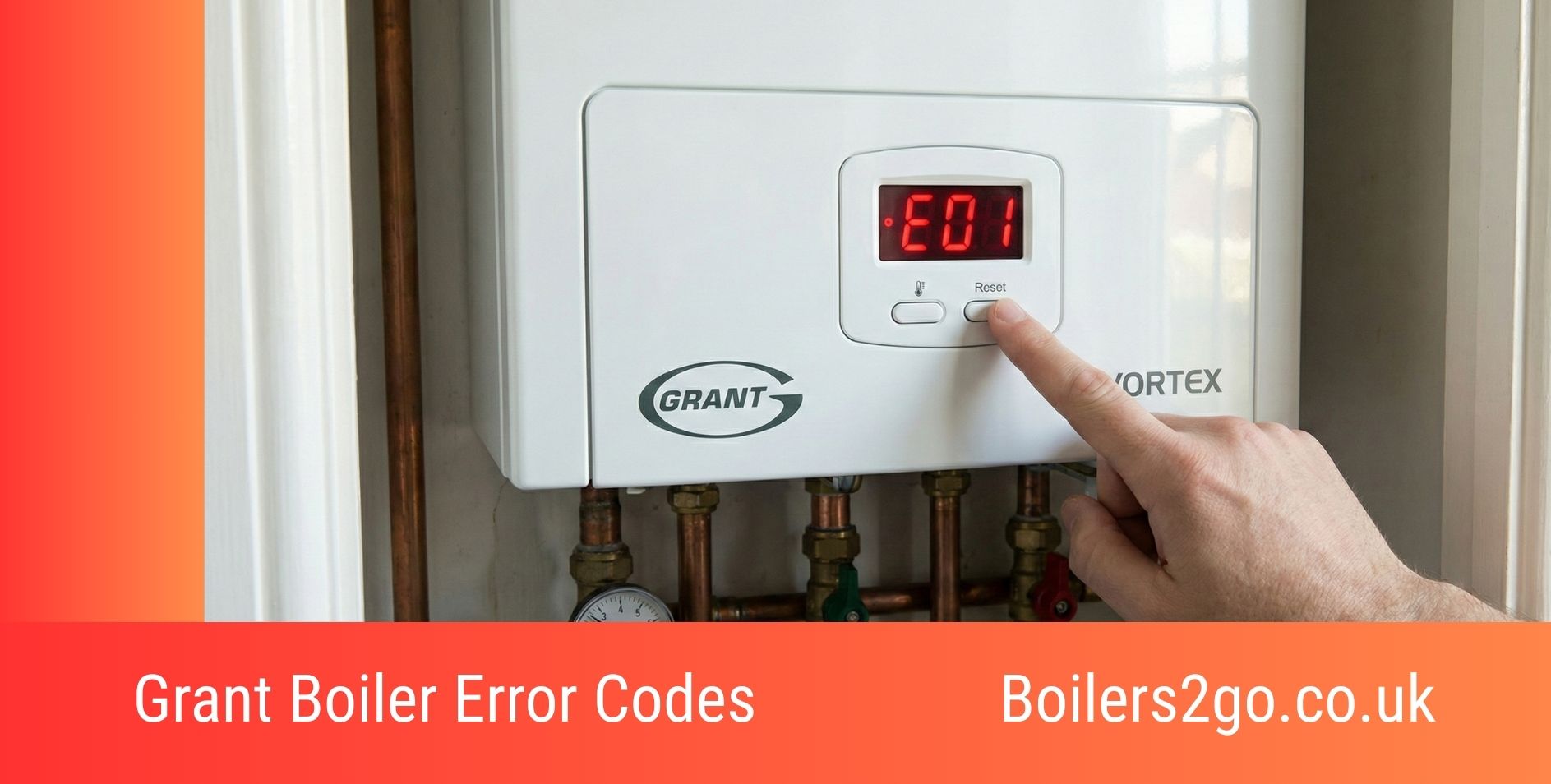
Grant boiler error codes are fault indications shown on a Grant boiler, either on the control panel or as a lockout light on the burner control box, depending on the model, serving as a diagnostic tool for central heating faults.
Get a boiler cover, repair and annual service plan online here >
These indications point to irregularities in components like pressure sensors, thermostats, or ignition systems, allowing for swift intervention in oil boiler troubleshooting.
By interpreting these signals, homeowners can differentiate between simple resets and more complex issues requiring professional oil boiler servicing. This guide explains the most common Grant boiler fault codes, their meanings, root causes, and step-by-step fixes tailored for everyday users.
Get a quote today and take the stress out of replacing your boiler. At Boilers2Go, we offer fast, reliable installation across the UK - often as soon as the next day. 
Need a new boiler?
Most Common Grant Boiler Error Codes
Below are the most frequent Grant boiler fault codes encountered by UK households. Each section breaks down the code’s meaning, potential causes with context, and targeted fixes. While some remedies are DIY-friendly, others demand an OFTEC engineer to ensure safety and warranty validity, since Grant’s oil-fired systems fall under OFTEC rather than Gas Safe regulation.
Familiarity with these codes allows for quicker diagnosis and more efficient remedies, though safety should always come first; consult an OFTEC engineer for complex problems requiring expert intervention. Keeping a record of any fault codes encountered helps an engineer arrive at a more efficient diagnosis.
Grant Boiler Low Water Pressure Fault
A low pressure fault on a Grant boiler indicates insufficient water pressure in the heating circuit, a common issue in sealed central heating systems where the gauge drops below 1 bar, preventing proper circulation and risking air locks or component strain.
What Causes Low Water Pressure on a Grant Boiler?
Low boiler pressure often stems from gradual water loss in the system, which is vital for distributing heat evenly through radiators and underfloor heating in UK homes.
Cause 1: Minor Leaks in Pipes or Radiators
Over time, small leaks develop at joints, valves, or radiator pinholes due to corrosion or thermal expansion, slowly depleting system water and triggering the pressure sensor in a Grant condensing boiler.
How to Fix Minor Leaks
- Inspect visible pipes and radiators for damp spots or drips; wipe dry and monitor for 24 hours.
- If confirmed, use a radiator key to bleed air from high points, then repressurise via the filling loop, the flexible hose connecting cold mains to the boiler.
- Turn the valves slowly until the gauge reads 1 to 1.5 bar, then close and test. For persistent leaks, seal threaded joints with PTFE tape, but call an engineer if the leak is internal.
Cause 2: Faulty Pressure Relief Valve
The pressure relief valve, designed to vent excess water safely, can stick open from limescale buildup in hard water areas, causing continuous drainage and low pressure alerts on an oil-fired boiler.
How to Fix a Faulty Pressure Relief Valve
- Isolate the boiler by switching off power and fuel supply.
- Locate the valve on the boiler’s outlet pipe and gently lift the lever to flush debris, listening for water flow into the drain. If it doesn’t reseat, the valve may need replacing, a straightforward swap for a confident DIYer, but an OFTEC service is the safer route to avoid voiding the Grant warranty.
If pressure stabilises after a fix but recurs, underlying sludge in the system may be the culprit; a power flush by a professional restores flow in older installations.
Grant Boiler High Water Pressure Fault
A high pressure fault signifies excessive water pressure above 2.5 bar in a Grant boiler’s hydraulic circuit, which can stress seals and gaskets, leading to leaks or boiler lockout in over-pressurised domestic hot water systems.
What Causes High Water Pressure on a Grant Boiler?
Elevated boiler system pressure disrupts the equilibrium needed for efficient heat transfer, often arising from expansion issues in confined heating networks common in UK terraced homes or flats.
Cause 1: Air Trapped in the System
Air ingress during bleeding or from a recent refill creates compressible pockets that mimic high pressure when the boiler heats up, fooling the sensor in a Vortex model.
How to Fix Trapped Air
- Switch off the boiler and let it cool.
- Start at the lowest radiator, fitting a bleed key to the valve and turning anti-clockwise until a hiss indicates air escaping; catch drips with a cloth.
- Repeat upstairs, working downwards, then check the boiler gauge.
- Top up if needed via the filling loop to 1 bar cold. Run the system for 15 minutes to purge remaining air.
Cause 2: Expansion Vessel Failure
The expansion vessel absorbs the increase in water volume during heating; if its diaphragm ruptures or the air charge depletes, unchecked expansion spikes pressure, a frequent fault in unserviced Grant Eco boilers after 5 to 7 years.
How to Fix Expansion Vessel Failure
- Press the vessel’s Schrader valve, similar to a bike tyre valve, with a finger; if water sprays, it’s waterlogged.
- Use a pump to drain the system partially, then reinflate to 0.75 bar with a car compressor.
- Tap the vessel to check for a hollow ring. If muffled, the unit needs replacing, ensuring compatibility with the boiler’s capacity, typically 8 to 12 litres for standard homes.
Monitoring with a pressure gauge kit helps catch drift early; consistent highs may indicate a blocked vent, warranting a full system diagnostic.
Grant Boiler Frost Protection Activated
A frost thermostat activates Grant’s built-in frost protection, bringing the boiler on when temperatures drop to around 5°C to prevent freezing in external pipes or the unit itself, a vital safeguard for outdoor-installed oil boilers in rural UK properties.
What Causes Grant Frost Protection to Activate?
This protective lockout engages automatically in response to low ambient conditions, but persistent triggers point to sensor or circulation shortcomings in the home heating infrastructure.
Cause 1: External Temperature Drop Without Power
In unpowered states, such as during a power cut, the frost stat detects sub-zero risks but can’t initiate a brief heat cycle, halting operations to avoid ice damage in vulnerable pipework.
How to Fix External Temperature Drop
- Restore electricity first, then reset by pressing the boiler’s frost override button, often integrated with the main switch.
- If the pipework is outdoors, insulate exposed sections with foam lagging and heat tape plugged into a thermostat-controlled socket.
- For landlords, installing a remote frost stat linked to smart heating controls supports proactive warming during a cold snap.
Cause 2: Circulating Pump Seizure
The pump, responsible for minimal flow during frost mode, seizes from inactivity or limescale, preventing the protective warm-up and causing a lockout.
How to Fix Circulating Pump Seizure
- Isolate power and fuel. Access the pump head via the boiler panel, removing the four screws.
- Gently rotate the shaft with a flathead screwdriver; if stuck, apply a light penetrating oil sparingly and retry after 10 minutes.
- Reassemble, power on, and test circulation by feeling for vibrations. Lubricating annually during servicing helps pre-empt recurrence.
This fault is common in exposed installations; pairing it with glycol antifreeze in vulnerable sections gives extra defence against British winters.
Burner Lockout: Ignition Failure
A flashing lockout light, often accompanied by a red neon, on a Grant boiler denotes burner ignition failure, where the oil burner fails to light, starving the central heating of fuel and halting hot water production.
What Causes the Burner Lockout?
Ignition faults interrupt the combustion process essential for oil boiler efficiency, typically from supply or electrode disruptions in the firing sequence.
Cause 1: No Fuel Supply or Blockage
A depleted oil tank or clogged filter deprives the burner of kerosene, causing an immediate shutdown to prevent dry firing and damage to the nozzle in the condensing heat exchanger.
How to Fix No Fuel Supply
- Check the tank gauge; if low, arrange a top-up from the oil supplier, ensuring a clean delivery.
- Inspect the filter bowl under the boiler for sludge, draining it via the plug into a bucket, rinsing with kerosene, and refitting.
- Prime the pump by bleeding air from the line until fuel flows steadily, then reset the burner button.
Cause 2: Faulty Electrodes or Photocell
Misaligned electrodes fail to spark, or a dirty photocell doesn’t detect flame, prompting lockout; dust from combustion residues accumulates over seasons in vented systems.
How to Fix Faulty Electrodes or Photocell
- Clean electrodes with fine emery paper, ensuring 3 to 5mm gaps per manual specs, adjusting with tweezers if bent.
- Wipe the photocell lens with a lint-free cloth soaked in isopropyl alcohol.
- Realign using the boiler’s sighting glass, then test fire. For precision, an engineer uses a multimeter to verify resistance.
Resetting up to three times is generally fine; repeated failures signal nozzle wear, fixable during annual OFTEC servicing.
Overheat Thermostat Trip: Red Neon Light
The overheat thermostat trip, indicated by a steady red neon light on the boiler panel, halts operations when internal temperatures exceed 90°C, protecting against scalding or component damage in a domestic heating appliance.
What Causes the Overheat Thermostat Trip?
Excessive heat buildup occurs when circulation falters, trapping warmth in the heat exchanger and bypassing safety limits in Grant’s multi-pass design.
Cause 1: Airlock in Heat Exchanger
Trapped air bubbles impede water flow, causing localised boiling and thermostat activation, exacerbated in sludgy systems common in older UK rentals.
How to Fix Airlock in Heat Exchanger
- Cool the boiler fully. Open all radiator bleed valves sequentially from lowest to highest, refilling via the loop to expel air.
- Tilt the boiler slightly if accessible to dislodge bubbles, then run on low heat for 30 minutes, bleeding as needed.
- Add a system cleanser for ongoing prevention.
Cause 2: Thermostat Sensor Malfunction
A faulty overheat stat probe misreads temperatures due to wiring corrosion or calibration drift, falsely tripping and disrupting reliable hot water supply.
How to Fix Thermostat Sensor Malfunction
- Disconnect power. Unclip the stat from its bracket, testing continuity with a multimeter, which should read closed below 90°C.
- If open, the part needs replacing with a compatible Grant component, with joints soldered securely.
- Calibration by immersing in hot water is possible on adjustable models, but electrical work like this is best left to an engineer.
Reset by pressing the red reset button once the boiler has cooled; pairing this with a magnetic filter helps catch debris early in future.
How to Prevent Grant Boiler Error Codes in the Future
Preventing Grant boiler faults starts with proactive maintenance, ensuring an oil-fired condensing system runs smoothly year-round. Scheduling annual OFTEC servicing to clean the burner, check electrodes, and flush the heat exchanger catches issues like sludge buildup before they trigger error codes. Many of the same faults, such as low pressure and overheating, affect gas boilers too, as our guide to common boiler problems explains.
For homeowners, monitoring pressure weekly via the gauge, topping up as needed, and insulating pipes to combat frost risk are all worthwhile, particularly for external Vortex models. Landlords should log services in tenant handbooks and encourage quarterly radiator bleeding to avoid airlocks.
Investing in a boiler filter to trap debris, and considering smart controls for remote monitoring, can reduce energy waste by up to 10% in UK homes. Using quality kerosene from trusted suppliers also minimises nozzle clogs, helping extend the boiler’s lifespan beyond the standard 10 to 15 years.
When Should You Call an OFTEC Engineer About a Grant Error Code?
While minor tweaks like bleeding radiators are within reach for most homeowners, certain scenarios demand immediate intervention from an OFTEC-registered engineer, the correct qualification for Grant’s oil-fired systems, to avert hazards in the central heating setup.
A quick check of the OFTEC technician register confirms an engineer is properly qualified to work on an oil-fired boiler before booking any repair.
Call without delay if error codes persist after resets, as this may indicate deeper electrical or fuel-related faults that could pose carbon monoxide risks. Leaking fuel lines, unusual smells, or boiler noises like banging signal combustion issues requiring professional diagnostics.
For landlords, any warranty claim or post-service recurrence needs expert verification to comply with UK housing standards. If a Grant boiler is over 10 years old and faults are multiplying, a safety inspection prevents escalation, since unqualified tampering voids guarantees and endangers occupants.
Related Oil Boiler Guides
Grant Boiler Error Codes: FAQs
How Do You Read and Reset Grant Boiler Error Codes?
Reading Grant boiler error codes involves noting the flashing display on the boiler’s front panel, where symbols like a spanner icon or specific numbers appear during a fault.
To reset, locate the reset button, typically a red or black switch on the control box, and press it firmly after addressing any obvious issues, such as checking fuel levels. Always consult the specific Grant boiler manual for model instructions, since an improper reset could make an underlying problem worse.
How Often Should I Service My Grant Boiler to Avoid Error Codes?
Annual servicing by an OFTEC engineer is recommended, focusing on combustion efficiency and component checks to prevent most common faults, such as ignition lockouts in oil systems.
Skipping a service doesn’t just raise the risk of a breakdown, it can also affect warranty cover, since most Grant warranties require proof of annual servicing to remain valid.
Can Cold Weather Trigger Multiple Grant Boiler Faults at Once?
Yes, extreme cold snaps often cascade issues like frost protection activity alongside low pressure from frozen pipes, so combining frost protection with insulated pipework is key for resilient home heating.
Properties with the boiler or pipework in an exposed outdoor location, common with oil-fired systems, are particularly at risk during a hard frost, so checking lagging before winter sets in is worth the effort.
Do Grant Error Code Displays Differ Between Models?
Yes. Fault display formats vary by Grant model and age: some models show codes or symbols on a control panel, while many oil boilers indicate a fault through a lockout light on the burner control box.
Keeping the model-specific manual to hand, or noting the exact code before calling an engineer, speeds up diagnosis regardless of which display format the boiler uses.
Do Grant Boilers Have Self-Diagnostic Features Beyond Error Codes?
Yes. Integrated sensors log historical faults via the control PCB, allowing engineers to retrieve data for predictive maintenance during routine oil boiler tune-ups.
This fault history can be particularly useful for a recurring issue, since it gives the engineer a pattern to investigate rather than just the single code showing on the day of the visit.
How Does Water Quality Affect Grant Boiler Pressure Errors?
Hard water accelerates limescale in valves and vessels, contributing to pressure faults; installing a water softener extends component life in lime-prone UK regions. Pressure faults are just as common on gas combis; our guide to Intergas boiler error codes, for example, explains how to top up an Intergas and what its other fault codes mean.
Even without a full softener, a scale inhibitor added during servicing offers some protection and is a lower-cost first step worth discussing with an OFTEC engineer.
Can a Grant Boiler Run on Both Oil and LPG?
It depends on the model. Grant is best known for its oil-fired Vortex, Eco, and Pro ranges, though the wider Grant product line also includes some LPG and mains gas options for properties without oil storage.
Confirming the exact fuel type of a specific model before ordering parts or booking a service is important, since oil, LPG, and gas systems have different servicing requirements and, in the case of oil and LPG, are overseen by different regulatory bodies.
How Long Do Grant Boiler Repairs Take Once an Engineer Is Called Out?
Straightforward fixes like clearing a blocked filter or resetting a tripped safety thermostat can often be completed within the same callout, typically an hour or two.
More involved repairs, such as replacing an expansion vessel or diagnosing a recurring lockout, may require a return visit if parts need to be ordered, so asking the engineer for a realistic timeline during the initial visit is worthwhile, especially for a property with no other heating source.
Get a quote today and take the stress out of replacing your boiler. At Boilers2Go, we offer fast, reliable installation across the UK - often as soon as the next day.
Need a new boiler?

I’m Penny North, a home energy heating expert. My mission is to demystify new boilers and complex heating systems to help you achieve a warm, cosy home with lower energy bills and a smaller environmental footprint.