

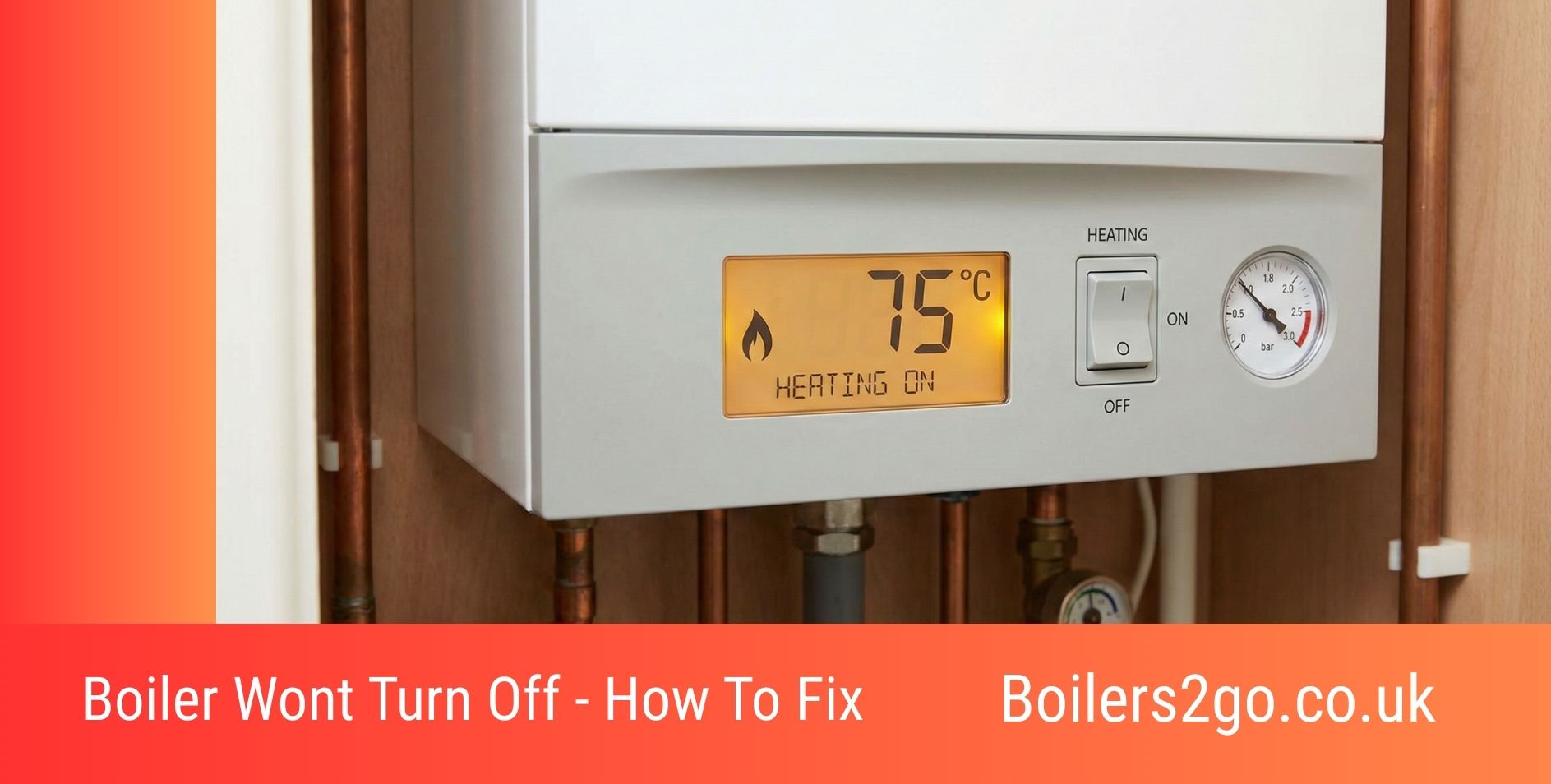
A boiler that runs continuously is more than just an annoyance. Left unaddressed, it adds significantly to your energy bills, puts unnecessary wear on components like the pump and heat exchanger, and in some cases can indicate a fault that becomes a safety concern.
The cause is usually one of a handful of well-understood faults: a thermostat that has stopped reading temperatures correctly, a timer locked in an always-on state, a motorised valve stuck open, or a condensate pipe frozen solid in cold weather. Most are fixable without replacing the boiler, though several require a Gas Safe registered engineer rather than a DIY attempt.
This guide covers each cause in detail, what you can safely check yourself, and when to call a professional. If your boiler is switching itself off rather than staying on, our guide on why a boiler keeps turning itself off covers that separate fault.
If a stuck valve or faulty controls keep causing problems, a boiler cover, repair and annual service plan bundles repairs and servicing together.
Boiler Won’t Turn Off: Video Guide
Quick Diagnosis: What Is Causing Your Boiler to Stay On?
Use the table below to identify the most likely cause based on what you are observing, before reading the detailed sections.
| Cause | Symptom | DIY or Engineer? | Urgency |
|---|---|---|---|
| Faulty thermostat | Boiler runs past set temperature; does not respond to turning dial down | DIY first steps; engineer if replacing | Medium |
| Broken timer / programmer | Boiler ignores scheduled off times; runs all day | DIY reset; engineer for hardwired replacement | Medium |
| Stuck motorised valve | Hot water circulating to radiators when heating is off | Engineer only | Medium-high |
| Low water pressure | Boiler overworks trying to compensate; pressure below 1 bar | DIY repressurise; engineer if recurring | Medium |
| Frozen condensate pipe | Lockout in cold weather; boiler attempts to restart continuously | DIY thaw safely | High (winter) |
| Frost protection mode | Boiler fires briefly and repeatedly in cold weather at low demand | DIY check settings | Low |
| Faulty wiring | Boiler ignores all signals; controls seem unresponsive | Engineer only | High |
Common Causes of a Boiler That Won’t Turn Off
1. Faulty Thermostat
A thermostat controls the boiler by measuring the room temperature and sending a signal to switch heating off once the set temperature is reached. When it develops a fault, either the temperature reading becomes inaccurate or the off signal is never sent, and the boiler keeps firing indefinitely.
Common causes of thermostat failure in UK homes include low or dead batteries in wireless models, incorrect placement near a draught, radiator, or window that gives false readings, general wear on older mechanical dials, and software glitches in smart thermostats after firmware updates. If the thermostat appears unresponsive, our guide to a thermostat and boiler not communicating covers the likely causes.
How to Fix a Faulty Thermostat
- Check and replace the batteries if the thermostat is a wireless or battery-powered model. Low power causes erratic or missing signals to the boiler.
- Turn the thermostat down to its lowest setting (around 10 degrees Celsius) and wait 5 minutes. If the boiler does not shut down, the thermostat is failing to send the off signal.
- Check the thermostat’s position. It should be on an internal wall, at roughly 1.5 metres height, away from direct sunlight, radiators, and external doors. Relocating it to a more representative position sometimes resolves persistent false readings without replacing the unit.
- For wired thermostats, use a multimeter to check for continuity across the terminals. For smart thermostats, try a factory reset via the manufacturer’s app or control panel.
- If none of the above resolves it, replace the thermostat with a compatible model such as a Honeywell T6 or a Nest Learning Thermostat. Replacement should be carried out by a qualified electrician to ensure correct wiring to the boiler’s low-voltage terminals.
A well-matched, correctly placed thermostat is one of the most effective tools for keeping energy bills under control. Our guide on where a central heating thermostat should be placed explains how to avoid false readings.
2. Broken Timer or Programmer
The timer or programmer dictates when the boiler runs its heating and hot water schedules. When it develops an electrical fault, loses its settings after a power cut, or the internal clock drifts, it can lock into an always-on state that ignores both the programmed schedule and any manual override commands. Our boiler timer not working guide covers these faults in more detail.
Older mechanical timers with rotating dials are particularly prone to pin-switch failures that leave the boiler permanently scheduled to run. Digital programmers can lose their settings entirely after even a brief power interruption, defaulting to a constant-on mode until reprogrammed. On Baxi boilers, a faulty timer is one of the more commonly reported causes of continuous running.
How to Fix a Broken Timer or Programmer
- Turn off power to the boiler at the fuse spur or consumer unit for 30 seconds, then restore it. This forces the programmer to restart and can clear a temporary software lock.
- Reprogram the schedule from scratch using the manufacturer’s instructions. Do not assume settings survived a power cut on older digital models.
- Test by manually setting the programmer to ‘off’ or ‘standby’ mode and confirming the boiler stops firing within a few minutes.
- If the programmer does not respond to manual inputs or keeps reverting to always-on after reprogramming, the unit needs replacing. Plug-in replacement programmers (such as Drayton Lifestyle or Horstmann) typically cost £20 to £50 and can be swapped by a competent homeowner. Hardwired units should be replaced by a Gas Safe registered engineer to ensure safe wiring integration.
3. Stuck or Faulty Motorised Valve
Motorised valves control which part of the system receives hot water: radiators, the hot water cylinder, or both. When a two-port or three-port valve sticks in the open position, hot water continues to circulate through the radiator circuit even when the thermostat has signalled heating to stop. The boiler senses the demand and keeps firing to meet it.
Limescale build-up is the most common cause in hard water areas like London and the South East, seizing the valve’s internal mechanism. Actuator motor failure and aged seals are also frequent culprits on systems that have not been serviced regularly. A symptom specific to this fault is radiators that are warm to the touch even when the heating is supposed to be off.
On a combi boiler, the equivalent part is the diverter valve, and our faulty diverter valve guide covers that closely related fault, particularly if you also have a hot water problem.
How to Fix a Stuck or Faulty Motorised Valve
- With the system switched off, locate the motorised valve (usually on the pipework near the boiler or hot water cylinder) and check if the manual lever moves freely. On most Honeywell and Sundial-type valves, there is a small manual lever or override tab. Gently move it through its travel.
- If the lever is stiff or will not move at all, limescale or debris is likely causing the seizure. Partial freeing with a descaling solution circulated through the system can help, but in most cases the actuator head needs replacement.
- Actuator heads (the electrical motor on top of the valve body) can be replaced without draining the system on most common valve types. They typically cost £30 to £60 and clip or unscrew from the valve body. Confirm the model and wiring type before ordering.
- If the valve body itself is seized or corroded, full replacement requires draining the heating circuit. This is engineer work: have a Gas Safe registered plumber carry out the replacement to avoid airlocks and water damage.
4. Low Water Pressure
Low system pressure does not directly cause a boiler to run continuously in the way a thermostat or valve fault does, but on some modern boilers the pressure sensor triggers a compensatory mode where the boiler fires more frequently to try to maintain temperature across a system that is not circulating efficiently. The gauge on the front of the boiler is the quickest diagnostic: if it reads below 1.0 bar, low pressure is a contributing factor. If the pressure keeps falling but you can’t find any water, our guide on whether a boiler can lose pressure without a leak explains the hidden causes.
Common causes are slow leaks in the system, pressure lost after bleeding radiators without topping up, a weeping pressure relief valve, or a failing expansion vessel. Our low boiler pressure guide covers each of these in more detail.
How to Fix Low Water Pressure
- Locate the filling loop, usually a flexible braided hose beneath the boiler with a valve at each end. Open both valves slowly and watch the pressure gauge. Close them once it reaches 1.2 bar.
- Check visible pipework, radiator valves, and boiler connections for drips or damp patches. A leak is the most common reason pressure keeps dropping after topping up.
- Check the expansion vessel using a tyre pressure gauge on the Schrader valve (with the system depressurised). It should hold approximately 0.75 bar. A flat vessel needs recharging with a pump or replacement if the diaphragm has failed.
- If pressure drops repeatedly within a few days of being topped up, call a Gas Safe engineer to carry out a pressure test and identify the source of the loss.
5. Frozen Condensate Pipe
Condensing boilers produce acidic wastewater as a byproduct of the condensing process. This drains out through the condensate pipe, usually white plastic running to an external drain. In cold UK winters, the water in the external section can freeze, blocking drainage entirely. The boiler detects the blockage and may cycle on and off repeatedly as it tries to start, or lock out and attempt restarts in a pattern that looks like it will not switch off.
Properties where the condensate pipe runs along an exposed external wall or terminates at ground level in an uninsulated section are most vulnerable. The fault is more common after a sudden cold snap following a mild spell when pipes have not been lagged.
How to Fix a Frozen Condensate Pipe
- Locate the frozen section of the white plastic pipe on the outside wall. It often feels solid or shows visible frost at the outlet.
- Pour warm water (not boiling, which can crack the pipe) slowly along the frozen section using a jug or watering can. A hot water bottle held against the pipe for 20 to 30 minutes also works for less severe freeze-ups.
- Do not use a naked flame, heat gun, or hairdryer near the boiler or gas pipework. Do not use boiling water, which can cause the pipe to split.
- Once water flows freely from the outlet, reset the boiler via its control panel reset button.
- After thawing, wrap the external section with foam pipe lagging (available at any DIY store for a few pounds) to reduce the risk of refreezing. If the pipe keeps freezing every winter, consider having it rerouted to a more sheltered position or having trace heating tape fitted.
6. Frost Protection Mode
Most modern boilers have a built-in frost protection function that overrides normal thermostat signals in cold weather. When the boiler’s internal temperature sensor detects that the appliance is approaching freezing point, it fires briefly to protect the pipework and heat exchanger, then stops. This is normal behaviour and not a fault. Our guide to boiler frost protection explains how it works.
It can look like the boiler is refusing to turn off, particularly if the property is empty and the thermostat is set very low or switched off. If the boiler is firing for short periods every hour or so during cold weather and the rest of the system appears normal, check whether frost protection mode is active via the boiler’s settings menu.
On most models, frost protection can be adjusted in the service menu but should not be disabled entirely. If you are unsure whether what you are seeing is frost protection or a genuine fault, consult the boiler’s user manual or call the manufacturer’s helpline.
7. Faulty Wiring
Damaged or loose wiring between the thermostat, programmer, and boiler can cause the boiler to run continuously because it never receives the electrical signal to stop. This is less common than the causes above but more serious when it does occur, as wiring faults can create fire risks if left unaddressed.
Signs that wiring may be the cause include the boiler not responding to any control inputs, the programmer or thermostat display going blank, or the issue developing immediately after any work was done nearby (including decorating or fitting a new socket).
Wiring work on a boiler circuit is not DIY territory. If you suspect a wiring fault, turn off power to the boiler at the fuse spur and call a Gas Safe registered engineer. Do not attempt to inspect or repair the wiring yourself.
How to Prevent Your Boiler from Running Continuously
Most of the faults described above develop gradually rather than suddenly. Regular maintenance catches the early signs before they cause a breakdown or a high energy bill. Annual servicing also picks up many other common boiler problems early, before they turn into costly repairs.
- Annual service by a Gas Safe engineer. This is the single most effective prevention step: a competent engineer will check thermostat calibration, valve operation, programmer function, pressure, and all electrical connections in one visit.
- Monthly pressure checks. The gauge should hold between 1.0 and 1.5 bar. A gradual drop indicates a slow leak that needs finding before it becomes a bigger problem.
- Magnetic filter installation. Sludge build-up in the system contributes to valve seizure and pump wear. A Magnaclean or Fernox TF1 on the return pipe significantly slows the rate of accumulation.
- Insulate exposed condensate pipe runs before winter. This takes under an hour and prevents one of the most common winter call-outs.
- Smart thermostat upgrade. Devices like Hive, Nest, or Tado provide remote monitoring and alerts for unusual boiler runtime, so you can spot a problem from your phone before it has been running for days.
When to Call a Gas Safe Engineer About a Boiler That Won’t Turn Off
Some of the causes above can be safely addressed with the steps described. Others are strictly engineer work. Call a Gas Safe registered engineer immediately if:
- You can smell gas at any point. Turn off the gas supply at the meter, open windows, do not use electrical switches, and call the National Gas Emergency Service on 0800 111 999.
- The boiler is making banging, whistling, or gurgling noises that were not present before the fault developed.
- Your carbon monoxide alarm activates. Evacuate the property and call the National Gas Emergency Service on 0800 111 999 (or 999 if anyone feels unwell).
- The boiler does not respond to any control inputs, including the main power switch on the unit itself.
- Basic troubleshooting has not resolved the fault after one or two attempts.
- The boiler is under warranty: check terms before carrying out any repair, as DIY intervention may void cover.
In the UK, any work on gas appliances must legally be carried out by a Gas Safe registered engineer. You can verify an engineer’s registration at gassaferegister.co.uk.
Boiler Won’t Turn Off: FAQs
Can a Boiler That Won’t Turn Off Raise Carbon Monoxide Levels?
A continuously running boiler that is also suffering from a flue blockage, poor combustion, or inadequate ventilation can produce elevated carbon monoxide as a byproduct of incomplete combustion. CO is odourless and colourless, which makes it particularly dangerous. Every home with a gas boiler should have at least one carbon monoxide alarm fitted (British Standard BS EN 50291). If your alarm activates, leave the property immediately, do not operate electrical switches, and call the National Gas Emergency Service on 0800 111 999 (or 999 if anyone feels unwell).
How Does Hard Water Affect Boiler Shutdown?
In hard water areas such as the South East, East of England, and parts of the Midlands, limescale accumulates on heat exchanger surfaces and inside valve bodies faster than in soft water regions. A scaled heat exchanger reduces flow efficiency and can cause the boiler to run longer trying to reach the target temperature. Scaled motorised valves seize and fail to close on demand. Installing a scale reducer on the cold mains inlet and dosing the system with inhibitor at annual service significantly reduces the rate of accumulation.
Is It Safe to Leave a Continuously Running Boiler On Overnight?
Not advisable. A boiler running continuously puts extra strain on the pump, heat exchanger, and controls, and it wastes a significant amount of gas. More importantly, if the reason it is not turning off is a wiring fault or a stuck valve combined with a thermostat that cannot read temperature accurately, there is a risk of overheating the system. If you cannot get an engineer out immediately, turn off power to the boiler at the fuse spur as a temporary measure and get professional help the following morning.
Can Smart Thermostats Help With a Boiler That Won’t Turn Off?
Smart thermostats such as Hive, Tado, and Nest provide several advantages over conventional controls when a boiler is running unexpectedly. Most offer app-based alerts when the boiler has been running for longer than a defined period, allowing you to spot the fault remotely rather than only discovering it on your energy bill. Some models also allow you to switch the heating off remotely if you cannot get home immediately. They integrate with most UK combi and system boilers via the standard two-wire volt-free connection, though installation should be confirmed compatible with your specific model.
What Should Tenants Do if a Landlord’s Boiler Won’t Turn Off?
Tenants should document the issue with dated photographs and a written note of when the fault was first noticed, then notify the landlord in writing by email or letter. Under the Homes (Fitness for Human Habitation) Act 2018, landlords are legally required to ensure heating systems are in proper working order. If the landlord does not arrange repair within a reasonable time (typically 24 to 48 hours for a heating fault), tenants can escalate to the local council’s environmental health department, who can issue an improvement notice requiring the repair to be carried out.
Can an Oversized Boiler Run Continuously?
Not usually continuously, but it can look that way. An oversized boiler can cause a pattern called short cycling, where the boiler heats the system very quickly and then shuts off, only to restart within minutes as temperatures drop. This repeated on-off cycling can make it seem as though the boiler is never properly off. It also accelerates wear on the heat exchanger and ignition components. If your boiler was installed without a proper heat loss calculation for your property, it may be worth having an engineer assess whether it is correctly sized for your home.
Article published by Penny North, Home Energy Heating Expert at Boilers2Go.

I’m Penny North, a home energy heating expert. My mission is to demystify new boilers and complex heating systems to help you achieve a warm, cosy home with lower energy bills and a smaller environmental footprint.