

Boiler short cycling is one of the most common and frustrating problems UK homeowners and landlords deal with. It happens when the boiler fires up, runs for a minute or two, then switches off again, only to repeat the whole cycle almost immediately.
Left unchecked, it wastes gas, pushes up your heating bills, and puts unnecessary wear on components that are expensive to replace. Boiler pressure problems and power faults can sometimes trigger similar behaviour, so it is worth understanding what short cycling actually is before reaching for the phone.
This guide covers what causes short cycling in combi, system, and regular boilers, how to identify which fault applies to your situation, and the practical fixes for each, from things you can sort yourself to jobs that need a Gas Safe registered engineer.
Get a boiler cover, repair and annual service plan online here >
Watch our video on boilers short cycling below:
What Is Boiler Short Cycling?
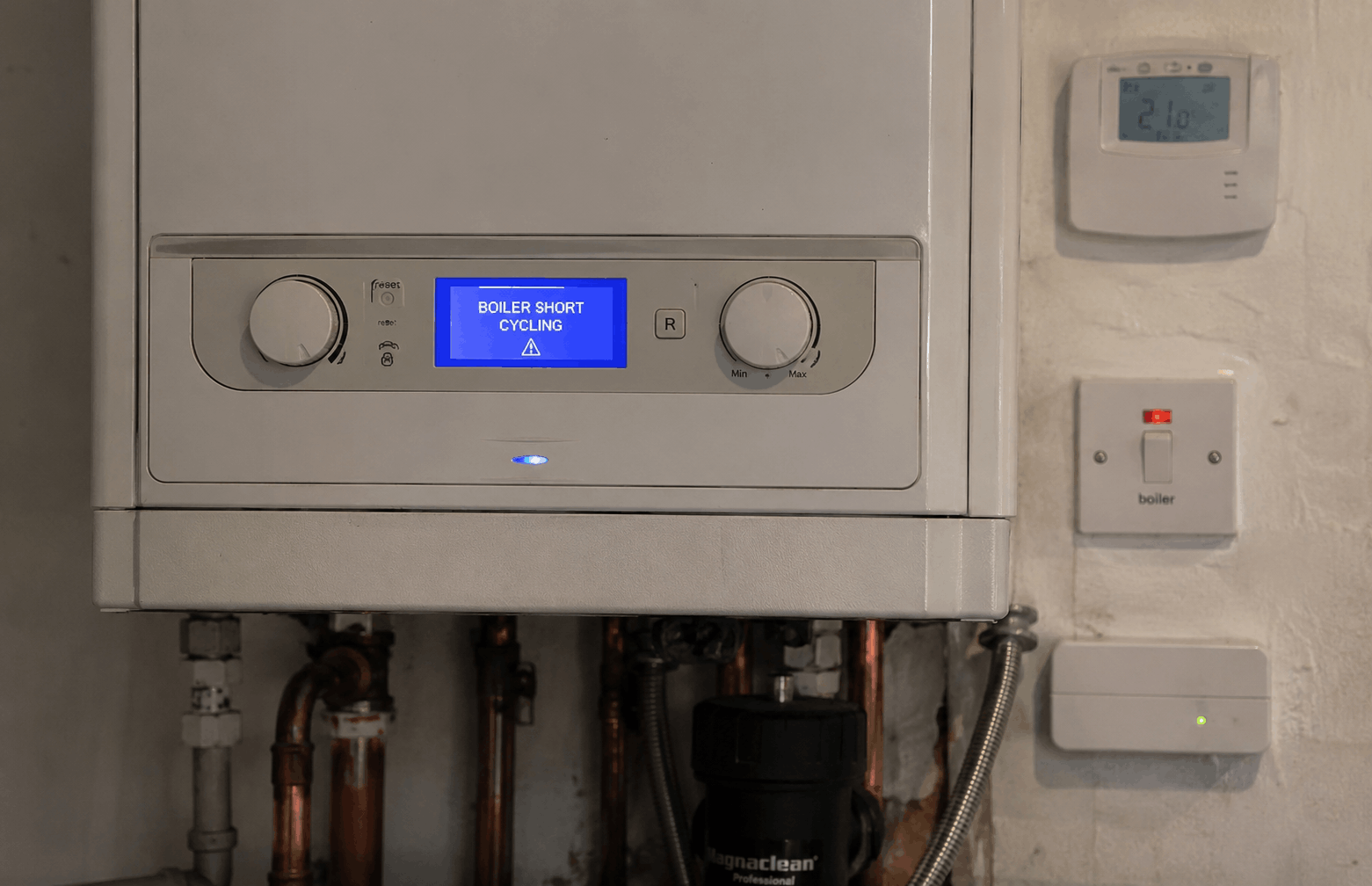
Boiler short cycling is when a boiler repeatedly starts and stops in very quick succession, rather than running for a normal heating cycle of around 10 to 15 minutes. Instead, you might hear it ignite, run for 60 to 90 seconds, shut down, then fire up again within minutes.
Some people call it “kettle cycling” because it sounds a bit like a kettle boiling and switching off on repeat. In severe cases, the boiler can cycle five to ten times an hour, none of which are doing anything useful for your heating or hot water.
It affects all types of gas boiler, including combi boilers, system boilers, and conventional heat-only boilers. It is especially common in modern condensing boilers, which are more sensitive to system conditions than older atmospheric models. If your boiler keeps turning itself off frequently, short cycling may be the cause.
Why Does Boiler Short Cycling Happen?
At its core, short cycling happens when the boiler reaches its target temperature too quickly and the controls tell it to shut off, only for the heat demand to reappear almost immediately. The most common causes in UK homes are listed below, roughly in order of how often they show up.
Is Your Boiler Oversized for the Property?
An oversized boiler is the single biggest cause of short cycling in the UK, and it is a problem that has got worse as older, lower-output boilers have been replaced with modern high-output units without a proper heat-loss calculation first.
A boiler that is too powerful for the home heats the water so fast that it hits its target temperature almost immediately, shuts off, loses heat quickly, and fires straight back up again. No amount of tweaking fixes the root cause.
How to Fix an Oversized Boiler
The permanent fix is to replace the boiler with a correctly sized model. A proper Room-by-Room or Whole-House Heat Loss Survey (carried out by a Gas Safe engineer before purchase) is the only reliable way to work out what output your home actually needs.
A useful short-term workaround: many modern boilers from Worcester Bosch, Vaillant, and Ideal have a “range-rating” or “maximum heating output” setting in the engineer menu. Turning this down reduces the kW output and can significantly reduce short cycling without replacing the boiler.
Is the Thermostat in the Wrong Place?
A thermostat positioned near a radiator, in direct sunlight, above a heat source, or next to the boiler itself will read a higher temperature than the rest of the house. It tells the boiler the property is warm when it is not, triggering an early shutdown.
This is surprisingly common in older properties where the original thermostat location was never ideal, and in newer installations where the engineer did not discuss placement with the homeowner.
How to Fix a Badly Placed Thermostat
- Move the thermostat to an internal wall in a room that is used regularly. Aim for around 1.5 metres from the floor, away from draughts, radiators, and windows.
- If you have a smart thermostat (Hive, Nest, Tado, Drayton Wiser), recalibrate or relocate the main temperature sensor.
- Consider upgrading to a load-compensating or weather-compensating control (Opentherm or eBUS compatible). These read actual return water temperature rather than just room air temperature, which is a more accurate way to control a condensing boiler.
Are the Radiators or System Overheating Too Quickly?
Sometimes the issue is not the boiler output but the way heat moves through the system. If the pump speed is too high, the bypass valve is poorly set, or radiators are imbalanced, hot water can return to the boiler too fast, making it think the house has reached temperature.
How to Fix Radiator and System Overheating Issues
- Check the boiler pump speed setting. Many boilers default to the highest speed (3). Reducing to speed 1 or 2 slows the water flow and gives the system more time to absorb heat before it returns.
- Balance the radiators so heat is distributed evenly around the house rather than racing around the circuit.
- Check the automatic bypass valve (ABV). If it is open too wide, hot water bypasses the radiators and returns straight to the boiler, giving a false reading.
- Clean the plate heat exchanger on combi boilers if you also have inconsistent hot water flow, as a partial blockage here can cause the primary side to overheat rapidly.
Is There Low Water Pressure or Restricted Flow?
Low system pressure or a blocked filter can restrict water flow enough that the boiler overheats quickly and shuts down on its built-in safety limit. This is one of the easier faults to check because you can read the pressure gauge yourself.
How to Fix Low Pressure or Poor Flow
- Check the pressure gauge on the boiler front panel. It should read between 1.0 and 1.5 bar when the system is cold.
- Top up via the filling loop if pressure has dropped below 1.0 bar. If you have never done this before, there is a clear walkthrough in your boiler manual.
- Bleed all radiators and check for airlocks, which can also restrict flow.
- Fit or replace a magnetic system filter (Magnaclean, Fernox TF1) and consider a full powerflush if the system water is heavily contaminated with sludge.
If the pressure keeps dropping after you top it up, there may be a slow leak somewhere in the system. That is a separate fault to investigate before spending money on anything else. Our boiler leaking guide covers the most common causes.
Is the Boiler Thermistor Faulty?
The thermistor is the temperature sensor inside the boiler. If it gives inaccurate readings, the boiler can think it has reached the target temperature and shut off, even when the water is barely warm.
How to Fix a Faulty Thermistor
This requires a multimeter test by a Gas Safe engineer. The part itself is inexpensive, typically £10 to £25, but diagnosing and replacing it correctly is a job for a qualified person. Watch for these fault codes, which are often linked to thermistor problems:
- Vaillant: F.75
- Worcester Bosch: EA 227
- Ideal Logic: F1 or L1
Is Limescale Causing the Problem?
Limescale build-up is a serious issue in hard-water areas across the South East, Midlands, and parts of Yorkshire. It coats the inside of the heat exchanger over time, acting like insulation and causing the water inside to overheat rapidly.
The result is a boiler that hits its safety limit almost as soon as it fires, shuts off, cools slightly, and repeats the cycle. It is a progressive problem: the more scale builds up, the worse the short cycling gets.
How to Fix Limescale-Related Short Cycling
- Have the main heat exchanger chemically cleaned or, if badly scaled, replaced. Heat exchanger replacement currently costs £450 to £750 including labour, based on 2025 pricing.
- Fit an inline scale reducer or electrolytic scale inhibitor on the cold mains if you have a combi boiler.
- Install a water softener for whole-house protection. It is a bigger upfront cost but the most effective long-term solution in persistently hard-water areas.
How to Prevent Boiler Short Cycling
Most short cycling problems are preventable. They tend to develop gradually through a combination of poor installation sizing, lack of system maintenance, and dirty system water, all of which are avoidable with the right habits in place.
- Always get a proper heat-loss calculation done before fitting a new boiler. Never accept a straight swap based on the existing boiler output alone.
- Book an annual boiler service with a Gas Safe engineer. Pump speed, bypass settings, thermistors, and heat exchanger condition are all checked during a thorough service.
- Fit a quality magnetic filter and top up the inhibitor concentration annually or after any major system work.
- Upgrade to smart or modulating controls that adjust output based on actual heat demand rather than simple on/off switching.
- Keep system pressure between 1.0 and 1.5 bar and bleed radiators at the start of each heating season.
For more guidance on keeping your heating system in good shape, the Energy Saving Trust has straightforward advice on boiler efficiency and upkeep.
When You Must Call a Gas Safe Engineer
Some of the checks above (pressure, bleeding radiators) are straightforward DIY tasks. Others are not. Call a Gas Safe registered engineer straight away if any of the following apply:
- You can smell gas or hear unusual banging or clunking noises from the boiler.
- The boiler displays a fault code and locks out completely.
- You have bled the radiators and repressurisied the system but the short cycling returns within a few hours.
- The boiler is losing pressure quickly, which points to a possible leak in the system.
- You are unsure about any gas or water connections. Working on sealed system components without a Gas Safe registration is illegal in the UK and genuinely dangerous.
You can verify any engineer’s credentials before they start work using the official Gas Safe Register search.
How Much Does It Cost to Fix Boiler Short Cycling?
The cost depends entirely on the cause. Here is a realistic breakdown based on current 2025 UK market prices:
- Pump speed adjustment or radiator balancing: £80 to £150 including call-out and labour.
- Thermistor replacement: £100 to £200 parts and labour.
- Powerflush (to clear sludge): £300 to £800 depending on property size and number of radiators. Larger homes with heavily blocked systems sit at the top end of that range.
- Heat exchanger replacement: £450 to £750 including parts and labour.
- New correctly sized boiler: £2,250 to £3,000 for a standard combi swap, fully installed.
If you are looking at a heat exchanger replacement on a boiler that is over 10 years old, it is worth getting a new boiler quote at the same time. The maths sometimes tips in favour of replacement rather than repair. Our guide to boiler installation costs explains what to expect from the process.
Frequently Asked Questions
Will short cycling damage my boiler in the long term?
Yes, and more quickly than most people expect. Each start-up cycle puts stress on the fan, igniter, pump, and PCB. Manufacturers suggest constant short cycling can reduce boiler lifespan by 30 to 50%, and some industry sources note it can age a boiler by the equivalent of ten years in just two or three seasons of heavy cycling.
My boiler only short cycles when heating hot water, not on central heating. Why?
This pattern almost always points to a blocked or failing secondary (plate) heat exchanger on a combi boiler. The restricted flow causes the primary side to overheat very quickly when hot water is called for. A Gas Safe engineer can confirm with a flow rate test.
Can a smart thermostat make short cycling worse?
It can, yes. If the thermostat uses a very tight temperature differential (0.25°C or similar) or aggressive on/off switching rather than proper modulation, it can actually increase cycling frequency. Switching to Opentherm-compatible controls usually resolves this, as the boiler can modulate its output rather than simply turning on or off at full power.
Is short cycling the same as boiler kettling?
No, though the two can occur together. Kettling is a loud boiling or rumbling noise caused by limescale build-up inside the heat exchanger. Short cycling is the repeated on-off behaviour. Limescale can cause both at the same time, but fixing the kettling does not automatically fix the short cycling.
How do I know if my boiler is the wrong size for my home?
The most reliable way is a professional heat-loss calculation. As a rough guide, a modern well-insulated three-bedroom semi typically needs around 9 to 12 kW. If your boiler is rated at 24 kW or above for that type of property, oversizing may well be contributing to short cycling.
Can I fix short cycling myself, or do I always need an engineer?
Checking and topping up boiler pressure, bleeding radiators, and moving a poorly positioned thermostat are all things most homeowners can handle safely. Anything involving the internal components of the boiler, the gas supply, or sealed system pipework should be left to a Gas Safe registered engineer.
Stay warm, The Boilers2Go Team

I’m Penny North, a home energy heating expert. My mission is to demystify new boilers and complex heating systems to help you achieve a warm, cosy home with lower energy bills and a smaller environmental footprint.