

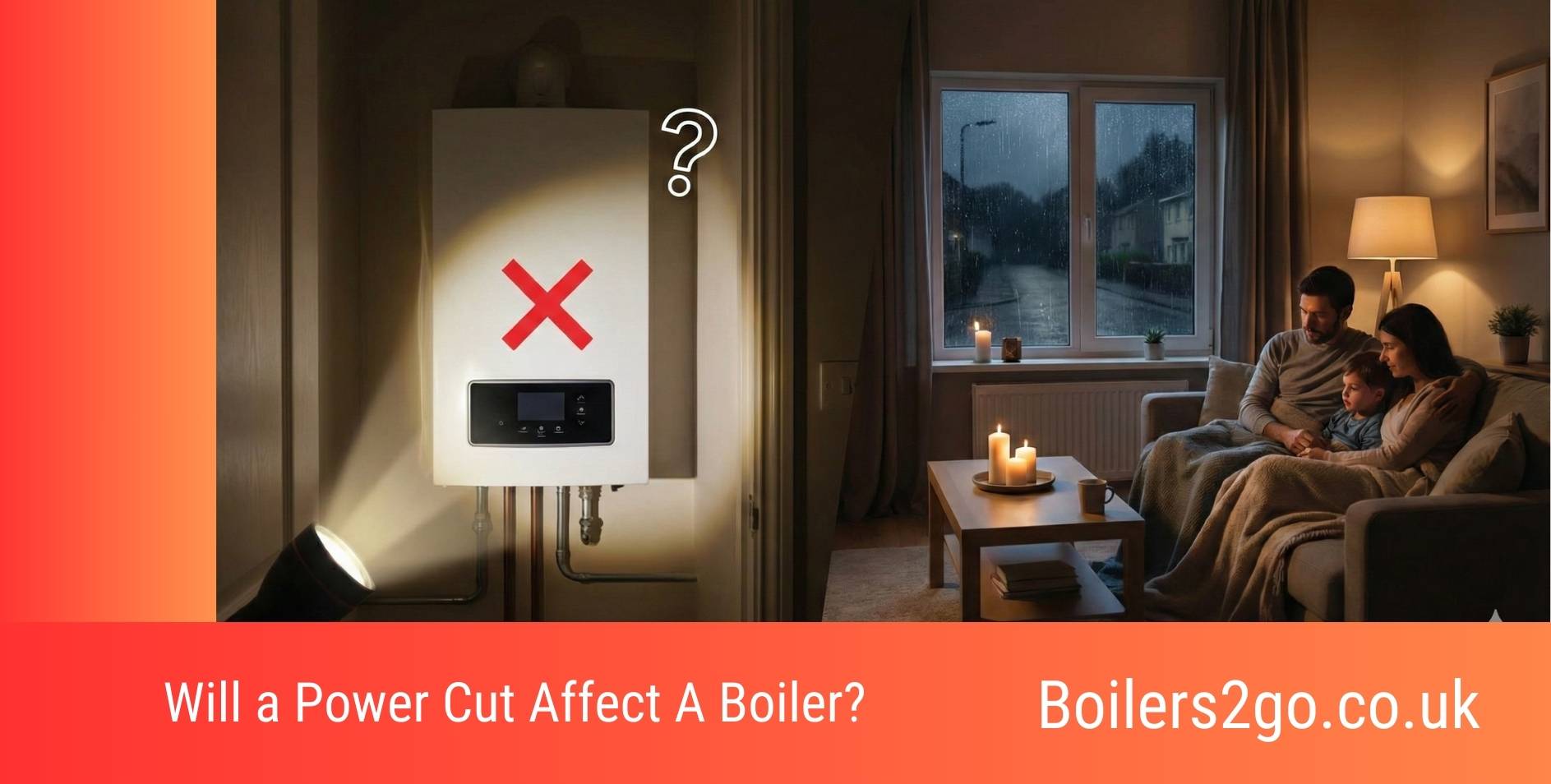
Yes. Your gas or oil central heating system, despite using fuel to create heat, relies entirely on electricity to function safely. A power cut will immediately stop all modern boilers, regardless of type, from operating.
This guide explains exactly how a power outage affects your boiler, what risks exist when power is restored, the steps to take before calling an engineer, and how to protect your system from surge damage in the future.

Need a new boiler?
Get a quote today and take the stress out of replacing your boiler. At Boilers2Go, we offer fast, reliable installation across the UK - often as soon as the next day.
Get Installation QuotePower Cuts and Boilers: Video Guide
How Does a Power Cut Affect Your Boiler?
All modern central heating systems, including combi, system, and conventional (regular) boilers, require an electrical supply to power their critical components. While the boiler burns natural gas or oil to generate heat, the control, safety, and circulation mechanisms are entirely electrical.
During a power cut, these components lose power and the boiler shuts down as a safety precaution. The following are the key components affected:
Electronic Ignition
Modern boilers use an electronic spark to ignite the gas burner. Without electricity, this first step in the heating cycle cannot happen. Older pilot light-controlled boilers might continue running in some circumstances, but these are increasingly rare in UK homes and largely phased out on any post-2004 condensing replacement.
The Circulating Pump
The pump is what pushes hot water from the boiler around the radiators and back again. It is fully electric. Without it, heat stays trapped inside the boiler and nothing reaches your radiators or hot water outlets. The boiler shuts down before this becomes a problem because the fan check comes first.
Controls, PCB, and Thermostats
Your boiler’s Printed Circuit Board (PCB), the central control unit, together with your wall-mounted thermostat, smart thermostats, and programmers, are all reliant on electricity. They stop regulating temperature and timing the moment power is cut, making the system non-functional.
Safety Fan
The fan is required to expel combustion gases safely out of the flue before the burner is allowed to fire. Without power to the fan, the boiler cannot ignite, which is a deliberate safety feature rather than a fault. This prevents dangerous gases from accumulating if there is no safe way to vent them.
Is There a Risk of Boiler Damage When Power Is Restored?
A straightforward power cut will not damage a modern boiler. The real risk comes from what happens when the electricity comes back on: a brief but potentially damaging voltage spike that races through your home’s wiring.
When the electricity network is restored after an outage, particularly after a longer cut, there can be a sudden reinstatement of voltage that is higher than the normal 230V supply. Your boiler’s most vulnerable component to this is the PCB.
Boiler PCB Failure From Power Surges
The PCB is the most complex and expensive electronic component in your boiler. A power surge can damage or destroy it, leading to a complete boiler breakdown that requires costly repair. PCB replacement typically costs £200 to £500 depending on the boiler brand and model. In some cases the cost makes replacement of the whole boiler the more economical decision, particularly on boilers over 8 to 10 years old.
Power surges from the National Grid are the leading cause of PCB failure in UK boilers. Unlike modern consumer units (which now include surge protection as standard in new installations), older consumer units and unprotected circuits leave the boiler exposed.
Boiler Timer and Programmer Reset
A less damaging but frequently frustrating consequence: many boiler programmers and digital timers lose their schedule and revert to factory settings after a power cut. The display clock may also reset to 00:00. You will need to manually reprogram the correct time and heating schedule before the system will run normally again. This is the most common reason a boiler appears broken after a power cut when nothing is actually damaged.
How to Prevent Power Surge Damage to Your Boiler
Two practical steps significantly reduce the risk of surge damage:
Step 1: Switch the Boiler Off During the Outage
As soon as you realise there is a power cut, switch your boiler off at the mains electrical fused spur switch. This is the dedicated wall switch near the boiler, typically a white or chrome double-pole fused spur. Turning it off completely disconnects the boiler from the mains and prevents the PCB from being exposed to any surge when power is restored.
Wait until the power has been restored and is clearly stable, at least a few minutes after the lights are solidly back on, before switching the boiler back on again.
Step 2: Fit a Surge Protector
A dedicated power surge protector fitted to the boiler’s fused spur circuit costs approximately £25 to £40 and can absorb a voltage spike before it reaches the PCB. This is particularly recommended for rural properties that experience more frequent power cuts, and for any home with an older consumer unit that does not include integral surge protection.
Modern consumer units installed or replaced since around 2022 typically include surge protection as standard across all circuits. If your consumer unit is older, ask an electrician whether a Type 2 SPD (Surge Protective Device) has been fitted.
What to Do If Your Boiler Is Not Restarting After a Power Cut
If your boiler is not restarting automatically after power is restored, work through these checks in order before calling an engineer.
Check 1: Confirm Power Is Fully Restored
Check all lights and sockets throughout the property. Confirm the boiler’s fused spur switch is in the on position. If the fused spur has tripped off due to a surge, reset it by pressing it firmly back to the on position. If it trips again immediately, stop and call an electrician or Gas Safe engineer, as this indicates a persistent fault that needs professional diagnosis.
Check 2: Inspect the Consumer Unit
Open your consumer unit and check whether the circuit breaker for the boiler is in the off or tripped position. If so, reset it to on. The boiler circuit is typically labelled “boiler” or “heating.” If the circuit breaker trips again immediately, do not keep resetting it. Call a Gas Safe engineer.
Check 3: Reset the Boiler
Most modern boilers restart on their own once power returns, but some go into a safety lockout after a power interruption and display a fault code until they are reset.
- Locate the reset button on your boiler’s control panel (usually marked “reset” or shown as a circular arrow symbol).
- Press and hold for 3 to 5 seconds as per your user manual, then release.
- Allow the boiler up to 60 seconds to attempt a restart and complete its ignition sequence.
- If the fault code returns immediately, attempt a second reset. If it persists after two resets, stop and call a Gas Safe engineer.
Check 4: Reprogram the Timer and Thermostat
This is the most commonly overlooked post-power cut check. If the boiler appears to have power but is not firing during scheduled hours, the programmer clock has almost certainly reset.
- Check the programmer or digital timer display. If it shows 00:00 or is blank, the schedule has been wiped.
- Reset the correct time and day, then re-enter the heating schedule. Consult your user manual or look up your model’s programming instructions online.
- On smart thermostats (Hive, Nest, Tado), check the app to confirm the system is online and has not switched to away or frost-protection mode following the connectivity loss during the outage.
What If the Boiler Is Still Not Working After All These Checks?
If you have confirmed power, reset the boiler twice, and reprogrammed the timer, and heating is still absent or a persistent fault code remains on the display, call a Gas Safe registered engineer. The likely culprits at this stage are:
- Blown internal boiler fuse: your boiler may contain an internal fuse (typically 3A or 5A) in a small fused spur box. A surge can blow this fuse even if the main consumer unit circuit did not trip. A Gas Safe engineer will check and replace it safely.
- PCB damage: if the Printed Circuit Board was damaged by the surge, it will need testing and likely replacement. This is not a homeowner repair. The cost varies significantly by model but typically runs £200 to £500 including labour.
When a Boiler Repair After a Power Cut May Not Be Economical
If the power cut has resulted in PCB failure on a boiler that is already over 8 to 10 years old, and particularly one that has had other recent repairs, a replacement boiler is often the more economical long-term decision.
Pouring £300 to £500 into a PCB repair on a 12-year-old boiler that is past its prime efficiency and likely to need further work within a year or two is rarely good value. A new A-rated boiler installed now will deliver better efficiency, a manufacturer warranty of up to 10 to 12 years, and lower monthly energy bills. If you are unsure what you have now, our guide to what type of boiler you have will help you work out the equivalent modern replacement.
If your boiler has suffered significant damage from a power cut and you are facing an expensive repair bill, request a new boiler quote from Boilers2Go today. We can provide a fixed-price quote for a high-efficiency replacement, helping you get your heating back quickly and reliably.
Power Cuts and Boilers: FAQs
Can I Get Hot Water From My Cylinder in a Power Cut?
If you have a traditional heat-only (conventional) boiler paired with a separate hot water storage cylinder, the water already in the cylinder will remain hot for several hours due to the cylinder’s insulation. A well-insulated modern unvented cylinder can retain useful heat for up to 12 hours or more depending on its quality and how recently it was heated.
You will not be able to reheat the water or draw new hot water, as the boiler and the pump that feeds the cylinder both require electricity to operate. A well-insulated cylinder holds its heat for longer, and our guide on how to insulate a hot water tank explains how to improve yours.
Does a Power Cut Affect Heat Pumps or Electric Boilers?
Yes, severely. An electric boiler or heat pump is entirely dependent on mains electricity to generate heat. When the supply goes down, these systems immediately cease to operate, leaving you without any heating or hot water until power is fully restored. Electric systems have no gas or oil fallback and are therefore more immediately affected by outages than gas boilers. For how these systems compare with gas on everyday bills, see our guide to central heating running costs.
Should I Turn My Boiler Off When a Thunderstorm Is Predicted?
Yes, it is sensible to turn off your boiler at the fused spur switch if you are expecting severe electrical storms. Lightning strikes can cause massive voltage surges that travel through utility lines into your home’s wiring. Switching off the boiler before the storm begins gives the PCB and thermostat the best protection against surge damage, particularly if your property does not have a modern surge-protected consumer unit.
Do Insurance Policies Cover Boiler Damage From a Power Surge?
It depends on your specific policy. Standard home insurance may cover lightning strike damage but often excludes or limits cover for surge damage from grid faults. Your energy network operator (the company that owns the cables and distribution infrastructure) is not liable for appliance damage caused by power cuts, regardless of duration, unless they can be shown to have breached their statutory duties.
Check your home insurance policy’s accidental damage and appliance breakdown sections. Dedicated boiler cover policies typically cover PCB failure if the boiler has been annually serviced and maintained. A plug-in or wired surge protector for approximately £25 to £40 is a low-cost preventative alternative to relying on insurance.
Will a Battery Backup (UPS) Keep My Boiler Running in a Power Cut?
A small Uninterruptible Power Supply (UPS) will not run the entire heating system through a full outage. The pump alone draws significant power that a domestic UPS cannot sustain for long. What a UPS can do is keep the low-power electronic controls (PCB and thermostat) running through a momentary flicker or brief outage, and crucially, it provides a clean regulated power supply that absorbs any surge when mains power is restored rather than allowing it to hit the PCB directly.
For rural properties in areas with frequent short-term outages, a UPS on the boiler’s electrical circuit is a practical investment for maintaining system stability and protecting the PCB.
What Happens if a Power Cut Occurs in Very Cold Weather?
An extended power cut during freezing weather introduces a pipe-freezing risk, particularly for any pipework in unheated spaces such as attics, garages, or outside walls. Many boilers have a built-in frost protection function that will fire the boiler briefly when temperatures drop, but this requires power to operate. If the power cut is prolonged and temperatures are below freezing, draining exposed pipework or using insulated lagging on vulnerable pipes helps prevent freeze damage. Once power is restored and the boiler is running again, check all visible pipes and radiator connections for signs of frost damage before leaving the system running unattended. If your boiler is already showing its age, our guide to getting your home winter-ready explains why it pays to deal with a replacement before the coldest weeks arrive.

I’m Penny North, a home energy heating expert. My mission is to demystify new boilers and complex heating systems to help you achieve a warm, cosy home with lower energy bills and a smaller environmental footprint.