

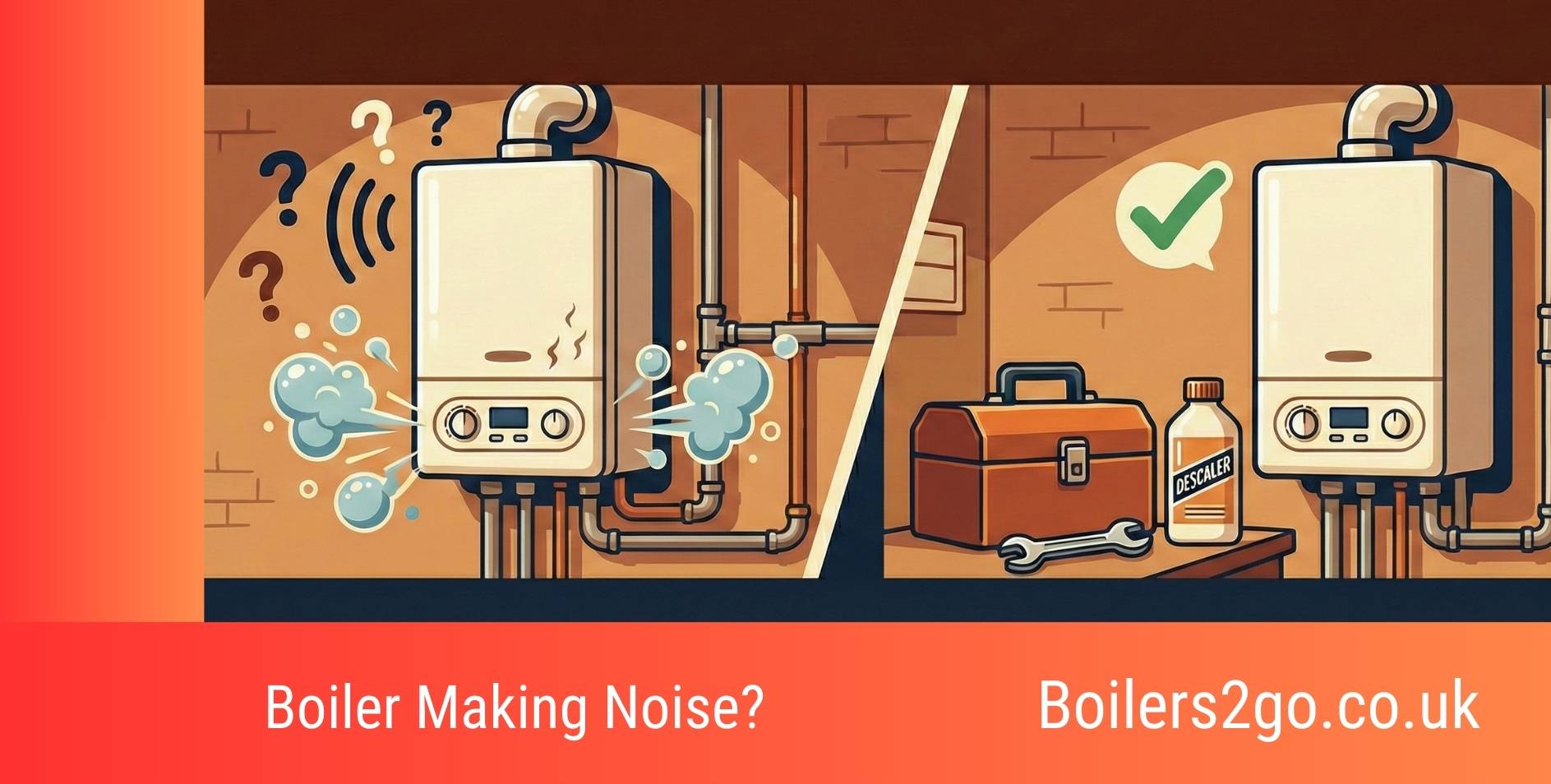
A healthy boiler is a quiet boiler, so a boiler making noise that’s started to cause concern is worth investigating.
Get a boiler cover, repair and annual service plan online here >
Strange sounds, be it banging, gurgling, or whooshing, are the system’s way of signalling a problem. These noises aren’t just annoying; they’re often the early warning signs of costly internal faults.
This guide translates these unsettling sounds, covering the causes and practical fixes to help keep a central heating system running safely and efficiently.
Get a quote today and take the stress out of replacing your boiler. At Boilers2Go, we offer fast, reliable installation across the UK - often as soon as the next day. 
Need a new boiler?
Why Is My Boiler Making a Banging or Rumbling Noise (Kettling)?
If a boiler making a banging or rumbling noise sounds exactly like a kettle boiling, which is why the industry calls it kettling, it’s overwhelmingly likely caused by a build-up of limescale or sludge (magnetite) on the main heat exchanger. This is arguably the most common and damaging type of noise problem for boilers in hard water areas of the UK.
The Cause
When water flows over the insulated layer of scale and sludge on the heat exchanger, the metal underneath overheats, and the water trapped in tiny pockets within the scale boils instantly, creating steam bubbles. When these bubbles collapse, they create a small internal explosion, the distinctive banging or rumbling sound.
The Fix
- Immediate action: if the noise is very aggressive, call an engineer.
- Professional remedy: the long-term fix is a powerflush of the heating system, or a chemical clean of the heat exchanger using specific descaling agents. This removes the insulating layer, allowing the water to heat smoothly and uniformly, which matters for both the efficiency and lifespan of a central heating system.
Get a boiler cover, repair and annual service plan online here >
Why Is My Boiler Making a High-Pitched Whistling or Humming Noise?
If a high-pitched whistling or humming noise is particularly noticeable, especially when the boiler is firing up or running, the primary suspect is usually the circulating pump or excessive air trapped inside the boiler.
Faulty Circulating Pump
If the noise is a high-pitched whine or a persistent humming, the circulating pump’s motor bearings may be seizing up due to old age, wear and tear, or contamination from sludge. The pump is essential for moving water from the boiler to the radiators, and when it struggles, it often generates a loud mechanical noise.
The fix: a Gas Safe registered engineer will need to inspect the pump and likely replace it if the bearings are damaged.
Trapped Air
A loud whooshing or whistling sound can also be air pockets rapidly moving through the pipes and across the heat exchanger. Air bubbles interrupt the flow of water.
The fix: try bleeding the radiators first. If the noise persists and seems to be coming directly from the boiler casing, the issue may be the automatic air vent inside the unit, which an engineer will need to check.
What Causes the Gurgling, Bubbling, or Dripping Sounds Coming From My Boiler?
The cause of gurgling, bubbling, or dripping sounds depends entirely on where the sound is coming from. These noises are nearly always related to water, air, or condensation, but they carry different levels of urgency.
Frozen or Blocked Condensate Pipe (Gurgling)
In a modern condensing boiler, a gurgling noise is most often associated with a partially or fully blocked condensate pipe. If the pipe, which takes acidic waste water outside, freezes in cold weather or gets blocked by debris, the condensate backs up inside the boiler, leading to gurgling as the boiler tries to drain.
The fix: this can often be solved by thawing the external pipe with warm, not boiling, water.
Low System Pressure (Gurgling/Air)
Persistent gurgling and bubbling can indicate excessive air in the system due to very low water pressure, often signalled by a low reading on the pressure gauge.
The fix: repressurise the boiler using the filling loop to the correct range, typically 1.0 to 1.5 bar cold.
Leakage (Dripping)
A distinct dripping sound clearly points to a leak. This could be from a compromised internal seal, a pipe connection, or the pressure relief valve (PRV) releasing excess pressure.
The fix: if dripping is heard, turn off the boiler and call a Gas Safe engineer immediately, since internal leaks can cause serious damage to electrical components like the PCB.
Get a boiler cover, repair and annual service plan online here >
Why Does My Boiler Make a Rapid Clicking Noise Before Ignition?
A rapid clicking noise before ignition is usually a tell-tale sign that the boiler is trying, but failing, to ignite the gas. The rapid clicking is the ignition electrode repeatedly trying to spark and light the gas supply.
This problem is often followed by a safety lockout error code on the boiler’s display, such as an F2 or L2 code depending on the model.
Common Causes for Ignition Failure
- Faulty gas valve: the valve might not be opening fully, or at all, to supply the gas, meaning there’s nothing for the electrode to ignite.
- Dirty or fouled electrode: the electrode responsible for generating the spark can become coated in dirt, preventing a strong, reliable spark.
- Flue blockage: the boiler’s safety mechanisms detect that the flue is blocked and prevent ignition for safety reasons.
The fix: because this involves the gas supply and ignition components, this is strictly a job for a Gas Safe registered engineer. They’ll need to clean the ignition probe, check the gas valve operation, and verify the integrity of the flue system.
When to Stop Repairing and Consider a New Boiler
If a noisy boiler is a chronic problem, requiring repeated visits from an engineer to replace parts like the pump or PCB, or dealing with severe kettling, that’s usually a sign the tipping point has been reached. Continuous costly repairs are a false economy, especially on a boiler over a decade old. For UK homeowners and landlords, reliability and efficiency matter most.
Moving past these noisy, inefficient struggles usually means replacing the old unit with a modern, A-rated, quiet, and reliable boiler. Installing a new boiler not only eliminates these frustrating sounds but can also meaningfully reduce gas bills thanks to improved efficiency.
A recurring noisy boiler doesn’t have to stay a recurring problem. Requesting a free, no-obligation new boiler quote is a straightforward first step towards peace of mind, quieter running, and lower energy costs.
FAQs
Is a Faint Whooshing or Water-Running Noise Normal When the Central Heating Turns On?
Yes, a faint, momentary whooshing or water-running noise immediately after the boiler fires up and the central heating begins is generally considered normal. This is simply the sound of the circulating pump starting up and pushing water through the pipework and around the radiators.
As long as the sound quickly settles down and isn’t a persistent loud whine, it’s usually not a cause for concern and is just the sound of a working heating system.
Could a Faulty Fan Be Responsible for Loud Noises Coming From My Boiler?
Absolutely. If the boiler is making a loud, screeching or very high-pitched whining sound that’s continuous while the boiler is running, the fan is a likely culprit. The fan is a mechanical component with bearings that can wear out over time.
When the bearings fail, the fan struggles to rotate smoothly, creating a loud friction noise. A failed fan is a serious issue that affects the boiler’s ability to safely expel combustion gases, and it must be replaced by a Gas Safe engineer.
Does Insulating the Boiler Pipes Reduce the Amount of Noise?
While insulating internal pipework (lagging) is primarily for energy efficiency and freeze prevention, it can help slightly to dampen operational noises. However, pipe insulation won’t fix loud noises caused by internal faults like kettling or a failing circulating pump.
Those faults require internal boiler repair. If the noise is coming from outside the boiler unit, such as pipes expanding or clicking, lagging may help reduce the sound transmission into the room.
What Is Boiler ‘Pumping Over’ and Does It Cause Noise?
Boiler ‘pumping over’ is a term used when the circulating pump draws air or water into the system via the expansion pipe, often causing gurgling and surging noises in the water flow.
It’s usually a symptom of a fault related to the expansion vessel or incorrect installation in an open-vented system. This condition needs to be corrected by a professional engineer, since it compromises the system’s efficiency and can introduce excessive air, leading to further noisy operation.
How Important Is Annual Boiler Servicing in Preventing Strange Noises?
Annual boiler servicing is genuinely important in preventing strange noises. During a service, a Gas Safe engineer checks for early signs of common noise-related issues, checking system pressure, looking for corrosion that leads to sludge and kettling, and ensuring the fan and pump are running smoothly.
Regular maintenance allows minor issues, like a slightly worn pump or a dirty electrode, to be caught and fixed before they escalate into a major, loud, and expensive component failure.
Can a Boiler Noise Mean It’s About to Break Down Completely?
It can, particularly with kettling or a failing pump, since both point to internal wear that tends to worsen over time rather than resolve itself. A sudden or worsening noise is worth acting on quickly rather than waiting for a full breakdown.
Is It Safe to Keep Using a Boiler That’s Making Noise?
It depends on the noise. A faint whoosh on start-up is generally fine, but banging, dripping, or clicking before ignition all warrant switching the boiler off and getting it checked, since continuing to run it risks further damage or, in some cases, a safety issue.
Get a quote today and take the stress out of replacing your boiler. At Boilers2Go, we offer fast, reliable installation across the UK - often as soon as the next day.
Need a new boiler?

I’m Penny North, a home energy heating expert. My mission is to demystify new boilers and complex heating systems to help you achieve a warm, cosy home with lower energy bills and a smaller environmental footprint.