

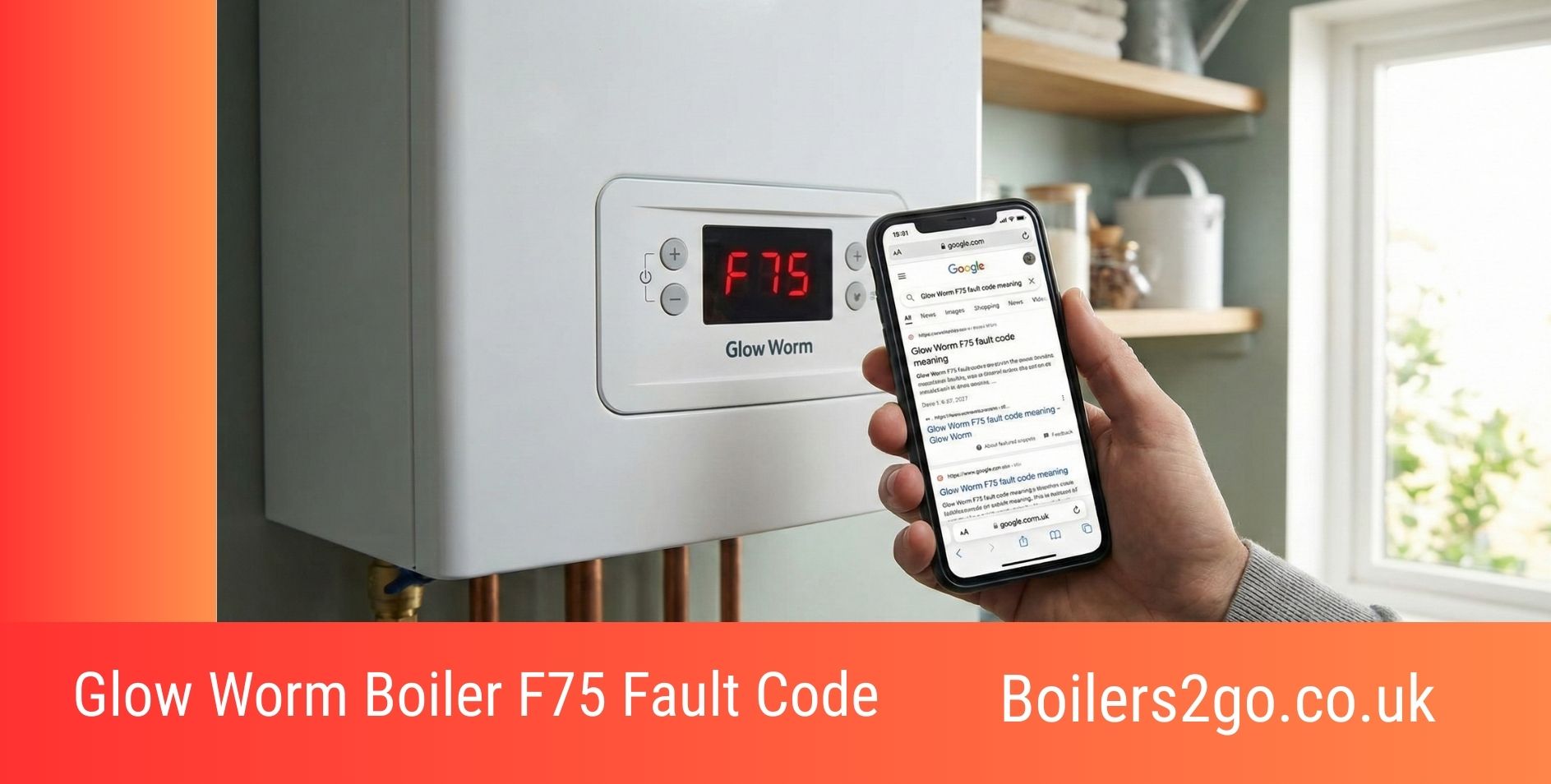
The F75 fault code on a Glow Worm boiler is a circulation alert that halts heating right when it is needed most. It commonly affects Ultracom and Energy models, and points to a problem where the boiler cannot confirm a proper water pressure change when the pump runs, often locking out as a safety measure.
This guide covers what the code means, the typical reasons it happens, and clear steps to fix each one, helping UK homeowners get back to warmth quickly and helping landlords avoid unnecessary tenant downtime.
What Does the Glow Worm Boiler F75 Fault Code Mean?
The Glow Worm boiler F75 fault code means the boiler has failed to detect a pressure rise when the pump starts, which points to a possible issue with water circulation or pressure sensing in the central heating system.
This safety feature exists to prevent dry firing or overheating. The PCB expects a small pressure bump as water moves, and if it does not happen, the boiler locks out to protect its components.
Why the Glow Worm F75 Lockout Occurs
The pump can often be heard whirring while the pressure gauge shows no movement, a telltale sign in both combi and system boilers that something is blocking reliable pressure detection.
What Are the Common Causes of the Glow Worm Boiler F75 Fault Code?
The common causes of the Glow Worm boiler F75 fault code generally involve a failure to detect or create water flow, ranging from sensor glitches to mechanical wear that tricks the system into registering no circulation at all.
These issues often build up quietly over time, particularly in UK hard water areas or in systems that have missed an annual service. The main causes are set out below, along with a clear fix for each.
Faulty or Blocked Pressure Sensor
A faulty or blocked pressure sensor develops when debris, sludge, or an electrical fault prevents accurate readings, which fools the boiler into registering no circulation even when pressure is actually fine.
This is the most frequent cause of F75, especially in older Glow Worm installations where limescale can clog the small sensing port over time.
How to Fix a Faulty or Blocked Pressure Sensor
- Check the pressure gauge first. If it does not rise when the pump runs, note this symptom before doing anything else.
- Attempt a single boiler reset by holding the reset button for 5 to 10 seconds to clear any temporary glitch.
- Call a Gas Safe engineer to inspect and clean the sensor, or replace it if damaged, typically costing £100 to £200 including labour.
- After the repair, a system power flush is worth considering to help prevent the issue recurring from dirty water.
Malfunctioning Boiler Pump
A malfunctioning boiler pump runs but fails to generate enough flow, usually due to seized bearings, sludge build-up, or an electrical fault, so no pressure change registers with the PCB.
This tends to hit pumps hardest in high-use properties, where the fault can mimic a total failure as far as the control board is concerned.
How to Fix a Malfunctioning Boiler Pump
- Listen for humming or vibration from the pump. If it is present but weak, try resetting the boiler first.
- Bleed the radiators and repressurise the system to rule out airlocks affecting flow.
- Have a Gas Safe professional test the pump speed and replace it if needed. A pump replacement typically costs £150 to £380 including labour, often alongside a system cleanse.
- Fitting a magnetic filter after the repair helps catch future debris before it reaches the pump again.
Low System Water Pressure
Low system water pressure results from leaks, radiator bleeding, or gradual evaporation, dropping below the level the pump needs to create a detectable movement.
This is a less direct cause on its own, but it often contributes to F75 when combined with a slightly oversensitive sensor in Glow Worm combi models.
How to Fix Low System Water Pressure
- Locate the pressure gauge. If it reads below 1 bar, prepare to top up the system.
- Use the filling loop, usually a braided hose or a pair of valves under the boiler, to add water slowly until the gauge reads 1.2 to 1.5 bar.
- Reset the boiler and monitor it. If the pressure holds, test the heating. If it drops again, start looking for a leak.
- Book an engineer for a persistent leak, or if repressurising alone does not clear the F75 code.
Sludge or Air in the System
Sludge or air in the system builds up from corrosion or poor inhibitor levels, restricting flow and preventing the small pressure spike the boiler expects, even though the pump itself is working.
This kind of silent blockage often follows a neglected annual service, which is a common pattern across older UK heating systems.
How to Fix Sludge or Air in the System
- Bleed all radiators, starting upstairs, to release any trapped air, and catch drips as you go.
- Repressurise the system after bleeding and reset the boiler.
- If only minor build-up is suspected, add a chemical inhibitor via a radiator as a first step.
- For heavier sludge, arrange a professional power flush, which typically costs £350 to £850 depending on the number of radiators, to restore full circulation.
Defective Expansion Vessel
A defective expansion vessel loses its air charge or diaphragm integrity over time, so it can no longer accommodate water expansion properly, which leads to erratic pressure readings.
This is a less common but easy to miss cause, and it tends to show up more in ageing Glow Worm installations that have not been serviced recently.
How to Fix a Defective Expansion Vessel
- Watch for pressure fluctuations or the need to top up frequently, both of which are useful clues.
- Reset and monitor the boiler. If F75 persists while the gauge otherwise looks stable, suspect the expansion vessel.
- A Gas Safe engineer will need to recharge or replace the vessel, which typically costs around £150 to £300.
- It is worth combining this with a full service to check any related components at the same time.
Related Glow Worm Fault Codes
F75 rarely appears in isolation, and it is worth being familiar with a few related codes in case more than one issue is affecting the system at once. On some Glow Worm models, a circulation or pressure problem shows up as the Glow Worm F9 fault code instead, which shares several of the same causes, including low pressure and a failing pump.
The full list of Glow Worm boiler error codes is a useful starting point if a different code appears alongside or instead of F75.
If the boiler is also failing to light, our Glow Worm F28 fault code guide covers ignition lockouts.
When Should You Replace a Glow Worm Boiler Showing F75?
If the F75 fault keeps returning despite these fixes, or the boiler is over 10 to 12 years old with rising bills, it is a strong signal to consider an upgrade for more reliable, efficient heating.
A new A-rated model largely eliminates these circulation issues and can save hundreds of pounds a year on energy. If you are weighing up whether to repair again or replace, our Glow-worm boiler reviews cover purchase prices and long-term running costs.
It is also worth confirming exactly what your Glow Worm boiler warranty includes, since parts such as sensors and pumps are often covered if annual Gas Safe servicing has been kept up to date.
Any engineer attending the property should be checked against the Gas Safe Register before work begins, whether that is for a repair or a full replacement.
Glow Worm F75 Fault Code: FAQs
How Does Hard Water Affect Glow Worm F75 Faults?
Hard water accelerates sludge and scale build-up in Glow Worm systems, which increases the risk of F75 by blocking sensors or pumps. Fitting a scale reducer is worth considering in limescale-heavy areas such as the South East.
Can Smart Controls Spot Early Signs of a Glow Worm F75 Fault?
Glow Worm-compatible apps or thermostats, such as Energy controls, can monitor pressure trends remotely, flagging anomalies before a full F75 lockout occurs in a connected property.
Is the Glow Worm F75 Fault More Common in Winter?
Yes. Demand surges in autumn and winter often expose underlying pump weaknesses, which is when F75 reports tend to spike. Pre-season checks in colder regions help prevent a mid-winter breakdown.
Does the Glow Worm Warranty Cover F75 Repairs?
Usually. Extended warranties typically cover parts such as sensors or pumps for an F75 fault, provided annual Gas Safe services have been documented. It is always worth verifying the exact policy details before assuming cover applies.
Can System Additives Prevent Glow Worm F75 Faults?
Quality inhibitors and cleaners help keep waterways clear, which significantly cuts the risk of F75 triggers from sludge build-up, particularly when dosed correctly during a refill.
How Much Does It Cost to Fix a Glow Worm F75 Fault?
Costs depend on the cause. Topping up pressure or bleeding radiators costs nothing if done safely at home, while component repairs such as a pressure sensor, pump or expansion vessel typically range from £100 to £380, and a full power flush for heavy sludge runs to around £350 to £850.
Does Home Emergency Cover Include a Glow Worm F75 Fault?
Many home emergency policies include boiler breakdowns such as F75 as standard, though cover often excludes pre-existing faults or systems that have missed a required annual service. Checking the policy wording before booking a repair can avoid an unexpected bill.

I’m Penny North, a home energy heating expert. My mission is to demystify new boilers and complex heating systems to help you achieve a warm, cosy home with lower energy bills and a smaller environmental footprint.