

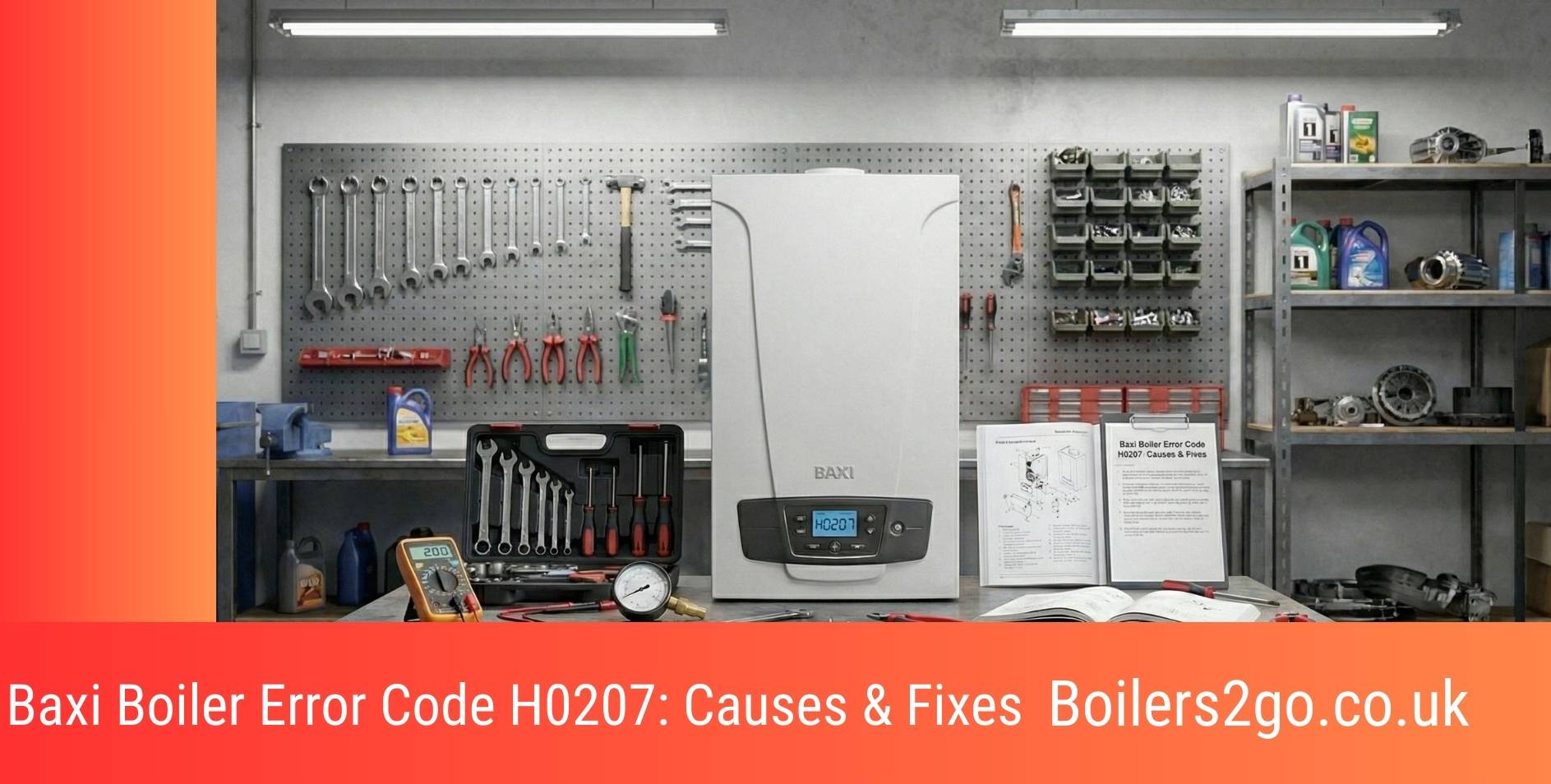
If your Baxi boiler is flashing H0207 (sometimes shown as H.02.07) and you have lost heating or hot water, you are dealing with one of the most common faults on the Baxi range. It is a low system pressure lockout, and in most cases it is something you can fix yourself in a few minutes.
This guide explains exactly what H0207 means, the most common reasons system pressure drops in the first place, and step-by-step fixes for each one. We will also cover when the fault points to something more serious that needs a Gas Safe engineer.
If you are weighing up whether to repair or replace, our Baxi vs Worcester Bosch comparison and Baxi boiler reviews are useful background reading.
Watch Our Video on the Baxi H0207 Error Code
What Does the Baxi Error Code H0207 Mean?
H0207 means your system water pressure has dropped below 1.0 bar, which is the minimum safe operating level on a Baxi boiler. The boiler locks out to prevent the pump and heat exchanger from running dry, which can cause serious internal damage if ignored.
Think of it as the boiler’s built-in safety net. Rather than risk component damage from poor circulation, it simply refuses to fire until pressure is restored. The fix in most cases is straightforward: top the system back up and reset.
The normal operating range for a Baxi boiler is 1.0 to 1.5 bar when the system is cold, rising slightly to around 2.0 bar when the heating is running and the water has expanded. If your gauge reads below 1.0 bar, that is what has triggered the H0207 lockout.
What Causes the Baxi Error Code H0207?
System pressure does not normally drop on its own. There is almost always a specific cause behind it, and identifying which one applies to your situation is the key to a lasting fix rather than a temporary top-up.
System Leaks
A slow leak anywhere in the pipework, radiators, or joints will gradually drain pressure over days or weeks. The usual suspects are corroded pipework in older systems, a loose joint that has worked free over time, or a failing radiator valve.
How to Fix a System Leak
- Inspect visible pipes, radiator valves, and joints for damp patches or drips. A torch helps with pipework hidden behind furniture or under floorboards.
- Gently tighten any loose valve connections with a spanner. Do not over-tighten, as this can crack older fittings.
- Repressurise via the filling loop to 1.2 bar (see the step-by-step below) and reset the boiler to check whether H0207 clears.
- If pressure drops again within a few days, the leak is still active. A Gas Safe engineer will need to trace and seal it, which typically costs £100 to £300 depending on access and whether any pipework needs replacing.
Faulty Pressure Relief Valve
The pressure relief valve (PRV) is designed to release water if system pressure climbs too high, protecting the boiler from damage. If the valve has worn or has debris jammed in the seat, it can start discharging water at normal operating pressure, slowly draining the system and triggering H0207.
How to Fix a Faulty Pressure Relief Valve
- Check the external discharge pipe (usually a small copper or plastic pipe exiting an outside wall) for dripping while the boiler is running.
- Repressurise and reset to see if the pressure holds steady over the following day.
- If the discharge pipe keeps dripping, the valve needs replacing. This is a Gas Safe job and typically costs £150 to £250 including parts and labour.
- Ask your engineer to flush the system at the same time if debris in the valve seat was the cause, to prevent it recurring.
Recent Radiator Bleeding
Bleeding radiators releases trapped air, but it also lets out a small amount of water each time. If you have recently bled your radiators and not topped the system back up afterwards, that is the most likely explanation for H0207.
How to Fix Pressure Loss After Bleeding
- Confirm the pressure gauge is showing low, ideally below 1.0 bar, after the bleeding session.
- Use the filling loop to slowly add water until the gauge reads 1.2 bar.
- Reset the boiler and run a short heating cycle to confirm normal operation.
- Make topping up part of your routine after any future radiator bleeding, and consider an inhibitor top-up to reduce how often air builds up in the system.
Evaporation in Open Vented Systems
Older UK properties sometimes still run open vented heating systems with a feed and expansion tank in the loft, rather than a sealed system. These lose small amounts of water naturally through evaporation, which can show up as a gradual pressure drop over weeks or months.
How to Fix Evaporation-Related Pressure Loss
- Check the loft tank level and top it up to the marked line if it has dropped.
- Reset the boiler and observe pressure over the next few days.
- If you are topping up frequently, consider fitting a float valve to automate the process and reduce the risk of the tank running dry unnoticed.
- Converting to a sealed system removes this issue entirely and tends to improve overall efficiency. Expect to pay £200 to £400 for the conversion, depending on your existing pipework.
Faulty Pressure Sensor
Occasionally the fault is not the system pressure at all but the sensor reading it. A faulty sensor can report low pressure even when the system is correctly filled, triggering H0207 unnecessarily.
How to Fix a Faulty Pressure Sensor
- Repressurise and reset the boiler. If the code clears and returns inconsistently despite stable pressure, sensor fault is more likely than a genuine leak.
- A Gas Safe engineer can test the sensor directly with a multimeter rather than relying on guesswork.
- If the sensor has failed, replacement typically costs £150 to £300 including labour.
- In hard-water areas, scale buildup around the sensor can also cause erratic readings. A system flush at the same time as the repair clears this.
How to Repressurise Your Baxi Boiler Step by Step
Whatever the underlying cause, the immediate fix for H0207 is the same: top the system back up to the correct pressure. Here is how, regardless of which filling loop type your Baxi has.
- Locate your filling loop. Look underneath the boiler. You will find either two black or blue lever handles, two silver taps with end caps, or a single green Easy-Fill handle, depending on your model and age.
- Turn off the boiler before you begin, and let it cool if it has been running recently.
- Open the filling loop slowly. For lever or tap-style loops, turn both a quarter turn to open. For the Easy-Fill type, pull the green handle and hold.
- Watch the pressure gauge as water enters the system. Stop as soon as it reaches 1.2 bar. Do not rush this step, as opening the valves too quickly can overshoot the pressure.
- Close the filling loop fully. Push the Easy-Fill handle back in, or turn the taps a quarter turn back to closed.
- Reset the boiler by pressing and holding the reset button, then check that heating and hot water resume normally.
If you need to repeat this process more than once or twice a year, that is a sign water is escaping somewhere in the system and the underlying cause needs investigating rather than just topping up repeatedly.
When to Call a Gas Safe Engineer
Most H0207 cases are resolved with a simple repressurise. Call a Gas Safe registered engineer if any of the following apply:
- Pressure drops again within a few days of topping up, suggesting an active leak.
- You cannot find or identify your filling loop type, or it appears damaged.
- The pressure relief valve discharge pipe is dripping continuously.
- You smell gas at any point. Stop immediately, leave the property, and call the National Gas Emergency Service on 0800 111 999.
- The boiler has lost pressure and is also displaying a second, unrelated fault code.
You can verify any engineer’s Gas Safe credentials before they visit using the official Gas Safe Register. For further guidance on pressure and system maintenance, the Energy Saving Trust has useful background on keeping a heating system efficient.
When Should You Consider a New Boiler?
If H0207 keeps returning despite a confirmed leak repair, or your Baxi is approaching 12 to 15 years old with a growing list of repairs, it is worth weighing up the cost of continued fixes against a new installation.
A modern A-rated combi boiler typically costs £2,250 to £3,000 fully installed in 2025, and brings improved efficiency alongside more reliable pressure management. If your current boiler is needing repeat call-outs for the same fault, that cost comparison is worth having.
Frequently Asked Questions
How does hard water affect how often H0207 appears?
Minerals in hard water (common across the South East, Midlands, and parts of Yorkshire) can cause scale to build up around valve seats and sensors, leading to more frequent pressure faults. Fitting a water softener or scale reducer can extend the time between top-ups, and a magnetic filter helps protect the wider system.
Are there seasonal patterns to H0207 faults?
Yes. Water expands slightly when heated, which can mask a small leak during winter when the heating runs constantly. The same leak often becomes more obvious in spring when the system is used less and pressure has more chance to settle and drop. Checking pressure year-round, not just in winter, catches leaks earlier.
Does my Baxi warranty cover H0207 repairs?
Most Baxi warranties cover component failures such as a faulty pressure relief valve or sensor, provided the boiler has been serviced annually by a Gas Safe engineer and you have kept service records. Pressure loss caused by an external leak in your own pipework is generally not covered, as this falls outside the boiler itself. Check your specific warranty terms or contact Baxi directly to confirm.
Can sealants stop H0207 from recurring?
Leak sealant products can sometimes seal very small, hard-to-find leaks (known as micro-leaks) within the system, which may stabilise pressure. They are not a substitute for finding and fixing a visible or significant leak, and should be used as a last resort or alongside, not instead of, a proper diagnosis from a Gas Safe engineer.
What is the difference between H0207 and other Baxi pressure codes like A.02.06 or E118?
A.02.06 is a temporary low pressure warning, where the boiler may pause and resume automatically once topped up. H0207 is the permanent, blocking version of the same fault: the boiler will not restart until pressure is manually restored and the boiler is reset. E118 is the equivalent low-pressure fault code used on some older Baxi models. All three point to the same underlying issue: insufficient system water pressure.

I’m Penny North, a home energy heating expert. My mission is to demystify new boilers and complex heating systems to help you achieve a warm, cosy home with lower energy bills and a smaller environmental footprint.