

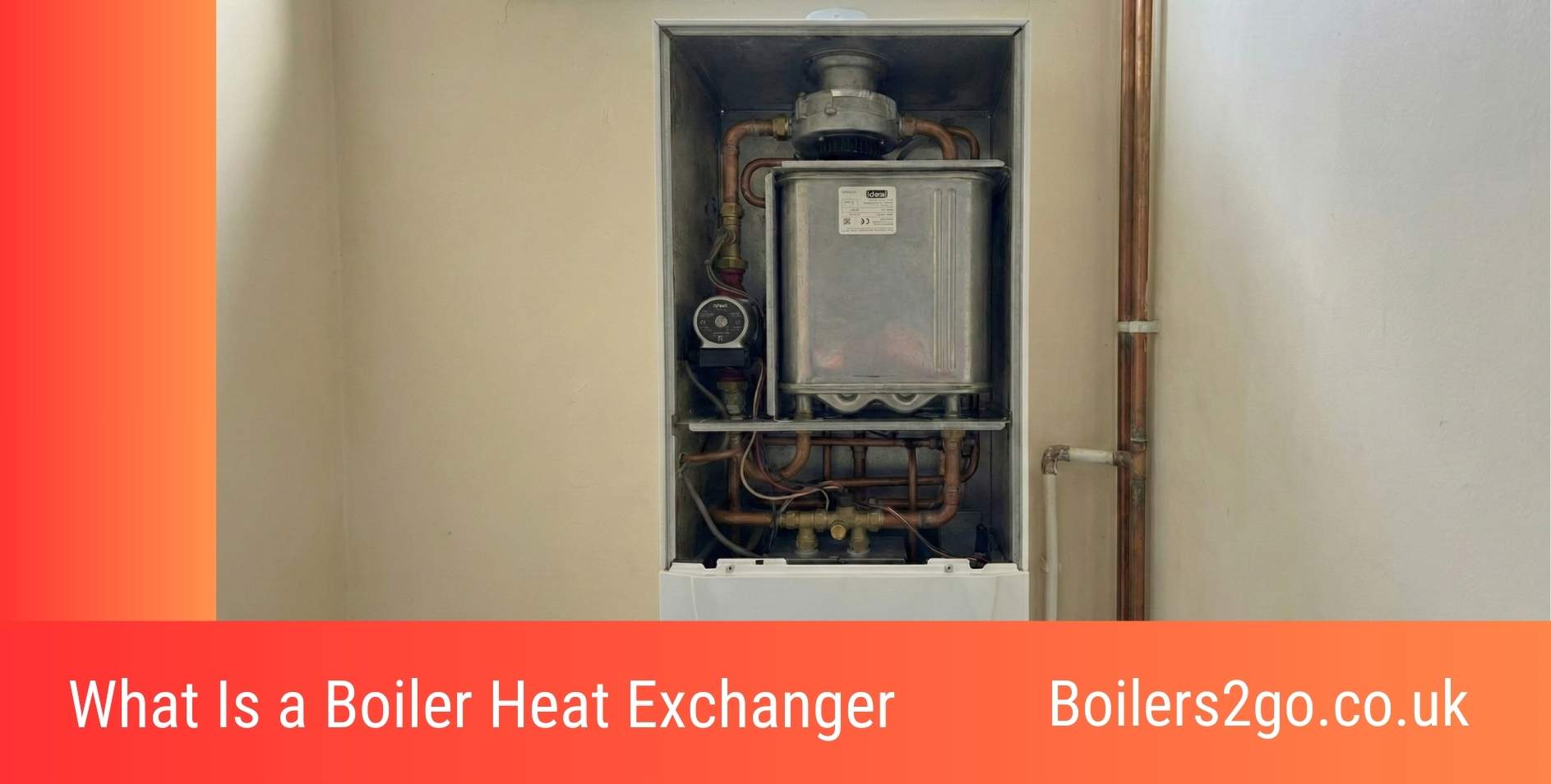
The heat exchanger is one of the most important parts of a boiler. It is the component that actually turns burning gas into usable heat for radiators and hot water, without the water and combustion gases ever mixing.
If a boiler were a car, the heat exchanger would be the engine block. When it is working well, heating feels effortless. When it starts to fail, problems quickly show up elsewhere in the system.
What Does a Boiler Heat Exchanger Do?
A boiler heat exchanger transfers the heat from burning gas into water, safely and efficiently. Inside the boiler, gas is burned to create heat, and the heat exchanger is the part that passes that heat into the water.
It is made from shaped metal pipes or plates. Hot combustion gases pass over one side, while cold water flows through internal channels. Heat moves through the metal, warming the water, but the two never touch. This separation is vital for safety and efficiency.
Once heated, that water is sent around the radiators or to the taps, depending on what the boiler is being asked to do at that moment.
How Does a Boiler Heat Exchanger Work?
When the heating is turned on or a hot tap is opened, the boiler fires up. The burner ignites gas, heating the metal surfaces of the heat exchanger. Cold water flows through it, absorbs that heat, and leaves as hot water ready for use.
Most modern heat exchangers are made from stainless steel or aluminium, materials chosen because they handle high temperatures well and transfer heat efficiently. Older boilers sometimes used cast iron, but that is far less common now due to weight and corrosion issues.
Primary vs Secondary Heat Exchangers: What’s the Difference?
Not all boilers use just one heat exchanger.
Primary Heat Exchanger
The primary heat exchanger heats the water that circulates around the central heating system. That water flows through the radiators, returns to the boiler, and is reheated again and again. In system and regular boilers, this circuit also heats a coil inside a stored hot water cylinder, such as a Megaflo unvented cylinder, rather than heating tap water directly.
Secondary Heat Exchanger
In combi boilers, there is also a secondary, or plate, heat exchanger. This is what provides instant hot water to the taps. It works by transferring heat from the primary system to fresh mains water, again without the two ever mixing. System and regular boilers do not need one because hot water is stored in a cylinder instead, and our guide to the main types of boilers explains the difference.
This setup allows combi boilers to deliver hot water on demand without storing it in a tank.
How Condensing Boilers Recover Extra Heat
Condensing boilers take things a step further.
After the primary heat exchanger has done its job, waste gases would normally exit through the flue. A condensing boiler captures extra heat from those gases using a secondary heat exchanger.
By cooling the exhaust gases below their dew point, water vapour condenses and releases additional hidden heat. That recovered heat is then used to pre-warm water returning to the boiler.
This process can improve efficiency by 10 to 12%, which is why modern condensing boilers achieve efficiency levels of up to 90 to 95% compared with older models.
Heat Exchanger Materials: Stainless Steel vs Aluminium
Most modern boilers use either stainless steel or aluminium heat exchangers. Both work well, but they behave differently over time.
Stainless Steel Heat Exchangers
Stainless steel is highly resistant to corrosion across a wide range of water conditions. It is durable, stable, and tends to last a long time with minimal issues.
The trade-off is cost and slightly slower heat transfer, but in real-world use this is rarely noticeable to homeowners.
Aluminium Heat Exchangers
Aluminium transfers heat extremely well and allows boilers to be compact, efficient, and lighter. It is also cheaper to manufacture and recyclable.
However, aluminium is more sensitive to system water quality. Without proper treatment, sludge and incorrect pH levels can cause corrosion or efficiency loss over time.
How Long Do Boiler Heat Exchangers Last?
With good maintenance, stainless steel heat exchangers often last 15 to 20 years or more, while aluminium heat exchangers typically last 10 to 15 years, sometimes less if system water is not well maintained.
The biggest factor is not the material. It is how clean the heating system is kept.
How Do Sludge and Magnetite Damage a Heat Exchanger?
Over time, corrosion inside radiators and pipework creates a black sludge called magnetite. This sludge circulates through the system and can cause serious problems inside the heat exchanger.
Aluminium exchangers are particularly vulnerable because they have narrower channels. Sludge restricts flow, creates hot spots, and forces the metal to overheat. Over time, this can lead to cracking, erosion, and reduced efficiency.
This is why filters, inhibitors, and regular servicing matter far more than most people realise.
Warning Signs of a Failing Heat Exchanger
Heat exchanger problems rarely appear out of nowhere. Common early signs include the following.
- Strange boiler noises like kettling, whistling, or rumbling
- Yellow or orange flames instead of a steady blue flame
- Uneven heating or hot water cutting in and out
- Rising gas bills without better heat output
- Water leaking inside the boiler casing
- Sooty marks, unusual smells, or carbon monoxide alarms activating
These symptoms can point to cracking, scaling, corrosion, or restricted flow, all issues that need attention from an engineer listed on the Gas Safe Register.
How Does Servicing Protect a Boiler Heat Exchanger?
During an annual boiler service, the engineer checks combustion, water quality, and heat transfer, all of which affect the heat exchanger.
Catching early signs of sludge build-up or corrosion can prevent costly repairs later. In many cases, simple maintenance steps extend the life of the heat exchanger by years.
Related Boiler Heat Exchanger Guides
- Faulty heat exchanger in a boiler
- What is a magnetic filter?
- Central heating sludge and how to remove it
- How much does a powerflush cost?
Why Does the Heat Exchanger Matter?
The heat exchanger is where a boiler’s efficiency, reliability, and safety all come together. Whether it is stainless steel or aluminium, primary or secondary, its condition directly affects how well heating and hot water perform.
Looked after properly, with the system kept clean, it will quietly do its job for years. Ignored, it is often the component that turns a small issue into a major breakdown.
Boiler Heat Exchangers: FAQs
Does Water Hardness Affect Heat Exchanger Lifespan?
Yes. Hard water areas are more prone to limescale build-up inside the heat exchanger. Over time, scale acts as insulation, forcing the boiler to work harder and increasing the risk of overheating and damage.
Can Low Boiler Pressure Damage a Heat Exchanger?
Indirectly, yes. Low pressure can cause poor water circulation, leading to hot spots inside the heat exchanger. Repeated overheating and cooling stresses the metal and can shorten its lifespan.
Do System Filters Protect the Heat Exchanger?
They do. Magnetic system filters capture magnetite sludge before it reaches the heat exchanger, helping prevent blockages, overheating, and internal wear, which is especially important for aluminium exchangers.
Why Does a Heat Exchanger Fault Make a Boiler Shut Down?
Modern boilers have safety sensors that monitor temperature and flow. If the heat exchanger overheats or water flow is restricted, the boiler will shut down automatically to prevent damage or unsafe operation.
Are Heat Exchangers Covered by a Boiler Warranty?
Often yes, but coverage varies by manufacturer and model. Many warranties include the heat exchanger as a core component, provided the boiler is serviced annually and system water quality standards are met.
Can Power Flushing Fix Heat Exchanger Problems?
Not if the damage is structural. Power flushing can improve circulation and remove sludge, but it will not repair a cracked or badly corroded heat exchanger. It is preventative or supportive maintenance rather than a cure for structural damage.
Why Does a Faulty Heat Exchanger Smell Metallic or Hot?
Overheating metal, burning dust, or minor leaks inside the boiler casing can create metallic or hot smells. While not always dangerous, these smells should always be checked by an engineer.
Do Smart Heating Controls Reduce Heat Exchanger Wear?
Yes. Smarter controls reduce unnecessary boiler cycling, which lowers thermal stress on the heat exchanger and can help extend its working life over time.
Can a Heat Exchanger Be Replaced Without Replacing the Boiler?
In many cases, a heat exchanger can be replaced as a standalone repair, provided the rest of the boiler is in good condition and the part is still available for that model. On an older or discontinued boiler, however, the cost of a replacement heat exchanger can approach a significant share of a full replacement, which is worth weighing up with a Gas Safe engineer before committing to the repair.
How Much Does It Cost to Replace a Boiler Heat Exchanger?
Replacing a boiler heat exchanger typically costs from around £300 for a straightforward secondary exchanger to £700 or more for a primary exchanger on a larger or premium model, including parts and labour, with costs varying by boiler type and heat exchanger material.

I’m Penny North, a home energy heating expert. My mission is to demystify new boilers and complex heating systems to help you achieve a warm, cosy home with lower energy bills and a smaller environmental footprint.