

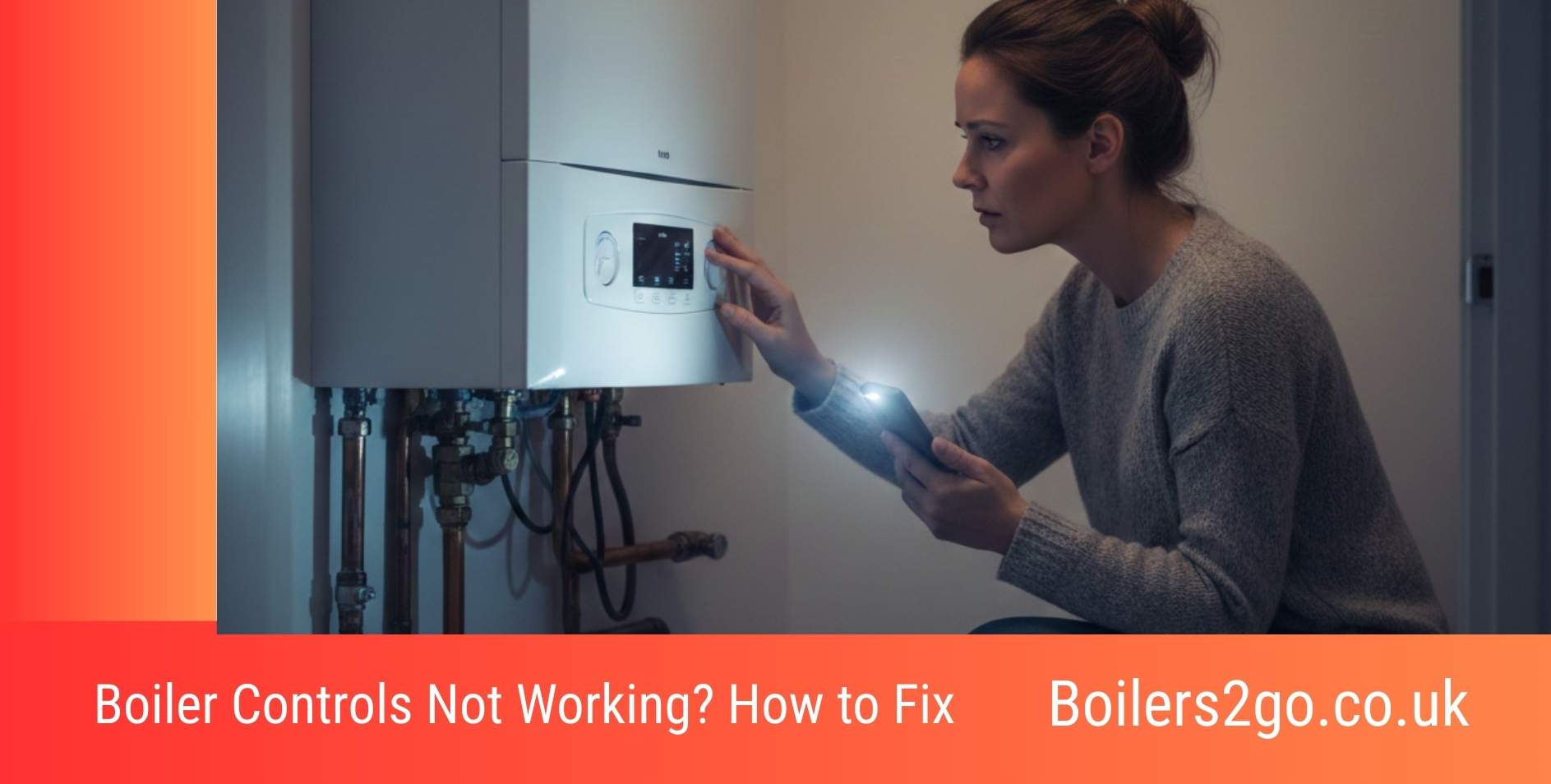
When your boiler stops responding to the thermostat, it can feel like the whole heating system has failed — especially in winter when radiators stay cold or hot water disappears.
The good news is that in many cases, the problem isn’t the boiler itself. At Boilers2go, we find that most thermostat and heating-control issues come down to simple faults like batteries, settings, wiring, or signal problems. If your controls are due an upgrade, our Nest vs Hive smart thermostats comparison is a good place to start.
This guide explains how to diagnose thermostat problems quickly, what you can safely check yourself, and when it’s time to call a Gas Safe engineer.
First Check: Is It Really the Thermostat?
Before assuming something serious has gone wrong, check for these common signs.
Your thermostat or controls may be the issue if:
-
the boiler doesn’t fire when heating is turned on
-
radiators stay cold even when the thermostat is turned up
-
the boiler turns on and off repeatedly
-
the thermostat display is blank
-
a smart-heating app shows the system offline
These symptoms often point to a control or communication problem rather than a boiler fault.
Quick Boiler Control Checks You Can Do in Minutes
Start with the simplest things first.
Check that:
-
the boiler power switch is on
-
the fused spur hasn’t tripped
-
the thermostat display is working
-
batteries (if fitted) aren’t flat
-
the heating schedule hasn’t been turned off
Sometimes a power cut or reset can leave the heating system needing a manual restart.
Common Thermostat and Boiler Control Problems (and Fixes)
Most heating-control faults fall into a few predictable categories.
No Power to the Thermostat or Boiler Controls
If the thermostat display is blank or the boiler isn’t responding, power supply issues are often the cause.
Check the fused spur, the consumer-unit breaker, and any appliance switches near the boiler. Resetting power can restore communication between the thermostat and boiler.
With smart thermostats, restarting the router or receiver can sometimes fix connection issues.
Heating Schedule or Thermostat Settings Problems
It’s surprisingly common for heating to stop simply because of incorrect settings. If your heating comes on at the wrong times or ignores its schedule altogether, our guide to a boiler timer not working covers programmer and clock faults in more detail.
Holiday mode, schedule changes, or app-based geofencing can prevent heating from turning on when expected.
Try turning the thermostat up a few degrees above the current room temperature. If the boiler starts, the issue is likely programming rather than hardware.
Flat Batteries in Wireless Thermostats
Wireless thermostats and radiator valves rely on batteries, and low power can cause communication problems.
Replacing batteries often restores normal operation immediately.
If the display looks faint or the thermostat responds slowly, batteries are usually the first thing to check.
Dirty Sensor or Ageing Thermostat
Dust buildup inside a thermostat can affect temperature readings over time. Older thermostats may also become less accurate. If yours is due for replacement, our guide to the best smart thermostats for boilers compares the main upgrade options.
Carefully cleaning around the thermostat and checking that it isn’t blocked by furniture can help restore accurate readings.
If a thermostat is more than ten years old, replacing it can improve heating control significantly.
Thermostat Placed in the Wrong Location
Thermostat placement can affect how the heating system behaves.
If the thermostat is:
-
near a radiator
-
on an external wall
-
in direct sunlight
-
close to a door or draught
it may misread the temperature and control the boiler incorrectly.
For most homes, the thermostat works best on an internal wall in a living area, around 1.5 metres above the floor.
Thermostat Wiring or Signal Problems
If the thermostat has power but the boiler still doesn’t respond, communication between the two may be the issue.
This could involve:
-
loose wiring connections
-
wireless signal problems
-
receiver faults
-
smart-thermostat connection issues
Wireless thermostats sometimes need to be paired again with their receiver.
Smart-heating systems may need router or app resets if they lose connection.
Smart Thermostat Troubleshooting
Smart heating systems add convenience, but they also introduce new things to check.
If you’re using systems like tado°, Nest, or Hive, check:
-
Wi-Fi connection
-
receiver power supply
-
app updates
-
firmware updates
-
thermostat pairing
Most smart-heating problems are still caused by power or connection issues rather than hardware failure.
When Should You Call a Gas Safe Engineer About Boiler Controls?
If the thermostat appears to be working but the boiler still won’t respond, the issue may be inside the heating system.
Possible causes include:
-
faulty PCB
-
circulation-pump problems
-
diverter-valve faults
-
boiler safety lockouts
These require professional diagnosis.
A typical diagnostic visit usually costs around £80–£120, depending on location.
Regular boiler servicing helps prevent many of these issues before they cause breakdowns.
Boilers2go Advice on Fixing Thermostat Problems
In most homes, thermostat problems are solved by checking:
-
power supply
-
batteries
-
settings
-
thermostat location
-
wireless connection
Only after those checks should you assume the boiler itself has a fault.
Heating controls are often the simplest part of the system to fix.
Boiler Controls Not Working: The Bottom Line
If your boiler isn’t responding to the thermostat, don’t panic — most control problems are quick to diagnose and inexpensive to fix.
Start with the simple checks first. If the heating still isn’t working properly, a Gas Safe engineer can quickly identify whether the issue is the thermostat, wiring, or boiler components.
Once everything is working properly again, your boiler, radiators, and central-heating system should run smoothly and efficiently.

I’m Penny North, a home energy heating expert. My mission is to demystify new boilers and complex heating systems to help you achieve a warm, cosy home with lower energy bills and a smaller environmental footprint.