

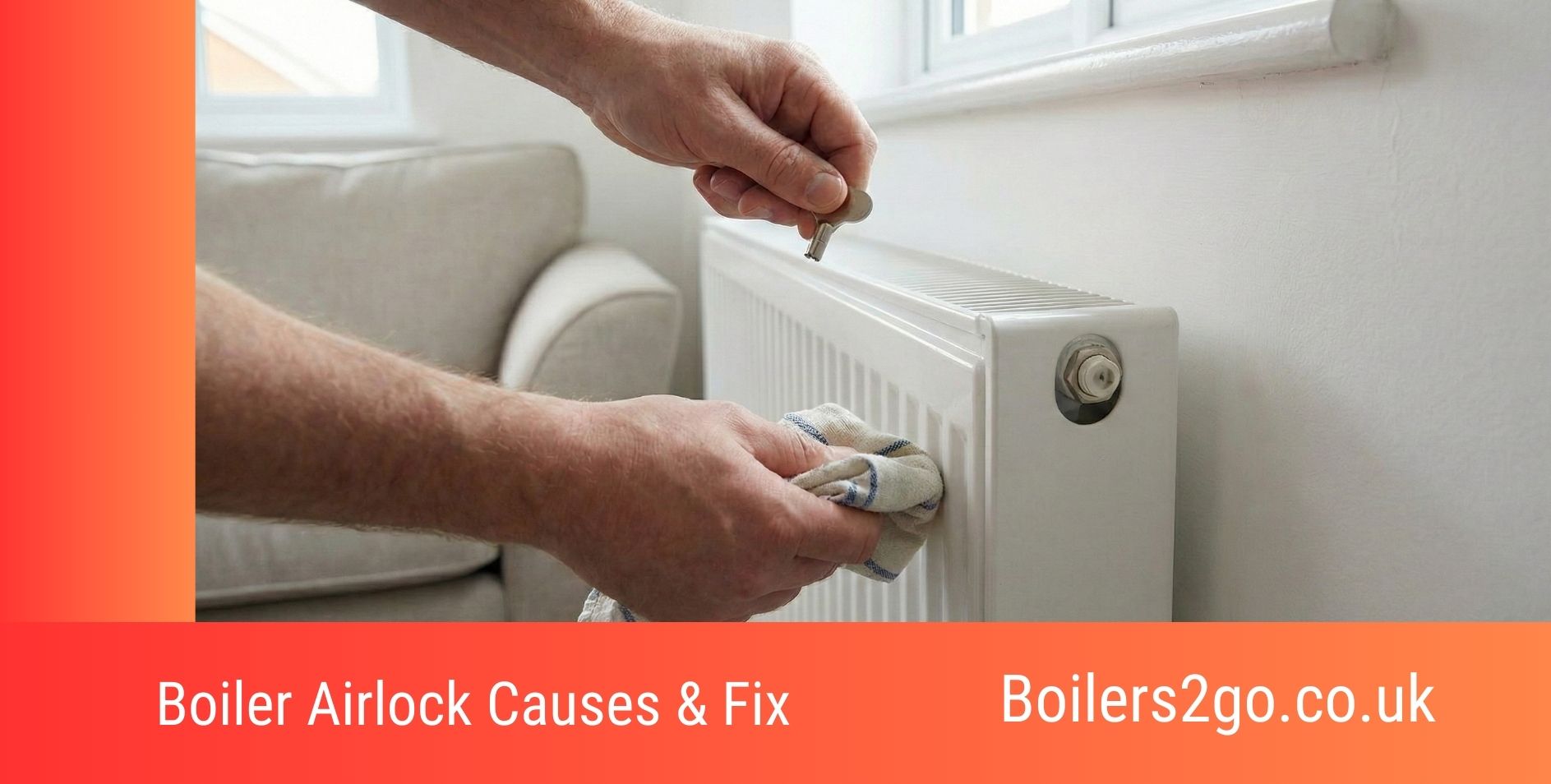
A boiler airlock is one of the most common reasons your central heating system suddenly stops working properly, leaving radiators cold at the top or your boiler making strange gurgling noises.
If you’ve ever searched for “boiler airlock”, you’re probably a UK homeowner or landlord desperate to get the heating back on without waiting days for an engineer.
In this guide, I’ll explain exactly what a boiler airlock is, why it happens, and — most importantly — how to fix it yourself safely and quickly.
What is a Boiler Airlock?
A boiler airlock is a pocket of trapped air inside the central heating system that blocks the normal flow of hot water. When air gets stuck in the pipes, pump, or heat exchanger, water can’t circulate properly.
This usually results in cold radiators (especially upstairs), noisy banging or gurgling from the boiler, reduced hot water pressure, or the boiler locking out completely.
In modern condensing combi boilers (like Worcester Bosch, Vaillant, Ideal or Baxi), an airlock can trigger fault codes such as E133, F22, F75, or simply “no heat” because the pressure sensor or pump can’t work correctly.
Watch our Boiler Airlock Video Below:
What Causes a Boiler Airlock?
Air can enter the heating system in several ways. Below are the most common causes UK homeowners and landlords face.
1. Low System Pressure and Recent Top-Ups
Low boiler pressure is the number one cause of air being sucked into the system. When pressure drops below 1 bar (often after a leak or bleeding radiators), and you refill the loop via the filling link or external filling loop, air can be drawn in instead of just water.
2. Bleeding Radiators Incorrectly
Bleeding radiators too aggressively or without closing the valve properly afterwards lets air rush back in as soon as the pump starts.
3. New Radiator or System Work
If you’ve recently added or replaced a radiator, flushed the system, or had any plumbing work done, air almost always gets trapped during refilling.
4. Faulty or Sticking Automatic Air Vent (AAV)
Most boilers have an automatic air vent on top of the pump or heat exchanger. If it sticks closed, air can’t escape naturally and builds up over time.
5. Pump Failure or Air in the Pump
A failing boiler pump (or one running at the wrong speed) can’t push water hard enough to move trapped air pockets.
6. Sludge and Corrosion Creating Air Pockets
Over years, magnetite sludge builds up in older systems (especially open-vented ones). This debris can trap tiny air bubbles that eventually join into a full airlock.
How to Fix a Boiler Airlock – Step-by-Step for Each Cause
Fixing an Airlock Caused by Low Pressure / Recent Top-Up
Low pressure airlocks usually clear once the system is repressurised correctly:
- Turn the heating off and let the system cool for 1–2 hours.
- Locate your filling loop (flexible silver hose or built-in key under the boiler).
- Open both valves slowly until pressure reaches 1.2–1.5 bar on the gauge.
- Close valves tightly and remove the key if external.
- Turn the boiler back on — the pump should now push the air towards the vents.
Fixing an Airlock After Bleeding Radiators
Bleeding-related airlocks need systematic bleeding from the lowest radiator upwards:
- Start with the ground-floor radiator furthest from the boiler.
- Bleed each radiator in sequence moving upstairs.
- Keep checking boiler pressure — top up if it drops below 1 bar.
- Once all radiators are hot at top and bottom, reset the boiler.
Clearing Air After New Radiator Installation or System Drain
Air after a full drain is stubborn:
- Use the “mains water flush” method: attach a hosepipe to the upstairs bleed valve and downstairs drain cock, flush cold mains water through for 10–15 minutes.
- Refill slowly while keeping upstairs bleed valves open until water (not air) comes out.
- Repeat bleeding sequence twice.
Replacing a Faulty Automatic Air Vent
A sticking AAV is a 10-minute DIY job on most boilers:
- Isolate the boiler electrically and turn off water.
- Place a towel underneath and unscrew the AAV cap (usually plastic).
- Clean or replace the vent (£8–£15 part from Screwfix or PlumbCenter).
- Refit and repressurise.
Clearing Air Trapped in the Boiler Pump
Pump airlocks make a loud whining noise:
- Turn the boiler off.
- Locate the large brass pump in the middle of the boiler.
- Unscrew the silver screw in the centre of the pump (have a cloth ready — water will come out).
- Use a flat-head screwdriver to gently spin the pump shaft a few times.
- Retighten the screw, repressurise, and restart.
Dealing with Sludge-Related Airlocks
If your system is 10+ years old and has never been power-flushed, sludge is likely trapping air. A DIY magnetic filter (e.g., MagnaClean) and chemical cleaner (Fernox F3 or Sentinel X400) left in for a week can help, but a professional powerflush (£400–£600) is usually required.
How to Prevent Boiler Airlocks in the Future
- Keep boiler pressure between 1.2–1.8 bar at all times.
- Fit a quality magnetic system filter (Adey MagnaClean, Fernox TF1) when you next service the boiler.
- Have the system power-flushed every 8–10 years.
- Use inhibitor fluid (Fernox F1 or Sentinel X100) and top up every year.
- Set the pump speed to medium or high (setting 2 or 3) — low speeds encourage air trapping.
- Install an auto air vent on any high points in the pipework (common in loft conversions).
When You Absolutely MUST Call a Gas Safe Engineer
While most airlocks are DIY-fixable, book a Gas Safe registered engineer immediately if:
- You smell gas at any point.
- The pressure keeps dropping rapidly (possible hidden leak).
- The boiler shows fault codes E118, F75, or repeatedly locks out after you’ve tried the fixes.
- You have a sealed system and no external filling loop (some newer Worcester & Vaillant models).
- You’re a landlord — you have a legal duty under the Gas Safety (Installation and Use) Regulations 1998 to use a qualified engineer for anything beyond basic bleeding.
FAQs
Will an airlock damage my boiler if left for a few days?
Yes — running with an airlock can overheat the heat exchanger, trigger the overheat stat, and in extreme cases cause permanent pump or exchanger damage.
My upstairs radiators are cold but downstairs are hot — is that definitely an airlock?
In 9 out of 10 cases, yes — classic symptom of air trapped at the highest point. Start bleeding upstairs first.
Can a boiler airlock affect hot water as well as heating?
On combi boilers, yes — severe airlocks stop the pump detecting flow and you lose hot water too. System and heat-only boilers usually keep hot water.
How long does it take for an airlock to clear itself?
Rarely. Some small pockets clear in a few hours of running, but most need manual intervention.
Is it safe to keep resetting the boiler when it locks out with an airlock?
Only do it 2–3 times while you’re trying the fixes above. Repeated resets without solving the root cause can stress components.
Stay warm, The Boilers2Go Team

I’m Penny North, a home energy heating expert. My mission is to demystify new boilers and complex heating systems to help you achieve a warm, cosy home with lower energy bills and a smaller environmental footprint.