

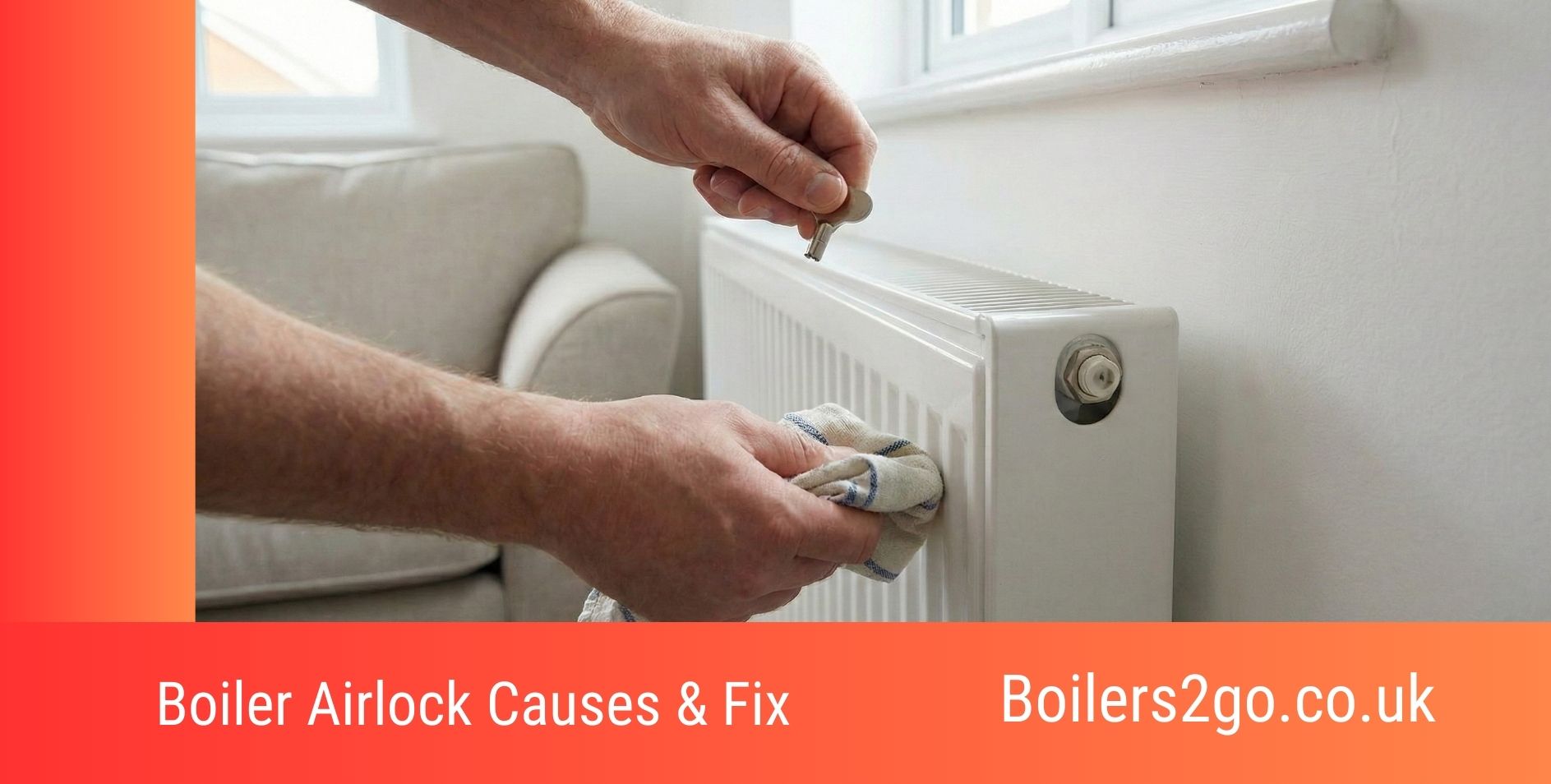
A boiler airlock is one of the most common reasons a central heating system suddenly stops working properly, leaving radiators cold at the top or a boiler making strange gurgling and banging noises. The good news is that most airlocks can be cleared yourself in under an hour without needing an engineer.
This guide covers what a boiler airlock is, the six most common ways air gets into a system, and step-by-step fixes for each cause. It also explains the symptoms clearly, since cold radiators and gurgling noises can sometimes point to other faults rather than an airlock.
If your boiler controls are not responding or your thermostat appears to be reading incorrectly, see our guide to boiler controls not working alongside this one, as both problems can cause similar symptoms.
If airlocks or other faults keep coming back, a boiler repair, service and cover plan bundles repairs and your annual service together.
Watch Our Boiler Airlock Video
What Is a Boiler Airlock?
A boiler airlock is a pocket of trapped air inside the central heating system that blocks the normal flow of hot water. When air gets stuck in the pipes, pump, or heat exchanger, water cannot circulate properly and your heating or hot water stops working as it should.
In modern condensing combi boilers (Worcester Bosch, Vaillant, Ideal, Baxi), an airlock can trigger fault codes such as E133, F22, or F75, because the pressure sensor or pump cannot detect proper flow. Older system and heat-only boilers are also susceptible, particularly after maintenance or a seasonal restart.
It is worth noting that some symptoms of an airlock (cold radiators, gurgling noises, low pressure) can also be caused by sludge build-up, a failing pump, or a stuck valve. If the fixes below do not resolve the issue, one of those other causes may be at play.
What Are the Symptoms of a Boiler Airlock?
Airlocks tend to produce a fairly recognisable set of symptoms. The most common ones are:
- Radiators cold at the top but warm at the bottom, which is a classic sign of trapped air rising to the highest point in the panel.
- Upstairs radiators cold while downstairs radiators heat normally, as air naturally accumulates at the highest points in the pipework.
- Gurgling, hissing, or banging noises from the boiler or pipes when the heating is running.
- Hot water taps sputtering or producing inconsistent flow rather than a steady stream.
- The boiler pressure gauge reading low, even after topping up via the filling loop.
- The boiler locking out with a low-flow or low-pressure fault code shortly after starting.
If your upstairs radiators are completely cold while downstairs ones heat well, that is an almost certain indicator of an airlock. Start bleeding upstairs first in that scenario.
What Causes a Boiler Airlock?
Air can enter the heating system in a number of ways. Understanding which applies to your situation helps you choose the right fix rather than working through every option unnecessarily. Because airlocks share symptoms such as cold radiators and gurgling with other faults, our round-up of common boiler problems is worth checking if none of the causes below fits.
1. Low System Pressure and Recent Top-Ups
Low boiler pressure is the most common cause of air being drawn into the system. When pressure drops below 1.0 bar (often after a slow leak or bleeding radiators) and you refill via the filling loop, air can be drawn in alongside the water if the top-up is done too quickly or the loop is not sealed properly afterwards.
2. Bleeding Radiators Incorrectly
Bleeding radiators too aggressively, or failing to close the bleed valve fully afterwards, lets air rush back in as soon as the pump starts circulating water. The fix is straightforward, but the bleeding sequence matters: always start from the lowest radiator and work upwards.
3. Recent Radiator or System Work
If you have recently added or replaced a radiator, had a powerflush, or had any plumbing work carried out on the heating circuit, air almost always gets trapped during refilling. Even careful engineers often leave some air in the system that needs bleeding out over the following days.
4. Faulty or Stuck Automatic Air Vent
Most boilers have an automatic air vent (AAV) on top of the pump or heat exchanger. Its job is to release air from the system automatically. If it sticks closed, air cannot escape and builds up over time into a full airlock. This is a common fault on boilers over five to eight years old that have not been serviced regularly.
5. Pump Failure or Incorrect Pump Speed
A failing pump, or one running at too low a speed, cannot push water hard enough to clear air pockets. Air then collects at high points in the pipework rather than being carried around the circuit. On most boilers, a pump set to speed 1 is too slow for a typical UK property; setting 2 or 3 is usually more appropriate.
6. Sludge and Corrosion Creating Air Pockets
In systems over ten years old that have never been chemically treated or power-flushed, magnetite sludge builds up along the bottom of radiators and pipework. This debris traps small air bubbles that gradually join together into a larger airlock. Hard-water areas across the South East and Midlands are particularly prone to this because limescale accelerates internal corrosion.
How to Fix a Boiler Airlock: Step-by-Step Fixes by Cause
Fixing an Airlock Caused by Low Pressure or a Recent Top-Up
Low-pressure airlocks usually clear once the system is repressurised correctly and the pump has had a chance to push air towards the vents.
- Turn the heating off and let the system cool for one to two hours.
- Locate the filling loop (a flexible silver hose, a rigid link with two taps, or a built-in keyed connection under the boiler).
- Open both valves slowly and watch the gauge. Stop at 1.2 bar, then close both valves tightly.
- Turn the boiler back on. The pump should now push the remaining air towards the auto air vents.
- If air keeps coming back, bleed each radiator in sequence as described below.
Fixing an Airlock After Bleeding Radiators
Bleeding in the wrong order is one of the most common reasons air re-enters the system. Always work from the lowest point upwards.
- Start with the ground-floor radiator furthest from the boiler.
- Use a radiator bleed key to open the valve at the top of each radiator. Hold a cloth underneath. Listen for hissing air and wait until a steady stream of water appears, then close the valve.
- Work through each radiator in sequence, moving upstairs last.
- Check boiler pressure after each radiator and top up if it drops below 1.0 bar.
- Once all radiators are fully hot, reset the boiler if needed.
Clearing Air After a New Radiator or Full System Drain
Air after a full system drain is more stubborn and needs a systematic approach to shift properly.
- If air keeps returning after a full drain, a heating engineer can force it out with a mains-pressure flush using the correct fittings.
- Refill slowly while keeping upstairs bleed valves open until water (not air) flows steadily from each one.
- Run the full bleeding sequence twice, checking pressure between each pass.
Replacing a Faulty Automatic Air Vent
A sticking AAV is a straightforward fix and one of the few boiler repairs a confident DIYer can tackle without Gas Safe registration, provided it is on the water side rather than the gas side of the boiler.
- Isolate the boiler electrically and turn off the water supply.
- Place a towel underneath and unscrew the AAV cap (usually plastic).
- Clean or replace the vent. A replacement AAV costs £8 to £15 from Screwfix or a plumber’s merchant.
- Refit, repressurise, and test.
Clearing Air Trapped in the Boiler Pump
A pump airlock produces a loud whining or humming sound but little or no circulation. You can often clear it without needing an engineer.
- Turn the boiler off.
- Locate the large brass pump (usually in the centre of the boiler). Place a cloth underneath.
- Unscrew the slotted screw in the centre of the pump body. A small amount of water will come out.
- Use a flat-head screwdriver to gently rotate the pump shaft a few turns. This breaks the airlock loose.
- Retighten the screw, repressurise to 1.2 bar, and restart.
Dealing with a Sludge-Related Airlock
If the system is ten or more years old and has never been treated, sludge is likely trapping air throughout the circuit. A DIY magnetic filter (MagnaClean, Fernox TF1) and a chemical cleaner such as Fernox F3 or Sentinel X400 circulated for a week can help with mild cases, but a professional powerflush is usually the most effective fix.
A powerflush typically costs £300 to £800 depending on property size and how many radiators need flushing. In severely blocked systems, the engineer may recommend a combination of powerflush and new magnetic filter installation to prevent sludge re-accumulating.
How to Prevent Boiler Airlocks
Most airlocks are avoidable with a few straightforward maintenance habits. They tend to develop when systems are left unserviced, run without inhibitor, or topped up incorrectly.
- Keep boiler pressure between 1.0 and 1.5 bar at all times. Pressure dropping below 1.0 bar is the most common entry point for air.
- Fit a quality magnetic system filter (Adey MagnaClean, Fernox TF1) and have it cleaned at every annual service. This catches sludge before it creates rough surfaces that trap air.
- Use an inhibitor (Fernox F1 or Sentinel X100) and top it up annually or after any system work. Without it, internal corrosion produces gases that contribute to airlocks.
- Have the system power-flushed every eight to ten years, or sooner if the water runs black when you bleed a radiator.
- Set the pump speed to setting 2 or 3. Speed 1 is too slow for most UK properties and allows air to stagnate at high points.
- Fit an auto air vent at any high points in the pipework, which is particularly relevant for loft conversions or extended ground-floor runs where the pipework rises and falls significantly.
The Energy Saving Trust has straightforward guidance on boiler efficiency and the long-term value of annual servicing for UK homeowners.
When to Call a Gas Safe Engineer About a Boiler Airlock
Most airlocks are DIY-fixable with the steps above. Call a Gas Safe registered engineer straight away if any of the following apply:
- You can smell gas at any point. Do not attempt any fixes. Leave the property and call the National Gas Emergency Service on 0800 111 999.
- Pressure keeps dropping rapidly after topping up, which points to a hidden leak somewhere in the system.
- The boiler keeps locking out with codes E118, F75, or F22 after you have bled the radiators and repressurised correctly.
- You have a sealed system with no visible or accessible filling loop. Some newer Worcester Bosch and Vaillant models use an internal keyed filling link that is not immediately obvious.
- You are a landlord. Under the Gas Safety (Installation and Use) Regulations 1998, anything beyond basic radiator bleeding should be carried out by a qualified engineer in a rented property.
You can check any engineer’s Gas Safe credentials before they visit using the Gas Safe Register engineer finder.
Boiler Airlock: FAQs
Will an Airlock Damage My Boiler if Left for a Few Days?
Yes, and more quickly than most people expect. Running the boiler with an active airlock causes the heat exchanger to overheat, which trips the overheat stat. In severe cases, repeated overheat cycling can cause permanent damage to both the heat exchanger and the pump. Deal with it as soon as you identify the problem. If your boiler is repeatedly shutting down like this, our guide to why a boiler keeps turning itself off covers the other causes worth ruling out.
If Upstairs Radiators Are Cold but Downstairs Are Hot, Is It an Airlock?
In the vast majority of cases, yes. Air rises to the highest points in the system, so upstairs radiators are the first to show cold tops. Start by bleeding upstairs radiators first. If they remain cold after bleeding and repressurising, a stuck zone valve or pump issue may be contributing.
Can a Boiler Airlock Affect Hot Water as Well as Heating?
On combi boilers, yes. A severe airlock can stop the pump from detecting adequate flow, which cuts off the hot water circuit as well as heating. On system and heat-only boilers, hot water is usually stored in a cylinder and is less directly affected, though a very bad airlock can impact the cylinder coil performance. If your shower starts hot and then fades, see our guide on combi boiler hot water turning cold.
How Long Does It Take for a Boiler Airlock to Clear Itself?
Very small air pockets occasionally work their way out within a few hours of normal system operation. Anything more significant will not clear on its own and needs manual intervention through bleeding or a pump bleed. Leaving a significant airlock in place risks overheating components, so it is worth addressing quickly.
Is It Safe to Keep Resetting the Boiler During an Airlock?
Two or three resets while you work through the fixes is reasonable. More than that without resolving the underlying cause puts unnecessary stress on the ignition components and can accelerate wear on the PCB. If the boiler keeps locking out after two resets, stop and call an engineer.
How Much Does It Cost to Fix a Boiler Airlock Professionally?
A straightforward airlock fix (bleeding and repressurising) is typically included in a standard boiler service call-out, which costs around £80 to £130. If the cause is sludge requiring a full powerflush, expect to pay £300 to £800 depending on property size. Pump replacement, if the pump has seized and contributed to the airlock, typically costs £200 to £400 including parts and labour.

I’m Penny North, a home energy heating expert. My mission is to demystify new boilers and complex heating systems to help you achieve a warm, cosy home with lower energy bills and a smaller environmental footprint.