

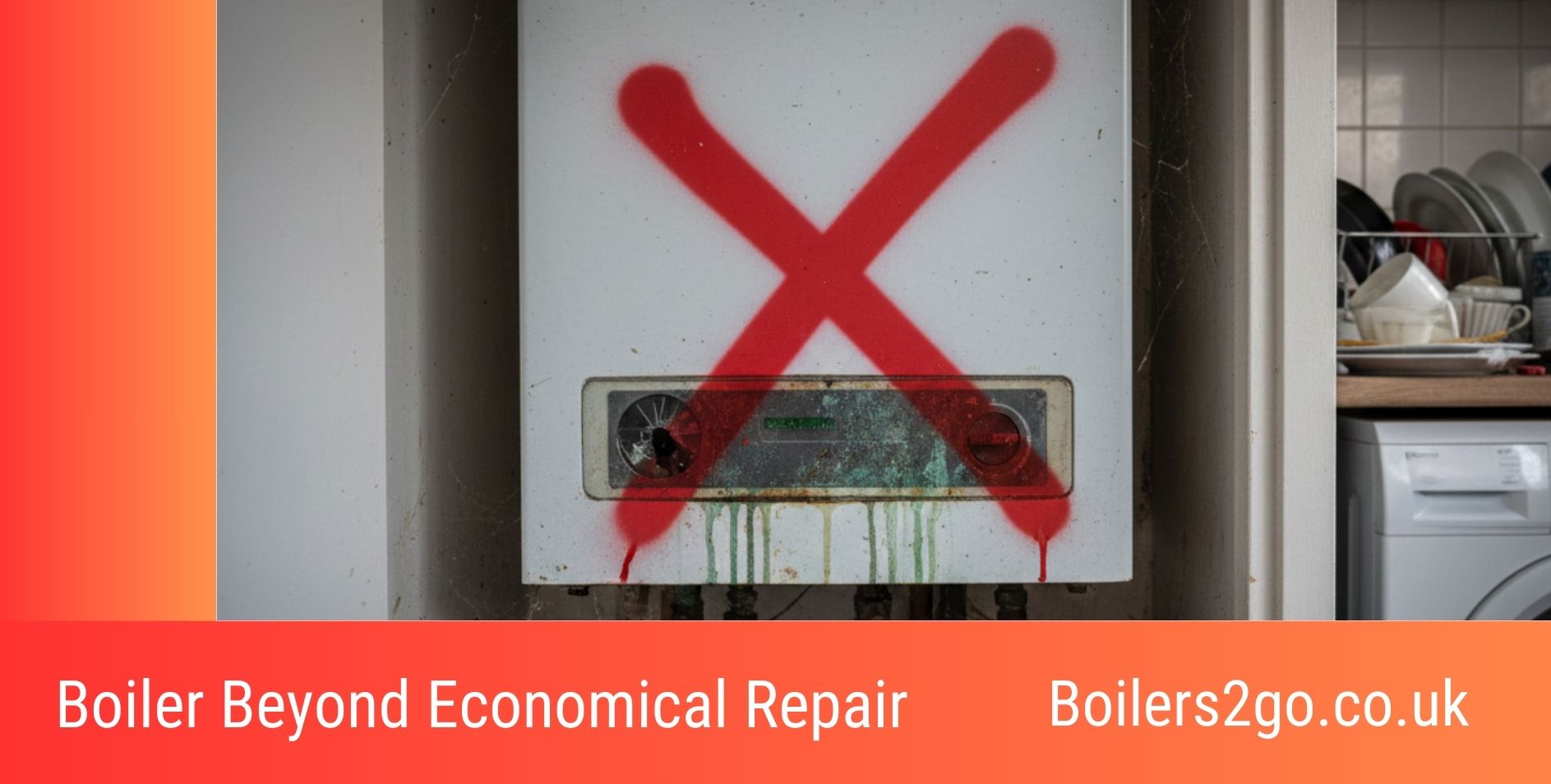
Being told a boiler is beyond economical repair, often shortened to BER, can feel like a bit of a gut punch.
One minute a repair seems likely, the next replacement is being suggested as the smarter move. The natural first thought is whether the engineer is being honest, or simply trying to sell a new boiler.
The truth is, BER is not about a boiler being completely dead. It is about whether fixing it still makes financial and practical sense. This guide covers what that really means, how engineers reach that conclusion, and the options available from there.
Get a quote today and take the stress out of replacing your boiler. At Boilers2Go, we offer fast, reliable installation across the UK - often as soon as the next day. 
Need a new boiler?
What Does Beyond Economical Repair Mean?
A boiler is classed as BER when the cost, risk, and hassle of repairing it outweigh the benefit of keeping it running. It is not a legal status or a scare tactic, but a judgement call based on age, condition, repair cost, and future reliability.
Most boilers in the UK have a realistic lifespan of 10 to 15 years. Once a boiler pushes past the 12 to 15 year mark, efficiency drops, parts wear out more often, and breakdowns tend to come closer together. At that stage, even a successful repair does not buy much long-term peace of mind.
How Can You Tell If a BER Diagnosis Is Correct?
A boiler is usually considered BER when repair costs are no longer sensible compared with replacement, not simply because it has broken down once. The main signs an engineer is likely basing this on are set out below.
1. Age of the Boiler
A boiler that is 10 to 15 years old or more, especially if it is non-condensing or an older combi or system model, rarely makes financial sense to repair extensively. Even once fixed, efficiency and reliability will not improve much. That lost efficiency shows up in your bills, as our guide to central heating running costs explains.
2. Cost of the Repair vs Replacement
As a rule of thumb, if a repair sits at £300 to £600 or more, a replacement costs £1,800 to £3,000, and the boiler is older or has a history of faults, the engineer is probably being honest. A large chunk of a new boiler’s value would otherwise be spent just to keep an old one limping along.
3. Parts Availability
If an engineer mentions that parts are obsolete, that the manufacturer no longer supports the model, or that refurbished parts would need to be sourced, that is a strong indicator BER is accurate. Unsupported parts also mean future breakdowns are likely to be worse.
4. Repeated Breakdowns
If this is not the first issue, especially involving components such as the heat exchanger, the main control board (PCB), or the fan or gas valve, it is often a case of throwing good money after bad.
It is entirely reasonable to ask exactly what part has failed, the cost of that specific repair, and whether the boiler is safe to keep running in the meantime. A competent engineer, especially one registered with the Gas Safe Register, should be able to explain this clearly rather than vaguely.
Get a quote today and take the stress out of replacing your boiler. At Boilers2Go, we offer fast, reliable installation across the UK - often as soon as the next day.
Need a new boiler?
What BER Indicators Do Engineers Look For?
Age is usually the first red flag. A boiler more than a decade old has already done most of its working life, and anything over 15 years is living on borrowed time.
For a pre-2005 non-condensing boiler, parts availability becomes a serious issue, since many manufacturers no longer produce replacements.
The second major factor is what has actually failed. Certain components are expensive and labour-intensive to replace, and on an older boiler, these repairs often signal BER rather than a one-off fix.
Typical examples include heat exchangers, which can cost £400 to £750, PCBs at around £260 to £500, and fans or gas valves that commonly land between £225 and £500. When faults like these appear on a boiler that is already ageing, it is rarely the last problem that will surface.
Repeated breakdowns are another strong sign. Multiple call-outs paid for in recent years form a pattern worth paying attention to, since at that point money is often being thrown after bad even if each individual repair looks cheaper than a new boiler in isolation.
A qualified engineer registered with the Gas Safe Register should be able to clearly explain which part has failed, why it matters, and what it would realistically cost to fix. If this cannot be explained in plain English, it is fair to question the diagnosis.
What Boiler Repairs Actually Cost in the UK Right Now
A new boiler is often mentally compared to a £150 repair, but in reality many boiler repairs run considerably higher than that. Our guide to boiler repair costs in the UK breaks down typical prices by fault.
Minor repairs, such as sensors or switches, typically fall between £100 and £300, averaging around £200. These can still make sense on a newer boiler.
Moving into components such as fans, pumps, or gas valves, costs usually sit between £225 and £600, averaging roughly £400.
The real tipping point comes with major components. PCBs and heat exchangers commonly cost £400 to £1,000 or more once parts and labour are included. On a boiler already 10 or more years old, repairs at this level rarely stack up financially.
As a general rule, any repair over £400 to £500 on an older boiler is where replacement starts to make far more sense.
How Replacement Costs Compare
A full boiler replacement is a bigger upfront cost, but it also acts as a reset button for the whole system.
In today’s UK market, a combi boiler replacement typically costs £2,000 to £3,000, averaging around £2,400. System boiler replacements usually fall between £2,300 and £3,500, averaging about £2,800.
That price usually includes the boiler itself, installation, new controls, flushing the system, and a manufacturer warranty that can run 7 to 12 years. Compared with paying hundreds repeatedly just to keep an old boiler alive, the long-term value becomes clearer.
If Replacement Isn’t Happening Yet, Why Cover and Servicing Still Matter
Not everyone is ready to replace a boiler immediately, and that is a perfectly reasonable position. For anyone choosing to keep an older boiler running for now, cover and servicing become essential rather than optional. Ongoing maintenance can extend the life of a boiler and improve its efficiency, getting the most out of it in the meantime. Simple settings changes help too: lowering your boiler flow temperature can trim running costs on a condensing boiler at no cost.
A proper annual service helps catch small issues before they turn into expensive failures, improves efficiency, and confirms the boiler is safe to use. On an ageing system, skipping servicing often leads directly to the kind of big BER-level repair covered above.
A boiler cover plan can also make sense if replacement is not possible right away. While it will not fix fundamental age issues, it can protect against a sudden £300 to £600 bill and provide some breathing space while a longer-term decision is made.
What does not usually work is limping along with no cover and no servicing, hoping for the best. That is when costs tend to spiral quickly.
What to Do If Your Boiler Is Declared BER
Anyone told their boiler is BER should ask for clarity as the next step: exactly what has failed, how much a repair would cost, and whether the boiler is safe to keep running. Our guide on whether to repair or replace your boiler gives a fuller framework for weighing up the options.
If the boiler is relatively young and the repair is borderline, a second opinion is worthwhile. If it is older and facing a major component failure, replacement is usually the sensible route.
The key thing to remember is that BER is not about pressure selling. It is about avoiding repeated stress, unpredictable bills, and wasted money. Sometimes replacing a boiler is not the cheapest option today, but it is often the cheapest option over the next 10 years.
For reassurance, the decision can be sanity-checked by looking at age, repair cost, and breakdown history together. When all three line up, beyond economical repair is usually an honest assessment, even when it is not the news that was hoped for. Anyone ready to move forward can get a quote for next day boiler replacement.
Beyond Economical Repair: FAQs
Can a BER Boiler Still Be Repaired?
In most cases, yes. BER is a recommendation based on cost-effectiveness, not a legal ban on repair. A homeowner can choose to proceed with a repair against advice, though it is worth being aware that a Gas Safe engineer may be reluctant to guarantee the work on a boiler they consider unsafe or unreliable, and warranty terms on the repair itself may be limited.
Does a BER Assessment Need to Be in Writing?
There is no legal requirement for a written BER assessment for a homeowner’s own boiler, though it is good practice to ask for one, including the specific fault and estimated repair cost. For a rental property, keeping a written record is particularly useful for a landlord’s own documentation and for any future dispute.
Is a Second Opinion Worth It if a Boiler Is Declared BER?
It can be, particularly if the repair estimate is borderline or the boiler is relatively young for the fault described. A second diagnostic visit has a cost, typically £60 to £120, but this is often worthwhile when a four-figure replacement decision is riding on the outcome.
Does Home Insurance Cover a Boiler That Is Beyond Economical Repair?
Standard buildings or contents insurance generally does not cover wear-and-tear failures like this, since BER reflects age and condition rather than sudden accidental damage. A dedicated home emergency or boiler breakdown policy may offer a contribution towards replacement in some cases, so it is worth checking the specific policy terms.
How Quickly Must a Landlord Act on a BER Boiler?
There is no fixed statutory deadline tied to the BER label itself, but a landlord has an ongoing legal duty to keep gas appliances safe and heating functional under tenancy law. In practice, this means acting promptly once an engineer flags a boiler as unsafe or unreliable, rather than waiting for a full breakdown to leave a tenant without heating.
Can a Boiler Be BER Even if It’s Still Running?
Yes. BER is about the economics and reliability of continued repair, not whether the boiler currently works. A boiler that is still running but has a serious fault developing, combined with its age and repair history, can still reasonably be classed as BER even before it fully breaks down.
Get a quote today and take the stress out of replacing your boiler. At Boilers2Go, we offer fast, reliable installation across the UK - often as soon as the next day.
Need a new boiler?

I’m Penny North, a home energy heating expert. My mission is to demystify new boilers and complex heating systems to help you achieve a warm, cosy home with lower energy bills and a smaller environmental footprint.