

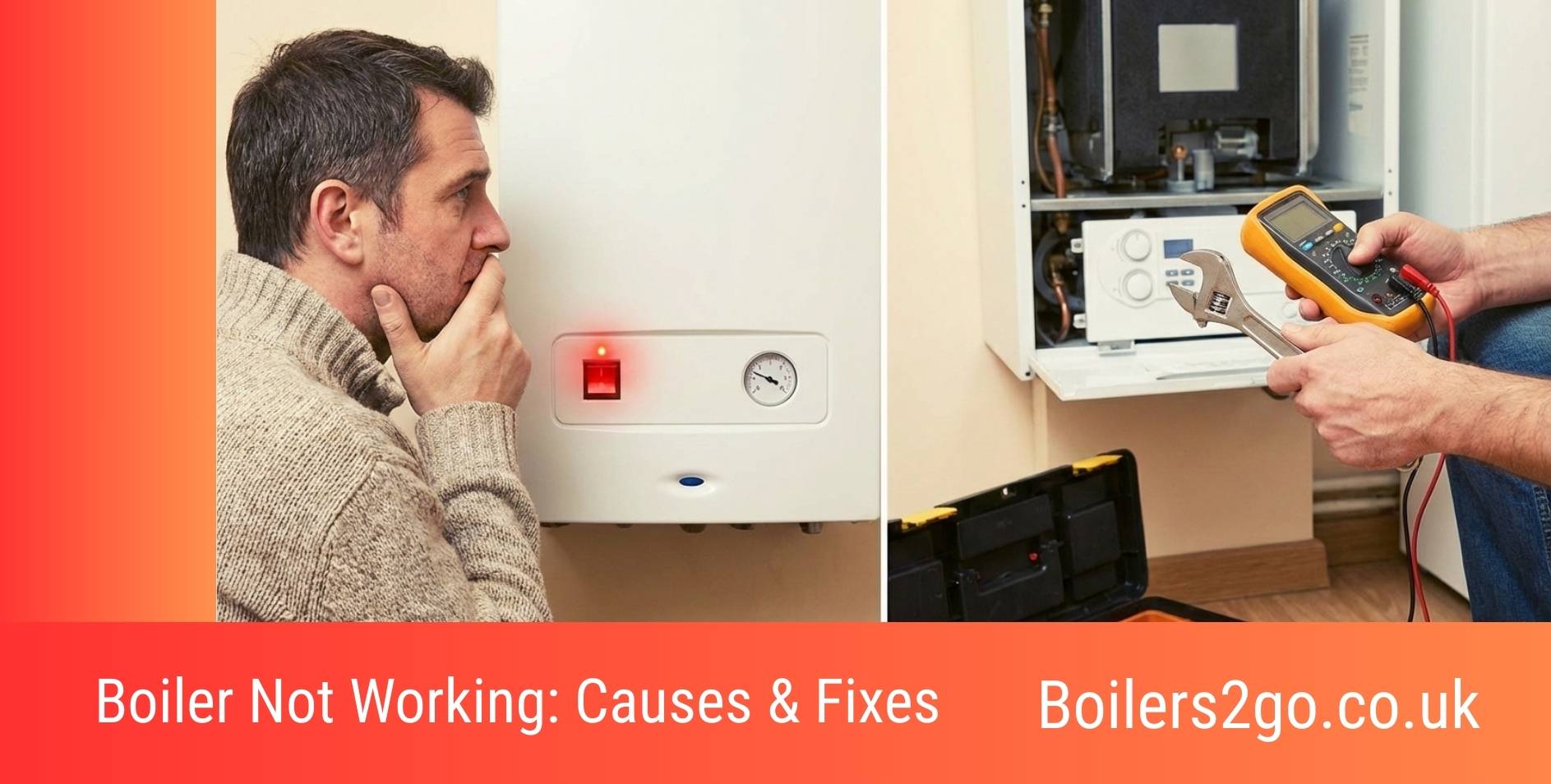
When the heating goes out and you find your boiler not working, it’s a miserable feeling, especially during a chilly British winter. I’ve seen this problem hundreds of times. The good news is that not every breakdown requires an expensive emergency call-out.
Many issues that lead to a completely non-functioning boiler are simple to diagnose and, occasionally, easy to fix yourself.
I’m here to provide a definitive, step-by-step guide to help UK homeowners and landlords understand the causes and find the quickest fix to restore your central heating and hot water.
What are the common non-boiler issues that result in my boiler not working?
The most common non-boiler issues that result in my boiler not working are surprisingly simple, often relating to the power supply, thermostat, or gas supply, which are easy to check before calling a professional.
- Power Supply Check: Is the power on? Check the fuse spur switch near the boiler and your main fuse box. A tripped circuit breaker is a frequent cause of a dead boiler.
- Gas Supply Check: Has the gas been cut off, or has your prepayment meter run out? If you have a gas hob, try lighting a burner. If the hob doesn’t light, the issue is with your gas meter or supplier, not the boiler.
- Thermostat and Programmer Check: Is your thermostat set correctly, and is the programmer turned to “On” or “Auto”? The boiler will only fire if the thermostat demands heat, and a low battery in a wireless thermostat is a common culprit for no heating.
The Fix:
Check and replace thermostat batteries, and ensure the temperature is set high enough to trigger the boiler.
Why is my boiler not working and displaying a low pressure (F1) fault code?
If your boiler is not working and is displaying a fault code like F1 or a similar low-pressure indicator, this is the system’s safety mechanism locking out the unit. All modern boilers need water pressure (often called system pressure) to be within a specific range to operate safely.
The Cause:
Low pressure (typically below 1.0 bar on the gauge) is usually caused by:
- A recent bleed of a radiator, which releases water and air.
- A slow, unidentified leak somewhere in the system (e.g., a radiator valve or a pipe joint).
The Fix (Repressurising):
- Locate the Filling Loop: This is usually a flexible hose underneath the boiler.
- Increase Pressure: Slowly open the isolation valves on the filling loop until the pressure gauge reads between 1.0 and 1.5 bar.
- Reset: Close the valves firmly and press the reset button on your boiler to clear the fault code and restart the ignition sequence.
If you have to repressurise the boiler frequently, you have a leak that needs tracing by a Gas Safe registered engineer.
Could a frozen condensate pipe be the reason my boiler is not working in cold weather?
Yes, if your boiler is not working during a cold snap, a frozen condensate pipe is a very likely cause for your boiler lockout. High-efficiency condensing boilers, common in UK homes, produce acidic wastewater (condensate) which drains away through a plastic pipe, often running outside to a drain.
The Cause:
If the external section of this pipe freezes, the wastewater backs up inside the boiler. To prevent internal flooding and damage, the boiler’s safety mechanism kicks in, leading to a complete system shut down, often accompanied by a gurgling noise and a lockout error code (like L2 or F75, depending on the model).
The Fix (Thawing):
- Locate: Find the visible plastic pipe running outside (usually 20mm in diameter).
- Thaw: Pour warm (not scalding hot!) water over the frozen section, usually where the pipe bends or exits the wall.
- Reset: Once the blockage is clear, the water will drain, and you can reset the boiler to restart the heating sequence. For prevention, I strongly advise insulating the pipe with foam lagging.
Why might my boiler be not working due to an ignition fault (lockout codes)?
If your boiler is not working and displays a specific ignition or flame loss lockout code (e.g., F2, F75, L2, L-F), it means the boiler is receiving power but failing to ignite the gas or failing to prove that a flame has been lit.
Common Internal Causes:
- Fouled Electrodes: The ignition and flame-sensing electrodes responsible for sparking the gas and detecting the flame can become dirty or corroded, preventing the flame from lighting or being detected.
- Faulty Gas Valve: If the gas valve fails, it may not be opening correctly to release gas, or it might be releasing too much gas. This prevents a clean ignition and triggers the lockout for safety.
- Pump/Circulation Faults (F75): While seemingly unrelated, on some boilers, a common code like F75 (loss of circulation) can prevent ignition. The boiler won’t fire if it thinks water isn’t flowing correctly.
The Fix:
These faults involve internal gas and electrical components. You must call a Gas Safe registered heating engineer to diagnose and repair the specific component causing the ignition failure.
Don’t Face the Cold Alone: Request a New Boiler Quote from Boilers 2 Go
If your boiler not working is becoming a routine occurrence, or if you’re facing repeated, costly repairs to internal components like the PCB, heat exchanger, or gas valve, it’s time to seriously consider an upgrade. For UK homeowners and landlords, continuous boiler downtime is not a sustainable or safe situation.
At Boilers 2 Go, we specialise in making the transition easy. We provide transparent, free, fixed-price quotes for installing a brand-new, reliable, A-rated, energy-efficient boiler. This upgrade will instantly boost your home heating reliability, provide superior temperature control, and significantly reduce your annual energy bills.
Say goodbye to cold homes and frustrating fault codes. Get a reliable heating solution installed by a trusted professional.
Request your free, no-obligation new boiler quote from Boilers 2 Go today!
FAQs
Is a lack of hot water a sign that my whole boiler is not working?
Not necessarily. If you still have functional central heating but are experiencing a lack of hot water, it usually points to a fault specific to the domestic hot water (DHW) components in your combi boiler.
The most likely culprit is a faulty diverter valve (stuck on the heating position) or a failed DHW thermistor (temperature sensor). While a major inconvenience, it typically means the core boiler unit is still functional, but a specific part dedicated to your taps has failed.
How often should I service my boiler to prevent it from not working?
I strongly recommend an annual boiler service by a Gas Safe registered engineer. Regular servicing is a critical preventative measure. During a service, an engineer checks and cleans essential components like the fan, electrodes, and sensors, and verifies the system pressure.
Catching small issues like debris build-up early prevents them from escalating into major faults that cause the boiler not working completely, saving you money and disruption in the long run.
What is dry cycling, and can it make my boiler appear to be not working?
Dry cycling is when a boiler turns on and off frequently without any genuine demand for heat from the thermostat. It can make the boiler appear erratic or faulty. This often happens because the central heating flow is restricted, or the boiler is oversized for the property, causing it to rapidly reach its set temperature and shut down.
It’s a sign of inefficiency and can prematurely wear out components, eventually leading to the boiler not working properly. An engineer can often adjust the boiler’s modulation settings to mitigate this.
If my boiler suddenly loses all power and the screen is blank, what should I check first?
If your boiler suddenly loses all power and the screen is blank (completely dead), the first thing to check is the external power supply, specifically the fuse spur switch located near the boiler, and then your home’s main fuse box or consumer unit. If the circuit breaker for the boiler has tripped, simply resetting it may restore power.
If it trips again immediately, it signals a serious electrical fault, likely within the boiler’s PCB or wiring, and requires immediate professional attention.
Can a fault with the time programmer cause the boiler not working?
Yes, a fault with the external time programmer or timer is a very simple but common reason why the boiler not working might occur. If the programmer’s internal clock battery fails or if the settings have been accidentally set to “Off” or a long timer setting, the boiler will not receive the signal to fire up.
Before troubleshooting internal boiler components, always ensure the programmer is displaying the correct time and that the system is correctly set to “Auto” or “On” for both heating and hot water.
Stay warm, The Boilers2Go Team

I’m Penny North, a home energy heating expert. My mission is to demystify new boilers and complex heating systems to help you achieve a warm, cosy home with lower energy bills and a smaller environmental footprint.