

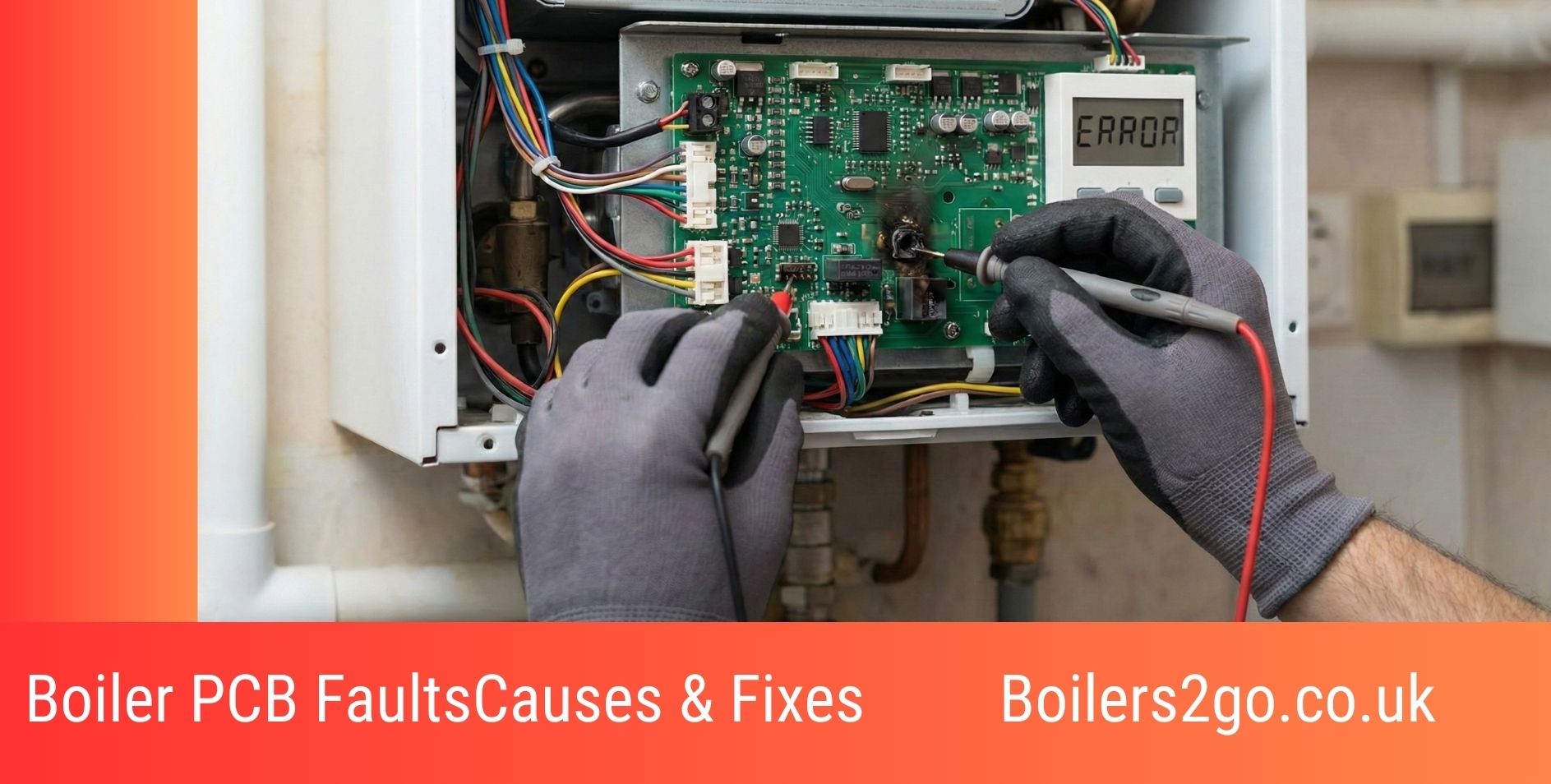
Boiler PCB faults are one of the most common reasons for a boiler suddenly stopping working or locking out in UK homes. The Printed Circuit Board (PCB) is essentially the “brain” of a modern gas boiler – it controls almost everything from ignition, fan speed, pump operation, safety checks and communication with the thermostat.
When the PCB develops a fault, your heating and hot water can disappear overnight, often with a confusing fault code or no display at all.
In this guide, I’ll explain exactly what boiler PCB faults are, the real-world causes behind them, and – most importantly – clear, step-by-step fixes that you can try safely before calling an engineer.
I’ll also cover the all-important prevention tips and when you absolutely must get a Gas Safe registered professional involved.
What Is a Boiler PCB and Why Do PCB Faults Happen?
A boiler PCB (Printed Circuit Board) is the main electronic control board inside your combi, system or regular boiler. It receives signals from sensors, the thermostat and the user control panel, then tells the gas valve, fan, pump and igniter what to do.
Modern PCBs are packed with microchips, relays and capacitors, making them sensitive to electrical surges, moisture and age.
PCB faults usually show as:
- Blank or flashing display
- Specific fault codes (e.g., E133, F75, F22, L2, 133 etc. depending on brand)
- Boiler repeatedly locking out and restarting
- No heating or hot water despite power to the boiler
What Are the Most Common Causes of Boiler PCB Faults?
1. Power Surges and Electrical Spikes
Power surges from lightning, faulty appliances or problems on the National Grid are the number one killer of PCBs in Britain.
How to fix a PCB fault caused by a power surge
- Reset the boiler (turn off at the isolator switch for 30 seconds).
- Check if the fuse in the boiler’s fused spur has blown – replace with an identical 3A or 5A fuse.
- If the boiler still won’t start, the PCB has almost certainly suffered permanent damage and will need replacing by a Gas Safe engineer. There is no safe DIY repair for a surge-damaged board.
2. Water Ingress and Condensation Damage
Condensing boilers produce acidic condensate. If the condensate trap or pipe blocks, water can back up and drip onto the PCB. Leaking heat exchangers or poor sealing also allow moisture inside the casing.
How to fix a PCB fault caused by water damage
- Turn off the electricity to the boiler at the fused spur.
- Dry any visible water with a towel.
- Use a hairdryer on cool setting to gently dry the board area (only if you are 100% confident and the boiler is isolated).
- In 90 % of cases, once a PCB has been soaked it will need full replacement – corrosion starts almost immediately.
3. Age and Component Fatigue
Most PCBs are designed to last 10–15 years. Capacitors and relays wear out, solder joints crack and tracks burn out.
How to fix an age-related PCB fault
- Unfortunately, there is no repair – the board must be replaced.
- A competent Gas Safe engineer can often fit a new genuine PCB in under an hour.
4. Loose or Corroded Connections and Wiring
Vibration over years can loosen plug connectors. Corrosion from damp can eat away at pins.
How to fix loose or corroded connections
- Isolate power.
- Open the boiler (only if you are competent – otherwise call an engineer).
- Carefully reseat every multi-pin connector on the PCB.
- Look for green corrosion and clean gently with an electrical contact cleaner spray if confident.
- This fix works surprisingly often and can save hundreds of pounds.
5. Faulty Sensors Fooling the PCB
A failed temperature sensor (NTC), air pressure switch (APS) or flow sensor can send incorrect signals, making the PCB think there is a dangerous fault and lock out.
How to fix sensor-related PCB faults
- Many boilers (especially Vaillant & Worcester) show specific codes such as F75 (pressure sensor) or F22 (low water pressure/NTC issue).
- Check and top up system pressure to 1–1.5 bar if low.
- Replacing the faulty sensor almost always cures the problem without needing a new PCB.
How Much Does It Cost to Replace a Boiler PCB in the UK (2025 prices)?
- Genuine Vaillant, Worcester Bosch, Ideal or Baxi PCB – £180–£320 + VAT
- Labour (usually 1–1.5 hours) – £80–£180
- Total typical cost – £280–£550 depending on boiler model and location
Always insist on a genuine manufacturer PCB – pattern parts fail much sooner.
How Can You Prevent Boiler PCB Faults in the Future?
- Fit a good-quality surge protector on the boiler’s fused spur (around £25–£40).
- Have your boiler serviced every 12 months by a Gas Safe engineer – they will spot early corrosion or loose connections.
- Keep the condensate trap and pipe clear (pour water through monthly).
- Install a magnetic system filter and use inhibitor to reduce internal corrosion.
- Keep the boiler cupboard dry and well ventilated.
- Consider a separate RCD-protected circuit for the boiler if you live in an area prone to power cuts.
When You Absolutely MUST Call a Gas Safe Engineer
You must call a registered engineer immediately if:
- You can smell gas
- The boiler is leaking water
- There are burn marks or a burning smell from the casing
- You are not 100 % confident working with electricity
- The fault returns after a reset or simple fix
Tampering with gas appliances without Gas Safe registration is illegal and extremely dangerous.
FAQs
Will a boiler PCB fault clear itself after a power cut?
A: Sometimes yes – a temporary glitch can be cured by isolating power for 5–10 minutes. However, if the fault code returns immediately, the PCB or a sensor is usually damaged.
Are refurbished PCBs worth buying?
A: They can be, but only from reputable suppliers with a 2-year warranty. Avoid cheap eBay “repaired” boards – they often fail again within months.
Can a faulty external programmer or thermostat damage the main PCB?
A: Yes. A short-circuit in a wireless receiver or old mechanical timer can send 240 V back down the low-voltage control circuit and destroy the PCB.
My boiler shows no lights at all – is it definitely the PCB?
A: Not always. It could be the 3A/5A fuse in the fused spur, a tripped RCD, or a failed transformer before the PCB. Always check these first.
Do all boilers have just one PCB?
A: No. Some high-end models (e.g., Viessmann Vitodens 100-W or Worcester 8000) have two separate boards – a main PCB and a secondary burner control board. Both can fail independently.

I’m Penny North, a home energy heating expert. My mission is to demystify new boilers and complex heating systems to help you achieve a warm, cosy home with lower energy bills and a smaller environmental footprint.