

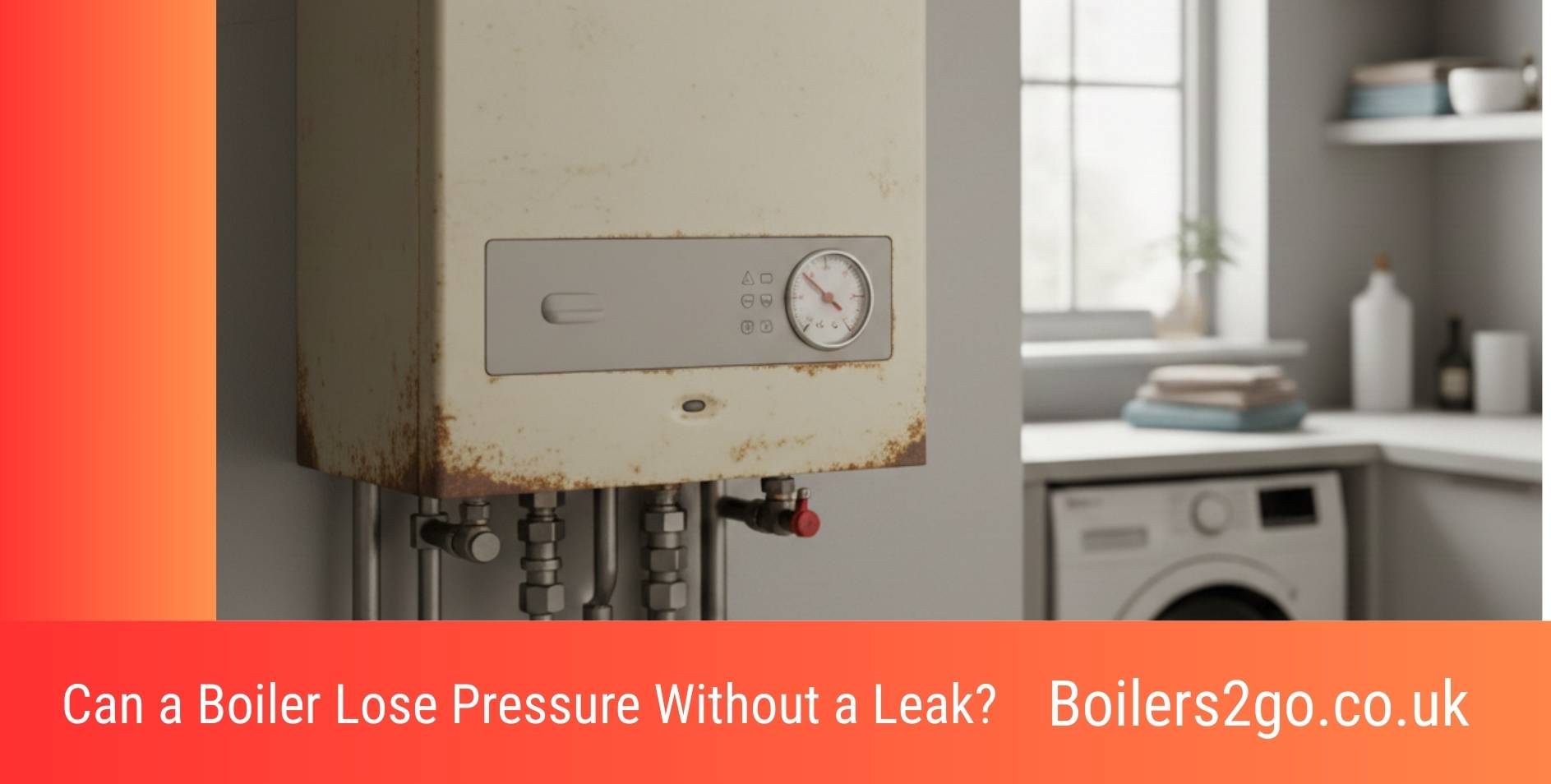
Yes — absolutely. A boiler losing pressure with no obvious leak is one of the most common issues we see in UK homes, and it often catches people out because there’s no dripping pipe or wet patch to point the finger at.
Modern boilers are sealed systems, which means any loss of water or trapped air inside that closed loop will show up as a pressure drop on the gauge. Sometimes that’s completely harmless. Other times, it’s an early sign that something inside the boiler or system isn’t quite right.
A useful rule of thumb:
If you’re topping up once or twice a year, that can be normal.
If you’re topping up every few weeks or more, there’s usually an underlying issue worth investigating.
Why Pressure Can Drop Even When Nothing is Leaking
Small internal leaks you’ll never see
Not all leaks end up as puddles on the floor.
Inside the boiler casing, tiny drips can land on hot components and evaporate almost instantly. Over time, even a very small loss adds up enough to pull the pressure down noticeably.
Elsewhere, water can escape from joints, seals or valves and run along pipework before drying out, leaving no obvious damp patch behind. Outside, the boiler’s safety discharge pipe can release water so slowly that you only ever see faint white staining rather than an active drip.
It doesn’t take much — a few spoonfuls a day is enough to drop pressure from healthy to zero over a week or two.
Normal behaviour after bleeding or maintenance
Sometimes the system is just settling.
Bleeding radiators releases trapped air, but it also releases a small amount of water. That reduces the overall volume in the system, so pressure drops slightly afterwards.
Automatic air vents do something similar over time. As air escapes from high points in the system, pressure can slowly drift down over months.
If the pressure drop started shortly after bleeding radiators or draining part of the system, a single top-up followed by monitoring is usually all that’s needed.
Expansion vessel problems
The expansion vessel plays a quiet but vital role in keeping pressure stable as the system heats and cools.
When it’s healthy, pressure rises gently as the heating warms up and settles back down as it cools. When it isn’t, pressure can behave erratically — climbing high when the heating is on, then falling very low once everything cools down.
This often happens when the vessel’s internal diaphragm fails or when the air charge leaks away through the Schrader valve (the tyre-style valve fitted to it). From the homeowner’s point of view, it just looks like unexplained pressure loss, but the cause is internal and usually needs an engineer to diagnose properly.
The pressure relief valve quietly passing water
The pressure relief valve (PRV) is designed to protect the system if pressure gets too high.
If it’s been triggered in the past — or if it’s simply worn — it may not reseat perfectly. That allows small amounts of water to escape, often only when the boiler is hot.
Because the PRV discharges outside, this can go unnoticed indoors. A common giveaway is a chalky white mark beneath the external copper pipe rather than an obvious drip.
You might notice a pattern where the pressure seems fine when you top it up, then slowly falls back below 1 bar after the heating has been running.
Auto air vent issues
Automatic air vents are meant to release air, but when they start to fail they can also contribute to pressure loss.
A vent that’s stuck slightly open can allow tiny amounts of water to escape along with air. Over time, that lowers pressure without leaving much more than crusty residue behind.
In other cases, repeated air build-up and purging can make the pressure gauge fluctuate as the balance of air and water inside the system changes.
These issues are often only spotted during a service when the engineer checks around the top of the boiler for signs of staining.
The gauge — or topping up — being the real problem
Occasionally, the pressure loss isn’t real at all.
A faulty gauge can under-read, making it look like the system is losing pressure when it isn’t. That encourages repeated topping up, which can then genuinely over-pressurise the system and cause the PRV to open.
This creates a frustrating loop: top up → pressure rises → PRV discharges → pressure falls again.
If the gauge reading doesn’t match how the heating behaves — for example, radiators are hot and stable but the gauge says zero — it’s time for a professional to check the true system pressure.
How to Judge Whether Your Pressure Loss Is Normal
A few simple observations can tell you a lot:
-
How often you top up matters
Once every few months can be acceptable. Anything more frequent usually isn’t. -
Check the external discharge pipe
Look for dampness or white staining after the heating has been on. -
Watch hot vs cold pressure
Large swings — such as very low when cold and close to 3 bar when hot — strongly suggest expansion vessel trouble. -
Think about recent work
If the drop started after bleeding radiators or draining the system, top up once and monitor before panicking.
If pressure continues to fall to zero, or you find yourself topping up regularly, it’s time to call a Gas Safe engineer to check for internal leaks, expansion vessel faults, PRV issues or failing vents.
The Bottom Line
A combi boiler losing pressure without a visible leak is common — and often fixable — but it shouldn’t be ignored if it keeps happening.
Occasional top-ups can be normal. Repeated pressure loss isn’t.
Catching the cause early usually means a simple repair. Leaving it unchecked can lead to bigger faults, nuisance lockouts, or damage to internal components.

I’m Penny North, a home energy heating expert. My mission is to demystify new boilers and complex heating systems to help you achieve a warm, cosy home with lower energy bills and a smaller environmental footprint.