

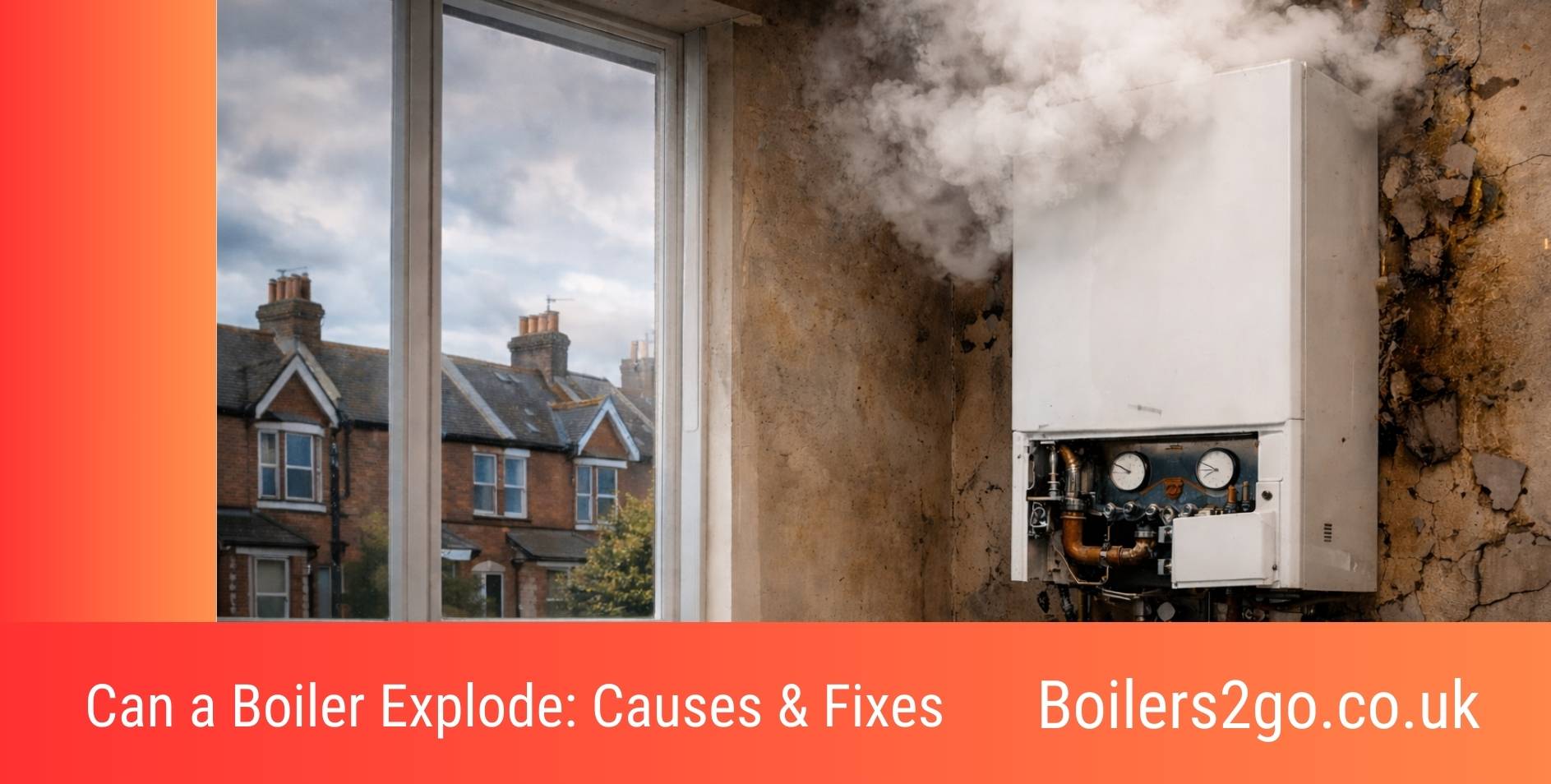
A boiler can only “explode” if pressure inside the system builds to a level that the vessel or pipes cannot contain. In older solid-fuel back boilers or commercial steam boilers this used to be more common, but modern combi, system, and regular gas boilers sold in the UK since the 1990s have multiple safety features that make a Hollywood-style explosion virtually impossible under normal circumstances.
In this guide, I’ll explain exactly why boilers might become dangerous, what the real risks are, and how to fix or prevent problems.
What Are the Real Dangers if a Boiler Is Neglected?
While a dramatic explosion is unlikely, neglected boilers can still cause serious incidents:
- Carbon monoxide (CO) poisoning – the biggest killer
- Gas leaks leading to fire or explosion (outside the boiler itself)
- Water leaks causing flooding or electrical fires
- Over-pressurisation leading to component failure or bangs (known as “kettling”)
What Causes a Boiler to Become Dangerous or Over-Pressurise?
1. Faulty or Stuck Pressure Relief Valve (PRV)
The pressure relief valve is the main safety device that releases excess pressure. If it becomes blocked with limescale or the spring fails, pressure can climb dangerously.
How to Fix a Faulty Pressure Relief Valve
- Turn off the boiler and water supply.
- Locate the PRV (usually a small brass valve with a red or black cap on the outside of the boiler or near the pressure gauge).
- Gently pull the lever – water should discharge safely through the tundrel pipe outside. If nothing comes out, the valve is seized.
- This is a job for a Gas Safe engineer – do NOT attempt to dismantle it yourself.
2. Filling Loop Left Open or Leaking
On system and regular boilers, the filling loop connects the mains water to the heating system. If the valves are left open or one of the non-return valves fails, mains pressure (3+ bar) continuously feeds the system.
How to Fix a Filling Loop That’s Left Open or Leaking
- Locate the braided hose or silver flexible link with two small taps.
- Both taps should be fully closed (handles across the pipe).
- If pressure keeps rising even when both taps are closed, one of the valves inside has failed – call a Gas Safe engineer to replace the filling loop.
3. Faulty Expansion Vessel
The expansion vessel is an air-filled tank that absorbs the natural expansion of water when it heats. If the diaphragm inside tears or the Schrader valve loses air, the system has nowhere for expanded water to go – pressure skyrockets.
How to Check and Fix an Expansion Vessel
- Turn off the boiler.
- Find the vessel (usually a red or blue oval tank at the back or side of the boiler).
- Press the Schrader valve (like a car tyre valve) with a screwdriver. If water comes out instead of air, the diaphragm is ruptured – the vessel needs replacing by a Gas Safe engineer.
- If only air comes out but pressure still rises, the vessel may need re-pressurising with a foot pump to 1–1.5 bar (again, best left to an engineer).
4. Blocked or Frozen Condensate Pipe (Combi & Condensing Boilers)
In very cold weather the external condensate pipe can freeze. The boiler detects the blockage and goes into lockdown, but in rare cases excess pressure can build elsewhere.
How to Safely Thaw a Frozen Condensate Pipe
- Locate the white 22mm or 32mm plastic pipe exiting the wall outside.
- Pour warm (not boiling) water over the frozen section or use a hot water bottle.
- Reset the boiler once thawed.
- Fit a larger 32mm pipe or add insulation/lagging to prevent it happening again.
5. Extremely Rare – Scale Build-Up Causing Kettling and Overheating
In very hard water areas, thick limescale inside the heat exchanger can cause localised boiling and steam pockets. This creates loud banging and, in absolute worst-case scenarios, can damage the heat exchanger.
How to Prevent and Fix Severe Limescale Build-Up
- Install a magnetic or electrolytic scale inhibitor on the incoming mains (highly recommended in hard water areas).
- Have the heat exchanger chemically cleaned or replaced by a Gas Safe engineer.
How to Prevent Boiler Pressure Problems and Explosions in the Future
- Book an annual boiler service with a Gas Safe registered engineer – this is a legal requirement for landlords and the single best way to catch issues early.
- Check your boiler pressure every month – it should sit between 1 and 1.5 bar when cold.
- Install a carbon monoxide alarm with a 7–10 year sealed battery on every floor.
- Fit an in-line scale reducer if you live in a hard water area (most of southern and eastern England).
- Never ignore banging, gurgling, or the pressure gauge creeping above 2.5–3 bar.
- Have an audible CO alarm AND a visual pressure gauge you can easily see.
When You Absolutely MUST Call a Gas Safe Engineer Immediately
Call a Gas Safe registered engineer straight away if you notice any of these red flags:
- The pressure gauge is above 3 bar and still rising
- The pressure relief valve is constantly discharging water outside
- You smell gas (call National Gas Emergency Service on 0800 111 999 first)
- Your carbon monoxide alarm is sounding
- The boiler is making loud banging or kettling noises
- There are wet patches or drips around the boiler casing
Do not use the boiler until it has been inspected.
FAQs
Can a combi boiler explode more easily than a regular boiler?
No. Combi boilers actually have fewer components that can cause over-pressurisation (no cold water tank or expansion issues), making them statistically safer.
Is it safe to sleep with the heating on if I’m worried about the boiler?
Yes, as long as you have working carbon monoxide alarms and the boiler has been serviced in the last 12 months. CO poisoning is the real night-time risk, not explosion.
My neighbour says old cast-iron boilers from the 1970s can explode – is that true?
Very old back boilers or solid-fuel boilers without modern safety valves were more risky, but virtually none of these are still legally in use in the UK today.
Will my home insurance cover damage if the boiler does over-pressurise?
Most policies cover “escape of water” but many specifically exclude damage caused by lack of maintenance or not having an annual service. Always check your policy.
Are electric boilers safer than gas boilers when it comes to explosion risk?
Yes – electric boilers have zero risk of gas explosion and no flue, but they can still leak or cause electrical fires if poorly maintained.
Stay warm, The Boilers2Go Team

I’m Penny North, a home energy heating expert. My mission is to demystify new boilers and complex heating systems to help you achieve a warm, cosy home with lower energy bills and a smaller environmental footprint.