

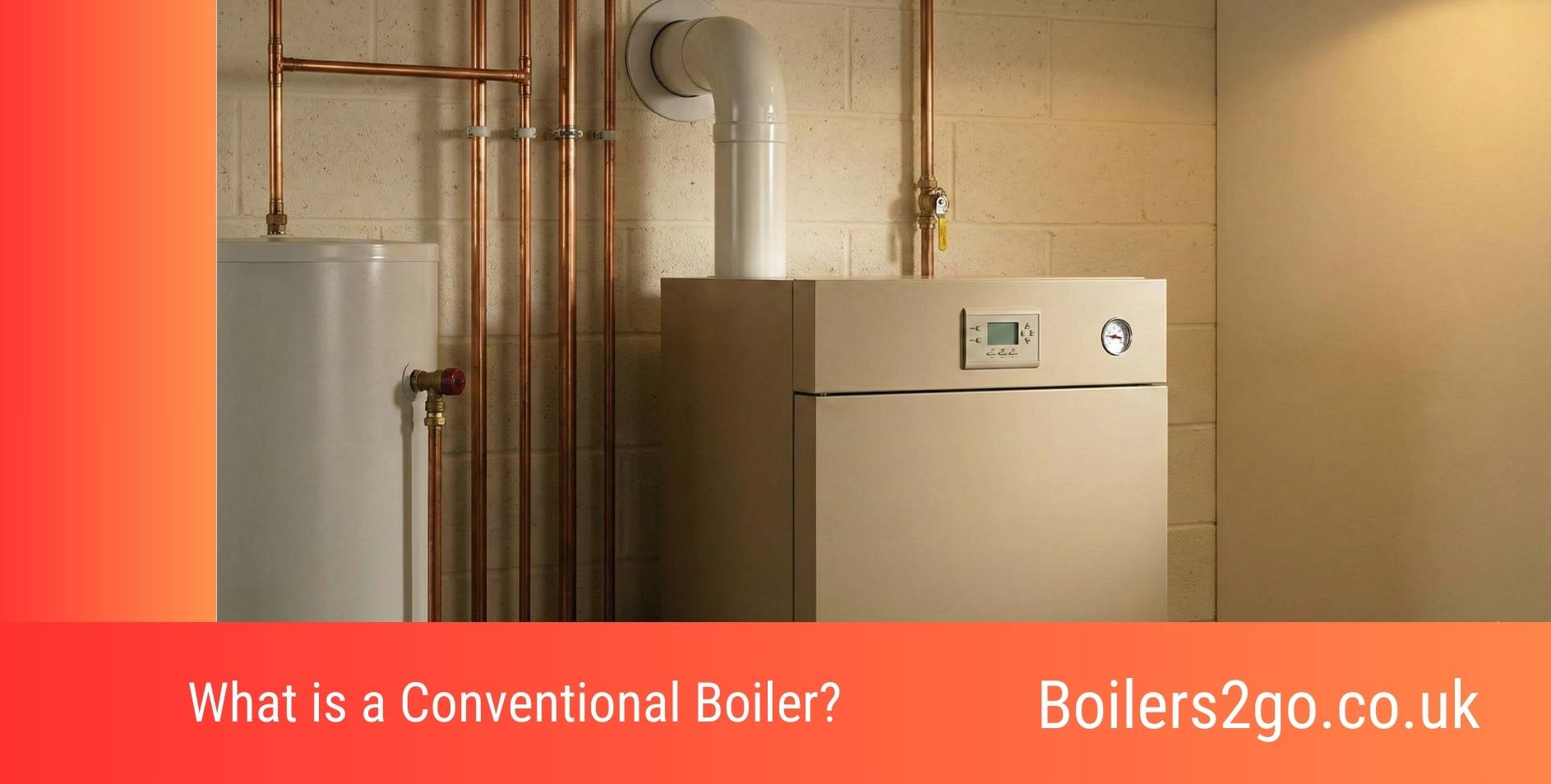
The core idea of a conventional boiler is the separation of heating and hot water storage. Unlike a modern combi boiler that heats water on demand, a conventional boiler—also known as a heat-only boiler or regular boiler —heats water from a cold water tank and stores it in a hot water cylinder, ready for you to use.
This design is what makes it a powerhouse for properties with multiple bathrooms and a high, simultaneous demand for hot water.
What are the essential components of a conventional boiler system?
To understand what a conventional boiler is, you must first know the essential components that make up the complete heating system. A conventional boiler system, also known as a regular boiler system, is a network that requires three primary elements, each playing a crucial role in delivering warmth and hot water throughout your property.
- The Boiler Unit (The Engine): This is the heat source. It burns fuel (usually natural gas, but sometimes oil or LPG) to heat the water. It’s a heat-only appliance, meaning its sole job is to heat the water circulated through it.
- The Cold Water Storage Cistern (The Reservoir): Typically located in the loft or highest point of the house, the cold water tank stores cold water from the mains. This water is fed by gravity down to the hot water cylinder and the heating system itself. This gravity-fed flow is a key difference from system boilers and combi boilers.
- The Hot Water Storage Cylinder (The Battery): Usually found in an airing cupboard, this is where the water heated by the boiler unit is stored until you open a hot water tap. This water cylinder allows for a large reserve of hot water, which is a massive benefit for high-demand homes.
How does a conventional boiler actually work to provide hot water?
When you ask, “How does a conventional boiler work?” the answer lies in a simple yet effective gravity-fed and pumped process. This system operates by heating and storing water, rather than providing it instantaneously.
- Cold Water Supply: Cold water flows from the storage cistern in the loft, using gravity to feed down into the hot water cylinder and the boiler.
- Heating Cycle: The heat-only boiler fires up, heating the water that is circulated between the boiler and the hot water tank.
- Hot Water Storage: The now-heated water is stored in the hot water cylinder. Because the water is pre-heated and stored in bulk, you get a consistent, high flow rate to multiple outlets simultaneously.
- Heating Circulation: Separately, a pump circulates heated water from the boiler to the radiators, providing your central heating.
The stored hot water is what gives a conventional boiler its edge in large households. You can have a shower, someone can be running a bath, and the washing machine can be on, all without a noticeable drop in flow or temperature, provided your cylinder is correctly sized.
Who is a conventional boiler best suited for?
As a heating expert, I can confidently say a conventional boiler is an ideal heating solution for a very specific type of UK property and user. It’s not just about the boiler itself; it’s about the entire heating infrastructure and your household’s daily hot water requirements.
- Large Homes with Multiple Bathrooms: This is the conventional boiler’s sweet spot. Properties with two, three, or more bathrooms need a lot of hot water simultaneously. Since the system stores a large volume of pre-heated water in the hot water tank, it can cope with several showers running at once, making it perfect for large families or landlords managing properties with high occupancy.
- Older Properties with Existing Pipework: If you live in an older property that already has a traditional boiler setup, replacing it with a new conventional boiler is often the most cost-effective and least disruptive option. It utilises the existing pipework, radiators, and chimney flue system, which avoids the expensive and messy process of upgrading pipework for a high-pressure mains-fed system.
- Homes with Low Mains Water Pressure: Because a regular boiler uses a cold water cistern and gravity to feed the system, it is much less reliant on the mains water pressure. This makes it an excellent choice for houses in areas where mains water pressure is known to be weak or unreliable.
What are the advantages and disadvantages of choosing this boiler type?
Understanding the trade-offs is crucial when deciding on a new boiler. Every system has its pros and cons, and the conventional boiler is no different.
Advantages of a Conventional Boiler
- High Hot Water Volume: The primary benefit. The stored hot water in the cylinder means it can meet high-demand usage across multiple outlets without fail.
- Backup Immersion Heater: Most hot water cylinders are fitted with an immersion heater. If your heat-only boiler breaks down, you can still heat water electrically—a lifesaver in an emergency!
- Compatibility with Older Systems: As I mentioned, it’s the easiest replacement for an existing conventional setup, saving you significant installation cost and time.
- Solar Thermal Ready: Many conventional boiler systems are easily integrated with solar thermal panels, allowing you to use renewable energy to heat your water, which is a fantastic way to improve efficiency and reduce your energy bills.
Disadvantages of a Conventional Boiler
- Space Requirements: The need for a cold water tank in the loft and a hot water cylinder in an airing cupboard means this system is not suited for smaller properties, flats, or those short on storage space.
- Non-Instant Hot Water: Once the stored hot water in the cylinder is used up, you have to wait for the boiler to heat a fresh batch—typically an hour or so.
- Heat Loss: Stored hot water can lose heat over time, even with good cylinder insulation, making it marginally less energy-efficient than on-demand systems like a combi. However, modern, A-rated conventional boilers are highly efficient at their core.
Are conventional boilers energy efficient?
Modern conventional boilers are highly energy efficient, thanks to mandatory UK regulations. Since the introduction of the Boiler Plus legislation, virtually all new gas boilers installed in the UK, including the heat-only boiler, must be condensing boilers with a minimum seasonal space heating efficiency of 92% ErP (Energy-related Products).
What this means for you:
- Condensing Technology: Modern conventional boilers use condensing technology to recover heat from the exhaust gases (flue gas) that would otherwise be lost. This process is what drives the efficiency rating over 90%, earning them an A-rated efficiency sticker.
- Savings Potential: If you are upgrading from an older G-rated boiler (which might be as low as 60-70% efficient), switching to an A-rated conventional model could lead to significant savings on your annual gas bills, often reducing energy consumption by up to 30%.
- System Sizing: For large homes with high hot water demand, a conventional boiler system, despite the minor heat loss from the hot water cylinder, is often the most efficient choice for meeting that demand. Attempting to run multiple showers simultaneously on an undersized combi boiler would be far less efficient for that property type.
What are the estimated costs for a conventional boiler installation?
The cost of a conventional boiler installation varies widely based on brand, power output (kW), and the complexity of the installation work, such as whether you need a new hot water tank or if you are moving the boiler location. I can give you some average estimates based on current UK market data (2025):
| Component/Work | Estimated UK Cost Range (Inc. VAT & Installation) | Notes |
| New Conventional Boiler Unit (Mid-Range) | £600 – £3,500 (Unit Only) | Price depends on brand (e.g., Worcester Bosch, Ideal) and kilowatt (kW) size. |
| Standard Installation (Like-for-Like Swap) | £1,700 – £4,500 (Total) | Replacing an existing conventional boiler with a new one in the same location. |
| Installation Complexity Add-ons | ||
| Power Flush of System | £400 – £600 | Essential for cleaning old pipework and radiators (LSI). |
| New Hot Water Cylinder | £200 – £500 (Cylinder Only) | May be needed if your existing cylinder is old or too small. |
| Moving Boiler Location | Up to £1,000+ | Requires significant pipework and flue extension work. |
In summary, for a standard replacement of a conventional boiler in the UK, expect to budget somewhere between £2,200 and £4,000 for the full job including the boiler unit, labour, and essential components. Always obtain a fixed-price quote from a Gas Safe registered engineer to get an accurate figure for your specific property.
What specific installation requirements are there for a conventional boiler?
The main installation requirements that differentiate a conventional boiler from a combi or system boiler are the separate components and the flue. A Gas Safe registered engineer must ensure all these parts are installed correctly and safely.
- Flue Requirements: As a modern condensing boiler, it requires a condensate pipe to safely drain the acidic wastewater produced during the highly efficient heating process. This pipe needs a continuous slope and protection from freezing if routed externally.
- Storage Space: You must have adequate space for three main components:
- The boiler unit itself (usually housed in a cupboard or utility room).
- The hot water cylinder (typically in an airing cupboard).
- The cold water storage tank (almost always located in the loft).
- Water Treatment: Following British Standards (BS 7593:2019), your installation should include a system clean (like a power flush), the addition of a chemical inhibitor to prevent corrosion, and the installation of a magnetic system filter to catch sludge and debris. This protects the new boiler and preserves its warranty.
What is involved in servicing and maintenance of conventional boilers?
The servicing and maintenance of conventional boilers follows standard best practices for all gas appliances, with a few extra checks due to the additional tanks and cylinder. This annual work is crucial for safety, efficiency, and keeping your manufacturer’s boiler warranty valid.
- Annual Service: An annual boiler service must be carried out by a Gas Safe registered engineer. This involves checking the boiler unit’s components, testing the gas pressure, performing a flue gas analysis to ensure clean combustion, and checking all safety devices.
- Landlord Requirement: If you are a landlord, an annual service is a legal requirement to obtain a Gas Safety Certificate (CP12) for your tenants, covering all gas appliances, including the conventional boiler.
- System Checks: Maintenance also involves checking the system pressure and inspecting the cold water tank in the loft and the hot water cylinder for any leaks, corrosion, or insulation degradation. You, as the homeowner, should also regularly check the pressure gauge and bleed your radiators if they are cold at the top.
What are the considerations when switching to a conventional boiler?
Switching to a conventional boiler is usually done when replacing an old, existing conventional system. However, if you are looking to switch from a modern combi or system boiler, there are unique technical and cost implications you need to be aware of.
Switching from a System Boiler to a Conventional Boiler
Switching from a system boiler to a conventional boiler is relatively minor, but there is one key component you must add back into the system.
- The Main Requirement: A system boiler draws water directly from the mains and only requires a hot water cylinder. To switch to a conventional boiler, you will need to install a cold water storage tank in the loft.
- Pipework Changes: The Gas Safe engineer will need to run new pipework from the main stopcock to the new cold water tank, and then a feed from that tank down to the hot water cylinder and the boiler.
- Reason for Switching: This conversion is generally only undertaken if you have poor or unreliable mains water pressure, as the conventional system’s reliance on gravity-fed water from the loft tank provides a more stable flow.
Switching from a Combi Boiler to a Conventional Boiler
Converting from a combi boiler to a conventional boiler is the most extensive and expensive conversion, as it requires adding several major components to the system.
- The Missing Components: A combi boiler does not use any external tanks or cylinders. Therefore, you must install both a hot water storage cylinder (in an airing cupboard) and a cold water storage cistern (in the loft).
- New Pipework: This is a major job. New pipework must be installed to accommodate the cold water tank and the hot water tank, as well as linking them all to the conventional boiler unit itself. This can involve significant disruption to floors, walls, and ceilings.
- Reason for Switching: Homeowners or landlords typically only make this switch if they are moving to a much larger property (e.g., adding a bathroom) or if the property requires a significantly higher, simultaneous hot water demand that the existing combi boiler cannot cope with.
Ready for a New Boiler Quote?
Now that you’re an expert on what a conventional boiler is, you might be considering a boiler replacement for your home or investment property.
Whether you’re looking to stick with a high-performance conventional boiler to handle your high hot water demand, or you’re considering a switch to a modern system boiler or compact combi boiler, the next logical step is to get a professional, accurate quote.
At Boilers 2 Go, we specialise in helping UK homeowners and landlords find the perfect, A-rated efficiency gas boiler for their needs. Our Gas Safe registered engineers are experts in all boiler types and will assess your property, water usage, and budget to provide a tailored recommendation.
Don’t wait until your current boiler breaks down! Get ahead of the curve, ensure your home is warm and your hot water is flowing reliably.
Click here to get your quick, no-obligation new boiler quote from Boilers 2 Go today!
FAQs
Do modern conventional boilers have a minimum efficiency rating in the UK?
Yes, they do. In the UK, thanks to the Boiler Plus legislation introduced in 2018, nearly all new domestic gas boilers, including conventional boilers, must have a minimum seasonal space heating efficiency of 92% ErP (Energy-related Products).
This means that a modern, newly installed heat-only boiler is a high-efficiency appliance, vastly superior to old G-rated models, which helps significantly with lowering energy consumption and reducing your heating bills.
Can I convert my conventional boiler system to a combi boiler?
You absolutely can convert your existing conventional boiler system to a combi boiler, but it’s a more complex process than a like-for-like swap. The conversion involves removing the cold water tank in the loft and the hot water cylinder in the airing cupboard, as well as altering pipework to connect the new combi boiler directly to the mains water supply.
While it saves space, it is usually more expensive due to the extra labour and component removal. This conversion is often only recommended for smaller homes with low hot water usage where the extra space gain is a major benefit.
How often should I have my conventional boiler serviced?
As an expert, I strongly recommend that your conventional boiler and entire central heating system be serviced annually by a Gas Safe registered engineer.
Regular boiler servicing is essential for safety—checking for things like a carbon monoxide leak —and maintaining efficiency. It also helps prevent small issues from becoming expensive breakdowns, and keeping a consistent service history is often a requirement for maintaining your manufacturer’s warranty on the boiler unit.
Are conventional boilers suitable for use with underfloor heating systems?
Yes, conventional boilers are perfectly suitable for use with underfloor heating systems. The boiler provides the hot water for the central heating loop, and an underfloor heating manifold then distributes the water at the required lower temperature throughout the floor circuit.
Since a regular boiler is a dedicated heating appliance, it integrates easily with most modern, low-temperature heating solutions, making it a flexible choice for both traditional radiator systems and newer underfloor installations.
What is the average lifespan of a modern conventional boiler?
With proper annual servicing and maintenance, you can generally expect a modern, high-quality conventional boiler to last between 10 to 15 years. Some robust models may even last longer.
The life span of the associated components, such as the hot water cylinder, can often exceed that of the boiler unit itself, meaning a simple boiler swap (like-for-like replacement) can be done without needing to replace the tanks.
Choosing a reputable brand and ensuring a professional installation are the two biggest factors in achieving a long boiler life.
Stay warm, The Boilers2Go Team

I’m Penny North, a home energy heating expert. My mission is to demystify new boilers and complex heating systems to help you achieve a warm, cosy home with lower energy bills and a smaller environmental footprint.