

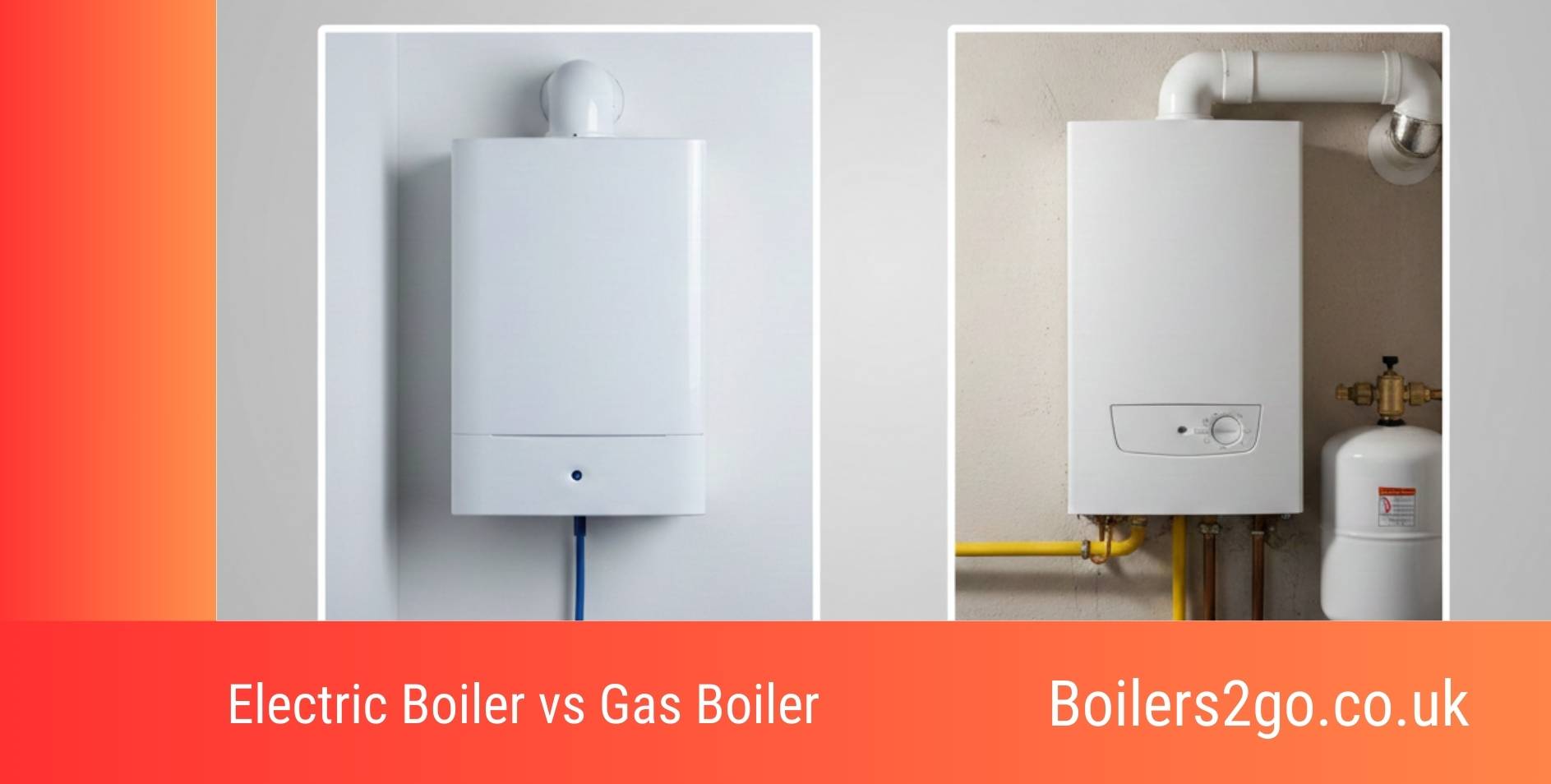
Electric boilers and gas boilers can both heat a UK home reliably — but they go about it in very different ways. One converts electricity into heat with near-perfect efficiency but faces high energy prices. The other relies on cheaper fuel, higher output, and a national grid connection, at the cost of carbon emissions and gas infrastructure.
For most homeowners, the decision isn’t about which is better in theory, but which one fits their property, location, lifestyle, and long-term plans.
Running Costs: Where the Real Difference Shows Up
This is where the gap between electric and gas boilers becomes impossible to ignore.
Electric boilers are close to 100% efficient — virtually every unit of electricity becomes heat. Modern gas boilers, by comparison, typically convert around 90–95% of gas into usable heat. On efficiency alone, electric looks unbeatable.
But fuel price changes the picture completely.
Across most of the UK in 2026, mains gas typically costs around 7–10p per kWh, while standard electricity sits closer to 27–33p per kWh. That difference dwarfs the efficiency advantage of electric boilers.
In real homes, that usually translates to something like this:
A typical gas-heated household might spend £700–£1,200 per year on space heating and hot water, depending on insulation, boiler size, and how aggressively the system is run.
The same heat demand supplied by an electric boiler often lands between £1,600 and £3,000 per year, sometimes more in larger or less efficient properties.
In other words, even though electric boilers waste almost no energy internally, they usually cost around double to run on standard tariffs.
Upfront Costs and Installation: Electric Is Easier (At First)
Installation is one area where electric boilers quietly score points.
A typical gas boiler replacement — especially a combi — usually falls in the £2,000–£3,500 range once flue work, gas pipe checks, and Gas Safe certification are included.
Electric boilers often come in a little cheaper, typically £1,500–£2,500 for a straightforward install, because there’s no flue, no combustion clearance, and no gas pipework. Maintenance is also simpler: no annual gas safety certificate, fewer moving parts, and less routine servicing overall.
That said, electrical work can surprise people. If your consumer unit needs upgrading or a dedicated high-capacity circuit has to be run, costs can climb toward £4,000–£5,000+, especially in older homes.
So while electric boilers often look cheaper to install on paper, the savings aren’t guaranteed.
Where Electric Boilers Genuinely Make Sense
Despite their higher running costs, electric boilers aren’t a bad idea — they’re just a specialist solution rather than a universal one.
In homes with no gas connection, electric boilers avoid the complications of oil or LPG storage, deliveries, and flue design. For smaller, well-insulated properties, they can be a clean, compact alternative.
They also shine in flats, apartments, and listed buildings where adding or modifying a flue is difficult, restricted, or outright prohibited. With no combustion, electric boilers remove carbon-monoxide risk entirely and fit neatly into tight cupboards or utility spaces.
Another niche where they quietly perform well is in solar-powered homes. When paired with rooftop PV, an electric boiler can effectively run on free electricity during daylight hours. Add a hot-water cylinder, smart controls, and (optionally) a battery, and the real-world running cost can drop dramatically — sometimes approaching gas levels in practice, even if not on paper.
Electric boilers also tend to be long-lived and low-maintenance, often lasting 15–25 years with minimal intervention. For landlords or homeowners who value simplicity and reliability over absolute fuel cost, that has real appeal.
The Downsides That Still Matter
For most households, the drawbacks remain significant.
Electric boilers struggle to match gas for high heat demand, particularly in large or poorly insulated homes. Many electric combis can’t comfortably supply multiple showers at once or recover hot water as quickly as gas equivalents.
They also leave you fully dependent on electricity. During a power cut, there’s no heating or hot water at all. And while the grid is getting cleaner, the carbon benefit of an electric boiler depends entirely on how your electricity is generated — without solar or green tariffs, the advantage can be smaller than expected.
A Simple Decision Tree: Gas vs Electric vs Alternatives
If you’re weighing up your options, this logic usually holds true:
If your home is connected to the gas grid, average-sized, and you want the lowest predictable heating bills, a modern gas boiler still makes the most sense.
If you’re off-grid, have good insulation, and want to avoid oil or LPG tanks, an electric boiler can be a practical solution — especially if solar PV is part of the plan.
If your property has flue restrictions, heritage constraints, or safety concerns around gas, electric becomes attractive despite higher energy costs.
If you’re planning a long-term shift toward renewables, an electric boiler can act as a stepping stone — but many homes will ultimately find a heat pump a better fit once insulation and emitters are upgraded.
And if your house is large, draughty, or high-demand, gas still wins for raw output and affordability unless major efficiency work is done first.
Installation Costs in Context (UK 2025–2026)
Most electric boiler installs land around £2,300–£3,500 all-in, with higher figures where electrical upgrades are needed. Gas boiler installs average slightly higher, but the lifetime running costs usually swing the balance back toward gas over time.
The real extra cost of electric heating isn’t the boiler — it’s the electricity.
Solar Panels: The Electric Boiler Game-Changer
Solar PV changes the maths more than any other factor.
A typical UK roof with a 4–6 kWp array can generate 2,500–4,000 kWh per year. If your electric boiler and hot-water system are set up to run when the sun is shining, a large chunk of your heating energy can effectively be free.
Pairing solar with:
-
a hot-water cylinder
-
smart load-shifting controls
-
optional battery storage
can turn an electric boiler into a low-carbon, low-running-cost system during much of the year, especially in spring, summer, and shoulder seasons.
It won’t eliminate winter costs entirely — but it narrows the gap with gas more than most people expect.
The Takeaway Most Homeowners Miss
Electric boilers aren’t “bad”, and gas boilers aren’t “outdated”. They simply solve different problems.
Gas boilers remain the best all-round solution for most UK homes today because fuel is cheap, output is high, and systems are already in place.
Electric boilers make sense where gas isn’t available, solar is present, space or safety matters, or simplicity outweighs fuel cost.
For many households, the smartest path is not a straight swap — it’s improving insulation and controls now, choosing the most sensible boiler for the short to medium term, and keeping an eye on future options like heat pumps when the house is ready.

I’m Penny North, a home energy heating expert. My mission is to demystify new boilers and complex heating systems to help you achieve a warm, cosy home with lower energy bills and a smaller environmental footprint.