

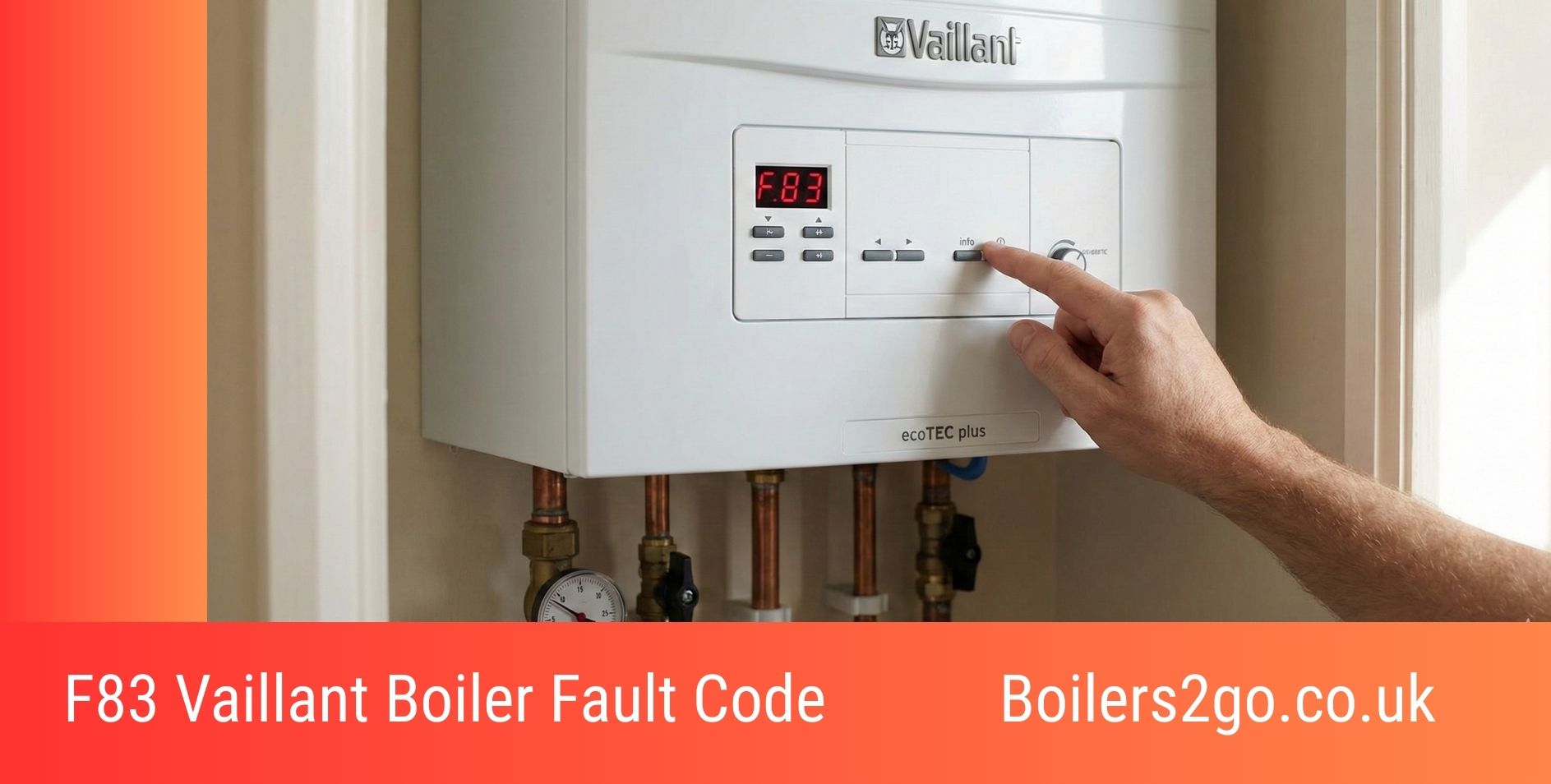
Your Vaillant boiler is showing the F83 fault code as a diagnostic alert, locking out the burner to protect the system when it senses abnormal temperature behaviors in the primary circuit of your domestic heating appliance.
This common error on models like the ecoTEC, ecoFIT, or atmoTEC series signals a temperature discrepancy in the flow and return pipes, where the boiler detects no or incorrect temperature rise after ignition, potentially linked to sensor malfunctions or circulation issues in your gas boiler setup.
In this guide, I’ll decode the F83 fault, often tied to NTC thermistors or water flow problems, offering clear explanations, causes, and fixes.
While some checks are homeowner-friendly, always involve a Gas Safe registered engineer for safety, as Vaillant boilers handle high-pressure water and natural gas to prevent hazards like leaks or inefficient combustion in your home heating installation.
Get a quote today and take the stress out of replacing your boiler. At Boilers2Go, we offer fast, reliable installation across the UK - often as soon as the next day. 
Need a new boiler?
What Does the F83 Vaillant Boiler Fault Code Mean?
The F83 Vaillant boiler fault code means the unit has registered an insufficient or erroneous temperature increase in the flow and return NTC sensors shortly after the burner activates, halting operation to avoid potential damage or inefficiency in your combi boiler or system boiler. This issue can occur due to various reasons, such as a malfunctioning thermostat, blocked pipes, or issues with the heat exchanger. For a clearer understanding of similar faults, the vaillant boiler f72 error explanation provides insights into how temperature discrepancies can affect boiler performance. Addressing these errors promptly is crucial to maintaining the efficiency and longevity of your heating system.
Causes
Faulty Flow or Return Temperature Sensor
A faulty flow or return temperature sensor, often an NTC thermistor, provides inaccurate readings to the PCB, mimicking no heat transfer and triggering the F83 error in Vaillant boilers exposed to hard water scaling common in UK regions like the South East.
How to Fix It: Isolate power and visually inspect the sensors for corrosion, clean gently if accessible per the user manual. Test resistance with a multimeter (should be around 10k ohms at 20°C); if faulty, replace with genuine Vaillant parts.
Homeowners can attempt this, but a Gas Safe engineer ensures proper calibration, typically costing £100-£200 including diagnostics to maintain boiler efficiency.
Low System Water Pressure
Low system water pressure drops below 1 bar, impeding circulation and causing the boiler to misread temperature deltas, a frequent culprit for the F83 code in unsealed systems with minor leaks in radiators or pipes.
How to Fix It: Check the pressure gauge, top up to 1.2-1.5 bar via the filling loop, bleeding radiators afterward to expel air. Monitor for drops indicating leaks; seal visible ones with tape temporarily. For landlords, schedule a pressure test by a professional to comply with rental safety checks, preventing recurrence and preserving heat output.
Circulating Pump Failure
Circulating pump failure, due to seizure or wear after 5-10 years, stalls water movement, leading to stagnant temperatures and the F83 fault in the primary heat exchanger circuit of your Vaillant heating system.
How to Fix It: Listen for the pump hum, silence means it’s stuck; free it by tapping gently or using the manual speed selector. Add lubricant if specified. Full replacement involves draining the system; opt for a Gas Safe specialist to install an energy-efficient model like Wilo, enhancing long-term reliability for multi-property owners.
Blocked Heat Exchanger
A blocked heat exchanger from limescale or sludge buildup restricts flow, causing uneven heating and false F83 alerts, prevalent in older UK properties without magnetic filters or inhibitors.
How to Fix It: Flush the system with a chemical cleaner like Fernox, circulating for hours before rinsing. Install a scale reducer in hard water areas. Severe blocks require power flushing by experts, a £400-£600 service that restores efficiency and cuts energy bills for eco-conscious homeowners.
Air Trapped in the System
Air trapped in the system creates pockets that disrupt smooth circulation, fooling sensors into detecting no temperature rise and activating the F83 code post-refilling or bleeding in vented boiler setups.
How to Fix It: Bleed all radiators starting from the top floor, refilling slowly to avoid surges. Use an automatic air vent if fitted. Persistent air suggests a leak; pressure test and seal. A heating engineer can purge the loop thoroughly, ideal for landlords ensuring tenant comfort without frequent call-outs.
Wiring or Connection Issues
Wiring or connection issues, like loose harnesses or corrosion from condensation, interrupt sensor signals to the control board, simulating a temperature fault in damp-prone boiler locations such as garages.
How to Fix It: Power off and check external wires for secure fits, reconnect if loose. Avoid internal tampering; a qualified electrician or Gas Safe pro should trace faults with a continuity tester, rewiring to BS 7671 specs for safe operation.
FAQs
How Can Annual Servicing Help Avoid the F83 Vaillant Fault Code?
Regular Gas Safe inspections calibrate sensors and flush debris early, potentially halving fault risks per industry data, while boosting your boiler’s A-rating for lower carbon footprints in sustainable UK homes.
Does the F83 Code Vary Across Vaillant Boiler Models?
While core to ecoTEC pros, it may manifest differently in turboMAX due to sensor tech variances—consult your specific manual or Vaillant’s app for model-tailored resets, handy for landlords with mixed fleets.
Can Smart Controls Influence the F83 Vaillant Error?
Overly aggressive zoning from thermostats like vSMART might strain pumps, indirectly prompting F83; fine-tune schedules via the app for balanced flow, aligning with modern home automation trends.
What’s the Typical Repair Timeline for an F83 Fault?
Simple sensor swaps take 1-2 hours, but exchanger cleans span a day—factor in engineer availability, with same-day options from providers like British Gas for minimal downtime in rental scenarios.
Is the F83 Vaillant Code Linked to Energy Tariff Changes?
Indirectly, as higher usage on variable tariffs stresses components; switch to fixed deals post-fix for predictable bills, per Ofgem advice, enhancing financial planning for property investors.

I’m Penny North, a home energy heating expert. My mission is to demystify new boilers and complex heating systems to help you achieve a warm, cosy home with lower energy bills and a smaller environmental footprint.