

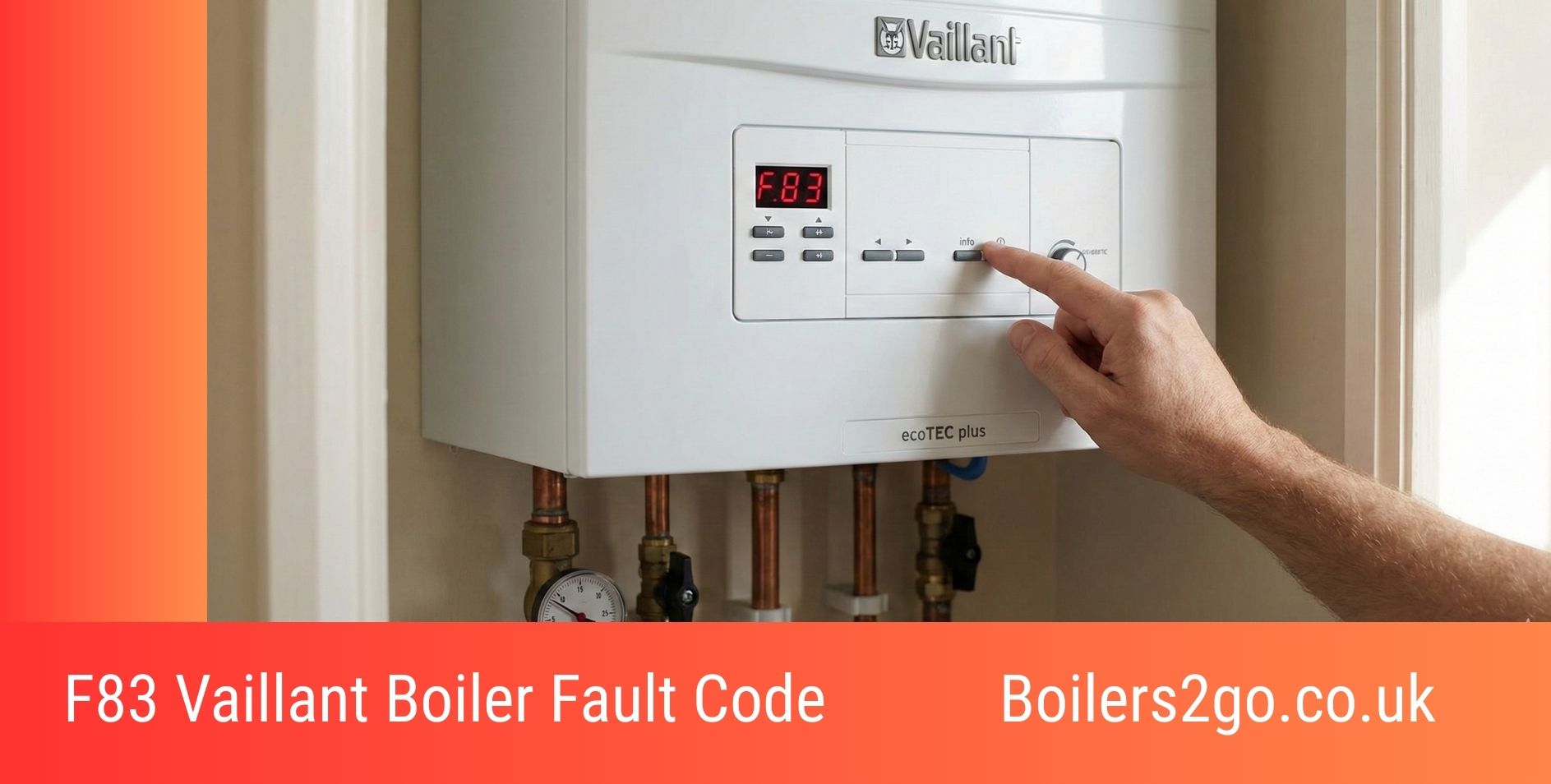
Your Vaillant boiler is showing the F83 fault code as a diagnostic alert, locking out the burner to protect the system when it senses abnormal temperature behaviors in the primary circuit of your domestic heating appliance. For other faults, see our full guide to Vaillant boiler error codes.
This common error on models like the ecoTEC, ecoFIT, or atmoTEC series signals a temperature discrepancy in the flow and return pipes, where the boiler detects no or incorrect temperature rise after ignition, potentially linked to sensor malfunctions or circulation issues in your gas boiler setup.
In this guide, I’ll decode the F83 fault, often tied to NTC thermistors or water flow problems, offering clear explanations, causes, and fixes.
While some checks are homeowner-friendly, always involve a Gas Safe registered engineer for safety, as Vaillant boilers handle high-pressure water and natural gas to prevent hazards like leaks or inefficient combustion in your home heating installation.
Get a quote today and take the stress out of replacing your boiler. At Boilers2Go, we offer fast, reliable installation across the UK - often as soon as the next day. 
Need a new boiler?
What Does the F83 Vaillant Boiler Fault Code Mean?
The F83 Vaillant boiler fault code means the unit has registered an insufficient or erroneous temperature increase in the flow and return NTC sensors shortly after the burner activates, halting operation to avoid potential damage or inefficiency in your combi boiler or system boiler. Our guide to the Vaillant F72 fault code covers a related temperature sensor fault.
What Causes the Vaillant F83 Fault Code?
Faulty Flow or Return Temperature Sensor
A faulty flow or return temperature sensor, often an NTC thermistor, provides inaccurate readings to the PCB, mimicking no heat transfer and triggering the F83 error in Vaillant boilers exposed to hard water scaling common in UK regions like the South East.
How to Fix It: Testing and replacing a flow or return temperature sensor means working inside the boiler casing, so it’s a job for a Gas Safe registered engineer. They’ll check the sensors against Vaillant’s specifications, make sure each one is seated correctly on its pipe, and fit a genuine Vaillant replacement if needed.
Low System Water Pressure
Low system water pressure, typically below 1 bar, reduces circulation through the boiler. Vaillant lists insufficient water in the boiler as a cause of F83, so low pressure is one of the first things to check, especially if the system has a slow leak from a radiator valve or pipe joint.
How to Fix It: Check the pressure gauge and top up through the filling loop to the pressure your installer recommends, usually between 1 and 1.5 bar when the system is cold. Bleed the radiators afterwards and recheck. If the pressure keeps dropping, there is a leak or a fault with the pressure relief valve or expansion vessel that a heating engineer should find and repair.
Circulating Pump Failure
Circulating pump failure, due to seizure or wear, stalls water movement, leading to stagnant temperatures and the F83 fault in the primary heat exchanger circuit of your Vaillant heating system.
How to Fix It: If the boiler fires but the radiators stay cold and the pump is silent, the pump may have seized or failed. Diagnosing and replacing a pump on a Vaillant boiler involves working inside the casing and usually draining the system, so this is a job for a Gas Safe registered engineer.
Blocked Heat Exchanger
A blocked heat exchanger from limescale or sludge buildup restricts flow, causing uneven heating and false F83 alerts, prevalent in older UK properties without magnetic filters or inhibitors. The same restriction can also let the boiler run too hot and trip its overheat protection, which shows as the Vaillant F20 fault code instead.
How to Fix It: A heating engineer can clean the system with a chemical cleanser, or power flush it if the sludge is severe, then refill it with inhibitor. Fitting a magnetic filter, and a scale reducer in hard water areas, helps stop the problem returning.
Air Trapped in the System
Air trapped in the system creates pockets that disrupt smooth circulation, fooling sensors into detecting no temperature rise and activating the F83 code after the system has been drained, refilled or topped up.
How to Fix It: Bleed all radiators starting from the top floor, refilling slowly to avoid surges. Use an automatic air vent if fitted. Persistent air suggests a leak; pressure test and seal. A heating engineer can purge the loop thoroughly, ideal for landlords ensuring tenant comfort without frequent call-outs.
Wiring or Connection Issues
Wiring or connection issues, like loose harnesses or corrosion from condensation, interrupt sensor signals to the control board, simulating a temperature fault in damp-prone boiler locations such as garages.
How to Fix It: Wiring checks inside the boiler casing are a job for a Gas Safe registered engineer, who can test the sensor connections and wiring harness and repair or replace them as needed.
How to Fix the Vaillant F83 Fault Code
To fix the Vaillant F83 fault code, start with the checks that are safe for a homeowner: make sure there is enough water in the system and that it can circulate, then reset the boiler. If F83 returns, the cause is inside the boiler and needs a Gas Safe registered engineer.
Vaillant F83 Checks You Can Safely Do Yourself
- Check the pressure: if the gauge reads below 1 bar, top up through the filling loop to the pressure your installer recommends. Our guide to low boiler pressure explains how.
- Bleed the radiators: release trapped air from any radiators that are cold at the top, then recheck the pressure and top up again if needed.
- Check radiator valves are open: make sure enough radiators are turned on for water to circulate around the system.
- Reset the boiler: press the reset button and let the boiler try to fire. If you’re unsure how, see our guide on how to reset a boiler.
Vaillant F83 Repairs for a Gas Safe Engineer
If F83 comes back after these checks, call a Gas Safe registered engineer. Depending on the cause, they will:
- check the pump is running, and replace it if it has seized or failed
- clear an airlock in the heat exchanger and vent the boiler properly
- test the flow and return temperature sensors and make sure each one is correctly positioned on its pipe
- inspect the sensor wiring and connections to the main PCB
- check for sludge or scale restricting flow through the heat exchanger
Don’t keep resetting the boiler if F83 keeps returning. Firing a boiler that has too little water or poor circulation risks overheating and damaging the heat exchanger.
Vaillant F83 Fault Code: FAQs
Can Annual Servicing Help Prevent the Vaillant F83 Fault Code?
Yes. An annual service by a Gas Safe registered engineer helps catch the causes of F83 early. The engineer checks the system pressure, the pump and the condition of the system water, so problems such as sludge build-up or a failing pump can be dealt with before they cause a lockout.
Does the F83 Code Mean the Same on All Vaillant Boilers?
Broadly, yes. On Vaillant ecoTEC boilers, F83 means the flow or return temperature sensor registered no temperature change, or too small a change, when the burner started. Fault code lists differ between Vaillant ranges and generations, so check the manual for your specific model.
Can a Thermostat Cause the Vaillant F83 Fault Code?
Not usually. F83 is triggered by what the boiler measures in its own flow and return pipes, so the usual causes are low water pressure, trapped air, a pump fault or a sensor problem rather than the heating controls. If the fault only appears when certain zones are calling for heat, ask an engineer to check the zone valves are opening properly.
How Long Does It Take to Fix a Vaillant F83 Fault?
It depends on the cause. Topping up the pressure or bleeding radiators takes minutes, and an engineer can usually replace a sensor or pump in a single visit if the part is available. A system clean or power flush takes longer.
Is It Safe to Keep Resetting a Vaillant Boiler Showing F83?
No. One reset after checking the pressure and bleeding the radiators is fine, but if F83 keeps coming back, stop and call a Gas Safe registered engineer. Repeatedly firing a boiler without enough water or circulation risks overheating and damaging the heat exchanger.

I’m Penny North, a home energy heating expert. My mission is to demystify new boilers and complex heating systems to help you achieve a warm, cosy home with lower energy bills and a smaller environmental footprint.