

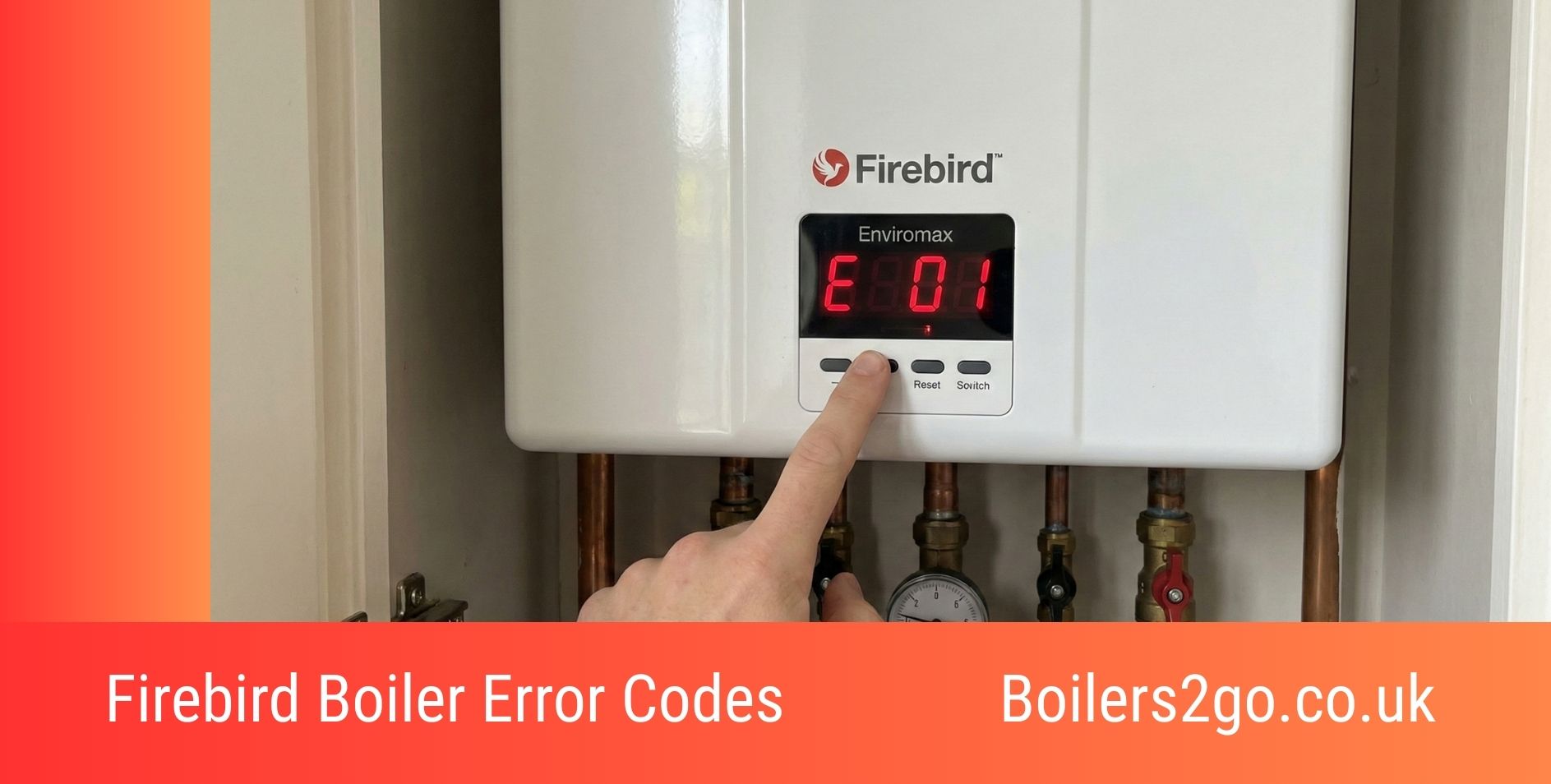
Firebird boiler error codes are electronic signals displayed on the LCD panel or via indicator lights that flag a potential fault in the boiler’s operation, from thermistor malfunctions to burner lockouts.
These codes act as a safety feature in Firebird’s oil-fired boilers, shutting down the unit to prevent damage or hazards such as incomplete combustion in the domestic heating system.
Get a boiler cover, repair and annual service plan online here >
Common in rural UK properties reliant on an oil tank, these alerts help maintain compliance with OFTEC installation standards and support energy efficiency in the home or a rental property.
This guide covers the most common Firebird fault codes on models like the Enviromax C26, C33 and Combi 26, explaining what they mean, why they happen, and practical fixes to get the system back online safely.
Firebird boilers are oil-fired rather than gas, so any work beyond the checks below should be carried out by a technician registered with OFTEC, the body that regulates oil heating installation and servicing in the UK, rather than a Gas Safe registered engineer.
Many of these codes can be prevented by keeping up with annual maintenance; our guide to oil boiler servicing costs covers what a service involves.
Get a quote today and take the stress out of replacing your boiler. At Boilers2Go, we offer fast, reliable installation across the UK - often as soon as the next day. 
Need a new boiler?
Firebird Error Code E1: Control Thermistor Fault
Firebird error code E1 means there is a fault with the control thermistor, the sensor that monitors the boiler’s main water temperature to regulate heating output.
What Causes Firebird E1?
- Wiring damage or loose connections: vibration from the pump or nearby appliances can loosen thermistor wires over time, particularly in older installations.
- Sensor corrosion or wear: exposure to moisture in a damp utility room can cause the thermistor’s resistance to drift, affecting accurate readings.
- PCB miscommunication: the printed circuit board fails to read the sensor correctly, sometimes following electrical disturbance from a power surge.
How to Fix Firebird E1
- With the boiler powered off at the isolator, a visual check of accessible thermistor leads can reveal an obviously loose or frayed connection, though live wiring should never be touched.
- An OFTEC registered technician can test the thermistor’s resistance and replace it if it is out of specification.
- If wiring and the sensor both check out, the technician can test the control board itself for a fault.
Firebird Error Code E2: Flue Thermistor Fault
Firebird error code E2 indicates a fault in the flue thermistor, the sensor tracking exhaust gas temperature to ensure safe venting.
What Causes Firebird E2?
- Soot build-up on the sensor from incomplete oil combustion, more likely on boilers that have gone without a service for some time.
- High-temperature damage from restricted airflow, sometimes linked to long flue runs exposed to the weather.
- Connection faults from corroded terminals, often caused by condensation in the flue chamber.
How to Fix Firebird E2
- An OFTEC registered technician can clean soot from the sensor as part of a service and test it at operating temperature.
- A faulty thermistor can be swapped, with a combustion analysis carried out afterwards to confirm safe operation.
- The flue itself should be checked for blockages such as debris or nesting, which supports compliance with BS 5410 oil firing standards.
Firebird Error Code E3: Secondary Flue Thermistor Fault
Firebird error code E3 signals a secondary flue thermistor fault, similar to E2 but tied to a backup safety sensor on many Enviromax condensing models.
What Causes Firebird E3?
- Dual sensor degradation with age, more likely on boilers that have gone several years without an annual service.
- Moisture ingress from a leaking condensate trap, which can corrode the secondary thermistor on condensing models.
- Electrical disturbance from a faulty external control affecting the sensor circuit.
How to Fix Firebird E3
- A technician can compare resistance readings between the primary and secondary sensors to identify a mismatch.
- Where needed, both sensors are often replaced together for reliability, with the control panel recalibrated afterwards.
- Flushing the condensate trap and checking inhibitor levels helps prevent moisture-related recurrence.
Firebird Error Code E5: Burner Fault
Firebird error code E5 means a burner fault, typically a lockout following failed ignition or flame detection.
What Causes Firebird E5?
- Oil supply interruption from a low tank level or a blocked filter, more common in off-grid homes during peak winter demand.
- Electrode misalignment, where dirty or incorrectly gapped spark electrodes fail to ignite the kerosene.
- Photocell blockage, where soot covers the flame sensor and prevents detection after short-cycling.
How to Fix Firebird E5
- Check the oil tank gauge and replace a clogged inline filter if accessible, then reset via the control knob.
- An OFTEC registered technician can clean and re-gap the electrodes to the manufacturer’s specification.
- The photocell can be cleaned or replaced if cracked, followed by a full burner pressure test to confirm correct operation.
Firebird Error Code EA: System Overheat
Firebird error code EA indicates a system overheat, where the high-limit thermostat cuts power to prevent the water reaching an unsafe temperature.
What Causes Firebird EA?
- Poor circulation from sludge or airlocks slowing water flow, creating hot spots in the heat exchanger.
- A stuck high-limit thermostat that fails to reset, sometimes linked to limescale in hard water areas.
- Pump seizure, particularly after a period of inactivity such as in a holiday home.
How to Fix Firebird EA
- Bleeding air from radiators and repressurising the system via the filling loop resolves some cases without needing a technician visit.
- The high-limit thermostat has a manual reset button; if it will not hold, it needs testing and possibly replacing.
- A seized or worn pump can be serviced or replaced, often alongside a power flush to clear sludge and restore even flow.
Firebird Boiler Error Codes: FAQs
How Often Do Firebird Boilers Need Servicing to Avoid Error Codes?
Annual servicing by an OFTEC registered technician is a requirement of most Firebird warranties, and it is also the most effective way to catch sensor drift, soot build-up and other early signs before they trigger a lockout.
Can Oil Quality Affect Firebird Error Codes?
Yes. Using poor quality or contaminated kerosene can increase soot deposits on flue sensors, contributing to codes such as E2 or E5 appearing more often. Sourcing fuel from a reputable supplier reduces this risk.
Does Ignoring Firebird Error Codes Affect the Warranty?
Ignoring codes and skipping the annual service can put your warranty at risk. Firebird warranty terms vary by model and registration, and annual servicing by an OFTEC registered technician is typically a condition of cover, so check your warranty documents for the exact terms.
Repeatedly resetting a fault instead of having it diagnosed properly can risk both further damage and the warranty itself.
Do Firebird Combi Boilers Show Different Error Codes to System Boilers?
Mostly not. Core codes such as E1, E2 and E5 are broadly shared across the range, though combi models can show additional hot-water-specific alerts not seen on sealed system or regular boilers.
Always check the fault code against the specific model’s own manual, since numbering can vary slightly between the Enviromax and Envirogreen ranges.
How Does Oil Tank Location Affect Firebird Burner Faults?
Tanks exposed to the elements or prone to sludge and condensation build-up can contribute to blocked filters and E5-type lockouts. Regular filter changes and keeping the tank in good condition helps prevent this in remote or off-grid properties. The same fuel-supply issues cause burner lockouts on other oil boilers too, as our guide to Grant boiler error codes shows.
Can I Reset a Firebird Boiler Myself?
Yes, once. A single reset after an obvious, resolved issue such as a genuinely empty tank is reasonable. If the code returns, it should be diagnosed by an OFTEC registered technician rather than reset repeatedly.
Get a quote today and take the stress out of replacing your boiler. At Boilers2Go, we offer fast, reliable installation across the UK - often as soon as the next day.
Need a new boiler?

I’m Penny North, a home energy heating expert. My mission is to demystify new boilers and complex heating systems to help you achieve a warm, cosy home with lower energy bills and a smaller environmental footprint.