

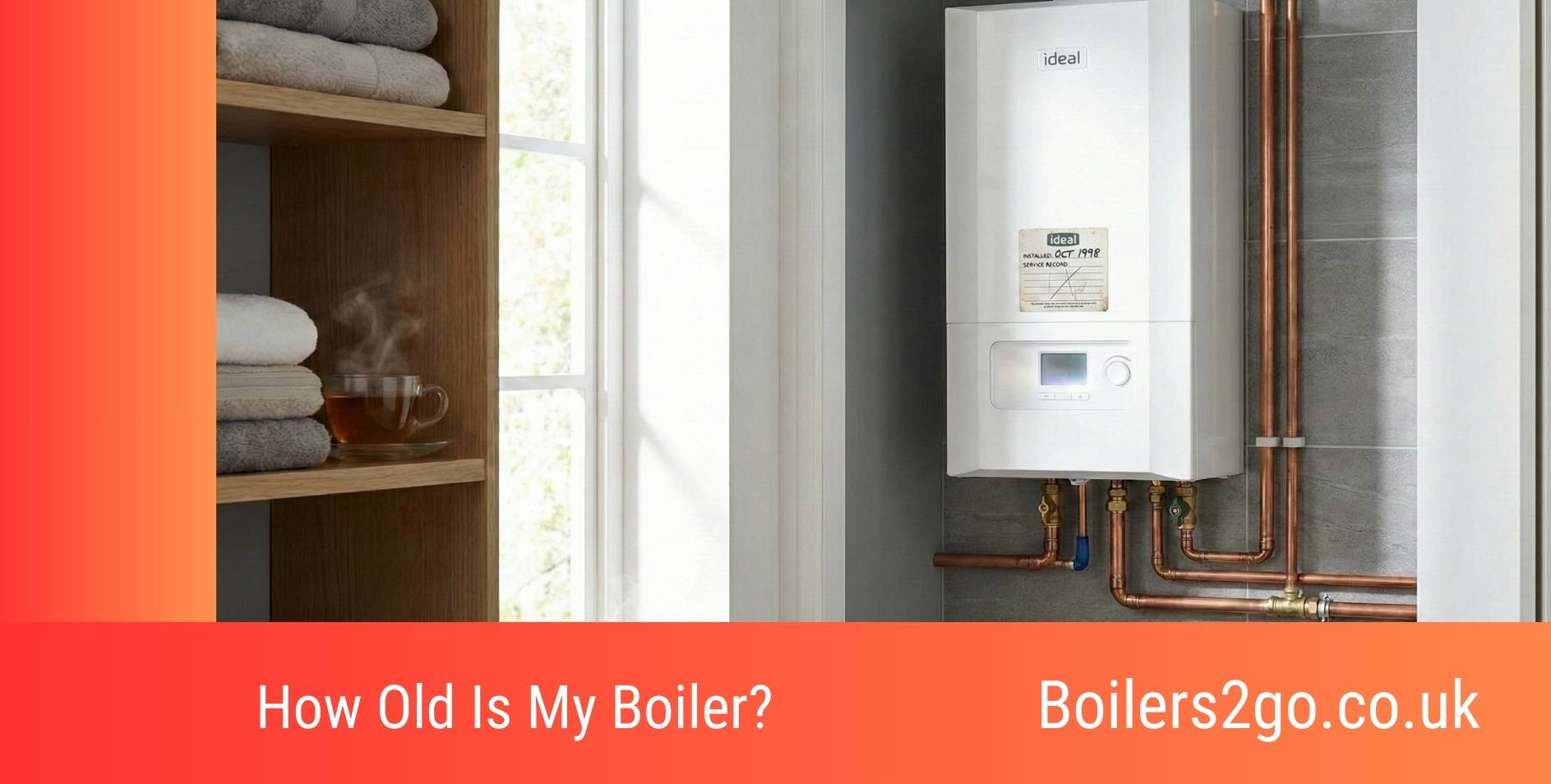
Knowing the age of a boiler is not just a matter of curiosity. It is a vital piece of information for any UK property owner, directly affecting everything from annual heating bills to the overall safety and reliability of a home’s central heating system.
Whether the property has a combi, system, or conventional boiler, this guide walks through the sometimes tricky process of determining its age, helping inform decisions around maintenance or an eventual replacement.
Get a quote today and take the stress out of replacing your boiler. At Boilers2Go, we offer fast, reliable installation across the UK - often as soon as the next day. 
Need a new boiler?
Where Can the Boiler Serial Number Be Found?
The boiler serial number, a key piece of information for determining its age, is usually found on a sticker or label directly on the boiler casing, or within the official documentation.
This serial number is like the boiler’s unique fingerprint, a long string of letters and numbers that contains coded information about its date of manufacture.
There are three primary places worth checking to locate this serial number.
On the Boiler’s Exterior
Look for a sticker on the underside of the boiler, the side panel, or, most commonly, on the inside of the drop-down flap or panel at the front. This label often features a barcode next to the serial number.
The Benchmark Certificate
This important piece of paperwork, often found in the installation manual, is completed by a Gas Safe registered engineer upon installation and during annual services. It should clearly record the installation date and often includes the boiler’s serial number, and is particularly useful for landlords needing proof of compliance.
The Installation Manual
If the sticker is faded or missing, a common issue with an older boiler, the owner’s manual or installation instructions provided with the boiler system should list the serial number and model information.
Get a quote today and take the stress out of replacing your boiler. At Boilers2Go, we offer fast, reliable installation across the UK - often as soon as the next day.
Need a new boiler?
How to Decode a Boiler’s Serial Number to Find Its Age
Once the serial number is in hand, its age can usually be decoded by identifying the specific digits or characters within the sequence that correspond to the year of manufacture and, sometimes, the week.
There is not one universal code, since each boiler manufacturer, from Worcester Bosch and Vaillant to Ideal and Baxi, uses its own format. Knowing the exact make and model first makes it easier to find the right decoding guidance, and our guide on what type of boiler you have can help with that.
Baxi boilers: for models manufactured after 2003, the 4th and 5th digits of the serial number typically indicate the year of manufacture, with the 6th and 7th digits often representing the week.
Vaillant boilers: serial numbers are often long, 20 to 28 characters. The 3rd and 4th characters typically represent the year of manufacture, with the following two numbers indicating the assembly week.
Ideal boilers: coding varies considerably by model, such as Logic, Mini, or Classic. For newer models from 2015 onwards, the date may be printed clearly at the end in DD/MM/YY format. For older Ideal Classic models, the third cluster of four digits often contains the year and week of production.
Worcester Bosch boilers: these can be tricky, since the serial numbers were often designed for internal use. For many models, the manufacturing date is hidden in the 11th, 12th, and 13th digits, or requires specific decoding. Contacting Worcester Bosch or a Gas Safe engineer with the full serial number is usually the quickest solution.
If the code cannot be deciphered, every manufacturer has a dedicated technical support line. Providing the serial number will usually get a definitive answer on the exact year the appliance was produced.
Why Is Knowing a Boiler’s Age So Important?
Knowing the age of a boiler makes it possible to assess its reliability, efficiency, and likely future maintenance costs, which can help save money and maintain safety.
A boiler’s age correlates closely with its performance and the risks it carries, which is worth understanding across a few different areas.
How Boiler Age Affects Efficiency and Energy Bills
Most modern condensing boilers, installed since the early 2000s, are A-rated with an energy efficiency of over 90%. Older, non-condensing models can have an efficiency rating as low as G, meaning they waste over 30% of the fuel consumed. The difference is stark, and an older heating system will cost noticeably more to run. Our guide on how to know if your boiler is condensing can help confirm which type is currently installed.
The average UK domestic boiler lifespan sits between 10 and 15 years. Once a boiler passes the 10-year mark, it is generally worth starting to think about a potential replacement.
For UK landlords, efficiency is not just about saving money. It is about providing tenants with an adequate, cost-effective heating solution, since an inefficient, ageing boiler can lead to tenant complaints and higher utility costs. If the boiler heats a hot water cylinder, a jacket is a cheap way to cut standby heat loss in the meantime, and our guide on how to insulate a hot water tank walks through it step by step.
How Boiler Age Affects Reliability and Breakdown Risk
As internal components such as the heat exchanger, pump, and valves age, wear and tear become inevitable. An older boiler is far more prone to frequent and costly breakdowns, particularly during the coldest winter months when central heating is relied on most. Finding replacement parts for discontinued models can also become genuinely difficult, leading to long periods without heat or hot water.
How Boiler Age Affects Safety
The most critical factor is safety. Older boilers, especially those that have not been properly maintained, carry a higher risk of developing faults, including the potential for carbon monoxide leaks, an invisible, odourless, and genuinely dangerous gas. Modern boilers have better safety features, but an annual service is non-negotiable for any unit, especially an older one.
How Can You Tell a Boiler’s Age Without the Serial Number?
If the boiler’s serial number cannot be found, there are several reliable alternatives for determining its age.
The Benchmark Certificate or installation invoice will contain the date the appliance was first installed, giving a highly accurate reflection of the boiler’s age within the property.
Every boiler model also has a unique Gas Council, or GC, number. While this does not give the exact manufacture date, it is a code a Gas Safe engineer can use to look up the start and end years of that particular model’s production, which can narrow down the age range considerably for an old, discontinued model.
The property’s Energy Performance Certificate may also contain details about the heating system, including the type and sometimes the age of the boiler, particularly useful for a landlord or someone who has recently bought the home.
Finally, a Gas Safe registered engineer will be able to look at the boiler model, casing style, and internal components to provide a good estimate of its age, often with access to industry-specific databases that can decode even obscure serial numbers.
Should You Replace an Old Boiler?
Once the boiler’s age is known, an age pushing past 10 or 12 years likely means sitting on an inefficient, higher-risk, and costly appliance. Continuing to pay for frequent repairs on an ageing system rarely makes financial sense in the long run, and it puts peace of mind at risk too.
Upgrading to an A-rated, energy-efficient boiler is one of the more effective investments available for a property, cutting energy bills and providing a reliable source of warmth and hot water for the next decade or more. Anyone ready to explore options can request a free, no-obligation boiler replacement quote. Any installation should be carried out by an engineer listed on the Gas Safe Register.
How Old Is My Boiler: FAQs
Does Boiler Age Affect Home Insurance?
Yes, particularly for a home emergency or boiler breakdown policy. Many insurers place an age limit, typically around 12 to 15 years, on the boilers they are willing to cover for repairs.
If the boiler is older than this, the policy excess may be higher, or the policy may only cover a repair up to a certain value, encouraging a full replacement instead. It is always worth checking the specific terms and conditions of a policy.
Can the Model Number Tell You a Boiler’s Age?
Generally, no. The model number, such as Logic Plus or Combi 30, only identifies the type and series of a boiler, not the specific date it was manufactured. The model number remains the same across a production run of several years, so the unique serial number, or the installation date on the Benchmark Certificate, is needed to pinpoint the exact age of an individual appliance.
Is It Cheaper to Repair or Replace an Old Boiler?
For a boiler over 10 years old, a major repair can quickly become uneconomical compared with a replacement. Replacing a part such as the heat exchanger or circuit board can easily run into the hundreds of pounds, sometimes reaching over £1,000, so upgrading to a more efficient model often makes more sense and can lead to long-term savings on energy bills. Our guide on whether to repair or replace your boiler covers the decision in more detail.
When the reduced efficiency and lack of a long warranty on a repaired old boiler are factored in, investing that money into a new, A-rated boiler, which comes with a long-term guarantee of up to 12 years, often provides better long-term value and significant savings on energy bills.
Are There UK Grants for Replacing an Old Boiler?
Yes, government-backed schemes are available in the UK, such as the ECO4 scheme (Energy Company Obligation), which runs until 31 December 2026 and is aimed at helping low-income or vulnerable households improve their home’s energy efficiency. Councils also offer support through the Warm Homes: Local Grant.
A very old, non-condensing, G-rated boiler may make a property eligible for a grant covering some or all of the cost of a new, highly efficient heating system. It is worth searching for current UK government and local council energy-saving schemes for the latest information, since eligibility and funding levels can change.
Is There a Legal Age Limit for Boilers in Rental Properties?
No. There is no specific legal maximum age limit for a boiler in a rented UK property, but landlords have a legal obligation to ensure all gas appliances, including the boiler, are safe.
This is confirmed through an annual Gas Safety Check carried out by a Gas Safe registered engineer, resulting in a Landlord Gas Safety Record (CP12). If an older boiler is deemed unsafe or not working correctly, the engineer will report it, and the landlord must address the issue, which often means replacement. The age of the boiler indirectly forces the landlord to consider replacement due to safety and repair costs.
Can a Boiler’s Age Be Estimated From Its Appearance?
To some extent, yes, an experienced Gas Safe engineer can often estimate a rough age range from casing style, control panel design, and the type of display fitted, since these change noticeably between eras. This is far less precise than a serial number or Benchmark Certificate, but it can be a useful starting point if no paperwork or legible serial number is available at all.
Does Warranty History Help Confirm a Boiler’s Age?
Yes, if the original warranty registration can be traced. Most manufacturers require registration within 30 days of installation, and contacting the manufacturer with the property address or the homeowner’s details from that time can sometimes confirm the original installation date, even where the physical documentation has since been lost.
Get a quote today and take the stress out of replacing your boiler. At Boilers2Go, we offer fast, reliable installation across the UK - often as soon as the next day.
Need a new boiler?

I’m Penny North, a home energy heating expert. My mission is to demystify new boilers and complex heating systems to help you achieve a warm, cosy home with lower energy bills and a smaller environmental footprint.