

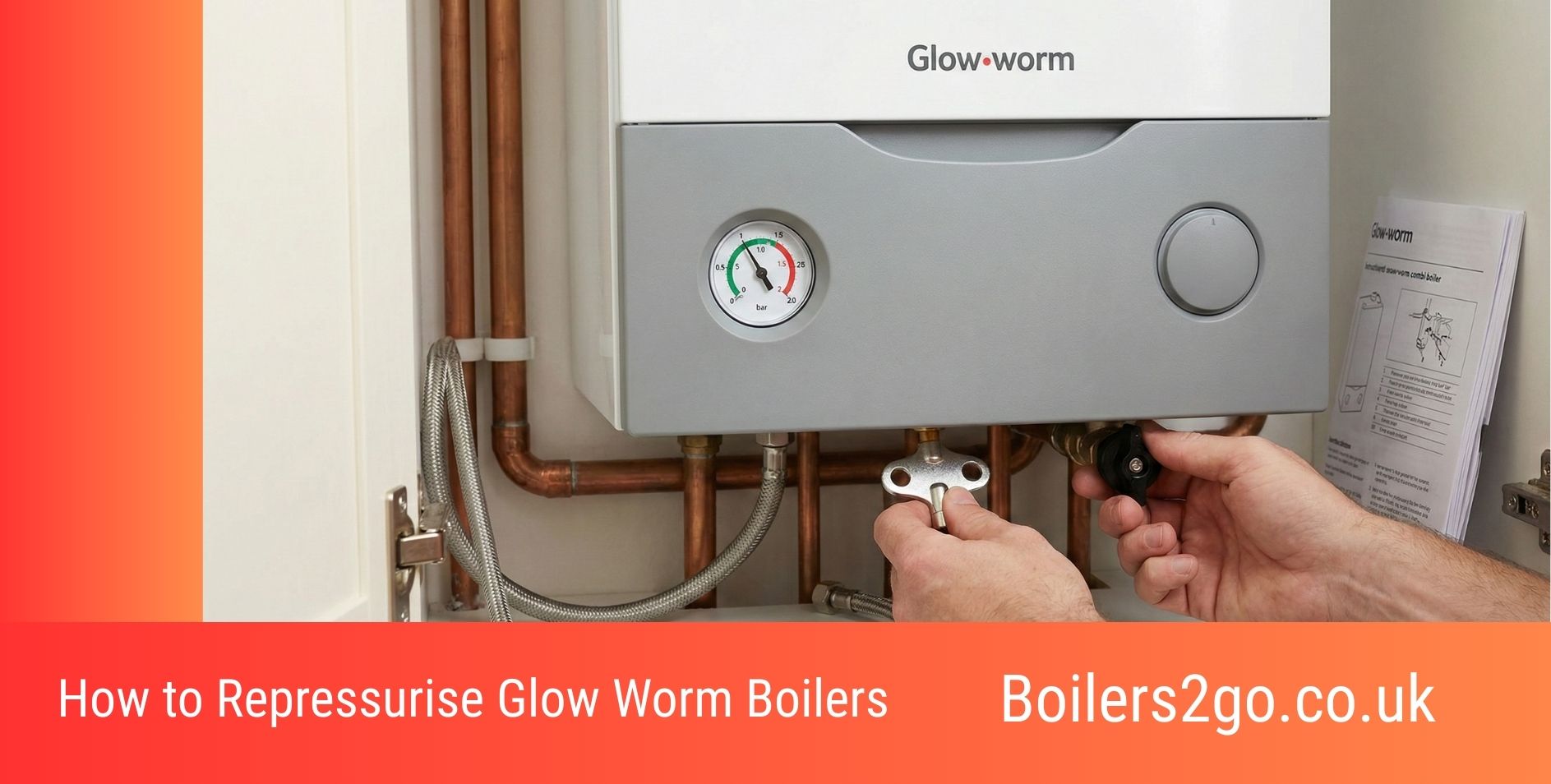
Learning how to repressurise Glow Worm boilers is one of the most common DIY fixes UK homeowners and landlords search for. If your Glow-worm combi boiler (such as the Energy, Betacom, Flexicom, Ultracom, Easicom or Procombi range) is showing a low-pressure fault code – usually F22, F1, L1 or a flashing red light – the system pressure has dropped below 0.5–1 bar.
The good news is that 9 times out of 10 you can fix this yourself in under 10 minutes without calling an engineer.
This guide explains everything: why the pressure drops, exactly how to repressurise every modern Glow-worm boiler model, and how to stop it happening again.
How to Repressurise a Glow Worm Boiler – Step-by-Step (2025 Models)
Every current Glow-worm combi has either an internal filling loop, an external flexible filling loop, or a built-in keyless filling link (Easicom 3 & Energy 3 models). Follow the guide that matches your boiler.
Method 1 – Built-in Keyless Filling Link (Easicom, Energy, Ultimate 3 models)
- Locate the white plastic filling knob underneath the boiler (usually on the right).
- Pull the knob downwards until it clicks and you hear water flowing.
- Watch the pressure gauge rise slowly to 1.3–1.5 bar.
- Push the knob firmly back up until it clicks off.
- Job done – no tools needed.
Method 2 – External Flexible Silver Filling Loop
- Find the braided silver hose with two grey valves (often supplied loose or fixed under the boiler).
- Connect it between the cold mains tap (left) and the heating flow valve (right).
- Slowly open BOTH grey valves a quarter turn.
- Listen for water entering and watch the gauge rise to 1.3–1.5 bar.
- Close both valves tightly and remove the loop (wipe any drips).
Method 3 – Internal Rigid Filling Loop with Black/Blue Lever
- Look for a black or blue lever under the boiler (Flexicom, Ultracom, older Betacom).
- Turn the lever 90° so it’s in line with the pipe.
- Open the small blue cold-water tap next to it (usually a flat-blade screwdriver slot).
- Fill to 1.3–1.5 bar, then close everything in reverse order.
Important: Never exceed 2 bar when the system is cold. If the gauge shoots straight past 3 bar and water pours out of the PRV pipe outside, close everything immediately and call a Gas Safe engineer.
What Causes Low System Pressure on Glow Worm Boilers?
Low pressure doesn’t happen by magic. Here are the real-world causes we see every day in UK homes:
1. A Small Water Leak on the Heating System
The most common cause is a minor leak somewhere on the pipework, radiators or underfloor heating. Even a drip the size of a pinhead can drop 0.1–0.2 bar per week.
2. Recently Bled Radiators
Every time you bleed a radiator you let air out – but you also let a tiny amount of water escape. If you’ve bled several radiators, pressure can drop noticeably.
3. Faulty or Leaking Pressure Relief Valve (PRV)
The orange or yellow safety valve outside the boiler can start weeping if it’s old or clogged with limescale (very common in hard-water areas like London and the South East).
4. Leaking Automatic Air Vent (AAV)
Many Glow-worm boilers have an auto air vent on top of the pump. The float inside can stick and let water drip into the boiler casing. Regular maintenance is essential to prevent overheating and other issues that might arise from a malfunctioning auto air vent. For those experiencing problems, understanding the specific symptoms and resolving them accordingly is crucial, which is where glow worm error codes explained can be invaluable. Familiarizing yourself with these codes can help you quickly identify the issue and take appropriate action to ensure your boiler operates efficiently. One common issue that may arise is indicated by the glow worm boiler f1 fault code, which often points to ignition or flame detection problems. Addressing this fault promptly is important to restore functionality and maintain safety. Consulting the boiler’s manual or a qualified technician can provide further guidance on resolving this specific error.
5. Recent Boiler Service or Repair
If an engineer has drained the system or replaced a part (e.g. expansion vessel or diverter valve), the pressure will be low until it’s topped up again.
6. Faulty Expansion Vessel
The red tank at the back of the boiler absorbs expansion when water heats up. If the diaphragm inside fails or the Schrader valve loses its air charge, pressure can drop quickly after the heating switches off. In such cases, the system may struggle to maintain consistent pressure, leading to potential inefficiencies in heating. If you’re experiencing issues related to this, the glow worm f9 fault explained could provide insight into underlying problems with your boiler system. Regular maintenance and monitoring of these components are essential to ensure optimal performance and prevent sudden breakdowns.
How to Prevent Low Pressure Happening Again
- Check boiler pressure every month – it should sit between 1–1.5 bar when cold.
- Fit a magnetic system filter (e.g. Magnaclean or Fernox TF1) to catch sludge that damages seals.
- Have the boiler serviced every 12 months by a Gas Safe engineer – they will recharge the expansion vessel and check the PRV.
- Fix even tiny radiator valve leaks straight away.
- In hard-water areas, consider a scale reducer or water softener.
When You Absolutely MUST Call a Gas Safe Engineer
You can repressurise the boiler yourself, but call a professional immediately if:
- Pressure drops again within a few days after topping up.
- You see water leaking from the boiler itself or the orange PRV pipe outside.
- The pressure gauge goes above 3 bar and won’t come down.
- You hear banging or kettling noises.
- Any fault code other than F22/F1/L1 appears.
- Your boiler is still under Glow-worm warranty (usually 2–10 years) – DIY work can invalidate it.
FAQs
My Glow-worm boiler shows 0 bar even after filling – what’s wrong?
The pressure gauge itself is probably faulty, or the system has a major leak. A Gas Safe engineer will need to fit a new gauge and pressure-test the system.
Is it normal for pressure to rise to 2.5 bar when the heating is on?
Yes – pressure normally rises 0.5–1 bar when hot. If it climbs above 2.8–3 bar, the expansion vessel has likely failed and needs replacing.
Can I use a external filling loop I bought from Screwfix on my Glow-worm?
Yes, any standard braided filling loop with 15 mm connectors and double check valves is fine, as long as it meets Water Regulations (it should have two isolation valves).
My Glow-worm Easicom 28 has no visible filling knob – where is it?
On 2023–2025 Easicom 3 models the white pull-down lever is hidden behind the drop-down flap at the very bottom right of the boiler.
Will repressurising the boiler reset the F22 fault code automatically?
Yes – once pressure reaches about 0.8 bar the code clears itself within 10–20 seconds and the boiler will fire up again.
Stay warm, The Boilers2Go Team

I’m Penny North, a home energy heating expert. My mission is to demystify new boilers and complex heating systems to help you achieve a warm, cosy home with lower energy bills and a smaller environmental footprint.