

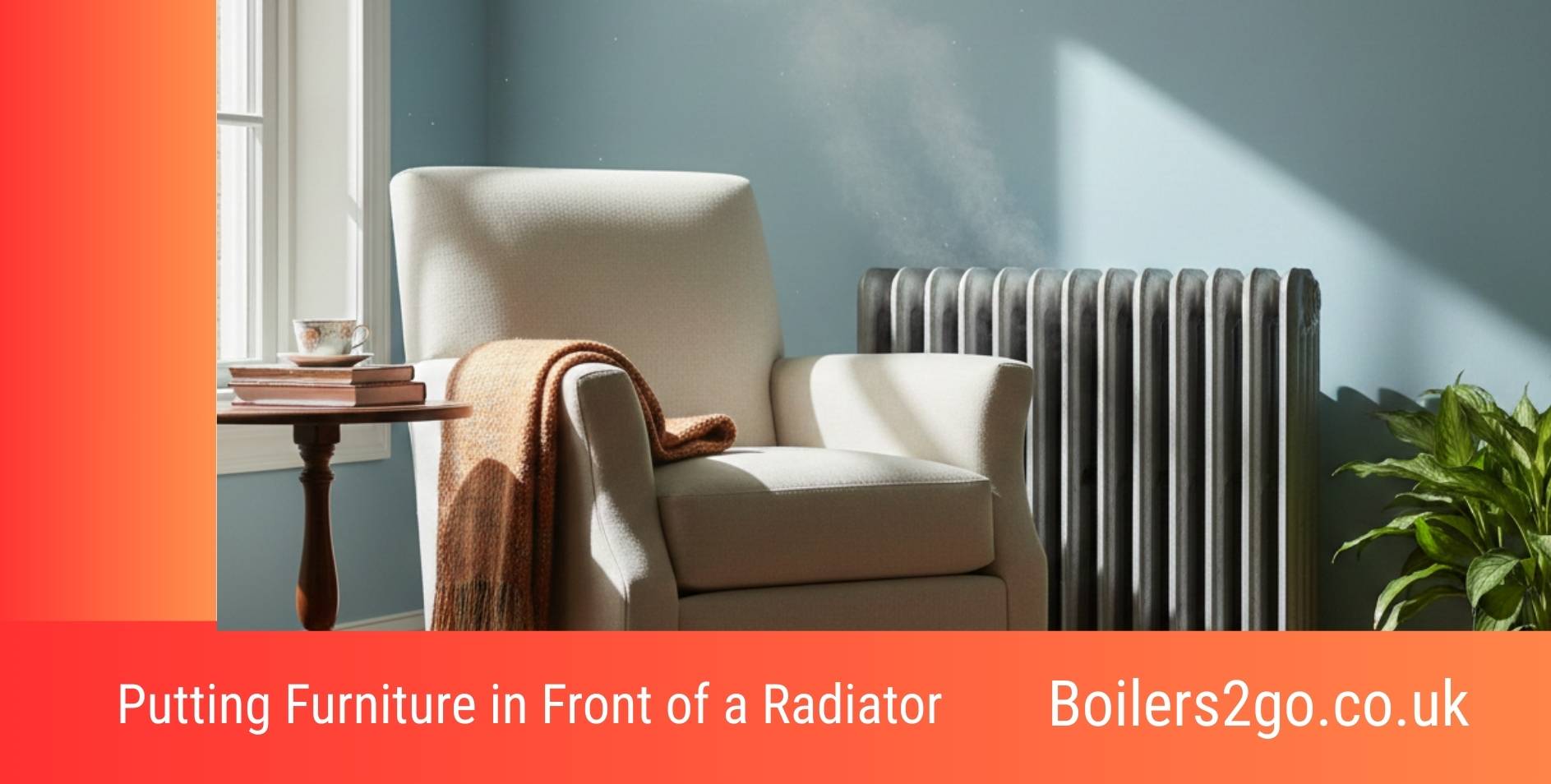
It is one of the most common layout choices in UK homes, and almost nobody questions it. A sofa under the window, a bed pushed back against the wall, a sideboard tucked neatly wherever it fits best. The only problem is that spot is often right in front of a radiator.
Putting furniture in front of a radiator isn’t automatically wrong, but done badly, it can make rooms feel colder, push bills up, and even create hidden damp or safety issues. The truth sits somewhere between never blocking a radiator and it not mattering at all.
This guide breaks down what actually happens when a radiator is blocked, and how to work around furniture without sabotaging the heating.
Get a boiler cover, repair and annual service plan online here >
Why Do Radiators End Up Behind Furniture?
Most UK homes were not designed around modern furniture layouts. Radiators are often placed under windows to counter draughts, on the only long wall in a room, or exactly where a sofa, bed or desk would naturally go.
Add smaller room sizes, rented layouts that cannot be changed, or a simple desire to hide an ageing radiator, and furniture ends up in front of it almost by default. The intention is entirely reasonable. The consequences usually are not.
What Happens When Furniture Blocks a Radiator
Radiators do not just radiate heat directly outward, they circulate air around a room.
Hot water heats the metal, the nearby air warms, that warm air rises, cooler air is pulled in underneath to replace it, and the loop repeats. That movement of air is what heats the whole room, not just the wall behind the radiator.
When furniture sits too close, warm air gets trapped behind it instead of rising, heat pools in one spot instead of spreading through the room, the room feels oddly cold even though the radiator itself is hot, and the boiler ends up running longer trying to reach the thermostat’s target temperature.
Is It Ever OK to Put Furniture in Front of a Radiator?
Yes, as long as it is not smothered. The difference between fine and problematic usually comes down to air gaps and furniture type, not whether something is placed there at all.
What generally works: a clear gap of 10 to 15cm between furniture and the radiator, low or open-backed furniture that lets air escape upward, and sofas or beds positioned slightly forward rather than flush against the wall.
What causes trouble: tall, solid furniture that seals the radiator in, wardrobes, bookcases or boxed-in beds, heavy curtains draped directly over the radiator, and cushions, throws or clothes left resting on top. Think of it as a screen rather than a wall.
Problems Caused by Blocking a Radiator With Furniture
Higher Bills
Blocked radiators do not heat rooms efficiently, so thermostats stay on longer, often without anyone realising why the house still feels chilly. The Energy Saving Trust notes that unobstructed radiators and good heating habits are among the simplest ways UK households can cut wasted energy without any spending on new equipment.
Cold Patches and Condensation
Poor air circulation can leave parts of a room cooler, encouraging condensation behind furniture, a common cause of mould that looks like a wall problem but genuinely isn’t one.
Overheating and Wear
Trapped heat can stress valves and paintwork, shortening a radiator’s practical lifespan over time.
Safety Risks
Soft furnishings too close to radiators can dry out, overheat, or in rare cases pose a fire risk. It also makes surfaces hotter to the touch, which matters for households with young children or pets.
How to Place Furniture Near a Radiator Without Blocking Heat
A full room redesign is not needed, just a strategic approach to what is already there.
- Pull furniture forward slightly. Even a hand’s width helps airflow considerably.
Use slatted or mesh radiator covers designed for convection rather than solid boxes, since the wrong style of cover can end up causing the exact blockage this guide is warning against.
- Swap bulky items for open or legged furniture wherever possible.
- Hang curtains so they sit above the radiator, not draped directly over it.
- Add reflective foil behind the radiator if it sits on an external wall, to bounce heat back into the room rather than losing it through the wall.
Small changes here often make a noticeable difference within a day.
The Underrated Option: Stop Hiding Radiators Altogether
Modern radiators are not all white, ribbed eyesores anymore. Slim vertical designs, coloured panels and minimalist styles can genuinely become part of a room’s look, and when they are left clear, they work better too.
The counter-intuitive truth is that a radiator left visible and unobstructed often heats a room faster and ends up looking cleaner than one buried behind furniture in an attempt to hide it.
If a room still never warms up properly once the furniture is moved, trapped air inside the radiator may be the cause; our guide on how to bleed a radiator walks through the fix.
Furniture in Front of a Radiator: The Bottom Line
Putting furniture in front of a radiator is not a heating crime, but blocking it completely is a slow leak on comfort and efficiency. If clearing the space reveals a radiator that’s hot at the top but cold at the bottom, that points to sludge rather than airflow, as our guide to a radiator cold at the bottom explains.
If rooms feel colder than they should, the boiler seems to run forever, or damp keeps turning up in odd places, it’s worth checking exactly what is sitting in front of the radiators. The fix is often simpler than turning the thermostat up. Sometimes the warmest home isn’t the one with the biggest boiler, it’s the one where the heat is actually allowed to move.
Furniture in Front of Radiators: FAQs
How Much of a Gap Does Furniture Need From a Radiator?
A clear gap of around 10 to 15cm is generally enough for most furniture types, provided the piece is low or open-backed. Solid, tall furniture needs more clearance, or is better avoided in front of a radiator altogether.
Can Putting a Bed in Front of a Radiator Cause Damp?
It can contribute to it, particularly with a solid, boxed-in bed frame flush against the wall. The combination of trapped warm air and reduced circulation behind the bed can encourage condensation, especially on an external wall in a poorly ventilated bedroom.
Do Radiator Covers Always Block Heat?
Not necessarily, but many do. Solid, boxed-in covers with no ventilation trap heat behind them in much the same way as blocking furniture. Covers specifically designed with slats or mesh for convection allow warm air to escape upward and cause far less of an efficiency loss.
Does Furniture in Front of a Radiator Increase Energy Bills?
It can, particularly across an entire house where multiple radiators are blocked. Individually the effect on one room might be modest, but a heating system working harder across several blocked radiators to compensate for uneven heat distribution adds up over a full winter.
Is It Worse to Block a Radiator on an External Wall?
Generally, yes. Radiators on external walls already lose some heat through the wall itself, so blocking the airflow on the room side compounds the problem. Reflective foil behind the radiator, combined with keeping the front clear, helps offset this on external wall installations specifically.
Should Furniture in a Rental Property Be Moved Away From Radiators?
Where possible, yes, since tenants often cannot move a radiator itself but can usually adjust furniture layout. Flagging poor heating performance caused by blocked radiators to a landlord is also reasonable, particularly if it is contributing to a damp or condensation issue that could otherwise be mistaken for a structural problem.

I’m Penny North, a home energy heating expert. My mission is to demystify new boilers and complex heating systems to help you achieve a warm, cosy home with lower energy bills and a smaller environmental footprint.