

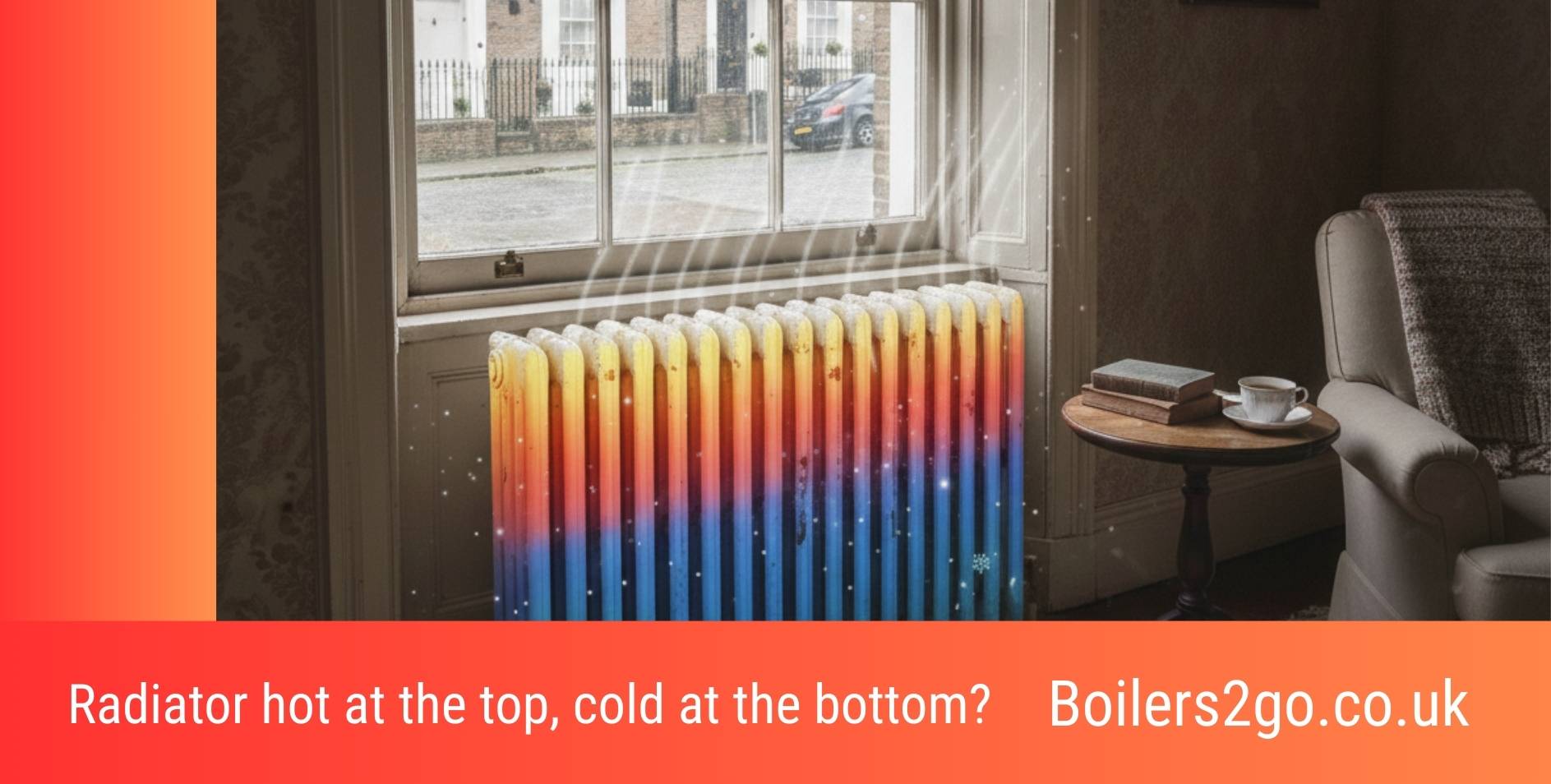
If your radiator is hot at the top but stubbornly cold at the bottom, you’re not alone — it’s one of the most common heating complaints in UK homes. And while it looks like a small annoyance, it’s often your heating system quietly telling you something isn’t right.
The good news? In most cases, it’s fixable. The bad news? Ignoring it can slowly push up bills, reduce comfort, and shorten the life of your boiler.
Let’s break down what this pattern really means — without overcomplicating it.
What that hot-top / cold-bottom pattern actually tells you
Radiators are designed so hot water flows evenly through the entire panel. When only the top heats up, it means hot water is entering the radiator but isn’t circulating properly through the lower section.
In plain terms: heat is getting in, but it’s not getting through.
That usually points to one of three things:
-
Air interrupting circulation
-
Sludge collecting at the base
-
Weak or restricted flow elsewhere in the system
A quick rule of thumb:
-
Cold at the top, warm at the bottom → usually air
-
Hot at the top, cold at the bottom → usually sludge
The most common causes (and why they sneak up on you)
Sludge building up where you can’t see it
Over time, tiny particles of rust, limescale and debris circulate with the heating water. Gravity does the rest. Those particles settle at the bottom of radiators, slowly forming a thick sludge that blocks internal channels.
The radiator still gets hot at the top, so it looks “mostly fine” — but the lower half can’t release heat into the room.
This is especially common in:
-
Older systems
-
Homes without a magnetic filter
-
Areas with hard water
Trapped air (less common, but still possible)
Air usually causes cold patches at the top, but in some systems it can distort circulation enough to create uneven heating that feels like a cold bottom.
If the radiator hisses, gurgles, or warms unevenly after bleeding, air may be part of the picture — just not the whole story.
Poor circulation elsewhere
If several radiators show the same hot-top, cold-bottom pattern, the issue may not be the radiator at all. Weak pumps, partially closed valves, or system-wide sludge can all reduce how effectively hot water moves around your home.
Quick checks you can do before calling anyone
Start simple: bleed the radiator
It costs nothing and rules out trapped air.
Turn the heating off and let the system cool.
Slowly open the bleed valve until air escapes.
Close it once water flows steadily.
Re-pressurise the boiler if needed and test again.
If the bottom still stays cold, air wasn’t the main issue.
Feel more than one radiator
If it’s just one radiator, the problem is likely local.
If it’s several, you’re probably looking at a system issue rather than a single faulty unit.
That distinction matters — and saves wasted effort.
When flushing actually makes sense
If one radiator is hot at the top and cold at the bottom, flushing that radiator alone can often bring it back to life.
This involves isolating it, draining out the dirty water, and flushing clean water through until it runs clear. It’s messier than bleeding, but far cheaper than replacing a radiator that’s structurally fine.
If multiple radiators are affected, that’s when a full system powerflush becomes the sensible option. It clears sludge from pipes, radiators and the boiler heat exchanger — not just the symptom you can see.
When it’s time to call a heating engineer
It’s worth getting professional help if:
-
More than one radiator is cold at the bottom
-
Bleeding and a single flush don’t improve things
-
The boiler is noisy, losing pressure, or short-cycling
-
You’re unsure about isolating valves or refilling pressure
A qualified engineer can tell whether you’re dealing with a local blockage or a wider circulation problem — and fix the cause, not just the symptom.
How to stop it happening again
Once radiators are heating evenly again, prevention matters:
Adding a central-heating inhibitor slows corrosion before sludge forms.
Installing a magnetic filter catches debris before it reaches radiators.
Bleeding radiators annually and keeping pressure stable reduces air ingress.
These small steps protect radiators, pumps and boilers — and quietly cut running costs over time.
The takeaway most homeowners miss
A radiator that’s hot at the top and cold at the bottom isn’t “just one of those things”. It’s an early warning sign — often of sludge — and fixing it sooner is cheaper, easier and less disruptive than waiting until the system struggles or the boiler fails.
Start simple. Escalate only if needed.
Your heating system will thank you — and your bills usually will too.

I’m Penny North, a home energy heating expert. My mission is to demystify new boilers and complex heating systems to help you achieve a warm, cosy home with lower energy bills and a smaller environmental footprint.