

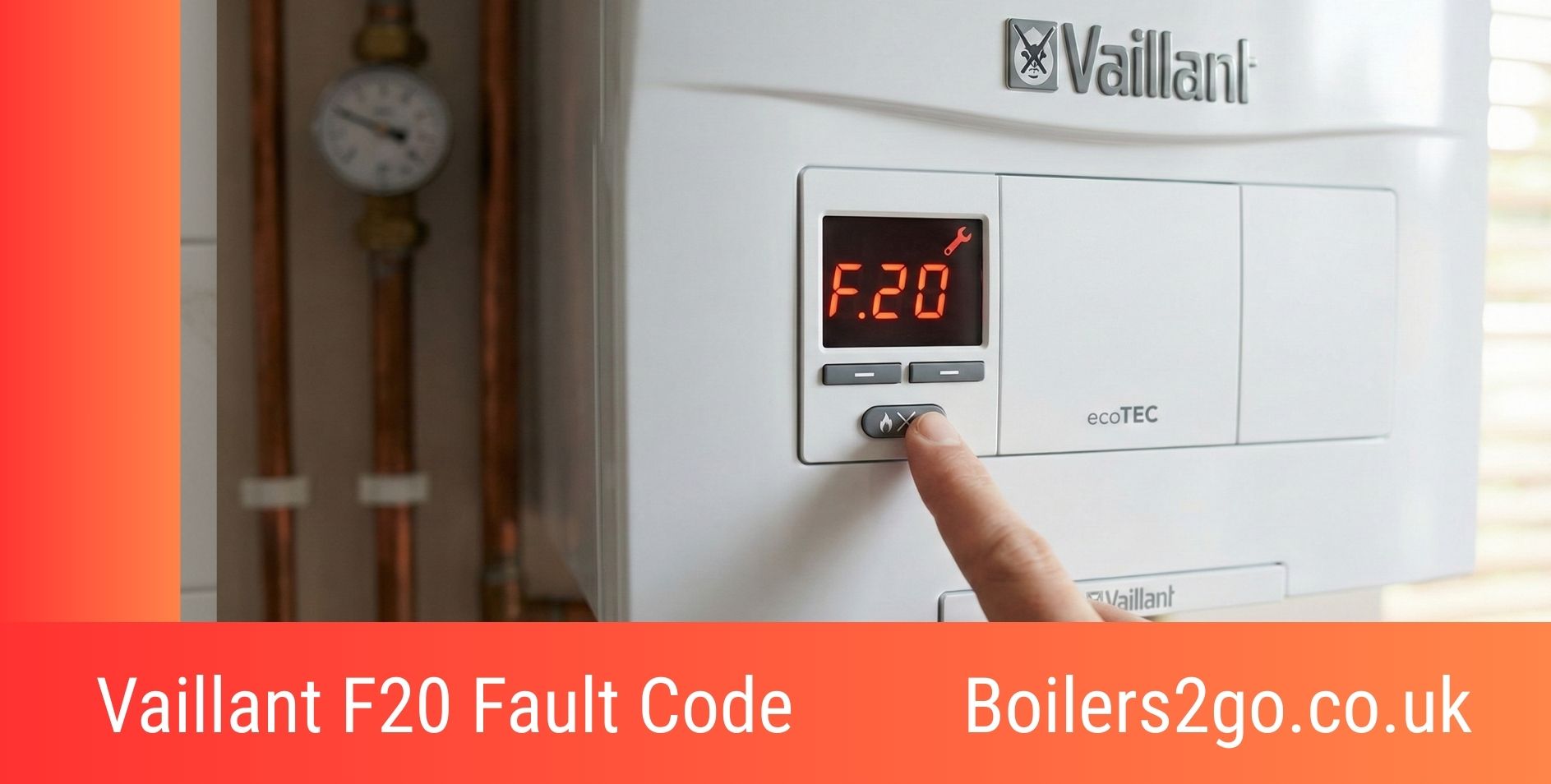
Seeing a fault code flash on your Vaillant boiler can be worrying, especially when the heating and hot water go off. If you see F20, switch the boiler off and let it cool before doing anything else. The F20 fault code is a specific issue that signals an overheating problem within the system. While it requires attention, understanding what it means is the first step toward a solution.
This guide explains the Vaillant F20 fault code, what causes it, and what you can do about it. We will cover simple checks you can perform and clarify when it is essential to call a professional.
What is the Vaillant F20 Fault Code?
The F20 fault code on a Vaillant boiler indicates that the boiler has overheated and initiated a safety lockout. This is a protective measure designed to prevent damage to internal components. When the boiler’s temperature sensors detect that the water has exceeded a safe limit, the system shuts down and displays the F20 code.
This fault is most commonly seen on Vaillant ecoTEC boilers, including many ecoTEC Pro and ecoTEC Plus models. The boiler will stop providing heating and hot water until the issue is resolved and the system is reset.
What Causes a Boiler to Overheat?
Overheating happens when heat from the boiler isn’t carried away from the primary heat exchanger efficiently. Common causes include restricted water flow due to blockages or limescale, faulty or blocked pressure-relief components, airlocks in the system, high system pressure, or failed parts such as the pump or a temperature sensor. Some engineers also note that a faulty fan can occasionally cause overheating by affecting safe operation, though this usually requires professional diagnosis.
Common Causes of the F20 Fault Code
An F20 error points to a problem with water circulation or temperature sensing. Here are the most common culprits a Gas Safe engineer will investigate.
1. Faulty NTC Thermistors
Your boiler has two Negative Temperature Coefficient (NTC) thermistors: one on the flow pipe and one on the return pipe. These sensors monitor the temperature of the water entering and leaving the boiler.
NTC thermistors monitor water temperature as it flows through the boiler and send this information to the main control board, which adjusts the gas burner accordingly. If a thermistor fails, it can provide incorrect temperature readings, causing the boiler to believe it’s overheating and triggering the F20 lockout—even if the actual temperature is safe.
2. Limescale Buildup in the Heat Exchanger
In hard water areas across the UK, limescale is a frequent cause of boiler problems. Over time, mineral deposits can build up inside the primary heat exchanger.
Limescale can build up in the heat exchanger, especially in hard water areas, restricting water flow, causing localised overheating, and often resulting in a distinct kettling noise before an F20 shutdown.
3. A Failing or Blocked Boiler Pump
The boiler pump is the heart of your central heating system, responsible for circulating hot water to the radiators and back to the boiler.
- Function: It pushes water through the entire heating circuit.
- Problem: If the pump is failing, blocked with sludge, or has seized, it cannot circulate water effectively. The water inside the boiler heats up rapidly but has nowhere to go, causing the temperature to rise until the F20 safety lockout is triggered.
Can I Fix an F20 Fault Myself?
When it comes to internal boiler components, the answer is always no. For safety and legal reasons, any work on the inside of a gas boiler must be carried out by a Gas Safe registered engineer. Tampering with internal parts like the pump, thermistors, or heat exchanger is dangerous and will void your boiler’s warranty.
However, there is one simple check you can perform before calling an engineer.
Check Your Radiator Valves
Ensure that all your thermostatic radiator valves (TRVs) and lockshield valves are open. If too many radiators are turned off, it can restrict water flow and mimic the symptoms of a circulation fault, potentially causing an F20 error. Make sure at least two-thirds of your radiators are switched on.
If all the valves are open and the fault persists after resetting the boiler, check that the pressure gauge reads between 1.0 and 1.5 bar when the system is cold, and look for any obvious leaks on radiators or exposed pipework. If the pressure is very low, keeps dropping, or you notice leaks, switch the boiler off and contact an engineer.
When to Call a Gas Safe Registered Engineer
If you have an F20 fault code, it is time to contact a certified professional. An engineer will be able to diagnose the specific cause and carry out the necessary repairs safely.
Here is what an engineer will typically do:
- Test the NTC Thermistors: They will use a multimeter to check if the thermistors are providing accurate readings. If they are faulty, they are a relatively simple and inexpensive part to replace.
- Inspect the Pump: The engineer will check if the pump is running correctly. They may need to free a stuck pump or replace it if it has failed.
- Assess the Heat Exchanger: If limescale is suspected, the engineer may recommend a system flush to remove the deposits. In severe cases, the heat exchanger itself may need to be replaced.
Always verify an engineer’s credentials on the official Gas Safe Register before allowing them to work on your boiler.
Preventing the F20 Fault Code
Preventative maintenance is the best way to avoid unexpected boiler faults.
- Annual Boiler Service: An annual service by a Gas Safe engineer can identify potential issues like failing pumps or early signs of limescale before they lead to a breakdown.
- Install a Magnetic Filter: A magnetic filter catches sludge and debris from your heating system, preventing it from entering the boiler and blocking components like the pump or heat exchanger.
- Use a Limescale Inhibitor: In hard water areas, a limescale inhibitor can help reduce the buildup of mineral deposits inside your boiler and pipework.
Regular maintenance not only helps prevent faults but also ensures your boiler runs efficiently, saving you money on energy bills and extending its lifespan.
FAQ: Vaillant F20 Fault Code
What does the F20 error mean on my Vaillant boiler?
The F20 error code signifies that your boiler has detected an overheating issue and has shut down as a safety precaution. This is typically caused by a problem with water circulation or a faulty temperature sensor.
How do I reset my Vaillant boiler after an F20 fault?
You should only reset your Vaillant boiler after you’ve done basic checks, such as confirming radiator valves are open and the system pressure is correct. If the F20 error reappears after resetting, stop attempting to reset the boiler and call a Gas Safe engineer to diagnose and fix the underlying problem. However, if the underlying cause of the F20 fault has not been fixed, the error will likely reappear.
How much does it cost to fix an F20 fault?
Typical repair costs can vary depending on your location and boiler model. As a rough guide, replacing faulty NTC thermistors is usually a low-cost job. Fitting a new boiler pump often falls in the £200–£400 range including installation. If the primary heat exchanger is required, this can be a substantial expense—often enough to consider a new boiler as a better long-term option. Always request a quote from your engineer for accurate pricing.
Is an F20 fault dangerous?
The F20 fault itself is not dangerous, as it is a safety feature that prevents the boiler from operating in an unsafe condition. If persistent overheating is not addressed, however, it can lead to damage of key components, so it’s important to resolve the issue promptly. However, the underlying cause should be addressed promptly by a Gas Safe registered engineer to ensure the continued safe operation of your appliance.

I’m Penny North, a home energy heating expert. My mission is to demystify new boilers and complex heating systems to help you achieve a warm, cosy home with lower energy bills and a smaller environmental footprint.