

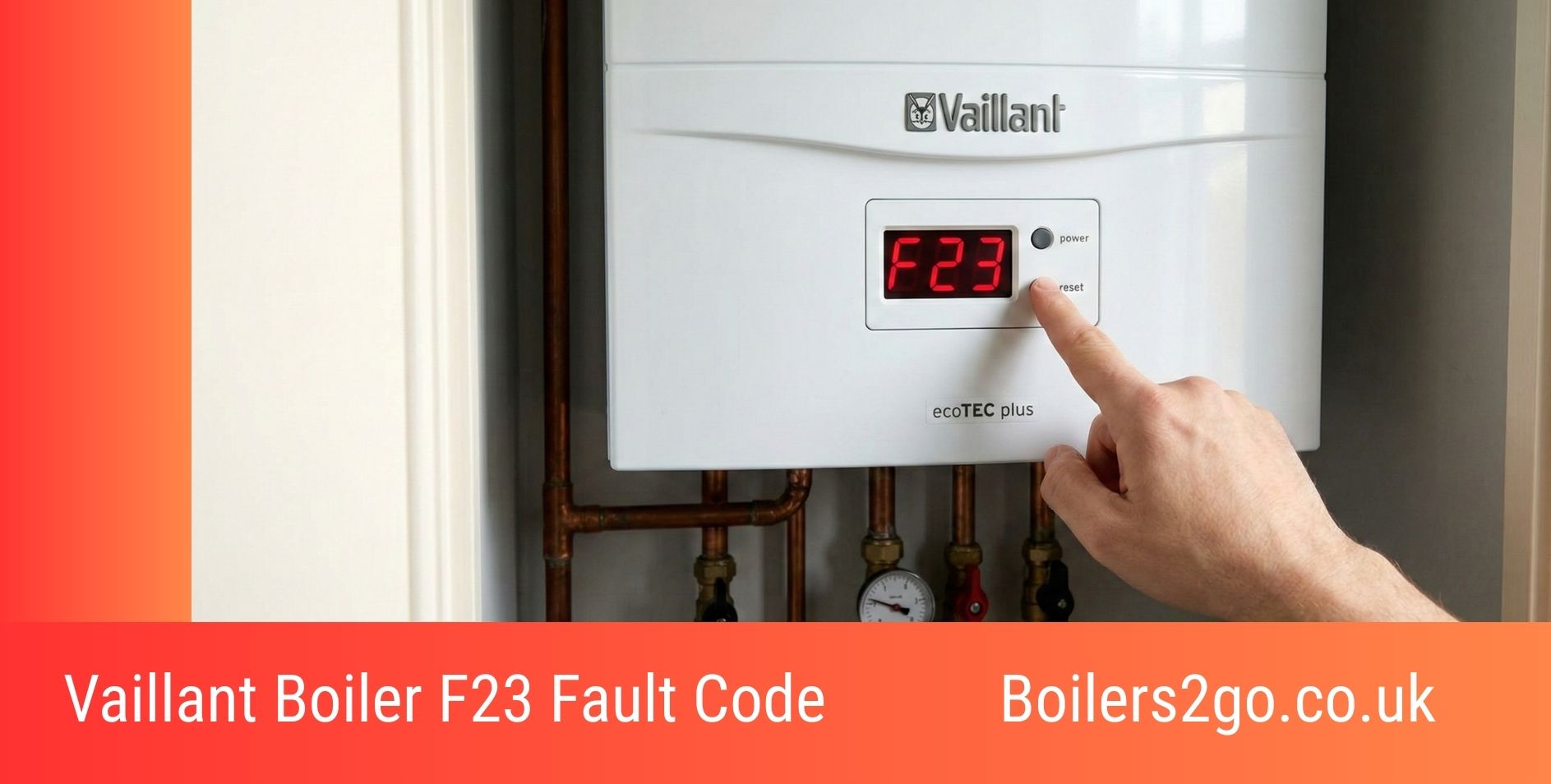
Seeing the Vaillant boiler F23 fault code on your display can be worrying, especially on a cold winter morning when you need hot water and heating the most. This error is one of the more common issues on Vaillant ecoTEC Pro, ecoTEC Plus and many newer Vaillant combi and system boilers across the UK.
The good news is that it’s usually fixable, often quickly, and in many cases without needing an expensive part replacement.
What Does the Vaillant F23 Fault Code Actually Mean?
The Vaillant boiler F23 fault code means there is too big a temperature difference between the flow (hot water leaving the boiler) and the return (cooler water coming back to the boiler).
In simple terms, your Vaillant boiler is detecting that the water is getting far too hot on the outgoing side compared to the returning side, normally a difference of more than 35–40°C triggers the F23 error. The boiler deliberately shuts down as a safety measure to protect the heat exchanger from overheating and potential damage.
This is also sometimes shown as an F.23 fault or simply “F23” on the boiler screen.
What Causes the Vaillant F23 Fault Code?
Several real-world issues can trigger the F23 error on Vaillant boilers. Below are the most common causes we see every week in homes across the UK, explained clearly. One of the common problems that can arise is related to the water pressure, which can often lead to a Vaillant boiler F32 fault code. Additionally, issues with the thermostat or a malfunctioning pump can also contribute to the F23 error, requiring prompt attention to ensure the boiler operates efficiently. Regular maintenance checks can help identify and resolve these issues before they escalate.
1. Blocked or Sludge-Filled System / Poor Circulation
A blocked or sludge-filled system is the number one cause of F23 faults. Over the years, central heating systems build up black iron oxide sludge and limescale (especially in hard water areas like London and the South East). This sludge restricts water flow, meaning the same water keeps circulating inside the boiler and gets hotter and hotter while the return stays cold.
2. Pump Problems or Pump Running Too Slowly
The pump inside or outside your Vaillant boiler might be seized, running at the wrong speed, or set too low. If the pump isn’t pushing water around the system fast enough, you get exactly the same overheating problem that triggers F23.
3. Closed or Partially Closed Valves
It’s surprisingly common for one or more radiator valves (including lockshield valves), the main flow/return valves under the boiler, or even motorised valves to be accidentally knocked closed or only partially open after decorating or bleeding radiators. Restricted flow = F23 fault.
4. Airlocks or Air in the System
Air trapped in the pipework or radiators acts like a blockage and stops water circulating properly.
5. Faulty NTC Temperature Sensors (Flow or Return Sensors)
The two NTC (Negative Temperature Coefficient) sensors measure the flow and return temperatures. If one has drifted out of calibration or failed completely, the boiler can wrongly think there’s a massive temperature difference and display F23.
6. Undersized or Blocked Plate Heat Exchanger (Combi Boilers Only)
On Vaillant combi boilers, hot water for taps/showers goes through a secondary plate heat exchanger. If this becomes blocked with limescale (very common in hard water areas), the primary circuit flow reduces and can trigger F23 when you run hot water.
How to Fix the Vaillant F23 Fault Code (Step-by-Step for Each Cause)
Fixing a Blocked or Sludge-Filled System
A blocked or sludge-filled system usually needs a professional powerflush carried out by a Gas Safe engineer. A proper powerflush with a high-velocity machine and strong chemicals will clear years of sludge in 6–8 hours.
Expect to pay £450–£750 depending on house size and location. After the flush, always add a quality inhibitor (such as Sentinel X100 or Fernox F1) to stop it happening again.
Fixing Pump Problems
Pump problems are straightforward for an engineer. They will check the pump speed setting (often it’s been accidentally turned down to 1 instead of 2 or 3) and test the pump capacitor. A new pump head or complete pump costs £180–£280 fitted.
Fixing Closed or Partially Closed Valves
Closed or partially closed valves are an easy DIY check.
- Go around every radiator and make sure both valves are fully open (turn the lockshield valve clockwise until it stops, then back half a turn).
- Also check the two large valves directly under the boiler are fully open. Reset the boiler after opening them — many F23 faults disappear instantly.
Fixing Airlocks or Trapped Air
Airlocks or trapped air can usually be cleared by bleeding all radiators starting from the lowest floor and working upwards. If you have a system with an automatic air vent on the boiler or cylinder, check it’s not stuck. Sometimes a quick “bump” of the heating on full for 10 minutes followed by re-bleeding solves it.
Fixing Faulty NTC Sensors
Faulty NTC sensors require a Gas Safe engineer. The flow NTC is usually on the left and the return NTC on the right of the heat exchanger. A pair of genuine Vaillant sensors plus labour is around £150–£220.
Fixing a Blocked Plate Heat Exchanger (Combi Only)
A blocked plate heat exchanger may need descaling or replacement. In hard water areas, fitting a scale reducer or magnetic filter on the incoming mains is highly recommended.
How to Prevent the Vaillant F23 Fault Code in the Future
Prevention is much cheaper than cure:
- Have your boiler serviced every year by a Gas Safe registered engineer (this is a legal requirement for landlords anyway).
- Keep inhibitor at the correct level — get it tested during the service.
- Install a magnetic system filter (e.g. MagnaClean, Fernox TF1) if you don’t already have one — they catch sludge before it reaches the boiler.
- In hard water areas, fit a scale reducer on the cold mains entering the property.
- Never turn radiator valves fully off in unused rooms — leave them at frost setting or at least quarter open so water keeps circulating.
When You Absolutely MUST Call a Gas Safe Engineer
You must call a Gas Safe registered engineer immediately if:
- You can smell gas at any point.
- The boiler is leaking water.
- You’ve tried the simple checks (valves open, radiators bled, reset) and the F23 fault keeps returning within minutes.
- The boiler is making loud banging or kettling noises.
- You’re a tenant — your landlord is legally responsible for arranging the repair.
DIY is fine for bleeding radiators and checking valves, but anything involving opening the combustion case or working on gas-carrying parts must be done by a qualified professional.
FAQs
Will my Vaillant warranty still be valid if I get an F23 fault?
Yes, as long as the boiler has been serviced annually by a Gas Safe engineer and inhibitor has been maintained. Vaillant extended warranties (7–10 years) specifically require proof of yearly servicing.
Can the F23 fault damage my boiler if I keep resetting it?
Repeatedly resetting without fixing the underlying circulation problem can overheat the heat exchanger and lead to cracking, which is a £800–£1,200 repair. Fix the cause, don’t just keep resetting.
Is the F23 fault more common on certain Vaillant models?
It’s particularly frequent on the ecoTEC Plus 824, 831, 835, 938 and the ecoTEC Pro 24, 28, 30 models because they have very sensitive temperature monitoring.
My boiler shows F23 only when I run a bath or multiple taps — is that normal?
No. That usually points to a heavily scaled plate heat exchanger on combi models. Book a descale or consider a replacement plate (£180–£250 fitted).
How quickly can a Gas Safe engineer usually fix an F23 fault?
If it’s valves or air, often same-day within an hour. If it requires a powerflush or pump, it can take a full day, but most engineers can diagnose the exact cause within 20–30 minutes.

I’m Penny North, a home energy heating expert. My mission is to demystify new boilers and complex heating systems to help you achieve a warm, cosy home with lower energy bills and a smaller environmental footprint.