

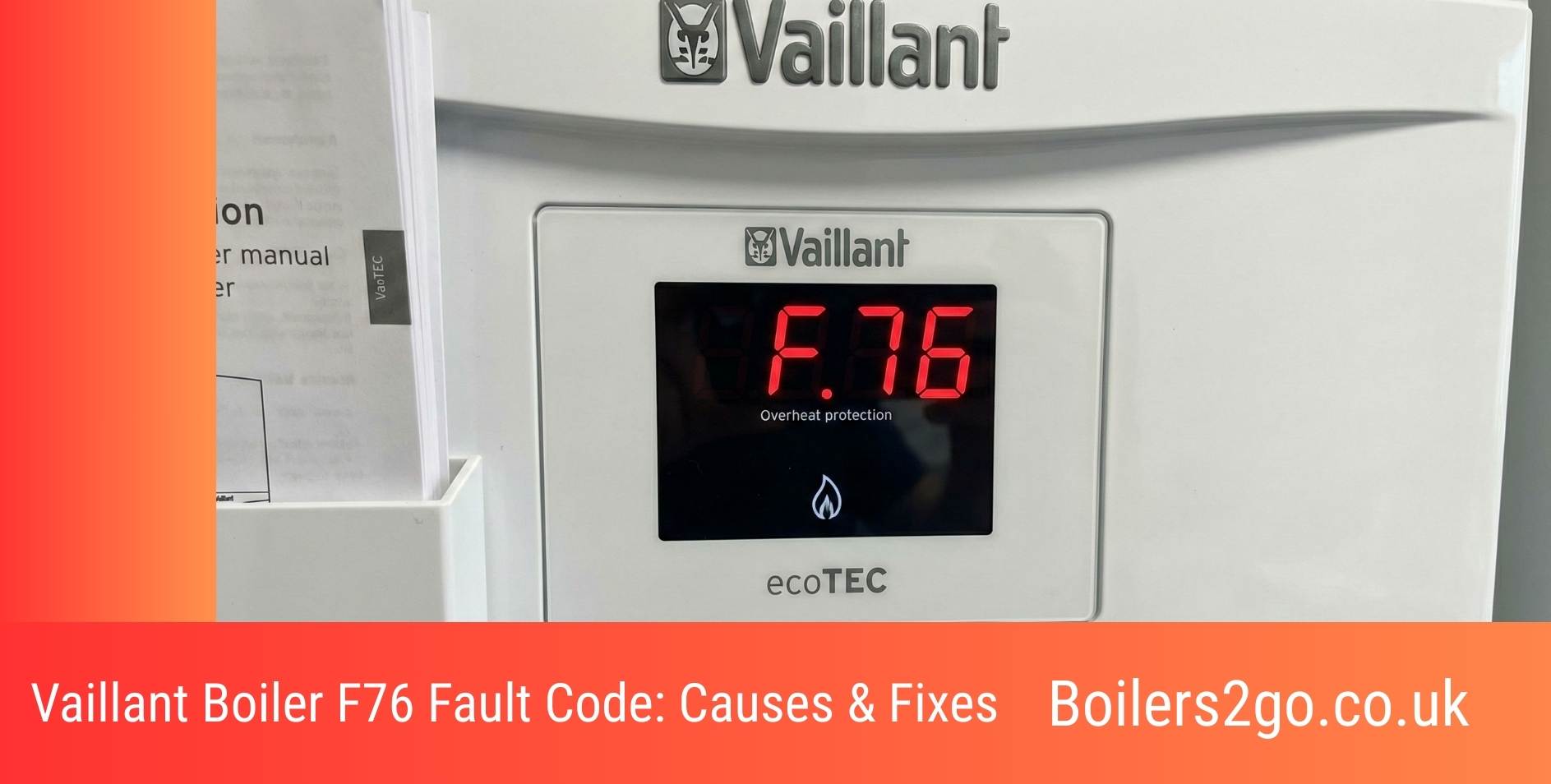
The Vaillant boiler F76 fault code is an emergency shutdown signal from the boiler’s printed circuit board, indicating that the overheating protection for the primary heat exchanger has been activated.
Think of the heat exchanger as the heart of a Vaillant combi boiler: it’s the component where cold mains water is heated by hot gases from the burner to provide radiators and taps with warm water.
The F76 error specifically means the thermal fuse, a small, non-resettable safety device fitted at the top of this exchanger, has detected temperatures exceeding safe limits, typically around 95 to 105°C, and has tripped to halt operation.
This fault code appears on digital displays in models like the ecoTEC 24, 28, 35, or 40, often alongside the boiler refusing to fire up, unusual humming or kettling noises from the unit, or intermittent hot water failures.
Unlike more minor faults such as low pressure or ignition issues, the F76 is a warning sign of potential heat exchanger failure, a known vulnerability in high-efficiency condensing boilers exposed to hard water over time.
For landlords managing rental properties, this can carry compliance implications under the Homes (Fitness for Human Habitation) Act 2018, since unreliable heating affects tenant welfare. Homeowners, meanwhile, face immediate discomfort and potentially higher energy bills if the system strains before fully locking out.
In essence, the F76 code protects the home from risks like scalding leaks or carbon monoxide exposure by prioritising safety over function. Ignoring it, though, can allow the underlying issue to escalate into a costlier repair.
What Causes the Vaillant Boiler F76 Fault Code?
The F76 fault typically stems from conditions that cause the primary heat exchanger to overheat, triggering the thermal fuse. This isn’t a random glitch. It’s a response to imbalances in water flow, sensor accuracy, or system blockages that prevent efficient heat dissipation.
In UK homes, where limescale from hard water areas exacerbates these issues, the F76 fault often emerges after 5 to 10 years of use, especially where annual servicing has lapsed.
Common triggers include low water circulation, which starves the exchanger of coolant, or faulty components misreading temperatures. The causes below each come with a tailored fix, though hands-on repair work always requires Gas Safe expertise to avoid voiding warranties or breaching UK gas regulations.
Cause 1: Tripped Thermal Fuse Due to Genuine Overheating
A tripped thermal fuse is the most direct trigger for the F76 code, where the exchanger’s temperature spikes beyond design limits because of an underlying flow problem. This fuse is a one-time sacrificial link, melting at high heat to break the circuit and protect the PCB and flue from damage.
How to Fix a Tripped Thermal Fuse
First, isolate the boiler by switching off the power at the fused spur and turning the gas supply valve to off. This prevents accidental ignition.
A Gas Safe engineer will access the heat exchanger by removing the front casing, visually inspect for signs of melting or discolouration on the fuse, a small white or ceramic component, and test continuity with a multimeter, expecting infinite resistance if it’s blown.
Replacement involves sourcing a genuine Vaillant part, typically £20 to £50, and fitting it in place, though this only addresses the symptom. The engineer must then diagnose and resolve the root overheating, such as flushing the system, to prevent recurrence.
Total fix time is usually 1 to 2 hours, with costs around £150 to £300 excluding any root cause repairs. For older boilers, if the exchanger shows warping, full replacement, £800 or more, or a new unit might be more economical.
Cause 2: Faulty Temperature Sensor or Wiring Connections
Faulty wiring or a malfunctioning temperature sensor, often the NTC thermistor, can falsely signal overheating to the PCB, prompting the F76 code even if actual temperatures are normal. Loose connectors corrode over time in humid airing cupboards, while sensors degrade from vibration or electrical surges. Where the flow and return sensors disagree persistently rather than signalling overheating, the boiler is more likely to show the Vaillant F84 fault code instead.
How to Fix a Faulty Temperature Sensor or Wiring
- A professional starts by resetting the boiler, holding the reset button for 5 seconds, to check if the fault is intermittent, since a meaningful share of F76 cases in Vaillant ecoTEC models trace back to dodgy plugs and connectors
- They’ll trace the wiring loom from the sensor, a probe on the exchanger outlet, to the PCB, using a multimeter to measure resistance, which should sit around 10kΩ at 25°C and drop predictably with heat. Corroded pins get cleaned with contact spray, connectors re-seated, or damaged cables replaced (£50–£100 labour). A faulty sensor gets swapped (part cost £30–£60)
- This fix is quicker, usually under an hour, and cheaper, around £100 to £200 total, than exchanger work, but it’s always worth testing post-repair by running the boiler in hot water mode and monitoring via the diagnostic menu
Cause 3: Low Water Pressure or Blocked Pressure Sensor
Low system pressure, below 1 bar, or a clogged pressure sensor prevents water from circulating properly through the heat exchanger, causing dry firing and the F76 code. This is more common in properties with frequent radiator bleeds or undetected leaks.
How to Fix Low Water Pressure or a Blocked Pressure Sensor
- Check the pressure gauge first. If it’s low, top up via the filling loop to 1.5 bar when cold, then bleed radiators to expel air
- For the sensor, a small diaphragm unit near the pump, the engineer drains the system slightly, removes the sensor, and cleans debris with a soft brush or compressed air, avoiding harsh chemicals that could tear the membrane
- Calibration is tested by repressurising and running a cycle. A faulty sensor is replaced with a Vaillant-compatible unit (£40–£70). Pairing this with a full system flush using a magnetic filter cleaner helps remove any sludge. Expect £120 to £250 total, with quarterly pressure logs a sensible habit for landlords
Cause 4: Airlocks or Blockages in the Heat Exchanger
Air pockets trapped in the pipes, or limescale and debris blocking the exchanger fins, restrict water flow, leading to hot spots and the F76 code. In hard water zones, scale buildup can mimic a partial blockage and noticeably reduce efficiency.
How to Fix Airlocks or Blockages
- Bleed all radiators starting from the highest, using an automatic air vent key, while monitoring pressure. For stubborn airlocks, the engineer powers off, isolates, and uses a vacuum pump to extract air from the pump head and diverter valve
- Blockages need a chemical flush: adding an inhibitor, running the system hot, then powerflushing with a professional rig to dislodge scale (2–4 hours). In severe cases, the exchanger may need ultrasonic cleaning or the primary plates replacing (£400–£700)
- A limescale reducer is worth adding afterwards in a hard water area. Costs typically run £200 to £500, with fairly immediate relief from gurgling noises and uneven heating
Cause 5: Faulty Pump or Diverter Valve Issues
A weak circulating pump or a sticking diverter valve fails to push water adequately, starving the exchanger and activating the F76 code. These components wear from constant use, particularly in demand-heavy homes with multiple bathrooms.
How to Fix a Faulty Pump or Diverter Valve
- Listen for pump humming without flow. Engineers test speed via the PCB menu, which should ramp up under load. A seized pump head is lubricated or replaced (£100–£150 part)
- For the diverter, a motorised flap switching between heating and hot water, it’s commanded open and closed via diagnostics. A chattering actuator is cleaned or swapped (£80–£120). Full pump replacement runs £150 to £300
- It’s worth checking for earlier error logs, since F61 or F62 codes can sometimes precede F76, and balancing flow rates after the repair helps restore modulation and efficiency
How to Prevent the Vaillant Boiler F76 Fault Code in the Future
Preventing the F76 fault comes down to proactive central heating maintenance, tailored for UK homeowners and landlords facing variable weather and water quality.
Schedule annual Gas Safe servicing (typically £80–£150) to inspect the thermal fuse, clean the exchanger, and test sensors, since Vaillant requires this for warranty validity of up to 10 years. Installing a magnetic system filter (£100–£200) helps trap sludge, and a water softener or scale inhibitor in hard water areas helps curb limescale and extend the exchanger’s working life. If a replacement makes more sense than ongoing repairs, our roundup of the best Vaillant system boilers is a good place to start.
For rentals, logging monthly pressure checks and briefing tenants on how to bleed radiators without over-depressurising the system both help. Keeping an eye out for early warnings, such as fluctuating hot water or unusual boiler sounds, allows problems to be caught before they escalate to a full lockout.
When Should You Call a Gas Safe Engineer About a Vaillant F76 Fault?
While basic checks like topping up pressure offer a useful first step, the F76 fault code demands a Gas Safe registered engineer without delay. DIY tinkering risks gas leaks, fire, or invalidating insurance.
When weighing up repair against replacement, our Vaillant boiler reviews cover prices, running costs and reliability across the range.
It’s worth calling immediately if the boiler won’t reset after three attempts, emits burning smells, or shows water pooling beneath it, which can indicate a cracked exchanger.
For landlords, this is non-negotiable under the Gas Safety (Installation and Use) Regulations 1998, with significant fines possible for non-compliance.
A diagnostic visit can usually be arranged within 24 hours through certified engineers, verifiable via the Gas Safe Register. Prioritising this is especially important in family homes or multi-occupancy lets, to avoid escalation to full system failure.
Vaillant Boiler F76 Fault Code: FAQs
Can the Vaillant Boiler F76 Fault Code Be Covered Under Warranty?
Vaillant warranties, typically 5 to 10 years on ecoTEC models, cover F76 faults where they stem from a genuine manufacturing defect, rather than wear from poor maintenance or hard water. It’s worth checking the paperwork or Vaillant’s online portal with the boiler’s serial number, and our Vaillant boiler warranty guide explains the conditions. Extended maintenance and support plans, arranged through Vaillant’s approved partners, often include labour but exclude pre-existing issues, so a pre-claim inspection is always worth getting first.
How Does Hard Water in the UK Affect the Vaillant F76 Fault?
Hard water, common across large parts of the South East and Midlands, accelerates limescale build-up in the heat exchanger, insulating fins and creating hot spots that can trip the F76 code. This can meaningfully reduce flow and mimic a blockage. Annual descaling or an in-line softener can help defer faults, and in particularly hard water areas, professional magnetic flushing every couple of years is worth considering.
Is the F76 Fault More Common in Older Vaillant ecoTEC Models?
Generally, yes. Older pre-2015 ecoTEC models tend to show higher F76 incidence, largely down to earlier sensor designs that are more prone to corrosion. Newer plus variants use improved NTC probes, which has helped reduce failure rates. If a boiler is 8 or more years old, it’s worth budgeting for potential sensor upgrades at the next service.
What Noises Indicate an Impending Vaillant Boiler F76 Fault Code?
Kettling, a boiling or rumbling sound from the exchanger, or persistent pump whining, both signal flow restrictions that can lead to F76. These differ from normal fan noise, so it’s worth getting familiar with a boiler’s usual sound profile. Early detection through a connected app, where fitted, can also flag issues before a full lockout occurs.
Does Installing a New Pump Always Resolve Recurring F76 Errors?
Not always. A new pump addresses circulation but won’t fix a faulty diverter valve or existing sludge buildup elsewhere in the system. A meaningful share of recurrences trace back to unaddressed contamination rather than the pump itself, so a full hydraulic test after any pump replacement is worth doing to confirm balanced flow, especially in larger homes with underfloor heating.
Related Vaillant Fault Codes

I’m Penny North, a home energy heating expert. My mission is to demystify new boilers and complex heating systems to help you achieve a warm, cosy home with lower energy bills and a smaller environmental footprint.