

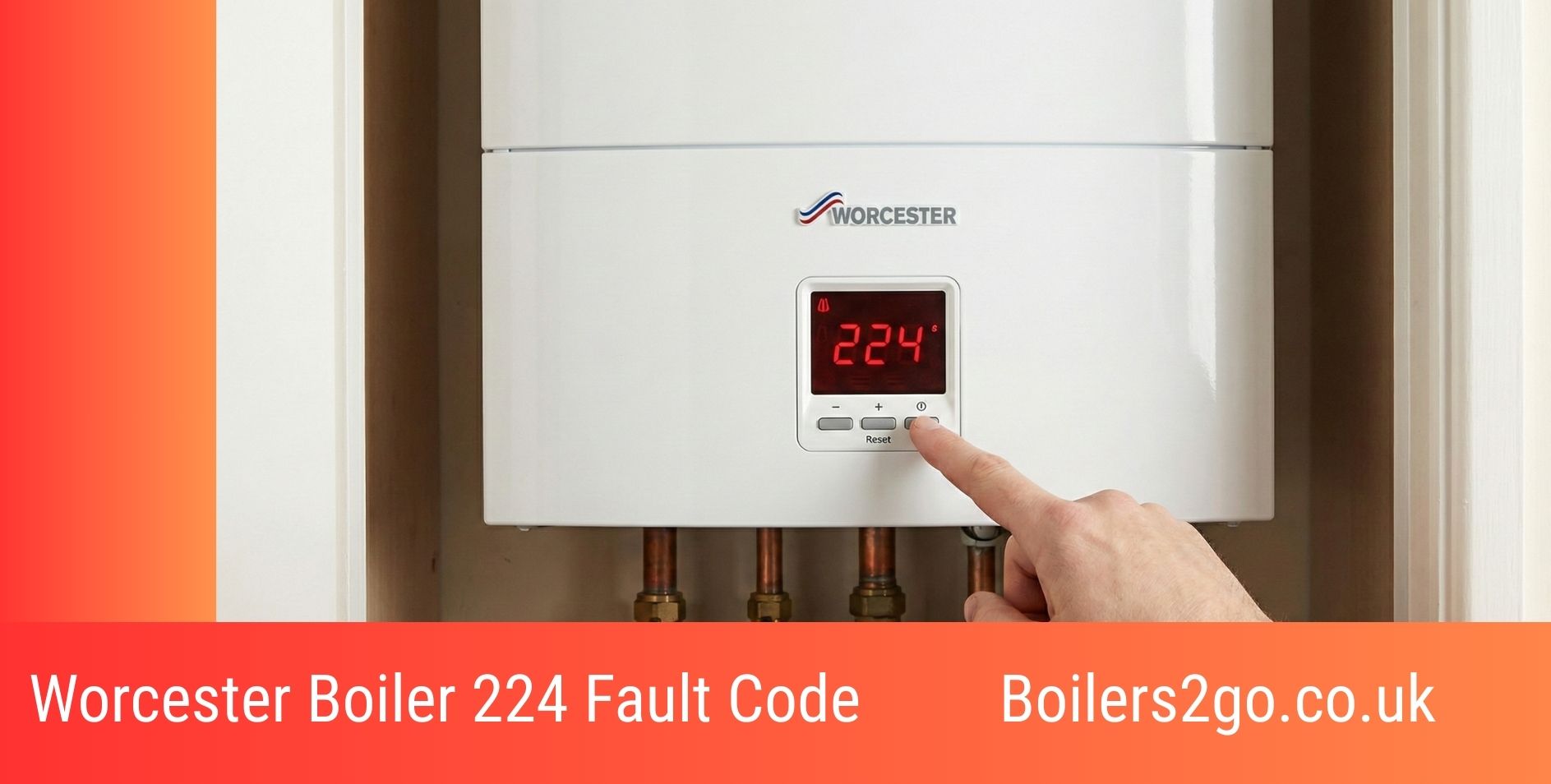
Spotting the Worcester boiler 224 fault code on your combi or system boiler’s display can leave you without heating or hot water, turning a routine UK winter day into an unexpected crisis for homeowners and landlords.
In this guide, I’ll explain what the 224 error means, discuss its triggers, and offer safe troubleshooting steps to help you decide if it’s a quick DIY fix or time for a Gas Safe engineer.
What Does the Worcester Boiler 224 Fault Code Mean?
The Worcester boiler 224 fault code means the boiler has entered an overheat lockout, also known as a “dry fire” protection mode, because the water temperature in the primary circuit has spiked too high without adequate circulation. When a Worcester boiler encounters the 224 fault code, it is essential to address the issue promptly to prevent potential damage to the unit. If this fault occurs frequently, it may indicate underlying problems with circulation or a malfunctioning pump. Additionally, users may also come across the Worcester Bosch EA227 error code, which signifies a different set of issues that may require professional input for resolution.
In straightforward terms, your boiler’s built-in safety limiter, a thermostat that monitors flow temperatures has tripped to avoid the heat exchanger (the core component transferring heat to your water) from warping or cracking under stress, which could lead to leaks or inefficiency in your domestic hot water and radiator setup.
This code is common on Worcester Bosch Greenstar ranges, installed in over a million UK homes from terraced properties in London to rural rentals in Scotland, where reliable condensing performance keeps energy bills low (ErP A-rated efficiency).
When 224 flashes, the boiler won’t restart until cooled and reset, often with a red triangle warning light, emphasising the need for prompt action to maintain compliance with Gas Safe regulations and avoid costly replacements.
What Causes the Worcester Boiler 224 Fault Code?
The 224 overheat lockout typically results from restricted water flow or faulty temperature controls that cause hot spots in the boiler, mimicking a “dry fire” scenario despite water presence.
From Gas Safe diagnostics across the UK, these issues often stem from maintenance neglect in hard-water areas like the South East or high-demand rentals with multiple occupants.
Here’s each cause detailed with why it happens in typical home heating scenarios.
Cause 1: Low System Water Pressure
System pressure dropping below 0.8–1.0 bar reduces water volume circulating through the heat exchanger, leading to rapid overheating as the boiler’s burner continues firing without enough coolant.
This is a leading trigger in older Greenstar models, where slow leaks from radiator valves or pipe joints – common in unserviced properties with 10+ years’ wear – gradually deplete pressure unnoticed until the thermostat trips.
How to Fix Low System Pressure Causing 224
- Gauge Check and Top-Up: Locate the pressure gauge on the boiler front (needle should sit in the green 1–1.5 bar zone when cold); connect the filling loop (silver braided hose or blue handles underneath) and slowly open valves until it rises – close tightly once reached, avoiding over-pressurisation that strains seals. This DIY step resolves 40–50% of 224 faults instantly.
- Leak Inspection: Wipe under radiators and the boiler for damp spots; tighten loose TRV caps or use leak-seal tape on minor drips (£5–£10 from DIY stores). Monitor for 24 hours – persistent drops need an engineer.
- Professional Repressurisation: A Gas Safe expert uses a pressure tester to confirm no hidden leaks, adding inhibitor chemical (£20–£30) to prevent corrosion; full service costs £80–£150, ensuring balanced flow in your sealed heating circuit.
Cause 2: Airlocks or Sludge Build-Up in the System
Trapped air bubbles or black iron oxide sludge (rust flakes from pipes) block water paths, starving the heat exchanger of flow and causing localised overheating that activates the 224 lockout.
Airlocks often form after bleeding radiators or draining for decorating, while sludge accumulates in hard-water zones like Manchester, reducing efficiency by 10–15% before the fault hits.
How to Fix Airlocks or Sludge Build-Up Causing 224
- Radiator Bleeding Sequence: Start on the ground floor, furthest from the boiler; insert a radiator key into the bleed valve and turn anti-clockwise until a hiss (air) escapes, then tighten when water dribbles – work upwards to the loft. Top up pressure afterwards. This purges air in 30% of cases without tools.
- Sludge Flush Prep: Add a chemical cleaner like Fernox F3 (£15–£20) via the header tank or filling loop, run the heating for 1–2 hours, then drain via a hose to an outside drain – repeat if water runs murky.
- Power Flush Service: Book an engineer with a high-pressure flushing rig (£300–£500) to blast debris from pipes and exchanger; they refit a magnetic filter (e.g., MagnaClean, £100–£150) inline to trap future particles, restoring smooth circulation and A-rated performance.
Cause 3: Faulty Circulating Pump
The pump (usually Grundfos or similar) propels water around the system; if its impeller seizes from debris or the motor fails from electrical wear, flow halts, overheating the exchanger and tripping 224.
This is prevalent in boilers over 7 years in family homes with high hot water use, where constant cycling strains the pump head, especially if not serviced annually.
How to Fix a Faulty Circulating Pump Causing 224
- Noise and Vibe Check: Turn on heating and listen for a steady hum from the pump (on the boiler’s right side); erratic whirring or silence indicates issues – feel for vibrations to confirm operation.
- Manual Freeing: With power off, remove the pump’s front cover (per manual) and rotate the shaft clockwise using a flat screwdriver – if stiff, add a drop of oil to bearings, but only if you’re comfortable; otherwise, stop here.
- Replacement by Expert: A Gas Safe engineer tests head pressure (should be 4–6m delivery); swap the pump unit (£150–£250 fitted), wiring it to speed setting II or III for optimal flow, then bleed air from the auto-vent at the pump top for immediate 224 clearance.
Cause 4: Blocked Heat Exchanger
Limescale or debris coats the exchanger’s plates/coils, impeding heat transfer and causing the water to boil locally, activating the overheat stat for 224. Hard-water regions like the Cotswolds accelerate this in unsoftened systems, where calcium deposits build yearly, dropping efficiency and risking cracks if ignored.
How to Fix a Blocked Heat Exchanger Causing 224
- Initial Descaling: Engineer isolates the boiler, removes the exchanger (30–60 minutes), and soaks in descaler fluid like Sentinel X400 (£20–£30); rinse thoroughly to avoid residue.
- Chemical Clean: For mild blockages, circulate a limescale remover through the system via the pump for 1 hour, then flush – effective for early-stage issues (£100–£200).
- Replacement if Severe: Fit a new stainless steel exchanger (£300–£500 parts and labour); they perform a full system clean and add a water softener bypass (£200–£300) for prevention, ensuring condensing efficiency remains above 90%.
Cause 5: Faulty Safety Temperature Limiter Thermostat
The limiter (overheat stat) itself can fail open-circuit from age or vibration, falsely detecting highs and locking out with 224 even at normal temps. Common in older CDi models in vibration-prone airing cupboards near washing machines, where solder joints fatigue after 8–10 years.
How to Fix a Faulty Safety Temperature Limiter Causing 224
- Reset Attempt: After cooling (30–60 minutes), press the red button on the stat (behind the front panel) firmly for 5 seconds – if it clicks, monitor for recurrence.
- Continuity Test: Engineer uses a multimeter across terminals (should show low resistance below 90°C); clean contacts if corroded.
- Stat Replacement: Swap the bi-metallic limiter (£40–£60 OEM part) with thermal paste for contact; calibrate to trip at 95°C, total fix £120–£220, including a full electrical check per BS 7671 standards.
How to Reset a Worcester Boiler After Addressing 224
Once the cause is fixed:
- Allow 20–30 minutes for cooling, ensuring pressure is 1–1.5 bar.
- Press and hold the reset button (spanner or flame icon on the fascia) for 3–5 seconds until the display clears and the burner attempts relight.
- Run a test cycle (heating on for 10 minutes); if 224 returns, note symptoms for your engineer to avoid repeated lockouts stressing the PCB.
FAQs
How does hard water specifically accelerate 224 overheat risks?
In UK postcodes with high calcium (e.g., SE England), limescale insulates exchanger coils, trapping heat and spiking temps 20–30% faster – annual softener checks mitigate this effectively.
Can smart thermostats like Hive influence 224 occurrences?
Overly aggressive zoning from incompatible controls causes uneven demand, mimicking flow issues; Worcester-compatible OpenTherm models reduce this by 15–20% through smoother modulation.
What’s the warranty implication of repeated 224 lockouts?
Worcester’s 5–12 year guarantees hold if serviced annually, but ignoring 224 voids heat exchanger coverage – log resets in your service book for claims.
Do 224 faults correlate with higher seasonal energy use?
Pre-lockout inefficiency from partial blockages boosts gas consumption by 10–15% in winter; early fixes align with SAP ratings for better EPC scores in rentals.
How does 224 differ from 227 on Greenstar models?
While 224 focuses on overheat from circulation woes, 227 signals pure ignition failure like gas supply cuts – both need checks but 227 often clears with a simple reset.

I’m Penny North, a home energy heating expert. My mission is to demystify new boilers and complex heating systems to help you achieve a warm, cosy home with lower energy bills and a smaller environmental footprint.