

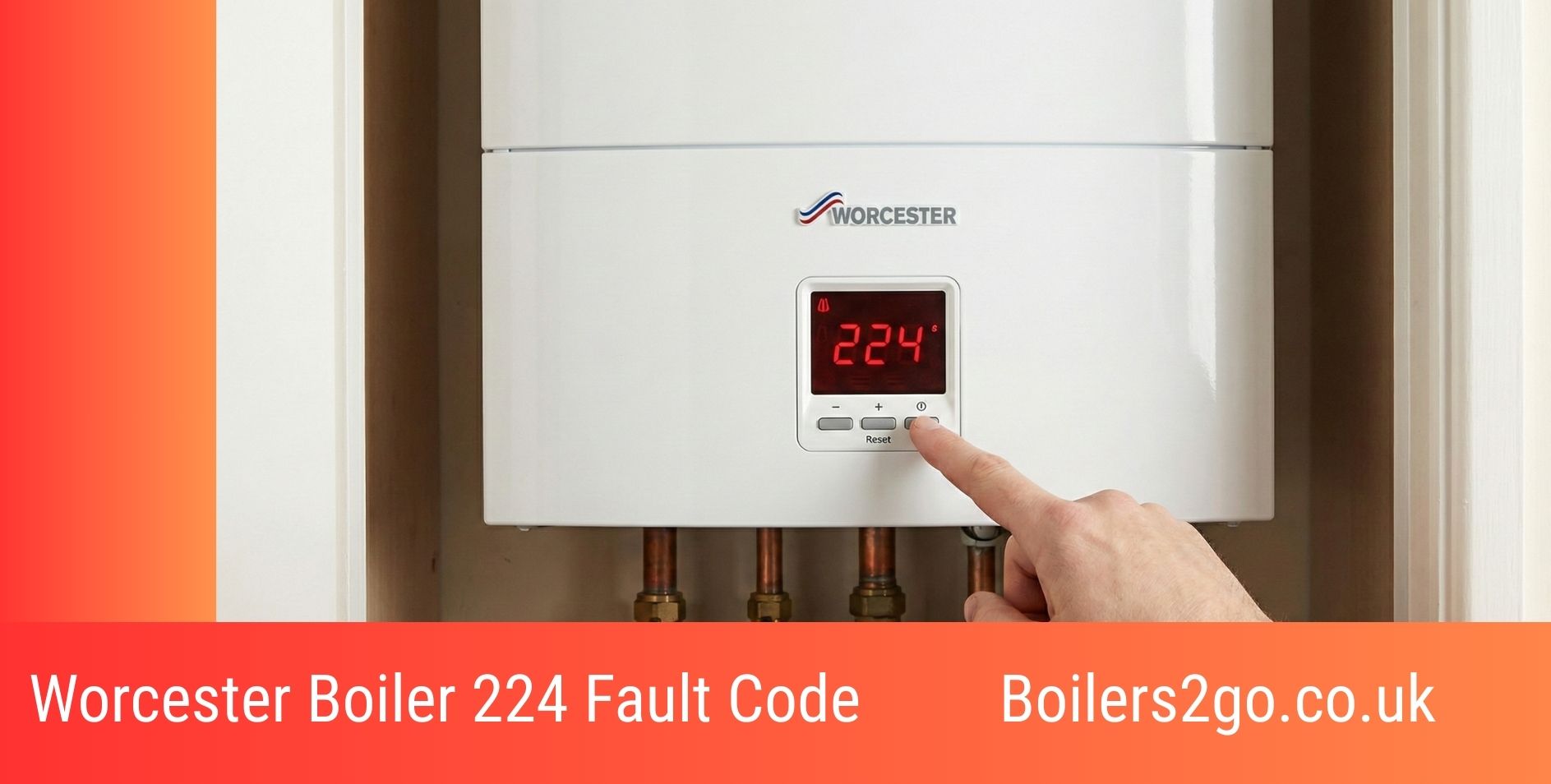
The Worcester Bosch 224 fault code (also displayed as E9 224 on some Greenstar models) means the boiler has detected an overheat condition and locked out to protect the heat exchanger. It is a locking fault, which means the boiler will not restart automatically. It needs to cool down, the cause needs to be identified, and then a manual reset is required.
Get a boiler cover, repair and annual service plan online here >
The 224 code appears on the Greenstar 4000, Greenstar 8000, and earlier Greenstar i, CDi, and Si series. It is one of the more serious fault codes on Worcester Bosch boilers and one that should not be cleared with repeated resets without understanding why it appeared. In most cases, 224 and related overheat codes are caused by circulation issues rather than a failure of the boiler itself.
Get a quote today and take the stress out of replacing your boiler. At Boilers2Go, we offer fast, reliable installation across the UK - often as soon as the next day. 
Need a new boiler?
Watch Our Video on the Worcester 224 Fault Code
What Does the Worcester Boiler 224 Fault Code Mean?
Code 224 means the boiler’s safety temperature limiter has detected that the flow temperature in the primary circuit has climbed above its safe threshold, typically around 105 degrees Celsius, and has tripped to prevent the heat exchanger from sustaining damage.
In practical terms, this happens when the boiler is generating heat but the water is not circulating fast enough to carry that heat away. The same heat builds up in one spot, temperature rises rapidly, and the safety thermostat trips. This is sometimes called a “dry fire” protection, though water is present; the problem is inadequate flow rather than absence of water.
On the Greenstar 8000 range, 224 may display as “224 V” on the digital screen. On older models it may appear as “E9” with 224 as a sub-code. Regardless of the display format, the fault and the causes are the same. If you are also seeing an EA227 code separately, that points to a different fault (ignition failure) rather than overheat.
What Causes the Worcester Boiler 224 Fault Code?
Almost every 224 lockout comes down to the same theme: heat building up faster than the system can move it away. Here are the most common causes in UK homes, in rough order of frequency.
Cause 1: Low System Water Pressure
Low pressure reduces the volume of water circulating through the heat exchanger. Less water means less capacity to carry heat away from the burner, and temperatures climb quickly. Worcester Bosch specifically flag pressure as one of the first things to check for a 224 fault. On the Greenstar 8000, low pressure may also trigger fault code 1017 W independently of the 224 lockout.
How to Fix Low System Pressure Causing 224
- Let the boiler cool for 15 to 20 minutes before doing anything. Resetting a hot boiler immediately after 224 often clears the code only for it to return within seconds.
- Check the pressure gauge on the boiler front panel. It should read between 1.0 and 1.5 bar when cold. If it is below 1.0 bar, repressurise using the filling loop.
- Reset the boiler once after topping up. Monitor it through a full heating cycle.
- If pressure drops again within a few days, there is a slow leak somewhere that needs tracing by a Gas Safe engineer. Our guide to low boiler pressure covers the most common causes of pressure loss.
Cause 2: Faulty or Seized Circulating Pump
The pump is the most common cause of 224 on Greenstar boilers. If the pump impeller has seized from debris, the motor has failed, or the pump is running at too low a speed, water cannot circulate through the heat exchanger fast enough. The boiler fires, heat builds rapidly, and the safety limiter trips.
The Grundfos and Wilo pumps used in Greenstar boilers are typically reliable for 10 to 15 years with annual servicing, but hard-water sludge and unfiltered systems can significantly shorten that lifespan.
How to Fix a Faulty Pump Causing 224
- Turn the heating on and listen for a steady hum from the pump. Silence or erratic whirring points to a pump problem.
- With the boiler switched off at the mains, the pump shaft can sometimes be freed by gently rotating it with a flat-head screwdriver through the centre bleed cap. Do this carefully and only if you are comfortable; stop immediately if there is any resistance.
- A Gas Safe engineer will test pump head pressure and flow rate. If the pump has failed, replacement currently costs £150 to £400 including labour, depending on the model and pump type.
Cause 3: Sludge or Limescale Restricting Flow
Magnetite sludge (black iron oxide from pipe corrosion) and limescale build-up inside the heat exchanger and radiators restrict water flow, forcing heat to accumulate locally. This is particularly common in systems over 10 years old in hard-water regions across the South East and Midlands that have never had a magnetic filter fitted. On some Greenstar models, severe heat exchanger restriction shows as cause code 219 alongside the E9 or 224 display.
How to Fix Sludge or Limescale Causing 224
- Add a chemical cleaner such as Fernox F3 (around £15 to £20) via the filling loop and run the heating at high output for one to two hours, then drain.
- For severe blockages, a professional powerflush is required. Powerflush costs currently range from £300 to £600 depending on property size and number of radiators.
- Fit a magnetic system filter (MagnaClean, Fernox TF1) at the same time. This is the single most effective prevention measure for repeat 224 faults from sludge.
- In hard-water areas, add a scale reducer on the cold mains inlet to slow limescale build-up in the heat exchanger.
Cause 4: Sticking Diverter Valve (Combi Models)
On Greenstar 8000 combi boilers and other Greenstar combi variants, a sticking diverter valve can restrict water flow through the primary heat exchanger. The valve gets stuck between heating and hot water positions, reducing the effective flow area and causing localised overheating. This cause is specific to combi boilers and does not affect system or regular boiler variants.
How to Fix a Sticking Diverter Valve Causing 224
This is an internal component requiring a Gas Safe engineer to test valve operation and check for partial blockages in the primary circuit. If the valve is stuck due to limescale or sludge, it can sometimes be freed with chemical cleaning rather than full replacement. Our guide to a faulty diverter valve covers the symptoms and repair options in more detail.
Cause 5: Blocked Heat Exchanger
A heavily scaled or sludge-blocked heat exchanger restricts flow significantly enough to cause rapid localised overheating. This is more severe than general sludge in the system and typically affects boilers that have been running without chemical treatment or filtration for many years.
How to Fix a Blocked Heat Exchanger Causing 224
- A Gas Safe engineer will isolate the boiler, remove the heat exchanger, and soak it in a commercial descaling solution.
- For mild blockages, circulating a limescale remover through the system under pump pressure for an hour can restore flow.
- If the heat exchanger is cracked or severely corroded, replacement costs approximately £300 to £500 for parts and labour depending on the Greenstar model.
Cause 6: Faulty Safety Temperature Limiter
The safety temperature limiter (overheat thermostat) can occasionally fail and trip at normal operating temperatures, producing a 224 lockout even when the boiler is not genuinely overheating. On Greenstar models, this may display as cause code 220 or 221 rather than the standard 224. This is a false positive and needs to be confirmed by a Gas Safe engineer before spending money on other components.
How to Fix a Faulty Safety Temperature Limiter Causing 224
- After the system has fully cooled (30 to 60 minutes), press the reset button on the boiler. Do not press the overheat reset button behind the front panel unless directed to by an engineer, as this bypasses the safety system and should only be done under professional supervision.
- A Gas Safe engineer will test continuity across the limiter terminals with a multimeter. A reading that shows open circuit at normal temperature confirms failure.
- Replacement of the overheat stat typically costs £120 to £220 including labour, plus any electrical checks required.
Get a quote today and take the stress out of replacing your boiler. At Boilers2Go, we offer fast, reliable installation across the UK - often as soon as the next day.
Need a new boiler?
What to Check Before Calling an Engineer About 224
The following checks are safe for any homeowner and help both rule out simple causes and give an engineer useful information before they arrive.
- Check the pressure gauge and top up to 1.0 to 1.5 bar if it has dropped below 1.0 bar.
- Bleed all radiators to remove trapped air, starting from the ground floor and working upstairs.
- Check the condensate pipe in cold weather. A frozen condensate pipe can occasionally contribute to lockouts in extreme conditions.
- Note any other codes showing alongside 224; our guide to Worcester Bosch boiler error codes explains what each one means.
How to Reset a Worcester Boiler After a 224 Fault
The reset sequence for a 224 lockout is the same across all Greenstar models:
- Allow 20 to 30 minutes for the system to cool fully before attempting to reset.
- Confirm pressure is between 1.0 and 1.5 bar before resetting.
- Press and hold the reset button (marked with a flame and spanner icon, or a circular arrow) for 3 to 5 seconds until the display changes and the boiler begins its ignition sequence.
- Run a test cycle with the heating on for 10 to 15 minutes and monitor the display.
- If 224 reappears within a day, stop resetting and call a Gas Safe engineer. Repeated resets on a genuine overheat fault risk damaging the heat exchanger.
When to Call a Gas Safe Engineer About the 224 Code
You should call a Gas Safe registered engineer if any of the following apply:
- The 224 code returns after a single reset, even if pressure and bleeding have been checked.
- You can smell gas at any point. Leave the property and call the National Gas Emergency Service on 0800 111 999.
- The boiler makes unusual noises (banging, gurgling, or humming without circulation) alongside the 224 code.
- The boiler is still under Worcester Bosch’s guarantee period. Repeated DIY resets without fixing the root cause can affect guarantee cover if damage results.
Verify any engineer’s credentials using the Gas Safe Register. Worcester Bosch also has a dedicated technical helpline for homeowners to call before booking an independent engineer if the boiler is still within guarantee.
Worcester Boiler 224 Fault Code: FAQs
How Does Hard Water Cause 224 Overheat Faults?
In hard-water postcodes across the South East and Midlands, calcium deposits build up inside the heat exchanger plates over time. This acts as insulation, slowing heat transfer from the burner to the water. The water heats up faster and local temperatures spike more quickly, making it significantly easier for the safety limiter to trip. Annual descaling and a scale reducer on the cold mains inlet are the most effective countermeasures.
Can Smart Thermostats Like Hive or Nest Cause 224 Faults?
Occasionally. An incompatible smart thermostat or one configured with very aggressive heat demand profiles can cause erratic cycling that contributes to uneven flow conditions. Worcester Bosch-compatible OpenTherm controls (such as the Bosch EasyControl) modulate output more smoothly and are less likely to create the sudden heat demand spikes that contribute to overheating. If 224 faults began after a thermostat change, this is worth checking. If a wireless thermostat loses its connection to the boiler altogether, a different code appears, which our Worcester boiler A21 fault code guide covers.
What Are the Warranty Implications of Repeated 224 Lockouts?
Worcester Bosch’s guarantee, which runs from 5 to 12 years depending on the model and installer accreditation, requires annual Gas Safe servicing to remain valid. If a 224 lockout is allowed to recur repeatedly without professional attention and the heat exchanger is subsequently damaged, that damage may not be covered if service records are absent. Logging each lockout and service visit in your guarantee booklet protects your position on any future claim.
How Does the 224 Code Differ From the EA227 Code?
Code 224 is an overheat lockout caused by circulation problems: the boiler lit but water could not move fast enough to carry heat away. The Worcester Bosch EA227 error code is an ignition lockout: the boiler failed to detect a stable flame during the ignition sequence. Both are locking faults requiring a manual reset after the cause is resolved, but they point to entirely different systems within the boiler.
Is the 224 Code More Common in Certain Seasons?
The 224 fault is more common at the start of the heating season (typically October to November) when boilers that have sat unused over summer are fired up for the first time. Sludge that has settled over the summer can disrupt circulation in the first few heating cycles. Running the heating briefly in September as a pre-season check, and having a service before the heating season begins, significantly reduces the risk of a first-day-of-winter lockout.
Get a quote today and take the stress out of replacing your boiler. At Boilers2Go, we offer fast, reliable installation across the UK - often as soon as the next day.
Need a new boiler?

I’m Penny North, a home energy heating expert. My mission is to demystify new boilers and complex heating systems to help you achieve a warm, cosy home with lower energy bills and a smaller environmental footprint.