

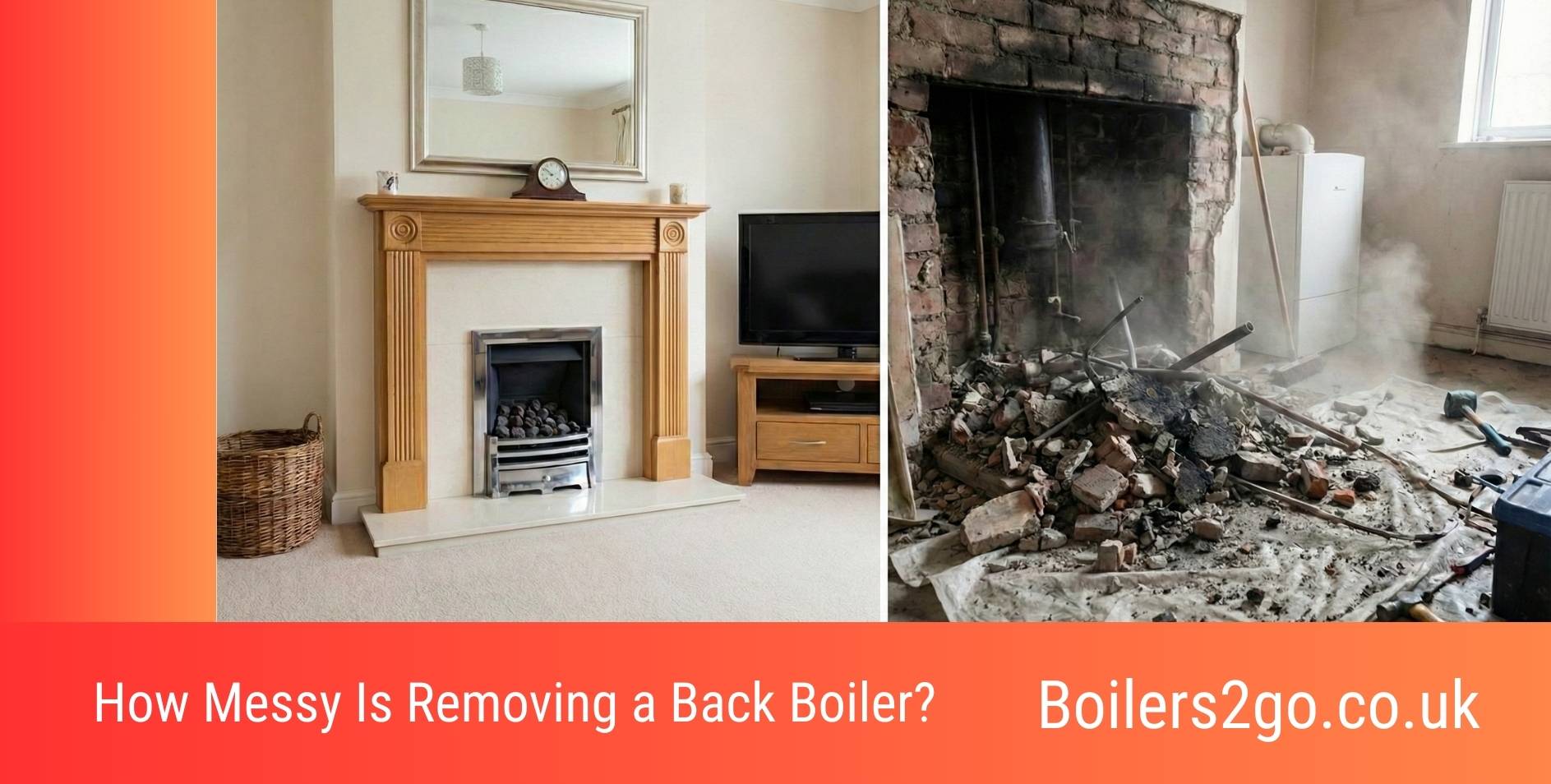
The short answer is: very. Removing a back boiler is one of the messier jobs in domestic heating, and for good reason. These units are tucked inside the chimney breast behind a fireplace, surrounded by decades of soot, ash, old brickwork, and pipework that has not been touched since installation. Getting them out requires opening up the chimney structure, disconnecting gas and water connections, and manoeuvring a heavy cast-iron or steel unit through a living space.
On a mess scale of 1 to 10, most back boiler removals sit at 7 to 9 if proper dust protection measures are not in place before work starts. With a well-prepared engineer and the right equipment, that figure comes down considerably. The disruption is real but it is temporary, and most experienced engineers leave the property clean at the end of each working day.
This guide covers exactly what creates the mess, how to control each type of disruption, what the removal process looks like day by day, and what to do about the fireplace once the boiler is out.
Get a quote today and take the stress out of replacing your boiler. At Boilers2Go, we offer fast, reliable installation across the UK - often as soon as the next day. 
Need a new boiler?
Back Boiler Removal: Video Guide
Back Boiler Removal Mess at a Glance
Back boiler removal creates five distinct types of mess, each with its own cause and its own control measure. The table below gives a quick overview before each one is covered in detail.
| Mess Factor | What Causes It | How to Control It |
|---|---|---|
| Soot and chimney debris | Decades of accumulation fall when the fireplace is opened | Seal room with dust sheets; wet-spray chimney lightly before opening |
| Brick dust and plaster | Breaking out the builder’s opening creates clouds of fine dust | Dust extraction cutting tools; temporary polythene stud walls |
| Water spills from old pipework | Rusty copper pipes split when moved; residual water drips | Drain system the day before; cap pipes immediately with push-fit caps |
| Floor damage from heavy unit | Cast-iron BBUs weigh 80–120 kg; dragging disturbs more dust | Lifting straps and sack truck; lay 12 mm plywood to protect floors |
| Asbestos (pre-2000 homes) | Fireback insulation or rope seals may contain asbestos | UKAS-accredited survey before any work; licensed removal only if found |
The total disruption depends on two things: the age and condition of the installation, and how well the engineer prepares the area before work begins. A boiler that has not been serviced for 20 years in a property with original 1970s pipework will create considerably more disruption than a maintained unit in a property where some modernisation has already taken place.
What Causes the Mess When Removing a Back Boiler?
1. Soot, Ash and Chimney Debris
Back boilers sit inside the chimney structure. The moment the fireplace front and the builder’s opening are removed, decades of accumulated soot and ash drop into the room. This is often the most visually alarming part of the job because it happens fast and covers a wide area.
The chimney itself may also have loose mortar, old insulation material, and debris from birds’ nests that fall when the liner is disturbed. Chimneys that have not been swept in years release significantly more material than those that have been maintained. On older properties, you may also find remnants of the original coal fire grate mixed in with the soot.
How to Minimise Soot and Ash Mess
- Seal the entire room with heavy-duty dust sheets and a zip-door system across the doorway before any work starts. This is the single most effective preparation step and takes under an hour to set up.
- Use industrial HEPA-filter vacuum extractors attached directly to cutting and chiselling tools as work progresses.
- A light wet-spray of the chimney interior before opening keeps soot damp and prevents it from becoming airborne. A professional engineer does this as standard.
2. Brickwork and Plaster Removal
The builder’s opening around the back boiler is usually bricked up or boarded with a fireplace surround. Breaking this out creates clouds of fine brick dust that travel through the property if the area is not properly isolated. Old plaster, particularly the lime-based variety common in pre-1980s properties, creates an especially fine particulate when disturbed.
If the original fireplace surround has any decorative value, this is also the stage where damage can occur if the engineer is not careful. It is worth discussing in advance whether the surround is to be retained or if the fireplace opening will be sealed over entirely.
How to Minimise Brick and Plaster Dust
- Hire a fitter who uses dust extraction cutting tools rather than standard angle grinders or cold chisels. The difference in dust output is significant.
- Lay thick corrugated cardboard or hardboard over carpets and fixed furniture before demolition begins.
- Ask for temporary polythene stud walls to be erected across doorways to fully isolate the work area from the rest of the house.
3. Old Pipework and Water Spills
The pipework connecting a back boiler to the central heating circuit is often original copper or iron from the 1960s or 1970s. When this pipework is disconnected and moved, it frequently splits or weeps at joints that have been under compression for decades. Even if the pipework holds, residual water in the system will drip from open ends until the pipes are capped.
If the system also includes a hot water cylinder (as most back boiler installations do), draining the cylinder and any loft tanks adds further water management to the job. Skipping this step is one of the most common causes of avoidable water damage during a removal.
How to Avoid Water Spills From Old Pipework
- Drain the entire heating system and any loft tanks the day before removal begins, not on the morning of the job. This gives time for residual water in radiators and low points in pipework to drain fully.
- Push-fit end caps on all open pipe ends as each connection is broken. These cost very little and prevent drips immediately.
- Keep buckets and old towels in the work area as a backup for any water that has pooled in low sections of the old pipework.
4. Heavy Cast-Iron Boiler Unit
Many back boiler units weigh between 80 and 120 kg. Moving them through a property to the front door or side gate is a two-person job at minimum, and dragging or tilting the unit across floors can cause significant damage to carpets, wooden floorboards, and tiles. The vibration from moving a unit of this weight also disturbs additional dust from the chimney cavity and surrounding walls.
Smaller properties where the boiler must be carried through narrow hallways or around tight corners present the most risk of damage. This is worth discussing with the engineer before booking so they can bring appropriate equipment.
How to Move a Heavy Back Boiler Safely
- Use proper lifting straps and a sack truck with stair-climbing wheels rather than trying to manoeuvre the unit by hand.
- Lay 12 mm plywood sheets or old solid-core doors flat along the route from the fireplace to the exit point. This distributes the weight and protects floor surfaces.
- Protect corners and doorframes with cardboard or foam padding before the unit is moved.
5. Asbestos in Pre-2000 Installations
Back boilers installed before 2000 may incorporate asbestos-containing materials. The most common locations are fireback insulation panels, rope seals around the boiler casing, and some types of ceiling tile or board used to line the builder’s opening. Disturbing these materials without proper precautions releases fibres that are a serious long-term health hazard.
This is not a reason to avoid the removal, but it is a reason to have the property surveyed before any work starts. A UKAS-accredited asbestos survey takes a few hours and is worth the cost for any property built or refurbished before 2000.
How to Deal With Asbestos Safely
- Arrange a UKAS-accredited asbestos survey before booking the removal if the property was built or significantly refurbished before 2000.
- If asbestos is found, only a licensed asbestos removal contractor can legally remove it. Never attempt DIY removal of suspected asbestos materials.
- Once the asbestos-containing materials have been safely removed and the area has been given a clean air certificate, the main back boiler removal can proceed normally.
How Long Does a Back Boiler Removal Usually Take?
A typical back boiler removal and replacement with a new combi takes 2 to 3 days from start to finish, and our back boiler conversion to combi guide covers the full process. Understanding what happens on each day helps you plan the disruption to your household.
- Day 1 (the messiest): System drain-down, removal of the gas fire front, disconnection of the back boiler unit, breaking out the builder’s opening, and removing the old boiler from the property. This day produces the majority of dust, debris, and physical disruption.
- Day 2: Removal of the old hot water cylinder and loft tanks (if upgrading to a combi), re-routing of pipework to the new boiler location, flue installation through the exterior wall, and fitting of the new boiler.
- Day 3 (where needed): Commissioning and testing of the new system, final pipework connections, gas safety checks, and handover. The engineer should also make temporary good the fireplace opening and clear all waste from the property.
The fireplace area itself is typically left sealed but not fully decorated after removal. Final plastering, hearth laying, and any decorative reinstatement are usually separate trades and happen after the heating engineer has finished.
Back Boiler Decommissioning vs Full Removal: What Is the Difference?
Not every homeowner needs to remove the back boiler entirely. If the structure of the fireplace makes removal particularly complex or expensive, decommissioning is an alternative: the boiler is disconnected from the gas and water supplies and sealed in place, with the fireplace bricked or boarded over.
Decommissioning costs considerably less than full removal and creates less mess. The downside is that the unit remains in the wall, which can complicate future building work and may affect the property’s marketability if buyers expect a clean conversion. A Gas Safe engineer can advise on whether decommissioning is safe and appropriate for your specific installation.
What Happens to the Fireplace After Back Boiler Removal?
Once the back boiler and gas fire are out, you have three main options for the fireplace opening:
- Seal it over: the recess is bricked up and plastered to create a flat wall. This is the simplest and least expensive option and the most common choice when the opening has no aesthetic value.
- Fit a decorative feature: a modern decorative gas fire, electric fire, or a wood-burning stove (subject to a HETAS-certified installation) can be fitted into the opening once the chimney has been swept and lined.
- Leave it as a feature fireplace: the opening can be left open or fitted with a decorative grate, provided the chimney is swept and a suitable cowl is fitted to prevent downdrafts.
Whatever option you choose, the chimney breast will need at least an air brick or ventilation vent installed if the opening is sealed. Without ventilation, dampness builds up behind the sealed opening and can cause significant internal damage over time.
Can You Get Help With Back Boiler Removal Costs?
Back boiler replacement may qualify for funding under the UK government’s ECO4 scheme (Energy Company Obligation), which supports low-income households in upgrading inefficient heating systems. Back boilers are typically G-rated, which makes properties with them strong candidates for eligibility.
Switching from a G-rated back boiler to a modern A-rated combi boiler can reduce heating energy use by 15 to 25 per cent in many homes, with savings depending on property size and usage. Eligibility for ECO4 is based on household income, benefit status, and property energy rating. Check with your energy supplier or an ECO4-registered installer for current availability.
How to Plan for a Smooth Back Boiler Removal
Getting the preparation right before the engineer arrives makes a significant difference to how disruptive the job feels. It also helps to budget for the whole project rather than the removal alone, and our guide to new central heating system installation costs sets out typical prices if radiators and pipework need replacing too.
- Book a Gas Safe registered engineer who specialises in back boiler removals. Experienced fitters bring the right dust-control equipment as standard rather than as an add-on.
- Schedule the work for spring or summer where possible. Open windows provide natural ventilation and make dust management considerably easier.
- Remove all furniture, ornaments, and soft furnishings from the room at least two days before work starts. Allow extra time for anything that is difficult to move.
- If the property was built or refurbished before 2000, arrange an asbestos survey at least a week before the planned removal date.
- Consider having the fireplace reinstatement (plastering, new hearth, sealing or decorative fitting) arranged with a separate trade to follow immediately after the heating engineer finishes. Getting everything done in one sequence means the mess happens once rather than twice.
Back Boiler Removal: FAQs
Can I Keep My Gas Fire After Removing the Back Boiler?
No, not the original gas fire that came with the back boiler system. The two are connected and the fire cannot operate without the boiler. However, many homeowners fit a modern decorative gas fire, electric fire, or a bio-ethanol fire into the opening once the old unit is removed, as long as the chimney is swept and properly lined. A Gas Safe engineer can advise on the most suitable option for your specific opening and chimney condition.
Will Removing a Back Boiler Increase My House Value?
In most cases, yes. A modern central heating system, and in particular a combi boiler installation, makes a home more appealing to buyers and can make it faster to sell or easier to let. Properties with a functioning back boiler are increasingly viewed negatively by buyers and mortgage lenders because of their low efficiency rating and the knowledge that replacement will be required eventually.
Do I Need Planning Permission to Remove a Back Boiler?
Planning permission is not normally required for a like-for-like heating system change. However, you must notify your local Building Control if you are altering or infilling a structural opening in the chimney breast, as this work falls under Part L (energy efficiency) and Part J (combustion appliances) of the Building Regulations. Your engineer will typically handle the Building Regulations notification as part of the job.
What Happens to the Old Water Tanks in the Loft?
If you upgrade to a combi boiler as part of the conversion, the cold-water storage tank and the hot-water cylinder both become redundant and are removed during the installation. This frees up significant loft space and removes the risk of tank or cylinder leaks in the future. The tanks are drained and disposed of by the engineer as part of the removal process.
Can I Remove a Back Boiler Myself to Save Money?
No, and in practice it is not legal to disconnect a gas appliance yourself. The gas supply to the back boiler must be isolated by a Gas Safe registered engineer before any other work begins. Attempting DIY removal also risks asbestos exposure if the property was built before 2000, structural damage to the chimney breast if the builder’s opening is not properly managed, and potential flooding if the heating system is not drained correctly. Back boiler removal is almost always included as part of the new boiler installation quote rather than charged separately, so there is rarely a practical saving available.
Can I Decommission a Back Boiler Instead of Removing It?
Yes, decommissioning is a legitimate option if full removal is not practical or cost-effective. The boiler is disconnected from gas and water supplies, sealed in place, and the fireplace is boarded or bricked over with adequate ventilation. Decommissioning can save around £500 to £1,000 compared to full removal, though the unit remains in the wall and may need to be disclosed to future buyers. A Gas Safe engineer will advise on whether this approach is safe for your specific installation.

I’m Penny North, a home energy heating expert. My mission is to demystify new boilers and complex heating systems to help you achieve a warm, cosy home with lower energy bills and a smaller environmental footprint.