

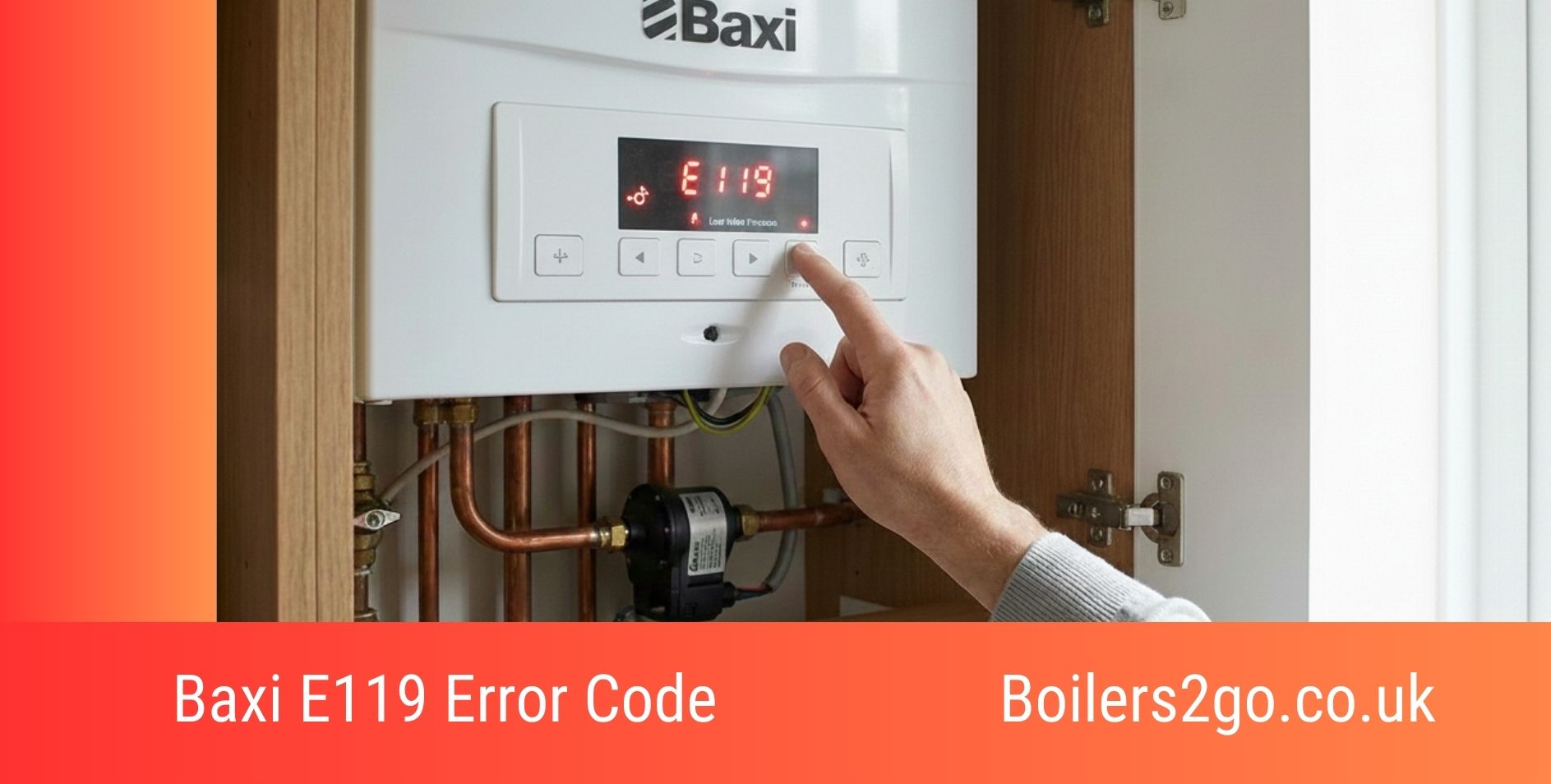
A Baxi boiler flashing E119, or simply showing a pressure gauge dropped to zero, is the single most common fault code Baxi owners across the UK see.
Whether the boiler in question is a Baxi Duo-tec, Platinum, EcoBlue, 600, 800, or even an older Potterton Promax fitted with a Baxi brain, E119 simply means water pressure in the heating system has dropped below 0.5 bar.
In many cases, E119 can be fixed in under ten minutes with nothing more than a filling loop key or a couple of taps under the boiler. Left unresolved, the boiler stays locked out with no heating or hot water until it’s sorted.
What Causes the Baxi E119 Fault Code?
E119 means the system pressure has dropped too low: if it falls below about 0.5 bar, the boiler locks out for safety, since it doesn’t want the pump running dry and overheating. Baxi combi and system boilers run as a sealed heating system, and the correct pressure when cold is usually 1 to 1.5 bar, checked via the grey or black pressure gauge on the front. Restoring pressure means adding water to the system using the filling loop, and consulting the user manual for model-specific instructions is always worthwhile. For other fault codes, see our full guide to Baxi boiler error codes.
Common Causes of Baxi E119 Low Pressure
- A radiator bled recently without the pressure being topped back up afterwards.
- A tiny leak on a radiator valve, towel rail, or underfloor pipe.
- The pressure relief valve, the orange or red pipe outside, dripping.
- An automatic air vent in the boiler leaking slowly.
- The expansion vessel losing its air charge, common after 6 to 8 years.
- Very rarely, a pinhole in the heat exchanger.
Step-by-Step: How to Fix Baxi E119 Low Pressure
Most E119 faults are solved by repressurising the system. Here’s exactly how to do it safely.
For Most Modern Baxi Boilers (Duo-tec, Platinum, 600, 800, EcoBlue, 200, 400)
- Locate the filling loop, usually a silver flexible hose with two black or blue taps, or a white plastic key slot under the boiler.
- Make sure both taps are fully closed, or the key is removed.
- Attach the filling loop properly if it’s not already connected, since some are left permanently attached.
- Open one tap slowly until water can be heard flowing.
- Slowly open the second tap.
- Watch the pressure gauge climb to 1.3 to 1.5 bar, the ideal range.
- Close both taps tightly in reverse order.
- Remove the key or flexible hose if required.
- The boiler should reset itself within 30 seconds. Press the reset button if needed.
If E119 is still showing after repressurising, the pressure is dropping away again, which points to one of the leak-related causes covered below.
For Older Baxi Solo, Bermuda, or External Filling Loop Models
These often use a separate black braided hose and a small square key. The same principle applies: open slowly, bring the pressure to 1 to 1.5 bar, then close tightly.
When Does Baxi E119 Mean Something More Serious?
If pressure is topped up to 1.5 bar but drops back below 0.6 bar again within a few hours or days, there’s a leak somewhere. Common places to check include:
- Radiator valves, looking for white limescale or damp patches.
- The orange pressure relief pipe dripping outside; even a slow drip loses pressure fast.
- A towel radiator in the bathroom; feeling for damp under the floor is worth doing.
- Underfloor heating loops, which can cause big pressure drops overnight.
- Inside the boiler itself, where the expansion vessel or heat exchanger needs an engineer to assess.
When to Call a Gas Safe Engineer About Baxi E119
Professional help is the right call if:
- Pressure drops away within minutes of topping up.
- Water can be heard dumping outside constantly.
- The boiler is leaking from the bottom.
- Confidence in using the filling loop is low.
- The boiler is still under warranty, since DIY repressurising is fine, but nothing else should be touched.
A proper, qualified engineer can be found via the Gas Safe Register, which confirms an engineer’s credentials before any work begins. Faults involving the fan or flue rather than water pressure, such as the Baxi E160 error code, are another situation where an engineer’s diagnosis is usually needed.
How Much Does a Baxi E119 Repair Cost?
- New pressure relief valve (PRV): £120 to £180.
- Expansion vessel recharge or replacement: £180 to £280.
- Automatic air vent replacement: £130 to £190.
- Heat exchanger (worst case, rare on Baxi): £600 to £900 fitted.
How to Stop Baxi E119 Happening Again
- Fit a magnetic system filter (Baxi or MagnaClean): this catches the sludge that can burst expansion vessels over time.
- Book an annual service: the engineer checks the vessel charge and PRV as standard.
- In a hard water area, most of south-east England: fitting an in-line scale reducer helps protect the system further.
Baxi E119 Fault Code: FAQs
Will Resetting the Boiler Clear Baxi E119?
Resetting only clears the fault display; it doesn’t fix the underlying low pressure, so E119 will simply reappear unless the pressure is brought back above roughly 0.6 bar first.
Topping up via the filling loop before pressing reset is the correct order, since resetting a boiler that’s still below the safe pressure threshold achieves nothing.
How Often Is It Normal to Top Up a Baxi Boiler?
Topping up once or twice a year, particularly after bleeding radiators, is generally normal and nothing to worry about.
Needing to top up every week or every month points to a leak somewhere in the system, and it’s worth investigating rather than treating frequent top-ups as routine maintenance.
Is Pressure Rising to 3 Bar Linked to Baxi E119?
Yes, this is almost always a sign of a failed expansion vessel, which can no longer absorb the normal increase in water volume as it heats up. Our guide to the boiler expansion vessel explains how it works.
This needs an engineer to recharge or replace the vessel, since a consistently high pressure spike on heating can eventually trigger the pressure relief valve to discharge, contributing to the very leaks that then cause E119.
Is Baxi E119 Covered by the Warranty?
Only if the boiler is still within its 5 to 10 year warranty period and has a complete service history, since low pressure itself isn’t automatically a warranty fault.
The underlying cause, such as a genuinely faulty expansion vessel or pressure relief valve, might be covered, so it’s worth getting a Gas Safe engineer to diagnose the root cause rather than assuming a simple pressure top-up voids or triggers a claim either way.
Can the Baxi Filling Loop Be Left Permanently Connected?
Yes, on modern Baxi boilers this is a designed feature rather than something to avoid, and it makes topping up considerably more convenient.
Older systems with a detachable key-operated loop should still have the loop removed after use, since permanent connection isn’t always intended on those designs.
Can Low Pressure From E119 Damage a Baxi Boiler?
The boiler’s own safety lockout is designed to prevent damage by stopping the pump running dry, so a properly functioning E119 lockout itself shouldn’t cause harm.
The bigger risk is leaving the underlying cause, typically a slow leak, unaddressed for a long period, since the leak itself can worsen over time and eventually point to a more serious repair than a simple top-up.
Is It Normal for Baxi Boiler Pressure to Rise When the Heating Comes On?
Yes, a small rise in pressure, typically 0.2 to 0.3 bar, is normal once the system heats up and the water expands slightly.
The gauge should be read when the system is cold for an accurate baseline, and a rise significantly beyond that normal range when the heating is on is the sign worth investigating, as covered in the FAQ on pressure spiking to 3 bar.

I’m Penny North, a home energy heating expert. My mission is to demystify new boilers and complex heating systems to help you achieve a warm, cosy home with lower energy bills and a smaller environmental footprint.