

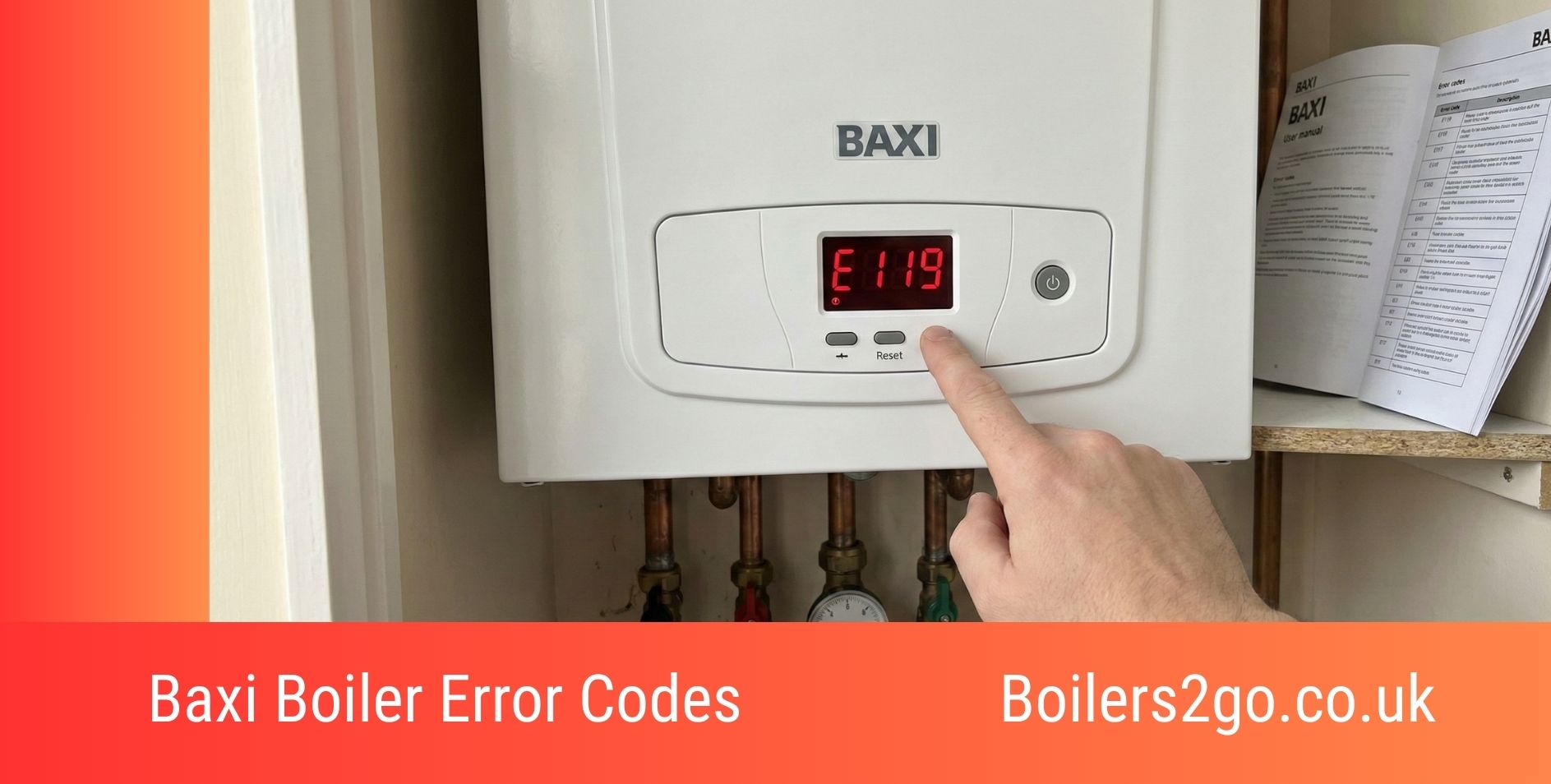
For a UK homeowner or landlord, few things are more frustrating than a central heating system that lets you down on a chilly winter evening.
A flashing display on a Baxi boiler showing one of its cryptic error codes is a common sight, and thousands search for answers on Baxi boiler error codes each month hoping for a quick diagnosis and fix.
These fault indicators are the boiler’s way of communicating a problem, whether it’s a simple pressure drop or a more complex ignition issue.
This guide breaks down the most common Baxi boiler fault codes, what they mean, the root causes behind them, and step-by-step fixes for everyday use.
From combi models like the EcoBlue and Duo-tec to Baxi system boilers, this covers what to look out for, and helps with deciding whether it’s a DIY task or time to call in a Gas Safe registered engineer.
While some Baxi heating system errors can be resolved at home, safety always comes first, especially when dealing with gas appliances.
Most Common Baxi Boiler Error Codes
What Does the E119 Error Code Mean?
The E119 error code on a Baxi boiler indicates critically low water pressure in the heating system, dropping below 0.5 bar, which prevents the boiler from firing up and circulating hot water effectively. To resolve it, check the pressure gauge and restore water pressure to the recommended level, typically between 1 and 1.5 bar. In some cases, locating and fixing any leaks in the system will also be needed, and resetting the boiler may be necessary to clear the error. Our Baxi E119 fault code guide covers each step in more detail.
This fault locks out the appliance to avoid dry running, which could damage internal parts like the heat exchanger. In UK homes, where sealed systems rely on consistent pressure, ideally 1 to 1.5 bar when cold, an E119 alert often leaves radiators cold and taps running tepid, disrupting daily routines for families or tenants.
What Causes the E119 Error Code?
The E119 error code is primarily caused by insufficient water in the closed-loop central heating circuit, but several underlying factors can trigger this drop.
Cause 1: Natural Pressure Loss Over Time
In sealed Baxi heating systems, gradual pressure loss usually points to a small leak, a weeping pressure relief valve or a faulty expansion vessel, and bleeding radiators will also lower the pressure.
How to fix it:
- Monitor the pressure gauge weekly. If below 1 bar, use the filling loop, a flexible hose connecting cold mains to the boiler, to top up.
- Turn the isolation valves 90 degrees to allow flow, watch the gauge rise to 1.2 bar, then close.
- Bleed radiators to release trapped air, then recheck after 30 minutes. For landlords, scheduling quarterly checks helps catch this early.
Cause 2: A Small Leak in the System
Drips from radiator valves, pipe joints, or the boiler itself erode pressure, common in properties with hard water scale buildup. These leaks can lead to heat loss and increased energy bills as the heating system works harder to maintain the desired temperature. Our guide to a leaking boiler covers how to trace the source. Tackling hard water scale buildup can also prolong the life of the boiler, making a water softener worth considering.
How to fix it:
- Inspect visible pipes and radiators for damp spots or corrosion, tightening loose fittings with a spanner if accessible.
- For hidden leaks, apply soapy water to suspect joints, since bubbles indicate an escape. Isolate the system, drain via the lowest radiator, and repressurise.
- If persistent, trace with a moisture meter or call a plumber to pressure-test the entire network.
Cause 3: Faulty Pressure Relief Valve
A stuck or worn pressure relief valve (PRV) on the boiler discharges water automatically, mimicking a leak and triggering E119.
How to fix it:
- Locate the PRV (usually on the boiler’s outlet pipe) and check for discharge pipe wetness. Gently lift the valve lever to test, water should flow freely then stop.
- If it drips continuously, replace the valve cartridge, a brass component inside, which requires draining the system first.
- Always test post-fix by running the boiler and monitoring for 24 hours.
What Does the E133 Error Code Mean?
The E133 error code signals a failure to detect the burner flame after ignition attempts, halting gas flow to prevent unsafe operation. This lockout protects against incomplete combustion, which could lead to soot buildup or incomplete burns in the heat exchanger.
Homeowners often notice this during startup, with the boiler clicking repeatedly but producing no heat, a frequent winter issue in unheated UK properties.
What Causes the E133 Error Code?
Ignition and flame detection issues drive the E133 code, often linked to supply disruptions or component wear.
Cause 1: Frozen Condensate Pipe
In sub-zero temperatures, the external plastic drain pipe for acidic condensate freezes solid, backing up the system and extinguishing the flame.
How to fix it:
- Identify the white or grey 22mm pipe exiting the boiler to the drain. Wrap it in lagging foam or heat tape, typically £10 to £15 from a DIY store.
- For an immediate thaw, pour warm, not boiling, water over the frozen section, or use a hairdryer on a low setting for 10 to 15 minutes.
- Ensure the pipe slopes downward to avoid future sags, securing it with clips if needed. Test by resetting the boiler; hot water should resume within minutes.
Cause 2: Interrupted Gas Supply
A closed meter valve, depleted prepay credit, or a supplier outage starves the burner of natural gas, mimicking a flame failure.
How to fix it:
- Verify the gas meter shows credit (top up via app if smart) and that the emergency control valve near the meter is parallel to the pipe.
Sniff for gas odours; if present, evacuate and call the National Gas Emergency Service on 0800 111 999.
- For blockages, gently tap the meter to dislodge debris, then reset. If supply resumes but E133 persists, check internal valves.
Cause 3: Faulty Ignition Electrode or Lead
The spark electrode, which senses and ignites the flame, corrodes or its wiring frays over time, failing to register combustion.
How to fix it:
- Power off at the fused spur, remove the boiler front panel, and locate the porcelain-tipped electrode near the burner.
- Clean carbon deposits with fine sandpaper, ensuring the gap is 3 to 4mm. Inspect leads for cracks, splicing if minor, but replacing the assembly (around £20–£40 for the part) if damaged.
- Reassemble, reset, and run a cycle. Professional calibration may be needed for precise alignment.
What Does the E110 Error Code Mean?
The E110 error code denotes primary heat exchanger overheating, where the boiler’s core temperature exceeds safe limits, around 85°C, triggering a shutdown to avert scalding or warping. This fault disrupts both heating and hot water, often with gurgling sounds, and is more common in Baxi system boilers with sludge accumulation. Our Baxi E110 error code guide covers the fixes in more detail.
What Causes the E110 Error Code?
Overheating in the E110 code arises from circulation blockages or pump inefficiencies, impeding heat dissipation.
Cause 1: Air Trapped in the Radiator Circuit
Air pockets from improper bleeding create hot spots, slowing water flow and causing localised overheating.
How to fix it:
- Turn off the boiler, attach a radiator key to the top bleed valve on each unit, and release air until water trickles out, placing a cloth underneath.
- Start from the lowest floor, working up. Refill via the filling loop to 1.5 bar, then run the pump override, if available, for 5 minutes to circulate.
- Monitor for recurrence, adding a chemical inhibitor if air returns frequently.
Cause 2: Pump Failure or Airlock
The circulating pump seizes or cavitates due to air, failing to push water through the heat exchanger.
How to fix it:
- Listen for the pump hum behind the boiler. If silent, or humming without flow, isolate electrically and manually spin the pump shaft with a screwdriver, adding a drop of oil if stiff.
- Bleed the pump’s air screw if present.
- For a seized motor, replace the pump head, around £100–£150, then test flow by checking radiator warmth after resetting.
Cause 3: Sludge Buildup in Pipes
Magnetite sludge from rust clogs narrow pipes, restricting flow and trapping heat in the exchanger.
How to fix it:
- Flush the system with a powerflush, connecting to the lowest drain point and running hot water with a descaler additive for 1 to 2 hours.
- Isolate zones via valves to target specific radiators.
- Follow with an inhibitor added via the header tank or filling loop. For severe cases, a professional flush helps prevent recurrence.
What Does the E168 Error Code Mean?
The E168 error code is a generic ignition or communication fault, where the printed circuit board detects an unspecified electrical or control issue, often after power surges. It shows up as erratic operation or a total lockout, which can be puzzling for anyone managing a Baxi combi unit in a rented flat.
What Causes the E168 Error Code?
Electrical glitches underpin the E168 code, ranging from transient errors to hardware degradation.
Cause 1: Temporary Power Fluctuation
Voltage dips from tripped breakers or grid instability confuse the PCB, logging a false positive.
How to fix it:
- Reset the boiler by pressing the reset button, or power cycling via the wall switch for 30 seconds.
- Check the consumer unit for partial trips, flipping breakers off and on. A surge protector on the boiler spur can help buffer future spikes.
- Run a test cycle; if stable, it’s worth logging the event for warranty purposes.
Cause 2: Loose Wiring Connection
Vibration or age loosens terminals on sensors or the gas valve, interrupting signals.
How to fix it:
- With power off, inspect the PCB for loose plugs, gently reseating them. A multimeter can test continuity on suspect wires.
- Tighten screws on connectors.
- Avoid soldering unless qualified, and photograph before disassembly to help with reassembly.
Cause 3: Faulty PCB or Sensor
Degraded electronics on the main board, or a shorted thermistor, send erratic data, defaulting to E168.
This is best diagnosed by swapping accessible sensors, such as the NTC thermistor, and testing resistance. PCBs require professional replacement due to programming requirements. Settings should be backed up where possible, and firmware updated via the Baxi app afterwards if the model supports it.
What Does the E160 Error Code Mean?
The E160 error code points to a fan speed anomaly, where the extraction fan runs too slow, too fast, or not at all, compromising flue gas venting and risking unsafe indoor air. Critical for Baxi boilers with balanced flues, this halts operation to comply with Building Regulations Approved Document J, which covers combustion appliances and fuel storage systems. Our Baxi E160 error code guide covers the fixes in more detail.
What Causes the E160 Error Code?
Fan discrepancies in E160 often result from mechanical or electrical hindrances.
Cause 1: Blocked Flue Terminal
Bird nests, leaves, or ice obstruct the external vent, impeding airflow.
How to fix it:
- Safely access the roof or wall terminal (using a ladder securely) and remove debris with gloves and a brush.
- Ensure 1m clearance from obstacles per Baxi specifications.
- Vacuum internals if accessible. Test the fan spin-up on reset; an audible whir confirms clearance.
Cause 2: Dirty or Worn Fan Blades
Dust accumulation or bearing wear reduces RPM, triggering the tachometer sensor.
How to fix it:
- Isolate power, remove the fan assembly, usually four screws, and clean blades with a soft brush and compressed air. Lubricate bearings if oiled ports exist.
- For wear, replace the fan module, around £80–£120, aligning it precisely during reinstall to avoid vibration.
Cause 3: Electrical Supply to the Fan
Loose wiring or a blown fuse cuts power to the fan motor.
How to fix it:
- Check the inline fuse (a 3A glass type on the PCB) for continuity, replacing it if black.
- Trace wires from the PCB to the fan for frays, stripping and reconnecting with crimps.
- Use a multimeter for 230V AC at the fan terminals during startup. If absent, trace back to the control relay.
How to Prevent Baxi Boiler Error Codes in the Future
Preventing Baxi boiler error codes involves proactive maintenance to keep a central heating system robust against common UK pitfalls like limescale and frost. That includes keeping the pressure in the right range: too little brings up E119, while overfilling during a top-up can trigger the Baxi 117 error code for high system pressure.
Scheduling an annual Gas Safe service to inspect components, flush sludge, and calibrate sensors is vital for warranty validity and efficiency under Boiler Plus regulations. Insulating pipes and the condensate drain with foam lagging helps thwart freezing, and fitting an external frost stat adds automatic protection.
For pressure stability, auto-fill valves and monitoring via a smart app can help. Landlords should log services for compliance, while homeowners benefit from weekly gauge checks and inhibitor top-ups. For an older unit that keeps faulting, a new boiler installation may make more sense than continuing to repair it.
When Should You Call a Gas Safe Engineer About a Baxi Error Code?
While minor tweaks like repressurising can resolve some Baxi boiler faults, certain scenarios demand immediate intervention from a Gas Safe registered engineer to avert dangers like gas leaks or explosions.
It’s worth calling without delay if error codes recur after resets, or are accompanied by gas smells, soot marks, or yellow flames, all hallmarks of combustion issues. Electrical faults such as E168 or E160 involving PCBs or fans require certified handling due to live wires, and any suspected leaks beyond visible drips need proper leak detection tools.
For landlords, persistent codes affecting tenant comfort can trigger legal duties under the Homes (Fitness for Human Habitation) Act 2018. It’s always worth prioritising a professional for part replacements like electrodes or valves, since DIY mishaps can void warranties and risk fines. Search the Gas Safe Register online for verified engineers in the local area.
Baxi Boiler Error Codes: FAQs
How Often Should a Baxi Boiler Be Serviced to Avoid Error Codes?
Annual servicing by a Gas Safe engineer is recommended for Baxi boilers, but in hard water areas like the South East, biannual checks are worth considering to help prevent scale-related faults. This includes a full system flush and component test, catching issues before they trigger error codes.
Can Weather Conditions Trigger Specific Baxi Boiler Faults?
Yes. In cold weather, a frozen condensate pipe is a common cause of lockouts (often shown as E133 on Baxi boilers), so insulating the condensate pipe helps. Low pressure (E119) is not seasonal and usually points to a leak or an expansion vessel problem.
What’s the Difference Between Temporary and Permanent Baxi Error Codes?
Temporary codes, like some E168 instances, clear after a reset and indicate a fleeting glitch, whereas persistent ones, such as repeated E160, signal a hardware failure needing replacement. It’s worth logging occurrences to track any patterns.
Do Baxi Boiler Error Codes Vary by Model, Like Combi vs System?
Yes. Core codes such as E119 (low water pressure) and E133 (ignition or gas supply) are shared across most current Baxi models, but some codes only apply to combi or system boilers. It’s worth consulting the specific model’s manual for tailored diagnostics.
Is There a Mobile App for Monitoring Baxi Boiler Faults?
Baxi’s myBaxi app connects compatible models for real-time alerts on potential errors, pressure readings, and service reminders, helping UK users stay ahead of breakdowns remotely.
Can Resetting a Baxi Boiler Too Many Times Cause Damage?
Repeated resets without addressing the underlying fault can put extra strain on components and mask a genuine issue. A single reset is usually fine to try, but if the code returns quickly, it’s worth calling an engineer rather than continuing to reset.
Do Older Baxi Boilers Show Different Error Codes to Newer Models?
Some older Baxi ranges use different numbering or display formats compared with current models like the EcoBlue or Duo-tec range. It’s always worth checking the specific model’s manual or the Baxi website, since a code that means one thing on an older boiler may not carry the same meaning on a newer one.
Baxi Boiler Comparisons
Related Baxi Boiler Guides

I’m Penny North, a home energy heating expert. My mission is to demystify new boilers and complex heating systems to help you achieve a warm, cosy home with lower energy bills and a smaller environmental footprint.