

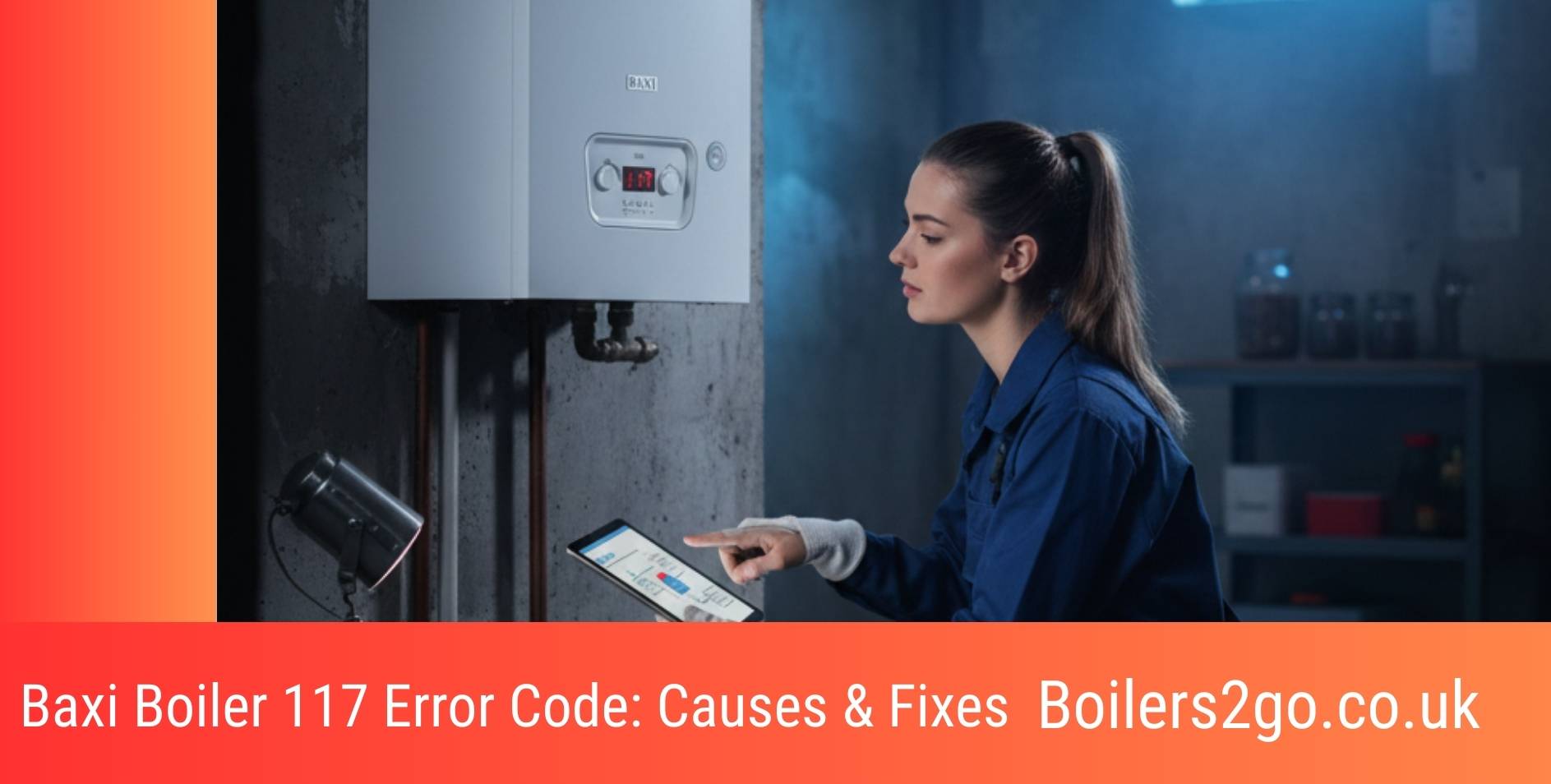
The Baxi 117 error code is a high pressure warning that triggers a safety lockout on combi and system boilers. When it fires, the boiler cuts out and leaves you without heating or hot water until the pressure drops back within the safe operating range.
Get a boiler cover, repair and annual service plan online here >
The normal working pressure for a Baxi boiler is between 1.0 and 1.5 bar when the system is cold. Once pressure climbs above 3 bar, the boiler’s onboard controls shut everything down to protect the heat exchanger, pipework and internal seals from damage.
The causes behind high pressure are much the same across brands, and our guide to the reasons boiler pressure is too high explains them in more detail.
This guide explains what causes the 117 fault, how to diagnose each scenario, and the step-by-step fixes you can try safely before calling an engineer.
Get a quote today and take the stress out of replacing your boiler. At Boilers2Go, we offer fast, reliable installation across the UK - often as soon as the next day. 
Need a new boiler?
What Does the Baxi Boiler 117 Error Code Mean?
The Baxi 117 error code means the water pressure inside the sealed central heating circuit has exceeded the safe upper limit, typically above 2.5 to 3 bar. The code is also displayed as E117 on some Baxi models.
The boiler’s pressure switch detects the elevated reading and triggers a safety lockout, cutting heating and hot water until the fault is cleared. This is the boiler doing its job correctly; the problem lies in whatever is causing the pressure to climb in the first place.
If left unresolved, sustained high pressure can cause noisy operation, stress on seals and pipework, and eventually leaks. UK hard water areas are particularly prone to this fault because scale buildup in valves and components makes pressure management less reliable over time.
What Causes the Baxi Boiler 117 Error Code?
The 117 fault is always a pressure problem, but the underlying cause varies. There are five common culprits, each with a different fix. To see how 117 relates to other Baxi faults, read our Baxi boiler error codes guide.
1. Overfilling During Repressurising
This is the most common cause of the 117 code. When the filling loop is left open too long during a routine top-up, water is pushed into the sealed circuit beyond the safe limit. It can happen easily, especially if the pressure gauge is not being watched closely throughout the process.
How to Fix Overfilling During Repressurising
- Turn the boiler off and allow it to cool down fully before doing anything. Hot systems can spray scalding water.
- Bleed a radiator, starting with one upstairs. Release water slowly using a bleed key until the pressure gauge drops to around 1.2 bar.
- Close the bleed valve, then reset the boiler and check it fires normally.
- If pressure climbs again quickly after the reset, the filling loop valve may be passing water and needs replacing. A Gas Safe engineer can do this for around £100 to £200.
2. Faulty Filling Loop Valve
A worn or damaged filling loop valve can allow mains water to slowly seep into the heating circuit even when you have not touched the filling loop yourself. The pressure rise is gradual, which is why it often goes unnoticed until the 117 code appears.
Worn washers, failed seals and hard water scale are the main culprits. If you find yourself topping up the pressure regularly and then seeing it climb above 2.5 bar, a passing filling loop valve is the likely explanation.
How to Fix a Faulty Filling Loop Valve
- Isolate the boiler and close the mains water supply.
- Inspect the flexible loop hoses for drips with the valves in the closed position. Moisture around the connections is a giveaway.
- Replace worn seals or the entire loop assembly. Replacement parts are available from most plumbing merchants.
- Repressurise to 1.2 bar, reset the boiler and monitor over 24 hours. If pressure rises again, call a Gas Safe engineer. Typical repair cost is £150 to £250.
3. Expansion Vessel Failure
The expansion vessel is a small pressurised tank inside the boiler that absorbs the increase in water volume as the system heats up. If the vessel’s internal diaphragm ruptures or the air pre-charge pressure drops too low, the vessel can no longer do its job and pressure climbs rapidly during heating.
The most common issue is not a full rupture but simply a vessel that has lost its air charge over time. This is often repairable without a full replacement.
How to Fix Expansion Vessel Failure
- With the system cold and depressurised, use a tyre pressure gauge on the vessel’s Schrader valve. The pre-charge should read around 0.75 bar.
- If the reading is low but the valve is dry, recharge the vessel to 0.75 bar using a bicycle pump or a compressor.
- If water comes out of the Schrader valve, the diaphragm has ruptured and the vessel needs replacing.
- A Gas Safe engineer will drain the system partially and fit a replacement. Budget £200 to £400 for parts and labour, then reset and test.
4. Faulty Pressure Sensor
In some cases the system pressure is actually fine, but a failing pressure sensor is misreading the level and triggering the 117 lockout incorrectly. Scale buildup and moisture ingress in the sensor are the usual causes, and this tends to affect boilers in hard water areas most often.
A clue here is if the pressure gauge on the boiler front reads normally but the 117 code keeps returning after resets.
How to Fix a Faulty Pressure Sensor
- Reset the boiler once. If the 117 code clears and pressure stays normal, monitor over the next few heating cycles.
- If the code returns immediately despite a normal gauge reading, the sensor is likely at fault.
- Do not keep resetting repeatedly; this can stress other components.
- A Gas Safe engineer can test the sensor, clean or replace it, and flush the system to remove scale. Typical cost is £150 to £300.
5. Blocked or Faulty Pressure Relief Valve
The pressure relief valve (PRV) is the system’s last line of defence. It should open automatically to vent excess pressure if the 117 threshold is reached. When the PRV is blocked by debris or worn to the point it no longer opens correctly, pressure has nowhere to go and the lockout follows.
Hard water scale is a frequent cause of PRV problems in UK homes. You may notice water dripping from the discharge pipe outside the property when pressure spikes, which is the PRV doing its job. If that discharge pipe runs dry during a 117 event, the valve may have failed.
How to Fix a Blocked or Faulty Pressure Relief Valve
- Check the overflow discharge pipe outside for any water flow during a high pressure episode. No flow suggests the PRV is stuck.
- Carefully lift the PRV lever briefly to release pressure, wearing gloves as the water will be hot.
- If the valve does not reseat properly afterwards and continues to drip, it needs replacing.
- A Gas Safe engineer can replace a PRV for around £150 to £250. Do not attempt to repair a PRV yourself.
Is It Time to Replace Your Baxi Boiler?
If the 117 fault is recurring regularly despite repairs, or your Baxi is ageing and developing multiple issues, it is worth taking stock of the repair costs versus replacement.
If you are open to switching brands, our Baxi vs Vaillant boilers comparison sets out how the two differ. Warranty terms, efficiency ratings and feature sets all matter when calculating long-term running costs.
A rough rule of thumb: if the cost of a repair exceeds 50% of what a replacement boiler would cost to install, replacement usually makes more financial sense. A new A-rated combi typically costs between £1,800 and £3,500 installed in 2026. That puts the repair threshold at around £900 to £1,750 depending on the model you would choose.
If you want to weigh up your options, you can request a new boiler quote from Boilers 2 Go today and see what a replacement would actually cost you.
When to Call a Gas Safe Engineer About a Baxi 117 Fault
Some pressure faults are safe to tackle yourself. Others need a registered professional from the start. Call a Gas Safe engineer straight away if:
- You can smell gas anywhere in the property.
- The boiler is actively leaking water.
- The 117 code returns repeatedly after resets or pressure adjustments.
- The pressure relief valve is discharging continuously.
- You are not confident working with the filling loop, bleed valves or internal components.
Tampering with gas appliances without Gas Safe registration is illegal. Even for pressure-related repairs that seem straightforward, it is always safer to have a qualified engineer diagnose the root cause rather than treating symptoms with repeated resets.
Baxi Boiler 117 Error Code: FAQs
How Does Water Quality Affect How Often the Baxi 117 Code Appears?
Hard water areas, which cover much of England and Wales, see higher rates of scale buildup in filling loop valves, pressure relief valves and sensors. This accelerates wear and makes pressure-related faults more frequent. A scale inhibitor added to the system fluid and a whole-house water softener can significantly reduce the frequency of 117 events over time.
What Accessories Help Prevent the Baxi 117 Code?
An automatic filling device (sometimes called a pressurisation unit) can maintain system pressure within the correct range without manual intervention, which reduces the risk of accidental overfilling. Magnetic system filters and inhibitor fluid also help by reducing internal corrosion and debris that clog valves.
Are There Smart Monitors for Baxi Boiler Pressure?
Yes. Smart thermostats with boiler monitoring functions, such as those from Hive or Nest, can track system behaviour over time. Some heating engineers also fit standalone pressure monitoring devices that send alerts when pressure moves outside the normal range. This is particularly useful for landlords managing multiple properties.
How Often Should a Baxi Expansion Vessel Be Checked?
The expansion vessel pre-charge pressure should be checked as part of every annual boiler service. An engineer can test it in a few minutes and recharge it if needed. Leaving this unchecked is one of the most common reasons the 117 fault develops in boilers that otherwise appear in good condition.
Can Adding Inhibitor Stop the Baxi 117 Code Recurring?
It can help. Inhibitor fluid reduces internal corrosion, which in turn reduces the sludge and scale deposits that clog valves and pressure sensors. It will not fix a mechanical fault, but it does slow down the rate of component wear that makes pressure problems more likely over time. Inhibitor should be added and checked at every annual service.
What Is the Correct Operating Pressure for a Baxi Boiler?
A Baxi boiler should sit between 1.0 and 1.5 bar when the system is cold. Once the heating is running, pressure will rise slightly as water expands, which is normal. The 117 lockout triggers when pressure exceeds approximately 3 bar. If your gauge is already showing above 2 bar when the system is cold, it is already too high and should be reduced before the next heating cycle. Pressure that falls too low causes problems of its own, restricting circulation and contributing to the overheat lockout behind the Baxi E1 error code.
Get a quote today and take the stress out of replacing your boiler. At Boilers2Go, we offer fast, reliable installation across the UK - often as soon as the next day.
Need a new boiler?

I’m Penny North, a home energy heating expert. My mission is to demystify new boilers and complex heating systems to help you achieve a warm, cosy home with lower energy bills and a smaller environmental footprint.