

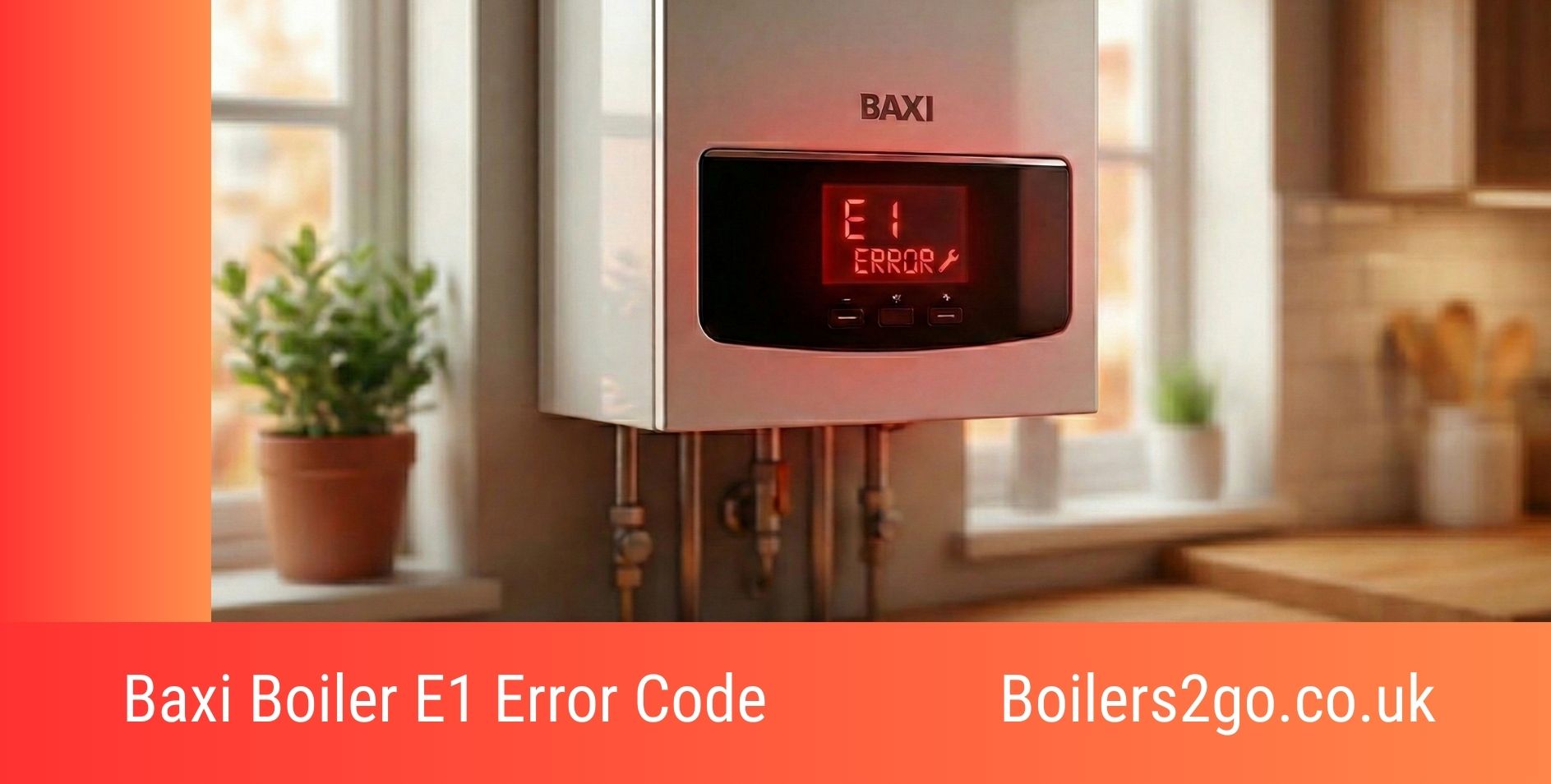
The Baxi boiler E1 error code is a common overheat alert that can leave a heating system stalled, especially in chilly British winters when it is needed most.
A Baxi Duo-tec or Platinum model flashing E1 and refusing to fire up is not a reason to panic. This guide explains what it signals, the typical triggers, and practical steps to get things running again for everyday homeowners and landlords.
What Does the Baxi Boiler E1 Error Code Mean?
The Baxi boiler E1 error code means the boiler has detected an overheating condition and locked out as a safety measure to prevent damage to internal components such as the heat exchanger.
It is Baxi’s way of protecting the system when temperatures spike abnormally, often accompanied by a reset button prompt. This is common in combi or system boilers where flow issues let heat build up unchecked.
How Does Baxi Overheat Protection Work?
This code ties into the boiler’s thermistor sensors monitoring water temperature. If they sense excess heat, E1 flashes to halt operation, avoiding risks such as leaks or inefficiency in the central heating network. A closely related fault is the Baxi E110 error code, which also signals overheating and shares many of the same causes.
What Causes the Baxi Boiler E1 Error Code?
The Baxi boiler E1 error code is caused by factors disrupting normal water flow or temperature control, leading to unsafe heat levels that trigger the lockout. In hard water areas, these often stem from neglected maintenance letting sludge accumulate or components wear. The key causes and their fixes are set out below. Several of these causes also lie behind other faults, which are covered in our full guide to Baxi boiler error codes.
Low System Pressure
Low system pressure happens when water levels drop below 1 bar, reducing circulation and causing localised overheating that prompts E1. This is often caused by slow leaks from corroded pipes, evaporation over time, or forgetting to top up after bleeding radiators, a frequent issue in older UK homes where seals degrade.
How to Fix Low System Pressure
- Check the pressure gauge on the Baxi. If below 1 bar, locate the filling loop, usually braided hoses under the unit, and slowly open the valves to add mains water until it reaches 1.2 bar with the boiler off and cold.
- Close the valves securely to avoid overpressurising, then press the reset button, often marked with a flame icon, for 3 to 5 seconds to clear the code.
- Turn on the boiler and test heating and hot water modes, monitoring the gauge over 24 hours for stability.
- If pressure falls again, inspect visible pipes and radiators for drips and tighten loose fittings if safe to do so, but call a Gas Safe engineer for hidden leaks, typically costing £100 to £300 including parts.
Faulty Circulation Pump
A faulty circulation pump fails to push water through the system effectively, trapping heat and leading to the E1 overheat code. This can stem from wear after constant use, sludge blockage in calcareous UK water, or electrical faults such as seized bearings following a power surge.
How to Fix a Faulty Circulation Pump
- Listen for unusual humming or grinding from the pump area. If absent or weak, reset the boiler first to rule out a temporary glitch.
- Bleed nearby radiators to release any airlocks that might be impeding flow, then repressurise the system to 1.2 bar.
- If noises persist, avoid tampering further and call a Gas Safe professional to test pump speed with a multimeter and replace it if needed, typically around £200 to £400 including labour and a new unit. Adding a magnetic filter to the return pipe afterwards helps catch future debris, alongside scheduling annual services to extend pump life.
Blocked Heat Exchanger
A blocked heat exchanger restricts water paths inside the boiler, causing heat to accumulate and trigger E1. This is often caused by limescale deposits from hard water common in many UK regions, or sludge from corrosion in an unmaintained system building up over years.
How to Fix a Blocked Heat Exchanger
- Turn off the boiler and let it cool completely to avoid burns, then reset it to check if it is a one-off.
- A chemical descaler can be added to the system via a radiator or filling point, circulated for 30 to 60 minutes per the product instructions, then flushed out.
- Repressurise and test operation. If E1 returns, it is likely a severe blockage requiring professional intervention. A Gas Safe engineer can carry out a full power flush or exchanger replacement, costing £300 to £600 depending on the model, and can also fit a scale reducer for ongoing protection.
Air in the System
Air in the system creates pockets that interrupt smooth water flow, leading to uneven heating and the overheat condition behind E1. This can happen from air entering during installation, repairs, or from low pressure pulling in bubbles through vents in an ageing setup.
How to Fix Air in the System
- Switch off the boiler and allow it to cool, then use a bleed key to vent each radiator starting from the top floor, catching drips with a cloth until a steady flow of water appears.
- Work down to lower levels, bleeding all points including towel rails or underfloor loops if present.
- Repressurise the system via the filling loop to 1.2 bar once done, then reset the boiler and run a heating cycle to check for even warmth. If air returns frequently, a Gas Safe professional can install an automatic air vent or check for entry points, typically £100 to £200.
Faulty Thermistor
A faulty thermistor misreads water temperature, falsely indicating overheat and causing the E1 lockout. This is often caused by sensor degradation from prolonged heat cycles or electrical faults such as short circuits in damp environments.
How to Fix a Faulty Thermistor
- Reset the boiler to confirm whether it is a transient error, holding the button until the code clears, then monitor temperatures.
- If E1 persists without actual overheating, checking radiator warmth confirms this, the sensor itself is likely at fault. This is not a DIY repair, since it is an internal component.
- A Gas Safe engineer can test resistance with a multimeter and replace the thermistor, typically costing £150 to £250 including diagnostics. Pairing the fix with a full service helps calibrate other sensors and prevent related codes.
Related Baxi Boiler Guides
The Baxi E20 error code is a related thermistor fault worth knowing about, as it can present with similar flow or pressure symptoms to E1.
If you are weighing up whether to stick with Baxi after a fault, our Baxi boiler reviews cover installation costs, maintenance requirements and long-term running costs, and our Baxi vs Worcester Bosch boilers comparison shows how the brand stacks up against a key rival.
When Should You Replace a Baxi Boiler Showing E1?
If the E1 error keeps returning despite these fixes, or the Baxi is over 10 years old with declining efficiency, that is a clear sign to consider a replacement for more dependable performance.
Upgrading to a modern A-rated model eliminates these overheat issues in most cases, cutting bills and boosting reliability. Anyone ready to explore options can request a gas boiler replacement quote. Any repair or installation should be carried out by an engineer listed on the Gas Safe Register.
Baxi E1 Error Code: FAQs
How Does Hard Water Contribute to Baxi E1 Errors?
Hard water accelerates limescale build-up in the heat exchanger, which restricts flow and indirectly increases the likelihood of an E1 overheat lockout. A water softener or scale reducer in high-mineral areas, such as much of the South East and Midlands, can meaningfully reduce this risk.
Does Winter Increase the Risk of a Baxi E1 Error?
Yes. Winter demand puts more strain on the whole system, which tends to reveal a weak pump or marginal pressure that coped fine during milder months. A pre-season check and balancing of the system before cold weather sets in helps prevent lockouts during the coldest stretches of winter.
Can Smart Controls Warn You Before a Baxi E1 Error?
Yes. Compatible smart controls and Baxi’s own connected app can flag unusual temperature patterns before a full E1 lockout develops, allowing adjustments to be made proactively in a connected home.
How Often Should a Baxi Boiler Be Serviced to Avoid E1?
An annual Gas Safe service is essential for catching sensor wear, pump issues, and early signs of limescale before they escalate into an E1 lockout. This is also a requirement for keeping most Baxi warranties valid.
Can Renewables Affect How Often a Baxi E1 Error Occurs?
Not directly. E1 is usually caused by flow, pressure or sensor problems within the boiler and heating circuit, so adding solar thermal or other renewables will not prevent it, and any combined system should be designed by a qualified installer.
Is It Safe to Keep Resetting a Baxi Boiler Showing E1?
Only once or twice. A reset or two while working through the checks above is reasonable, but repeatedly resetting a boiler that keeps locking out without addressing the underlying cause risks further damage to the heat exchanger or PCB, so it is best to stop after two attempts and call a Gas Safe engineer if the fault persists.
Does E1 Mean the Same Fault on Every Baxi Model?
The overheat principle behind E1 is consistent across the Baxi range, but the exact reset procedure and where the filling loop or reset button are located can vary between models such as the Duo-tec and Platinum ranges. Checking the specific manual for the model in question avoids confusion when following the steps above.

I’m Penny North, a home energy heating expert. My mission is to demystify new boilers and complex heating systems to help you achieve a warm, cosy home with lower energy bills and a smaller environmental footprint.