

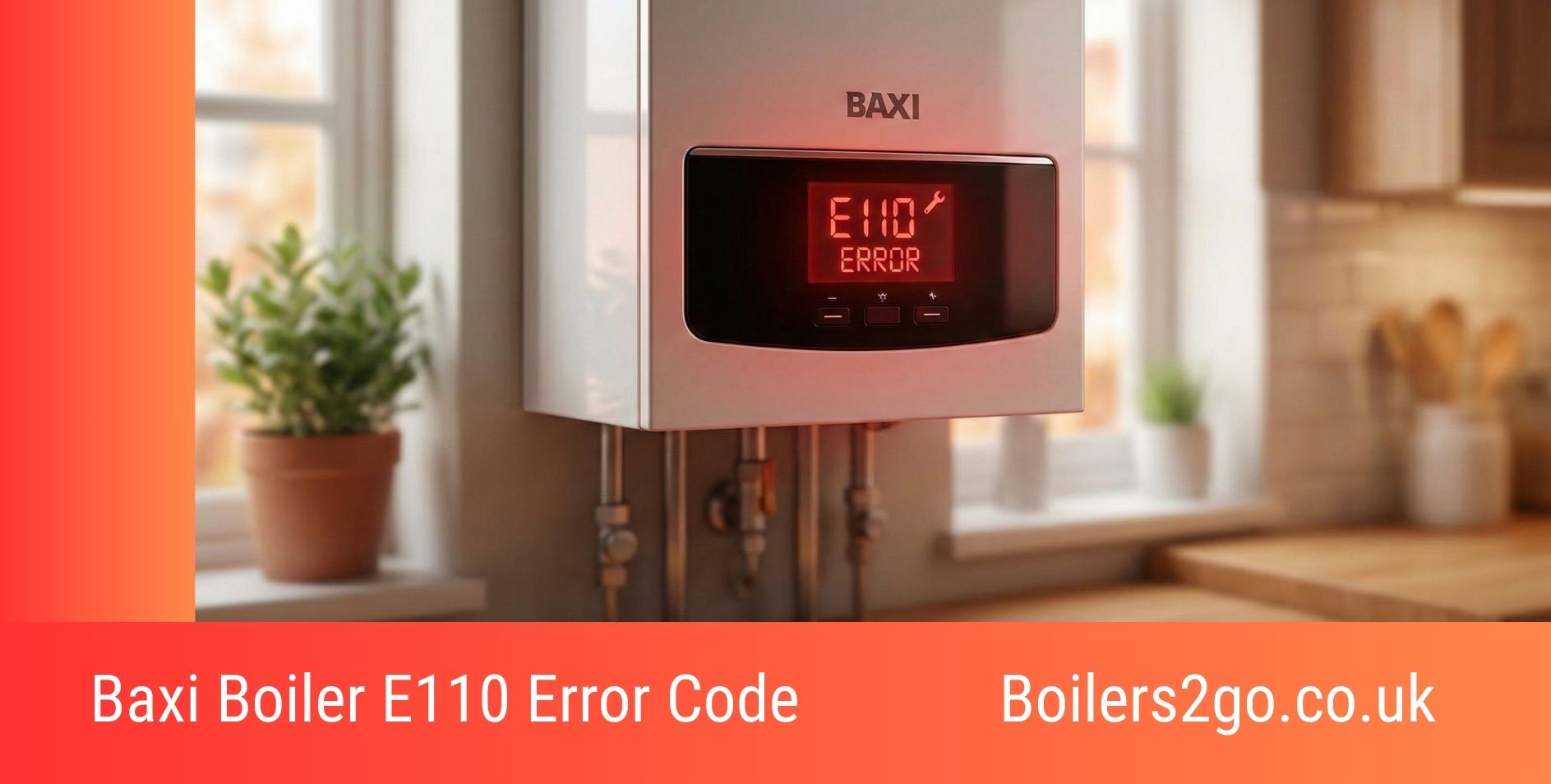
The Baxi boiler E110 error code is a serious overheat warning. It shuts the boiler down to keep things safe when the primary water temperature climbs too high, which is particularly common during periods of heavy demand in colder weather. For other faults, see our full list of Baxi boiler error codes.
If your Baxi is showing E110 and you’re left without heating or hot water, this guide explains what the code means, the most common causes, and numbered steps to fix each one.
What Does the Baxi Boiler E110 Error Code Mean?
The Baxi boiler E110 error code means the safety thermostat has tripped due to overheating, locking out the unit to prevent damage or hazards.
On models like the Duo-tec or EcoBlue, this code activates when the primary water temperature exceeds safe limits, often around 90 to 100°C, protecting the heat exchanger and other components in the central heating system.
How the Baxi Overheat Safety Mechanism Works
This built-in safeguard resets manually in some cases but signals deeper circulation or flow issues that need addressing to avoid repeated lockouts.
What Causes the Baxi Boiler E110 Error Code?
The Baxi boiler E110 error code is caused by conditions that lead to excessive heat build-up, disrupting normal operation and the boiler’s safety systems. In hard water areas, these often develop from neglected upkeep letting small problems compound over time.
It’s also worth ruling out other faults while you’re troubleshooting. Our Baxi E20 error code guide covers a related temperature sensor fault worth checking if a reset doesn’t hold.
If your Baxi keeps causing problems as it ages, our Baxi boiler reviews can help you weigh up a replacement against another repair, particularly once you’re facing a second or third call-out for the same unit.
Low Water Pressure
Low water pressure causes E110 by limiting circulation, allowing heat to concentrate and trip the thermostat. This is usually down to leaks from corroded pipes, evaporation in older systems, or pressure loss after radiator work. If the pressure falls further, below about 0.5 bar, the boiler will usually lock out with the Baxi E119 fault code instead, which deals with low pressure directly.
How to Fix Low Water Pressure
- Check the pressure gauge. If it’s below 1 bar, turn off the boiler and find the filling loop, usually a pair of hoses under the unit.
- Open the valves slowly to add water until the gauge reads 1.2 to 1.5 bar with the system cold.
- Close the valves tightly, reset the boiler, and test the heating and hot water.
- If pressure drops again, inspect for leaks or call a Gas Safe engineer to repair, typically £100 to £300.
Faulty Circulation Pump
A faulty circulation pump triggers E110 by failing to move water, creating hot spots that overheat. This is usually down to wear from constant running, sludge blockage, or electrical issues in high-demand setups.
How to Fix a Faulty Circulation Pump
- Listen for odd noises, then reset the boiler to test.
- Bleed the radiators to aid flow and repressurise the system.
- Avoid internal work. A Gas Safe engineer will test and replace the pump, typically £200 to £400.
- Ask for a magnetic filter to be fitted afterwards to trap debris.
Blocked Heat Exchanger
A blocked heat exchanger causes E110 by restricting flow, trapping heat inside. This is usually down to limescale from hard water or sludge from corrosion in an unserviced boiler.
How to Fix a Blocked Heat Exchanger
- Reset the boiler once it’s cooled to check if the fault was temporary.
- Add a descaler chemical and circulate it per the instructions, then flush the system.
- For more severe blockages, a professional power flush clears the pathways, typically £300 to £600.
- Dose the system with inhibitor annually to prevent it building up again.
Trapped Air in the System
Trapped air causes E110 by creating pockets that block circulation, leading to localised overheating. This is usually down to air entering during maintenance, low pressure, or seasonal changes pulling bubbles in.
How to Fix Trapped Air in the System
- Let the boiler cool, then bleed the radiators starting upstairs until water flows steadily.
- Work downwards through the property, including any towel rails.
- Repressurise to around 1.2 bar and reset the boiler.
- If this keeps happening, a Gas Safe engineer can fit automatic air vents, typically £100 to £200.
Faulty Safety Thermostat
A faulty safety thermostat triggers E110 by tripping prematurely, even without true overheating. This is usually down to age-related failure or false readings caused by a nearby fault such as poor flow.
How to Fix a Faulty Safety Thermostat
- Reset the boiler a couple of times to test.
- Allow the boiler to cool fully before each attempt.
- A Gas Safe engineer will test and replace the thermostat, typically £150 to £300.
- Ask the engineer to check for and address any root circulation issues at the same time.
When Should You Replace a Baxi Boiler Showing E110?
If E110 keeps returning despite these steps, or your Baxi is ageing with other issues mounting, it’s a good time to consider an upgrade for reliable, efficient heating.
Whoever you book, always confirm their credentials on the Gas Safe Register before any work begins.
Request a gas boiler replacement quote from Boilers 2 Go today.
Baxi E110 Error Code: FAQs
How Does Hard Water Accelerate Baxi E110 Faults?
Mineral deposits insulate the heat exchanger faster, heightening overheat risk. Scale reducers slow this down in affected areas.
What Symptoms Come With a Baxi E110 Fault?
Gurgling noises or rapid cycling often signal an impending lockout.
Can Smart Controls Warn You Before a Baxi E110 Lockout?
Yes. Compatible smart controls can track system temperatures, alerting you early to overheat patterns before a full lockout occurs.
How Often Should You Flush a Baxi System to Prevent E110?
Every 5 years, or alongside your annual service in hard water areas, helps keep the pathways clear.
Can Better Insulation Help Reduce Baxi E110 Faults?
Yes. Stabilising heat demand eases strain on the pump and heat exchanger, which lowers overheat risk in poorly insulated homes.
Is It Safe to Keep Resetting a Baxi Boiler Showing E110?
Resetting once or twice to rule out a temporary blip is fine, but a same-day repeat lockout is a sign to call a Gas Safe engineer rather than keep resetting. Repeated overheat trips can indicate a genuine fault that gets worse the longer it’s run.
Does E110 Always Mean the Baxi Heat Exchanger Is Damaged?
No. Low pressure and trapped air are both common, inexpensive causes and account for a large share of E110 lockouts. A blocked or damaged heat exchanger is usually the more serious end of the five causes and the one worth ruling out last, once the simpler fixes haven’t worked.

I’m Penny North, a home energy heating expert. My mission is to demystify new boilers and complex heating systems to help you achieve a warm, cosy home with lower energy bills and a smaller environmental footprint.