

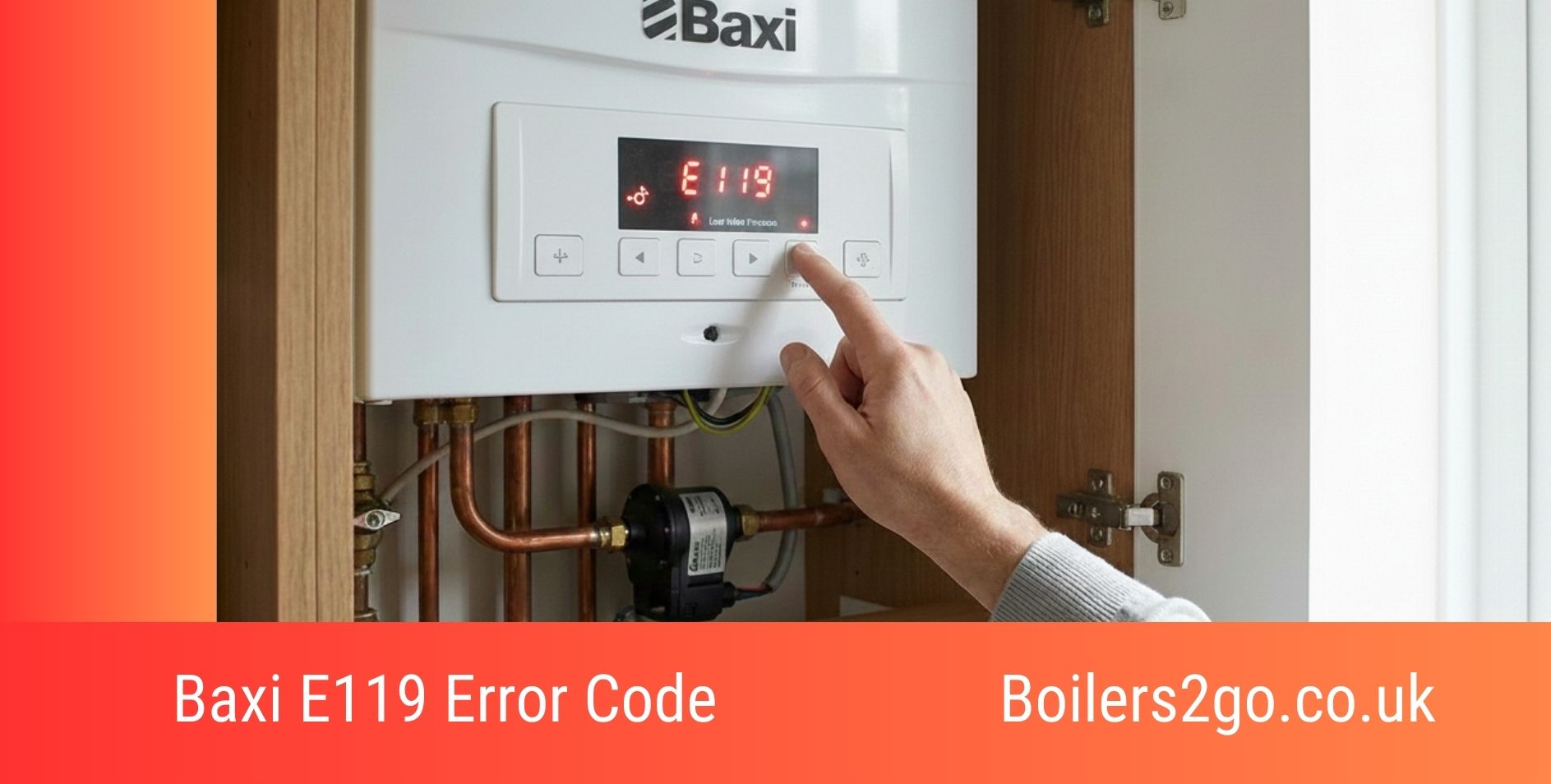
If your Baxi boiler is flashing E119 (or just showing a pressure gauge dropping to zero), don’t panic – this is the single most common fault code Baxi owners across the UK see.
Whether you have a Baxi Duo-tec, Platinum, EcoBlue, 600, 800, or even an older Potterton Promax fitted with a Baxi brain, E119 simply means “water pressure in the heating system has dropped below 0.5 bar”.
The good news? In about 8 out of 10 cases, you can fix E119 yourself in under ten minutes with nothing more than a filling loop key or a couple of taps under the boiler. The bad news? If you ignore it, the boiler will stay locked out and you’ll have no heating or hot water until it’s sorted.
This guide is written for every UK homeowner, landlord or tenant in a cold terraced house in Leeds, a flat in Glasgow or a semi in Surrey who’s staring at E119 right now.
Why E119 Happens on Baxi Boilers
Baxi combi and system boilers run as a sealed heating system. The correct pressure when cold is usually 1 to 1.5 bar (check the grey or black pressure gauge on the front). If it drops below about 0.5 bar, the boiler locks out on E119 for safety – it doesn’t want the pump running dry and overheating. To restore the pressure, you may need to add water to the system using the filling loop. Always consult the user manual for specific instructions or troubleshooting advice. For further assistance, online resources can provide baxi boiler error code solutions to help resolve any issues efficiently.
The usual culprits in real British homes:
- You (or someone) recently bled a radiator and didn’t top the pressure back up
- A tiny leak on a radiator valve, towelling rail or underfloor pipe
- The pressure relief valve (orange or red pipe outside) dripping
- Automatic air vent in the boiler leaking slowly
- Expansion vessel lost its air charge (common after 6–8 years)
- Very rarely – a pinhole in the heat exchanger
Step-by-Step: How to Fix Baxi E119 Low Pressure Yourself
99% of E119 faults are solved by repressurising the system. Here’s exactly how to do it safely:
For most modern Baxi boilers (Duo-tec, Platinum, 600, 800, EcoBlue, 200, 400)
- Locate the filling loop – usually a silver flexible hose with two black or blue taps, or a white plastic key slot under the boiler.
- Make sure both taps are fully closed or the key is removed.
- Attach the filling loop properly if it’s not already connected (some are left permanently attached).
- Open ONE tap slowly – you’ll hear water flowing.
- Now slowly open the second tap.
- Watch the pressure gauge climb to 1.3–1.5 bar (the sweet spot).
- Close both taps tightly in the reverse order.
- Remove the key or flexible hose if required.
- The boiler should reset itself within 30 seconds. Press the reset button if needed.
Still showing E119 after repressurising? The pressure is dropping away again – keep reading.
For older Baxi Solo, Bermuda or external filling loop
You might have a separate black braided hose and a small square key. Same principle – open slowly, take to 1–1.5 bar, close tightly.
Watch our photo guide here: How to repressurise your Baxi boiler
When E119 Means Something More Serious
If you top up to 1.5 bar and within a few hours or days it’s back below 0.6 bar again, you have a leak somewhere. Common places:
- Radiator valves (look for white limescale or damp patches)
- The orange pressure relief pipe dripping outside (even a slow drip loses pressure fast)
- Towel radiator in the bathroom – feel for damp under the floor
- Underfloor heating loops (big pressure drops overnight)
- Inside the boiler itself (expansion vessel or heat exchanger – needs an engineer)
When You MUST Call a Gas Safe Engineer
- Pressure drops away within minutes of topping up
- You can hear water dumping outside constantly
- The boiler is leaking from the bottom
- You’re not confident using the filling loop
- Your boiler is still under warranty (DIY repressurising is fine, but don’t touch anything else)
Find a proper engineer at www.gassaferegister.co.uk
Typical 2025 Repair Costs if It’s Not Just a Simple Top-Up
- New pressure relief valve (PRV): £120–£180
- Expansion vessel recharge or replacement: £180–£280
- Automatic air vent replacement: £130–£190
- Heat exchanger (worst case, rare on Baxi): £600–£900 fitted
How to Stop E119 Happening Again
- Fit a magnetic system filter (Baxi or MagnaClean) – catches the sludge that bursts expansion vessels
- Have an annual service – the engineer checks the vessel charge and PRV
- If you live in a hard water area (most of south-east England), fit an in-line scale reducer
Frequently Asked Questions About Baxi E119
Will resetting the boiler get rid of E119?
Only if you bring the pressure back above 0.6 bar first. Resetting alone does nothing.
How often is it normal to top up a Baxi boiler?
Once or twice a year after bleeding radiators is fine. Every week or month = leak.
My pressure shoots up to 3 bar when heating is on – is that linked?
Yes – almost always a failed expansion vessel. Needs an engineer.
Is E119 covered by my Baxi warranty?
Only if the boiler is still in its 5–10 year warranty and has a full service history. Low pressure itself isn’t a warranty fault – the cause might be.
Can I leave the filling loop permanently connected?
Yes on modern Baxi boilers – it’s designed that way and makes life easier.
Still stuck on E119 right now? Tell us your exact Baxi model and how quickly the pressure is dropping and we’ll point you in the right direction.
Stay warm and dry,
The Boilers2Go Team

I’m Penny North, a home energy heating expert. My mission is to demystify new boilers and complex heating systems to help you achieve a warm, cosy home with lower energy bills and a smaller environmental footprint.