

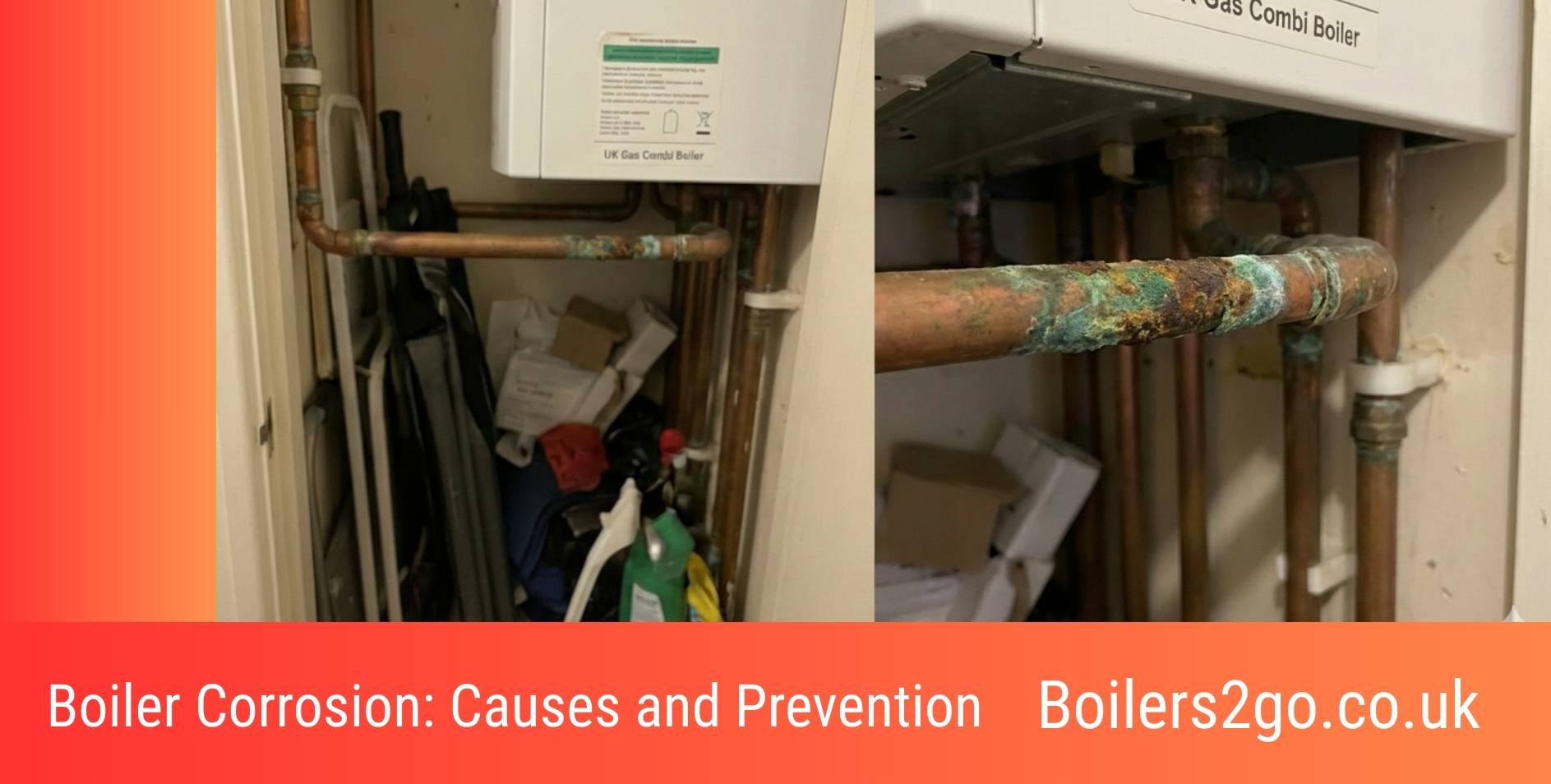
Boiler corrosion is one of the most common, and potentially most expensive, issues affecting UK boilers. Whether the goal is keeping repair bills down as a homeowner or preventing costly callouts as a landlord, understanding why corrosion happens and how to stop it is essential.
This guide breaks down the causes of boiler corrosion, how each issue can be fixed, and how to prevent corrosion from developing in the first place, covering system water quality, leaks, limescale, oxygen ingress, rust development, and component failure.
Get a quote today and take the stress out of replacing your boiler. At Boilers2Go, we offer fast, reliable installation across the UK - often as soon as the next day. 
Need a new boiler?
What Is Boiler Corrosion?
Boiler corrosion is the gradual breakdown of internal boiler components, usually metal parts, caused by chemical reactions such as oxidation, limescale buildup, acidic system water, or leaks. When corrosion starts, it weakens essential components like the heat exchanger, pipes, radiators, and internal seals.
Over time, this can lead to leaks, reduced efficiency, noisy operation, and complete boiler failure.
In the UK heating industry, corrosion is responsible for a large share of boiler breakdowns, especially in areas with poor water quality or hard water. Left untreated, it can shorten a boiler’s lifespan by years.
Main Causes of Boiler Corrosion
Below are the main causes of corrosion inside modern boilers and heating systems, along with detailed explanations and fixes.
Why Does Oxygen Ingress Cause Boiler Corrosion?
Oxygen ingress causes boiler corrosion because oxygen encourages oxidation, which leads to rust, weakened metal surfaces, and sludge formation inside the system.
Oxygen enters sealed heating systems through several faults or defects:
1. Micro-leaks in Pipework, Joints, or Radiators
Micro-leaks allow oxygen to continually seep into the heating system, creating a cycle of oxidation and rust.
How to Fix Micro-leaks in Heating Systems
- A Gas Safe engineer inspects the system for weeping joints, pinhole leaks, or failing radiator valves.
- Damaged joints are re-sealed, fittings tightened, or faulty valves replaced.
- After repair, the system water is flushed and treated with corrosion inhibitor to remove oxygen-rich water.
2. Faulty Automatic Air Vents
Automatic air vents are designed to release trapped air. When faulty, they can allow air into the system instead of releasing it.
How to Fix Faulty Automatic Air Vents
- Replace the faulty air vent.
- Check system pressure levels.
- Bleed radiators and rebalance the system.
- Add corrosion inhibitor to protect internal components.
3. Low System Pressure
Low pressure pulls air into the system through radiator valves and joints.
How to Fix Low System Pressure
- Repressurise the system using the filling loop, if safe to do so.
- Inspect for leaks causing the pressure drop.
- If pressure continues falling, a Gas Safe engineer should assess the expansion vessel and pressure relief valve.
Get a quote today and take the stress out of replacing your boiler. At Boilers2Go, we offer fast, reliable installation across the UK - often as soon as the next day.
Need a new boiler?
Why Does Acidic System Water Cause Boiler Corrosion?
Acidic system water causes boiler corrosion because low pH levels eat away at internal metals, damaging heat exchangers, radiators, and pipework.
Acidity is usually the result of:
- A lack of corrosion inhibitor.
- Bacterial growth in stagnant water.
- System sludge breaking down into acidic compounds.
- Chemical imbalance caused by contamination.
1. Lack of Corrosion Inhibitor
Without inhibitor, system water becomes corrosive.
How to Fix a Lack of Inhibitor
- Drain and refill the system.
- Add a high-quality corrosion inhibitor, such as Fernox or Sentinel.
- Consider installing a magnetic filter for ongoing sludge protection.
- Check inhibitor levels annually during servicing.
2. Bacterial Contamination
Bacteria thrive in dirty or stagnant heating systems, producing organic acids that attack metal components.
How to Fix Bacterial Contamination
- A full power flush or chemical flush is needed.
- After flushing, add inhibitor and possibly a biocide treatment.
- Ensure the system is correctly balanced and circulating properly.
Why Does Limescale Cause Boiler Corrosion?
Limescale causes boiler corrosion because scale creates hotspots on metal surfaces, leading to overheating, cracks, and accelerated corrosion, especially in hard water areas.
Limescale build-up is usually caused by:
- Untreated hard water entering the boiler.
- A lack of a limescale reducer.
- Limescale deposits forming on heat exchangers.
1. Hard Water Entering the Boiler
The UK has widespread hard water, especially across the South and Midlands.
How to Fix Hard Water Issues
- Install a limescale reducer or water softener.
- Fit a scale inhibitor on the cold feed to the boiler.
- Descale the heat exchanger if limescale has already formed.
2. Limescale on the Heat Exchanger
A scaled heat exchanger can overheat and corrode rapidly.
How to Fix a Scaled Heat Exchanger
- A Gas Safe engineer chemically descales or replaces the heat exchanger.
- Scale prevention devices are installed to stop recurrence.
Why Do Leaks Inside the Boiler Cause Boiler Corrosion?
Leaks inside the boiler cause corrosion because water exposure damages components, and leaking joints introduce oxygen, accelerating rust formation. Our boiler leaking guide covers the common causes and fixes for an active leak.
Internal boiler leaks are usually caused by:
- Perished seals.
- A faulty heat exchanger.
- Loose fittings.
- Corroded pipework.
1. Perished Internal Seals
Seals wear down over time due to heat and pressure cycles.
How to Fix Perished Seals
- A Gas Safe engineer replaces the faulty seals.
- The system is inspected for further signs of corrosion.
- Pressure and safety controls are tested.
2. Cracked or Leaking Heat Exchanger
This is one of the most serious corrosion outcomes.
How to Fix a Cracked Heat Exchanger
- In most cases, the heat exchanger must be replaced.
- For older boilers, replacement is generally more cost-effective than repair.
3. Loose Internal Fittings
Loose joints inside the boiler can release small amounts of water.
How to Fix Loose Fittings
- Tighten or replace the fittings.
- Inspect and dry the internal boiler casing.
- Test the boiler for pressure stability.
Why Does Sludge Cause Boiler Corrosion?
Sludge causes boiler corrosion because it is made from rust, dirt, and metal debris, which accelerates further corrosion and blocks circulation.
Boiler sludge is usually caused by:
- Rusting radiators.
- Untreated system water.
- A lack of inhibitor.
- Long periods without servicing.
1. Rusting Radiators
Internal radiator corrosion releases iron oxide sludge.
How to Fix Radiator Rust
- Replace severely corroded radiators.
- Flush the system.
- Maintain inhibitor levels.
2. Untreated System Water
Water with contaminants encourages chemical reactions.
How to Fix Untreated Water Issues
- Perform a system flush.
- Add appropriate chemicals, inhibitor, and cleaner.
- Fit a magnetic filter for ongoing sludge collection.
How to Prevent Boiler Corrosion in the Future
Preventing boiler corrosion involves ongoing maintenance rather than one-off fixes. Best practices include:
- Maintain inhibitor levels: check annually during servicing.
- Install a magnetic filter: to capture iron oxide and sludge.
- Ensure all system leaks are repaired promptly.
- Consider limescale protection: in hard water areas.
- Book annual boiler servicing: to detect corrosion early.
- Install a system filter and flush the system every 5 to 7 years.
Keeping a heating system clean and chemically balanced is the single most effective way to prevent corrosion long-term.
When to Call a Gas Safe Engineer About Boiler Corrosion
It’s time to call a Gas Safe engineer immediately if:
- The boiler is leaking water internally or externally.
- The heat exchanger is suspected to be cracked.
- There is repeated pressure loss despite topping up the system.
- The boiler makes banging, kettling, or metallic grinding noises.
- There is visible rust inside the boiler casing.
- There’s a smell of gas, or suspected carbon monoxide (open windows, leave the property and call the National Gas Emergency Service on 0800 111 999).
Corrosion-related failures can escalate quickly, so signs of internal damage should never be ignored. A Gas Safe Register check confirms an engineer’s credentials before any inspection or repair work begins.
Related Boiler Corrosion Guides
- Central heating inhibitors for corrosion
- What is central heating sludge
- Magnetic filters for central heating
- Limescale reducers for hard water areas
Boiler Corrosion: FAQs
Does Boiler Corrosion Mean I Need a New Boiler?
Not always. Minor corrosion on external fittings, or early-stage internal corrosion, can often be repaired.
Advanced corrosion, especially on the heat exchanger, usually means replacement is more economical than continued repair.
How Long Does a Boiler Last Before Corrosion Becomes a Problem?
Most modern boilers last 10 to 15 years, but corrosion can start much earlier in systems with poor water quality or no inhibitor protection.
Annual servicing is the most reliable way to catch early corrosion before it shortens that lifespan significantly.
Can Boiler Corrosion Cause High Energy Bills?
Yes. Corrosion reduces efficiency by restricting water flow, insulating heat exchangers with sludge or scale, and forcing the boiler to work harder than it should.
This effect tends to build gradually, so a slow creep in energy bills without an obvious cause is worth investigating as a possible sign of developing corrosion.
Is Boiler Corrosion Covered Under Warranty?
Usually not. Manufacturers generally consider corrosion a maintenance issue and often exclude it from cover unless it was caused by a manufacturing defect.
Keeping proof of annual servicing and inhibitor checks is the best protection if a warranty claim is ever needed, since it demonstrates the system was properly maintained.
Can I Check for Boiler Corrosion Myself?
Yes, to a point. You can look for obvious signs like leaks, discoloured radiator water, cold spots, or pressure drops without any special tools.
However, a full internal corrosion assessment needs to be handled by a Gas Safe engineer, since much of the damage happens inside sealed components that aren’t safe or practical to inspect otherwise.
Does a Power Flush Stop Boiler Corrosion Returning?
No, a power flush clears existing sludge and debris but doesn’t prevent new corrosion from forming on its own.
Pairing a flush with a fresh dose of corrosion inhibitor and, ideally, a magnetic filter is what actually protects the system going forward, rather than the flush by itself.
Can Corrosion Affect a System Boiler’s Cylinder?
Yes, an unvented cylinder can corrode internally over time in the same way as the boiler, particularly where the system water lacks adequate inhibitor protection.
Cylinder corrosion is often less visible day to day than boiler corrosion, so including the cylinder in the annual service check is worth confirming rather than assuming it’s covered automatically.
How Can Landlords Spot Boiler Corrosion Before It Fails?
Recurring tenant reports of cold radiators, unusual boiler noises, or repeated pressure top-ups are all early warning signs worth investigating rather than dismissing as one-off issues.
Scheduling the annual Gas Safe service slightly ahead of a tenancy renewal, rather than leaving it to the last possible date, gives more time to catch and address developing corrosion before it turns into an emergency callout.
Get a quote today and take the stress out of replacing your boiler. At Boilers2Go, we offer fast, reliable installation across the UK - often as soon as the next day.
Need a new boiler?

I’m Penny North, a home energy heating expert. My mission is to demystify new boilers and complex heating systems to help you achieve a warm, cosy home with lower energy bills and a smaller environmental footprint.