

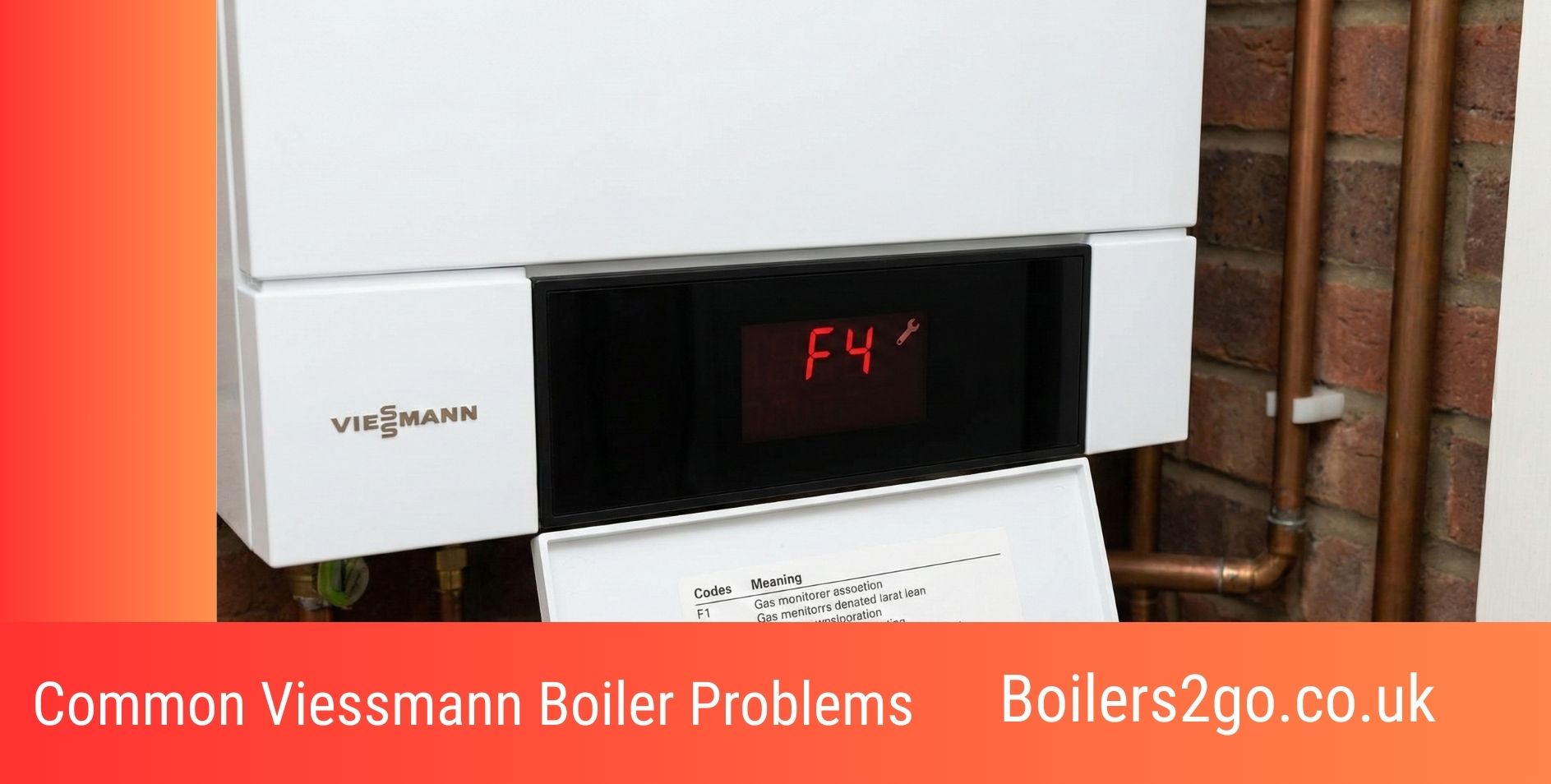
If your Viessmann Vitodens boiler has stopped working and there is a code on the display, you are in the right place. Viessmann makes some of the best-engineered boilers on the UK market, but that does not mean they are immune to faults. Knowing what the code actually means is the fastest way to decide whether you can sort it yourself or whether you need a Gas Safe engineer on site.
This guide covers the most common Viessmann fault codes seen on the Vitodens 050-W, 100-W, and 200-W, what causes each one, and the safe steps you can take before picking up the phone. It also covers when you should not attempt a fix yourself.
If you want to go deeper on a specific code, we have dedicated guides for the Viessmann F2 fault code, the Viessmann F1 fault code, and the Viessmann F5 fault code.
Get a boiler cover, repair and annual service plan online here >
Watch Our Video on Common Viessmann Boiler Problems
What Are the Most Common Viessmann Boiler Fault Codes?
The most common Viessmann fault codes UK homeowners encounter are F2, F4, F5, F1/E1, FD, F9, and 0A. They appear on the boiler display or through the ViCare app on newer Vitodens models.
Each code points to a specific category of fault. Some (like a frozen condensate pipe causing an F4) are straightforward to fix yourself in minutes. Others (like a PCB fault or failed gas valve) require a qualified engineer. The table below gives you a quick reference before we cover each one in detail.
- F4: No flame detected or flame lost during ignition
- F2: Overheat lockout or high-limit stat tripped
- F5: Flue overheat or air pressure switch fault
- FD: System water pressure too high
- 0A: Flame established but lost during operation
- F1/E1: Low water pressure or pressure sensor fault
- F9: Fan or flue gas temperature fault
Viessmann F4 Fault Code: No Flame Detected
F4 is one of the most common lockout codes on the Vitodens range. It means the boiler attempted to light but could not detect a flame, or the flame signal was present for a moment then disappeared.
In winter, this is frequently caused by a frozen condensate pipe rather than any internal fault. Check the external pipe first before assuming you need an engineer.
What Causes the Viessmann F4 Code?
- Frozen or blocked condensate pipe (very common between November and March)
- Gas supply issue: closed emergency control valve or low incoming gas pressure
- Faulty ignition electrode or damaged ignition lead
- Dirty or blocked burner
- Air in the gas line following recent gas work
How to Fix Viessmann F4 Yourself
Step 1: Check for a frozen condensate pipe.
Look for the white 22mm plastic pipe that exits the boiler and runs outside. If it is frozen, pour warm (not boiling) water along the frozen section or apply a hot water bottle until it thaws. Then reset the boiler.
Step 2: Check the gas supply.
Locate the gas meter emergency control valve (the lever next to the meter). It should be fully open and running in line with the pipe. If it has been knocked or turned, straighten it and reset the boiler.
Step 3: Reset the boiler.
Press and hold the reset button (marked with a flame and spanner symbol) for 3 to 5 seconds. On newer Vitodens models, the reset is done through the display menu. Allow the boiler to run through its ignition sequence.
If the boiler locks out again immediately after reset, stop there. Repeated resets without fixing the cause can damage the ignition components. At that point, you are looking at an electrode, gas valve, or PCB fault that needs a Gas Safe engineer.
Viessmann F2 Fault Code: Overheat Lockout
F2 appears when the boiler has detected that the water temperature has risen to a dangerous level and has shut down as a safety measure. This is not always a burner fault. In most cases, it is a circulation problem.
Before assuming the worst, check pressure first. Low system pressure is the single most common trigger for an F2 on the Vitodens range, and it is something you can fix yourself in a few minutes.
What Causes the Viessmann F2 Code?
- Low system water pressure (below 0.8 bar)
- Pump failure or a seized pump impeller
- Blocked or scaled main heat exchanger
- Closed or partially closed radiator valves restricting circulation
How to Fix Viessmann F2 Yourself
Step 1: Check the pressure gauge.
The gauge is usually visible on the front or underside of the boiler. It should read between 1.0 and 1.5 bar when the system is cold. If it is below 1.0 bar, repressurise using the filling loop (the flexible silver hoses with small taps underneath the boiler). Open both taps slowly until the gauge reads 1.2 bar, then close both taps fully.
Step 2: Bleed the radiators.
Trapped air can create hot spots in the system that trigger overheat lockouts. Bleed every radiator starting from the ground floor and working upwards.
Step 3: Check the pump.
You should hear a faint hum and feel slight vibration on the pump body when the boiler is running. No vibration and no sound usually means the pump has seized. That is a Gas Safe job.
If the pressure is correct, the radiators are bled, and F2 keeps returning, do not keep resetting. Call a Gas Safe engineer to check for a heat exchanger blockage or pump fault.
Viessmann F5 Fault Code: Flue Overheat or Air Pressure Switch Fault
F5 indicates the boiler has detected a problem with flue gas evacuation. Either the flue is running too hot, or the air pressure switch has not signalled correctly that the fan is working.
What Causes the Viessmann F5 Code?
- Blocked or obstructed flue terminal outside (leaf debris, bird nesting material, wasp nests, or snow in winter)
- Fan fault or restricted fan operation
- Incorrect flue installation (rare in recent installs but worth mentioning on older properties)
How to Fix Viessmann F5 Yourself
Safely inspect the flue terminal on the outside wall. Clear any debris, leaves, or blockages from the guard. Make sure nothing is within 300mm of the terminal, including plant growth or garden items that may have been moved by wind.
Reset the boiler once the terminal is clear. If F5 returns within a few minutes, the issue is likely an internal fan or air pressure switch fault. That requires a Gas Safe engineer.
Viessmann FD Fault Code: System Pressure Too High
FD appears when system pressure has exceeded roughly 3 bar. This most commonly happens after a filling loop has been left open by mistake or the system has been overfilled during a top-up. If the pressure only shoots up once the heating is running, a flat expansion vessel is the more likely cause, and our guide to replacing a Viessmann Vitodens 200 expansion vessel explains what the repair involves.
How to Fix Viessmann FD Yourself
- Find a standard radiator bleed valve (not a towel rail).
- Attach a bleed key and hold a cloth or short length of hosepipe over the valve to direct water into a bucket.
- Release water slowly until the pressure gauge drops to between 1.2 and 1.5 bar.
- Check the filling loop taps are both fully closed and that the caps are back in place.
- Reset the boiler.
If pressure climbs again within a few days without anyone topping up, there may be a fault with the pressure relief valve or the filling loop is not sealing properly. Get an engineer to check.
Viessmann 0A Fault Code: Flame Lost During Operation
Unlike F4 (which is a failure to ignite), 0A means the boiler lit successfully but the flame disappeared during normal operation. This points to gas supply or combustion stability issues rather than an ignition problem.
What Causes the Viessmann 0A Code?
- Low or fluctuating incoming gas pressure from the mains supply
- Dirty or misaligned flame detection (ionisation) electrode
- Strong wind blowing back down a horizontal flue on exposed properties
How to Fix Viessmann 0A Yourself
If it is a windy day and you have a horizontal flue on an exposed wall, try a single reset. Wind-induced flame loss is a known issue on certain installations and often clears on its own once conditions improve.
If 0A repeats across multiple days and in different weather conditions, call a Gas Safe engineer to test incoming gas pressure and clean or replace the ionisation electrode.
How to Prevent Viessmann Fault Codes
Most Viessmann fault codes are preventable. The boiler itself is well-engineered; it is usually the system around it or the lack of servicing that triggers a lockout. A few simple habits make a significant difference.
- Book an annual Gas Safe service every year without fail. This is also a condition of maintaining your Viessmann warranty. A Viessmann boiler service typically costs £80 to £130 depending on your location and the model. Skipping it can void manufacturer cover and result in a much more expensive repair later.
- Fit a magnetic system filter (Magnaclean, Fernox TF1) to catch sludge before it reaches the heat exchanger. Clean it at every annual service.
- Lag the condensate pipe with proper outdoor foam insulation. In colder parts of the UK, consider trace heating tape on external sections to prevent winter freeze-ups causing F4 lockouts.
- Check the pressure gauge monthly. Mark 1.2 bar on the gauge face with a marker pen so you can see at a glance whether it has dropped.
- Top up inhibitor (Fernox F1 or Sentinel X100) every five years or after any significant system work to protect the heat exchanger and pipework.
- If your Vitodens model supports it, fit a weather compensation probe. This reduces on/off cycling and puts less wear on the burner and fan over the boiler’s lifetime.
Viessmann’s own guidance on servicing requirements is available on the Viessmann UK maintenance FAQ page. You can also verify any engineer’s Gas Safe credentials before they visit using the Gas Safe Register search tool.
When to Call a Gas Safe Engineer About a Viessmann Fault
Some fault codes are safe to investigate yourself (pressure, condensate, flue terminal). Others are not. Call a Gas Safe registered engineer immediately for any of the following:
- Any work involving gas-carrying components: burner, gas valve, or ignition electrodes
- PCB diagnosis or replacement
- Heat exchanger cleaning or replacement
- Fan or air pressure switch faults
- Persistent lockouts after you have tried the safe resets above
- Any smell of gas at any point
If you smell gas, do not reset the boiler or operate any switches. Leave the property, open windows if it is safe to do so, and call the National Gas Emergency Service on 0800 111 999.
Viessmann Warranty: What You Need to Know
Viessmann offers generous warranties across the Vitodens range, but they come with conditions attached. Understanding these before anything goes wrong can save a significant amount of money.
- Vitodens 200-W: 10-year standard manufacturer warranty as standard when installed by an approved Viessmann engineer.
- Vitodens 100-W and 050-W: 5-year standard warranty, extendable up to 10 years when installed and serviced annually by a Viessmann-approved Gas Safe engineer.
- Heat exchanger: The stainless steel Inox-Radial heat exchanger on the 100-W carries a 10-year separate warranty. The 200-W heat exchanger warranty runs for the full duration of the boiler warranty.
To keep the warranty valid, the boiler must be serviced annually by a Gas Safe registered engineer. Missing a service year can void manufacturer cover, meaning any subsequent repair is at your own cost. Always request a service record and keep it somewhere accessible.
Common Viessmann Boiler Problems: FAQs
What Does the Spanner Symbol Mean on a Viessmann Boiler?
A spanner or wrench symbol is a service reminder, not a fault. It means the boiler has reached its programmed service interval. Book your annual service with a Gas Safe engineer and the symbol will be cleared once the service is logged.
Will Resetting a Viessmann Boiler Repeatedly Cause Damage?
Yes, it can. Viessmann boilers allow up to three resets within a 24-hour period before entering a safety lockout, and resetting repeatedly without fixing the underlying cause can accelerate wear on the igniter and PCB. If the boiler has not cleared after two resets, stop and call an engineer.
Is a Loud Boiling Noise Before a Viessmann F2 Fault Normal?
Yes, that sound is usually the pump struggling against restricted flow, or localised boiling inside a partially blocked heat exchanger. Repressurise and bleed first. If the noise and fault code persist, you are likely looking at a powerflush or pump replacement.
Can I Claim Viessmann Boiler Repairs on My Home Insurance?
Sometimes. Many home insurance and landlord policies cover “sudden and unforeseen” breakdowns but not wear-and-tear faults or failures caused by lack of servicing. Check your policy schedule for “emergency home cover” or “boiler breakdown cover” sections. Keeping a record of annual services can support a claim if it comes to it.
How Long Should a Viessmann Boiler Last?
With annual servicing and inhibitor maintenance, 15 years is a reasonable expectation for a Vitodens boiler. The Inox-Radial stainless steel heat exchanger is particularly durable and is one reason Viessmann can offer such long warranties. Boilers that are not serviced regularly tend to fail significantly earlier.
How Much Does a Viessmann Boiler Service Cost in the UK?
A Viessmann boiler service typically costs between £80 and £130 depending on your location and the specific Vitodens model. Services in London and the South East generally sit at the higher end. Some boiler cover plans include annual servicing, which can work out cheaper if you want predictable costs.
Can I Check Viessmann Fault Codes Through the ViCare App?
Yes, on Vitodens models with Viessmann’s connectivity module installed, the ViCare app will show live fault codes, system pressure, and operational data. It is a useful first check before calling anyone out. However, the app shows you the code; it cannot diagnose the root cause or carry out any repair.
Is Viessmann More Reliable Than Other Boiler Brands?
Viessmann consistently ranks among the top tier for reliability in the UK market, alongside Worcester Bosch and Vaillant. Our Viessmann vs Vaillant boilers comparison covers efficiency, warranty and long-term costs side by side.
Stay warm, The Boilers2Go Team

I’m Penny North, a home energy heating expert. My mission is to demystify new boilers and complex heating systems to help you achieve a warm, cosy home with lower energy bills and a smaller environmental footprint.