

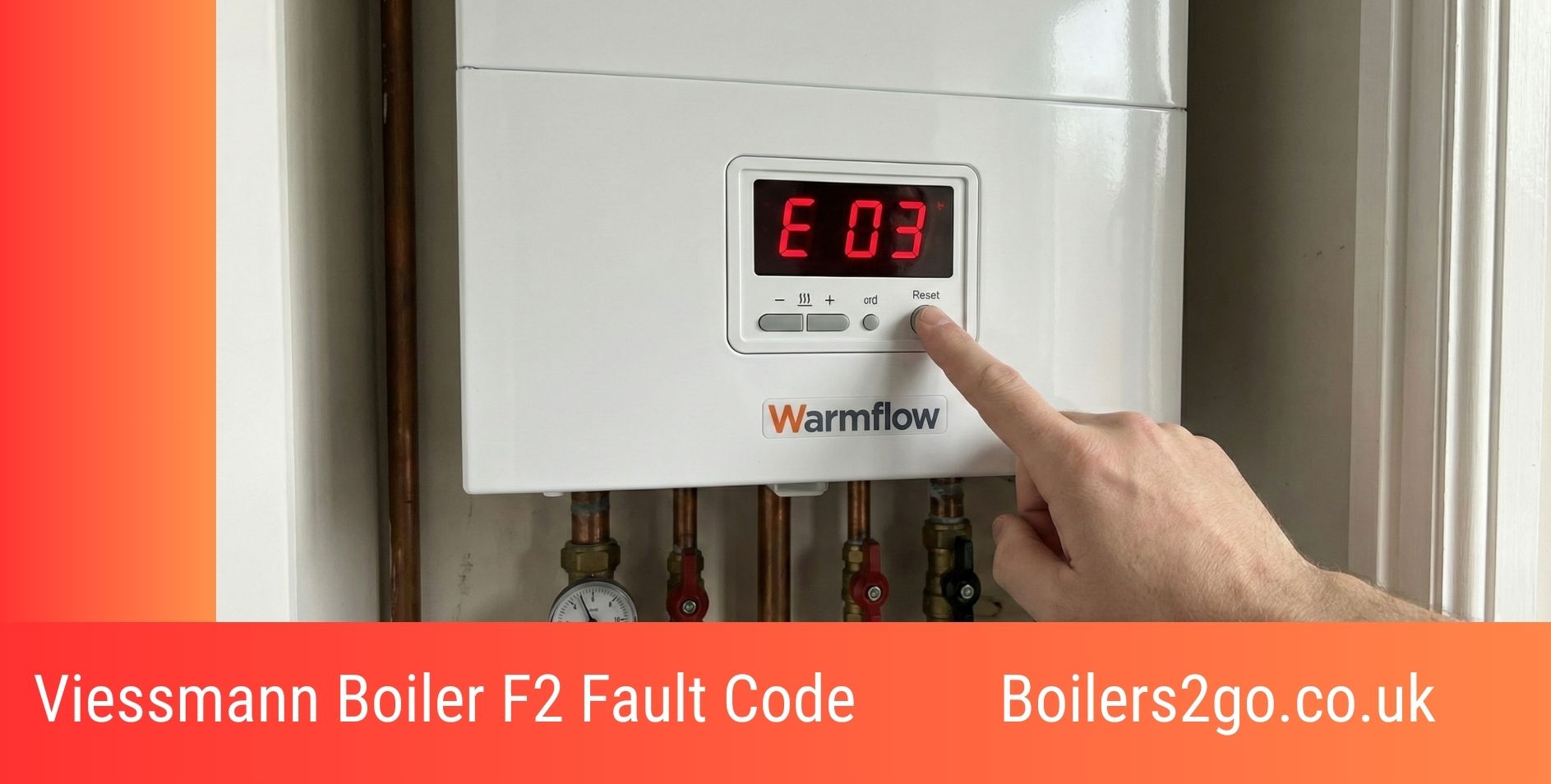
The Viessmann boiler F2 fault code on a Vitodens combi or system boiler can bring central heating and hot water to a sudden halt, leaving UK households feeling the chill.
This guide explains what the F2 error code means, its common triggers, and clear, actionable steps to diagnose and resolve it while prioritising safety.
What Does the Viessmann Boiler F2 Fault Code Mean?
On most Viessmann Vitodens models, the F2 fault code means the boiler’s high-limit safety device, the temperature limiter, has tripped because the system has detected an unsafe rise in water temperature.
This is an important distinction: F2 is not primarily an ignition or flame-detection fault on Viessmann boilers, that is usually F4. F2 is a safety response to overheating, most often caused by a circulation problem elsewhere in the system rather than a fault with the burner itself.
F2 is one of several circulation and pressure-related faults on the Vitodens range, and our guide to common Viessmann boiler problems covers the ignition and sensor faults that show up under different codes.
This code is widespread on Viessmann Vitodens models, including the 050-W, 100-W and 200-W, used across UK properties from suburban semis to rental homes, where reliable condensing boiler performance matters for energy savings and building regulations compliance.
Symptoms include no heat output, a flashing F2 on the display, and sometimes hot water cutting out mid-cycle as the boiler repeatedly tries and fails to stay below its safe temperature limit.
What Causes the Viessmann Boiler F2 Fault Code?
The F2 lockout stems from the boiler struggling to move heat around the system fast enough, so water temperature climbs past the safe limit and the temperature limiter cuts the burner. The underlying cause is usually one of a handful of common circulation or pressure issues.
Cause 1: Low System Pressure or Water Level
Low system pressure is one of the most common triggers for F2 on the Vitodens range. If there is not enough water in the sealed system, heat cannot be carried away from the boiler efficiently, and the temperature limiter trips as a precaution.
How to Fix Low Pressure Causing F2
- Check the pressure gauge on the boiler front panel. Most systems should read around 1 to 1.5 bar when cold, though this varies by model, so check the manual.
- Top up via the filling loop if the reading is low, following the boiler’s instructions, then allow the system to settle before checking again.
- If pressure keeps dropping after topping up, this points to a leak elsewhere in the system, which needs a Gas Safe registered engineer to locate and fix.
Cause 2: Trapped Air in the System
Air pockets in radiators or pipework can block the smooth flow of hot water, creating localised hot spots that trigger the temperature limiter even when overall pressure looks normal.
How to Fix Trapped Air Causing F2
- Bleed radiators, starting with the lowest floor first, using a radiator key until water (not air) comes out steadily.
- Check the boiler’s own air vent, since some Vitodens models have an internal bleed point that can also need venting.
- Repressurise the system afterwards, since bleeding radiators typically drops the pressure slightly.
Cause 3: Circulation Pump Failure or Restricted Flow
A seized or failing circulation pump cannot move hot water away from the boiler quickly enough, so heat builds up locally and trips the safety limiter. A partially closed valve somewhere in the system can cause the same restricted-flow effect.
How to Fix Pump or Flow Issues Causing F2
- Listen for the pump running when the heating calls for hot water. Silence usually indicates a seized or failed pump.
- Check that all radiator valves and any zone valves are open as expected, since a valve left closed can restrict flow to part of the system.
- A Gas Safe registered engineer can test the pump directly and replace it if it has failed, and check for other restrictions in the circuit.
Cause 4: Sludge or Debris Restricting the Heat Exchanger
Over time, sludge, rust and limescale can build up in the heat exchanger and pipework, particularly in systems that have not had an inhibitor or a recent power flush. This restricts flow in the same way as a failing pump, and can trigger repeated F2 faults.
How to Fix Blockages Causing F2
- An engineer can assess whether a power flush is needed to clear built-up sludge from radiators and pipework.
- A magnetic filter fitted to the system afterwards helps catch debris before it reaches the boiler again.
- Annual servicing with the correct inhibitor levels checked is the most effective way to prevent this cause recurring.
Cause 5: Faulty Temperature Limiter or Wiring
Occasionally the temperature limiter itself, or the wiring connecting it to the control board, is faulty and trips even when the system is not genuinely overheating. This is a component-level fault rather than a circulation problem, and needs a Gas Safe registered engineer to diagnose with a multimeter and replace if necessary.
How to Reset a Viessmann Boiler After Clearing F2
Once the underlying cause has been checked or fixed:
- Confirm system pressure is correct and there are no obvious air or circulation issues.
- Press and hold the reset button, usually marked with a flame and spanner symbol, for 3 to 5 seconds. On newer Vitodens models with a digital display, the reset is done through the display menu instead.
- Monitor a full heating cycle to check the boiler holds a stable temperature. If F2 returns immediately, stop resetting it and call a Gas Safe registered engineer rather than repeating the reset, since doing so without addressing the cause can risk further damage.
If a reset clears the fault but it returns within a few days, check our guides to the Viessmann F1 fault code and Viessmann F5 fault code, as related codes can appear in sequence when the same underlying circulation issue is present.
Any work beyond checking pressure and bleeding radiators should be carried out by an engineer listed on the Gas Safe Register, since only registered engineers are legally permitted to open up and work on the boiler itself.
Viessmann Boiler F2 Fault Code: FAQs
Does Skipping Servicing Make Viessmann F2 Lockouts More Likely?
Yes, in general terms. Boilers that go several years without an annual service are more likely to build up sludge and scale that restrict circulation, which is a common driver of F2 on the Vitodens range.
Regular annual servicing, including a check of inhibitor levels, is the most reliable way to reduce the risk.
Can a Smart Thermostat Trigger the Viessmann F2 Fault Code?
It is possible in principle if a poorly configured or incompatible zoning setup causes erratic demand on the heating circuit, though this is a less common cause than pressure, air or circulation issues.
Checking the thermostat’s compatibility with the boiler, ideally using OpenTherm where supported, helps avoid this.
Is the Viessmann F2 Fault Code Dangerous?
Not in itself. F2 is a safety feature working as intended: the boiler is protecting itself and the household from a genuine overheating risk rather than malfunctioning randomly.
The inconvenience is real, but repeatedly overriding or ignoring the fault rather than fixing the underlying cause is the actual risk, since it can lead to heat exchanger damage over time.
Does a Frozen Condensate Pipe Cause F2 on Viessmann Boilers?
Not usually. A frozen condensate pipe is more commonly linked to a different Viessmann fault code, but restricted drainage can sometimes contribute to wider system problems. If a condensate pipe is visibly frozen, thawing it safely with lukewarm water is a reasonable first step regardless of the exact code shown.
What Is the Difference Between F2 and F4 on a Viessmann Vitodens?
F2 relates to the temperature limiter tripping from overheating, most often due to a circulation or pressure issue, while F4 typically indicates the boiler could not detect a flame after attempting to ignite.
The two are diagnosed differently, so it is worth checking the boiler’s exact fault code carefully rather than assuming the cause based on general boiler knowledge from other brands.
Can I Keep Resetting My Viessmann Boiler if F2 Keeps Coming Back?
No. One reset after checking pressure and bleeding radiators is reasonable, but repeatedly resetting a boiler that keeps tripping on F2 risks masking a genuine circulation or component fault.
A Gas Safe registered engineer should investigate if the code returns more than once.

I’m Penny North, a home energy heating expert. My mission is to demystify new boilers and complex heating systems to help you achieve a warm, cosy home with lower energy bills and a smaller environmental footprint.