

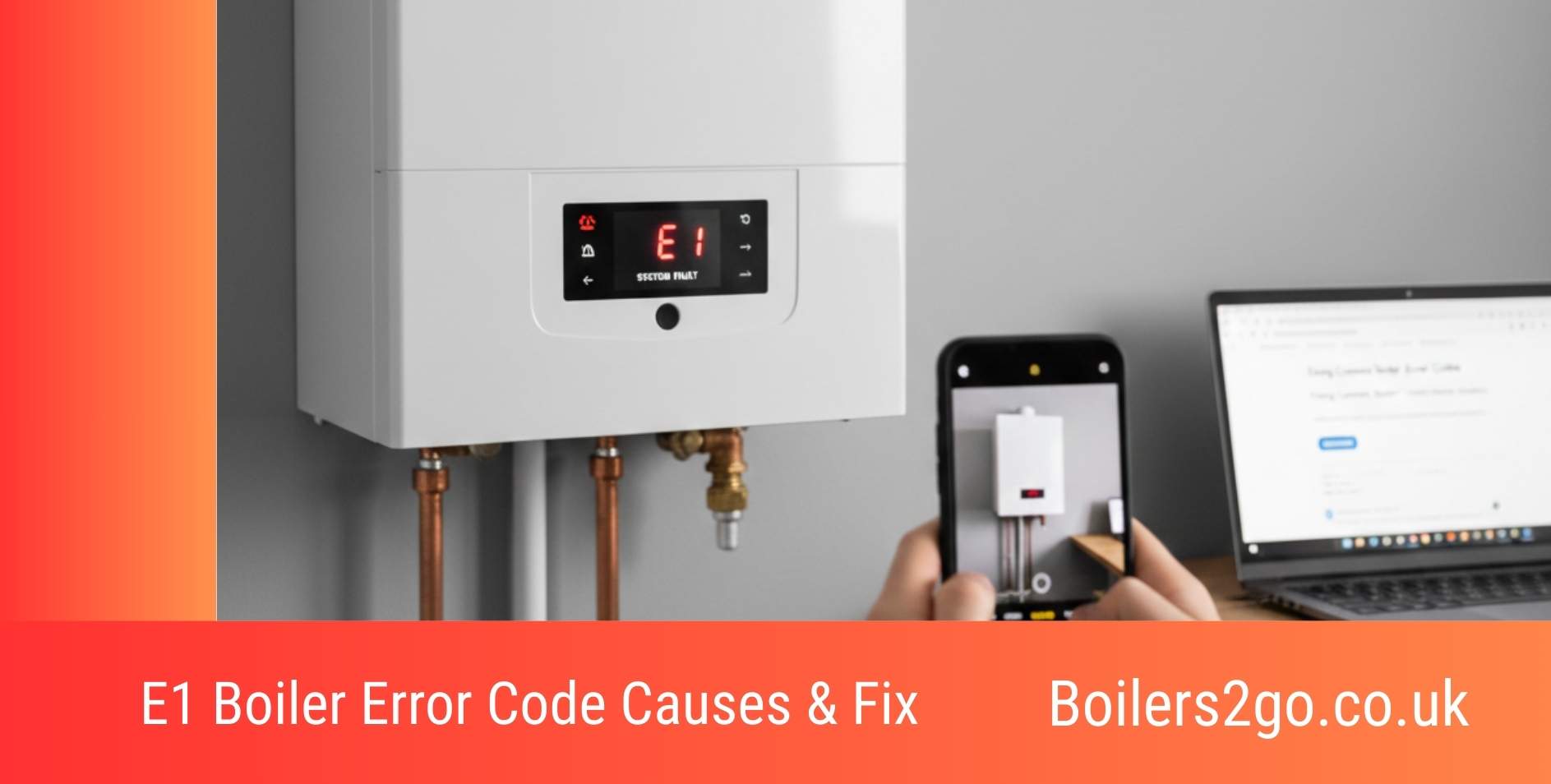
Seeing an E1 error code on your boiler can be worrying, but in most cases it’s something relatively straightforward. On many modern boilers, an E1 fault usually means the system pressure is too low, and the boiler has stopped running to protect itself.
Some boiler manufacturers also use E1 as a general fault category, which means the numbers that follow it are important. For example, E119 often means low pressure, while E133 usually relates to ignition problems.
So the first thing to do is check the full error code on the display or in your boiler manual.
What Does an E1 Boiler Error Code Mean?
An E1 error usually means the boiler’s water pressure has dropped too low. Boilers need enough pressure to circulate heat properly through radiators and pipework, and if it falls well below the normal 1–1.5 bar range, the boiler will lock out. Our guide to low boiler pressure covers the causes and fixes in more detail.
This safety feature prevents damage to components like the pump, heat exchanger, and sensors.
In simple terms, low pressure stops the boiler working safely, so it shuts down until the pressure is restored.
Some common E1-related codes you might see include:
- E119 — low system pressure
- E133 — ignition lockout or gas supply issue
- E110 — overheating fault
Different boiler brands use slightly different coding systems, so checking the manual always helps.
What Causes an E1 Boiler Fault?
Low pressure is by far the most common reason for an E1 error. The exact meaning varies by manufacturer, though, so check your brand’s own code list; Ferroli boilers, for example, use their own numbering, set out in our Ferroli boiler error codes guide.
This can happen if radiators have recently been bled without topping the system back up, or if there’s a small leak somewhere in the heating system. Over time, even tiny leaks from radiator valves, pipe joints, or the pressure relief valve can cause pressure to fall.
During very cold weather, a frozen condensate pipe can also stop the boiler operating correctly and trigger fault codes.
In some cases, the issue may be inside the boiler itself, such as a faulty pressure sensor, temperature probe, or PCB, though this is less common than simple pressure loss.
On certain models, E1-series faults can also relate to gas supply or ignition problems, which will usually show with additional numbers in the error code.
How to Fix an E1 Boiler Error Caused by Low Pressure
If the error is caused by low pressure, it’s often something you can safely fix yourself.
First, check the pressure gauge on the boiler. When the system is cold, it should normally sit between 1.0 and 1.5 bar. If it’s well below that, the boiler may display an E1 fault.
You can usually restore pressure using the filling loop, which is often a small silver braided hose or built-in lever underneath the boiler. Open the valves slowly and watch the pressure rise to around 1–1.5 bar, then close them firmly.
After that, reset the boiler using the reset button or dial setting recommended in the manual.
If low pressure was the cause, the boiler should start working again.
Check for Leaks if Boiler Pressure Keeps Dropping
If you need to top the pressure up regularly, there’s probably an underlying issue. Look around radiators, pipework, and beneath the boiler for damp patches, drips, or corrosion marks.
A system that keeps losing pressure usually means water is escaping somewhere, and that will need investigating.
When to Call an Engineer About an E1 Error
While an E1 fault is often minor, it shouldn’t be ignored. If the boiler is showing other symptoms as well, our guide to common boiler problems covers the most frequent faults and fixes.
You should contact a Gas Safe registered engineer if the pressure keeps dropping, if the error relates to ignition or overheating, or if you notice leaks or unusual boiler noises.
Repeatedly resetting the boiler without fixing the cause can lead to bigger problems later.
At Boilers2go, we often tell customers that E1 is usually a warning sign rather than a major failure — but it’s always worth checking properly.

I’m Penny North, a home energy heating expert. My mission is to demystify new boilers and complex heating systems to help you achieve a warm, cosy home with lower energy bills and a smaller environmental footprint.