

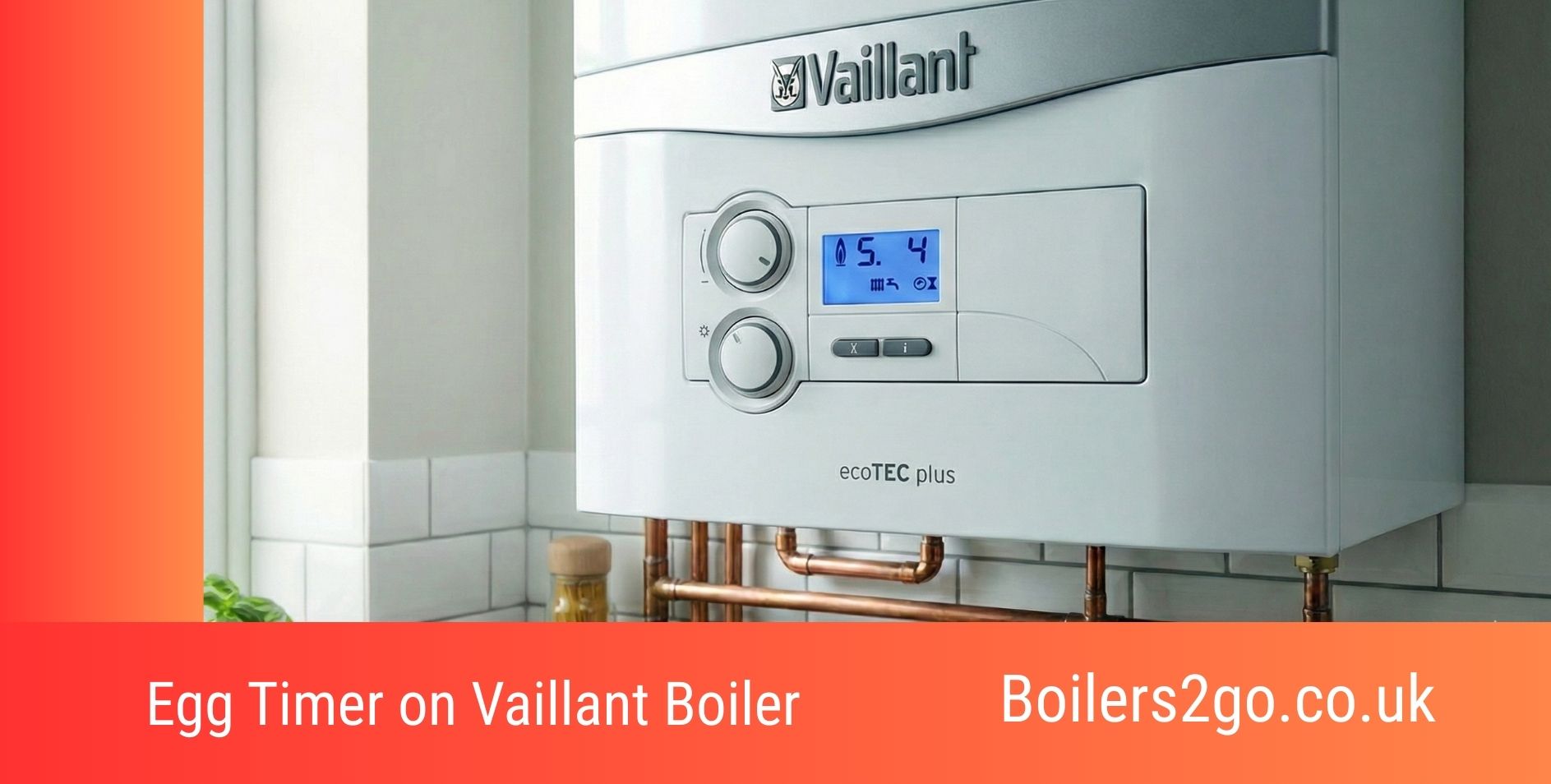
Seeing the egg timer (hourglass) symbol appear on your Vaillant boiler display is one of those moments that can cause unnecessary panic. The good news: in most cases it is not a fault at all. It is the boiler’s built-in anti-cycling protection doing exactly what it is designed to do.
That said, if the symbol is flashing persistently and you have no heating or hot water, something else is going on underneath it. This guide explains exactly what the egg timer means on Vaillant ecoTEC and ecoFIT models, the most common reasons it appears, and the practical steps to clear it.
If your Vaillant is also showing a fault code, our Vaillant boiler error codes guide explains what it means. Ignition problems or unresponsive timer controls are also worth checking alongside this guide, as both can trigger repeated anti-cycling.
Get a boiler cover, repair and annual service plan online here >
Watch Our Video: Vaillant Egg Timer Explained
What Is the Egg Timer Symbol on a Vaillant Boiler?
The egg timer (hourglass) symbol on a Vaillant boiler is a status indicator, not an error code. According to Vaillant’s own documentation, it signals that the anti-cycling function is active. In plain English: the boiler has recently fired and is in a short waiting period before it will ignite again.
Vaillant describe this themselves as a feature that “prevents frequent on/off operations and therefore contributes to prolonging the life of your boiler.” The delay is typically between 3 and 20 minutes depending on the model and how the anti-cycling period (diagnostic code d.002) is set.
On ecoTEC Plus, ecoTEC Pro, and ecoFIT Pure models, this symbol is entirely normal if it appears briefly and then disappears as the boiler resumes heating. The situation that needs attention is when the egg timer flashes continuously and the boiler is not producing heat or hot water.
When Is the Egg Timer Normal and When Is It a Problem?
Normal: The symbol appears for a few minutes after a heating cycle completes, then clears and the boiler fires again. The home is heating up and hot water works fine. No further action needed.
Investigate further: The symbol is flashing persistently, the radiators are cold, hot water is not working, or the boiler is accompanied by an F-code alongside the hourglass. One or more of the causes below is likely responsible.
What Causes the Egg Timer on a Vaillant Boiler?
Low Water Pressure
Low system pressure is the most common trigger for a persistent egg timer on Vaillant boilers. When pressure drops below around 1.0 bar, the boiler cannot circulate water safely and will hold in the waiting state rather than ignite. On the ecoTEC range, this is often accompanied by the F22 fault code.
Pressure drops gradually over time through normal evaporation, or more quickly after bleeding radiators, a small leak, or a recent powerflush. In sealed combi systems, pressure does not top itself up automatically.
How to Fix Low Water Pressure on a Vaillant Boiler
- Check the pressure gauge on the boiler front panel. It should read between 1.0 and 1.5 bar when the system is cold.
- If pressure is below 1.0 bar, locate the filling loop: a flexible hose with two small taps or valves, usually underneath the boiler.
- Open both valves slowly and watch the gauge. Stop when it reaches 1.2 bar, then close both taps firmly.
- Reset the boiler by pressing the reset button (marked with a circular arrow or “R”) for 3 to 5 seconds.
- Monitor the pressure over the next week. If it drops again within a few days without any radiator bleeding, there may be a slow leak in the system worth investigating.
Air in the Radiators or System
Trapped air in the heating circuit disrupts water flow and causes the boiler’s sensors to detect circulation problems. This is common at the start of the heating season, after summer downtime, or following any system work where the circuit was drained and refilled.
Air in the system can cause some radiators to be hot at the bottom but cold at the top, uneven heating across the property, or gurgling sounds in the pipework. All of these can push the boiler into repeated anti-cycling.
How to Fix Air in the Radiators
- Turn the boiler off and allow it to cool for 15 minutes.
- Starting from the ground floor, use a radiator bleed key to open the bleed valve at the top corner of each radiator. Hold a cloth underneath.
- Listen for hissing air escaping. Once a steady stream of water appears with no air bubbles, close the valve.
- Work through every radiator on each floor, ending at the top floor.
- Check the boiler pressure afterwards and repressurise if it has dropped below 1.0 bar.
- Run the heating for 10 to 15 minutes, then reset the boiler.
Thermostat or Controls Issue
A thermostat that is sending erratic signals, has a flat battery, or is positioned badly can tell the boiler the house is already warm when it is not. The boiler fires briefly, the thermostat cuts it off almost immediately, and the anti-cycling protection kicks in to prevent the constant on-off.
This is particularly common with wireless thermostats losing their signal, or smart controls like the Vaillant vSMART that have developed a connectivity issue with the boiler.
How to Fix a Thermostat or Controls Issue
- Check the thermostat batteries first. Replace them even if the display looks fine, as low batteries cause intermittent signal loss.
- Make sure the thermostat is set above the current room temperature so it is actively calling for heat.
- If you have a wireless thermostat, move it closer to the boiler temporarily to rule out signal drop.
- For vSMART or connected controls, power-cycle the thermostat by removing it from its base for 60 seconds, then reattaching.
- If the thermostat is positioned near a radiator, in sunlight, or in a warm hallway, it will read artificially high. Relocate it to an internal wall in a regularly used room, around 1.5 metres from the floor.
Blocked Condensate Pipe
A blocked or frozen condensate pipe is one of the most frequent causes of a Vaillant boiler going into lockout or anti-cycling mode, particularly between November and March. The condensate pipe carries acidic wastewater from the combustion process to the drain, and if it freezes or becomes blocked, the boiler shuts down to prevent overflow.
Look for the white plastic pipe (usually 22mm or 32mm diameter) that exits the boiler and runs outside or to an internal drain. A frozen section will often show as frost on the pipe itself.
How to Fix a Blocked or Frozen Condensate Pipe
- Pour warm water (not boiling) along the frozen section of the pipe. A hot water bottle placed against the pipe also works well.
- Do not use a heat gun or boiling water. Boiling water can crack the plastic pipe and create a worse problem.
- Once thawed, reset the boiler. It should fire up normally.
- For internal blockages, disconnect the pipe carefully (wear gloves as the condensate is mildly acidic), flush it through with warm water, then reconnect securely.
- To prevent future freeze-ups, lag the external pipe with foam pipe insulation available from any UK plumber’s merchant or DIY store.
Overheating or Poor Circulation
If the boiler’s flow temperature is climbing too fast because of restricted circulation, the high-limit thermostat trips and the egg timer appears as a protective delay. This is often caused by limescale in the heat exchanger (common in hard-water areas across the South East, Midlands, and parts of Yorkshire), a seized pump, or radiator valves that have been partially closed. If poor circulation progresses to a lockout with F83 on the display, our guide to the Vaillant F83 fault code covers the next checks to make.
On the Vaillant ecoTEC range, diagnostic codes d.40 and d.41 show live flow and return temperatures. If these are very close together (less than 5 degrees difference), poor circulation is the likely cause.
How to Fix Overheating or Poor Circulation
- Check that all radiator valves (TRVs) are open and none have been accidentally closed off.
- Listen for the pump running when the boiler fires. A hum and slight vibration on the pump body confirm it is working. No sound likely means a seized pump: a Gas Safe job.
- If limescale is suspected (older system, hard-water area, no inhibitor history), have a Gas Safe engineer carry out a descale or powerflush.
- Fit a magnetic system filter if one is not already installed. This catches magnetite sludge before it restricts the heat exchanger.
Can the Vaillant Anti-Cycling Period Be Adjusted?
Yes, on most Vaillant ecoTEC models the anti-cycling delay can be adjusted through the installer menu. The relevant diagnostic code is d.002 and the default maximum is typically 20 minutes. An engineer can reduce this during a service visit if the delay period is longer than needed for your system.
This is worth raising with your engineer if the egg timer appears for an unusually long time even when everything else in the system is working correctly. Do not attempt to access the installer menu yourself unless you are confident in what you are doing, as incorrect settings can affect boiler performance and efficiency.
How to Stop the Vaillant Egg Timer Appearing Unnecessarily
Most persistent egg timer issues are the result of underlying system conditions that build up gradually. The following habits keep the system in good shape and reduce the chances of the boiler dropping into anti-cycling mode unnecessarily.
- Book an annual Gas Safe service. This is the single most effective prevention measure. A thorough service covers pressure checks, pump and circulation testing, condensate trap cleaning, and heat exchanger inspection.
- Fit a magnetic filter (Magnaclean, Fernox TF1) and clean it at every annual service. Sludge buildup in the system is a leading cause of circulation problems and overheating.
- Use a quality inhibitor such as Fernox F1 or Sentinel X100 and top it up every five years or after major system work. This protects the heat exchanger and pipework from corrosion and scale.
- Lag the external condensate pipe before winter. It takes ten minutes and costs very little. It prevents the most common winter lockout cause.
- Check the pressure gauge monthly. A quick glance at the gauge takes seconds and catches drops before they trigger anti-cycling or fault codes.
- In hard-water areas, consider an inline scale reducer on the cold mains inlet. Long term, a water softener is the most effective solution if limescale is a recurring problem in your property.
When to Call a Gas Safe Engineer About the Vaillant Egg Timer
The DIY checks above cover most common causes. Call a Gas Safe registered engineer if any of the following apply:
- You can smell gas at any point. Leave the property, do not operate any switches, and call the National Gas Emergency Service on 0800 111 999.
- The egg timer is persistent and accompanied by an F-code on the display (F22, F28, F75, and F29 are the most common on Vaillant ecoTEC models).
- The boiler pressure keeps dropping after topping up, suggesting a leak somewhere in the system.
- The pump appears to have seized or you can hear unusual banging, grinding, or whistling from inside the boiler.
- The boiler has not been serviced in over 12 months and the underlying cause of the anti-cycling is not clear.
- Any work on internal boiler components, the gas valve, heat exchanger, or PCB.
You can check any engineer’s Gas Safe registration before they arrive using the official Gas Safe Register engineer finder. Always ask to see their ID card on arrival.
Vaillant Egg Timer: FAQs
Is the Egg Timer on a Vaillant Boiler Always a Sign of a Fault?
No. In most cases it simply means the anti-cycling function is active and the boiler is in a brief waiting period between heating cycles. This is completely normal. The situation that needs attention is when the symbol flashes continuously and the boiler is not producing heat or hot water.
Does the Egg Timer Symbol Look the Same on All Vaillant Models?
The hourglass icon is consistent across digital-display models including the ecoTEC Plus, ecoTEC Pro, ecoFIT Pure, and atmoTEC series. Older analogue Vaillant models use a flashing LED rather than an icon. If you are unsure what you are looking at, check the symbols section in your specific model’s user manual.
Can a Smart Thermostat Make the Vaillant Egg Timer Appear More Often?
Yes. Smart thermostats with a very tight temperature differential or aggressive on/off switching can cause the boiler to cycle more frequently than it should, triggering the anti-cycling protection more often. Thermostats using Opentherm or eBUS modulation are better suited to Vaillant boilers as they allow the boiler to adjust its output rather than simply switching on and off at full power.
Can Weather Conditions Cause the Vaillant Egg Timer to Appear?
Yes, particularly in winter. Freezing temperatures are the most common cause of a blocked condensate pipe, which pushes the boiler into lockout or anti-cycling mode. Insulating the external condensate pipe with foam lagging before the cold season starts prevents this from happening.
Will the Vaillant Egg Timer Affect My Energy Bills?
The anti-cycling function itself is designed to improve efficiency by preventing unnecessary rapid firing. However, if the egg timer is being triggered repeatedly by an underlying issue such as low pressure or poor circulation, the boiler is working harder than it should and that will show on your gas bill over time. Fixing the root cause is the fastest way to restore efficient operation.
Can I Monitor Vaillant Egg Timer Activations Remotely?
If your boiler is connected to the Vaillant vSMART or myVAILLANT system, you can monitor boiler status and receive alerts through the smartphone app. This is particularly useful for landlords managing multiple properties, as pressure drops and extended anti-cycling periods can be flagged before they become bigger problems.
Are There Warranty Implications if I Ignore a Persistent Vaillant Egg Timer?
If a persistent egg timer is pointing to an underlying fault (low pressure, pump failure, limescale) and that fault is left unaddressed, any resulting damage may not be covered under the Vaillant manufacturer warranty. Vaillant’s terms require annual servicing by a Gas Safe engineer for the warranty to remain valid. Document all service visits and keep receipts.
Stay warm, The Boilers2Go Team

I’m Penny North, a home energy heating expert. My mission is to demystify new boilers and complex heating systems to help you achieve a warm, cosy home with lower energy bills and a smaller environmental footprint.