

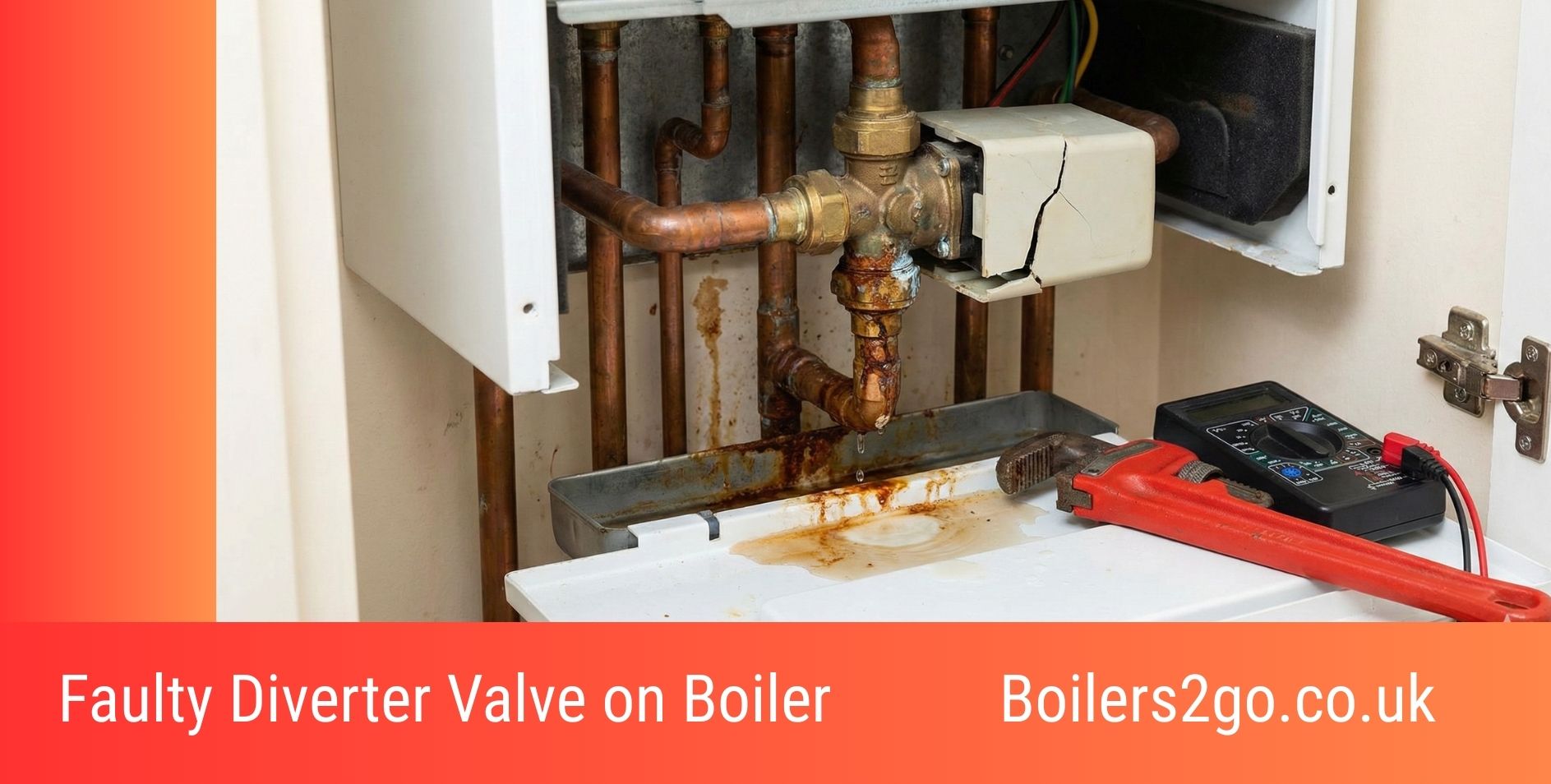
A faulty diverter valve is one of the most common reasons UK homeowners suddenly lose hot water, get lukewarm radiators, or find the heating and hot water fighting each other at the same time. It accounts for a significant share of combi boiler call-outs every year, and in most cases it is fixable without needing a new boiler.
Not every lockout is the diverter valve: electrical faults or a failing thermostat can also cause a boiler lockout, so it is worth knowing what you are dealing with before calling anyone out. Understanding the diverter valve specifically can save you time, money, and a cold night.
This guide covers exactly what a diverter valve does, the specific causes of failure, how to spot the symptoms, and practical fixes for each cause. If your boiler keeps turning itself off or won’t turn off, a diverter valve issue may well be the reason.
Need a new boiler?
Get a quote today and take the stress out of replacing your boiler. At Boilers2Go, we offer fast, reliable installation across the UK - often as soon as the next day.
Get Installation QuoteWhat is a Diverter Valve in a Combi Boiler?
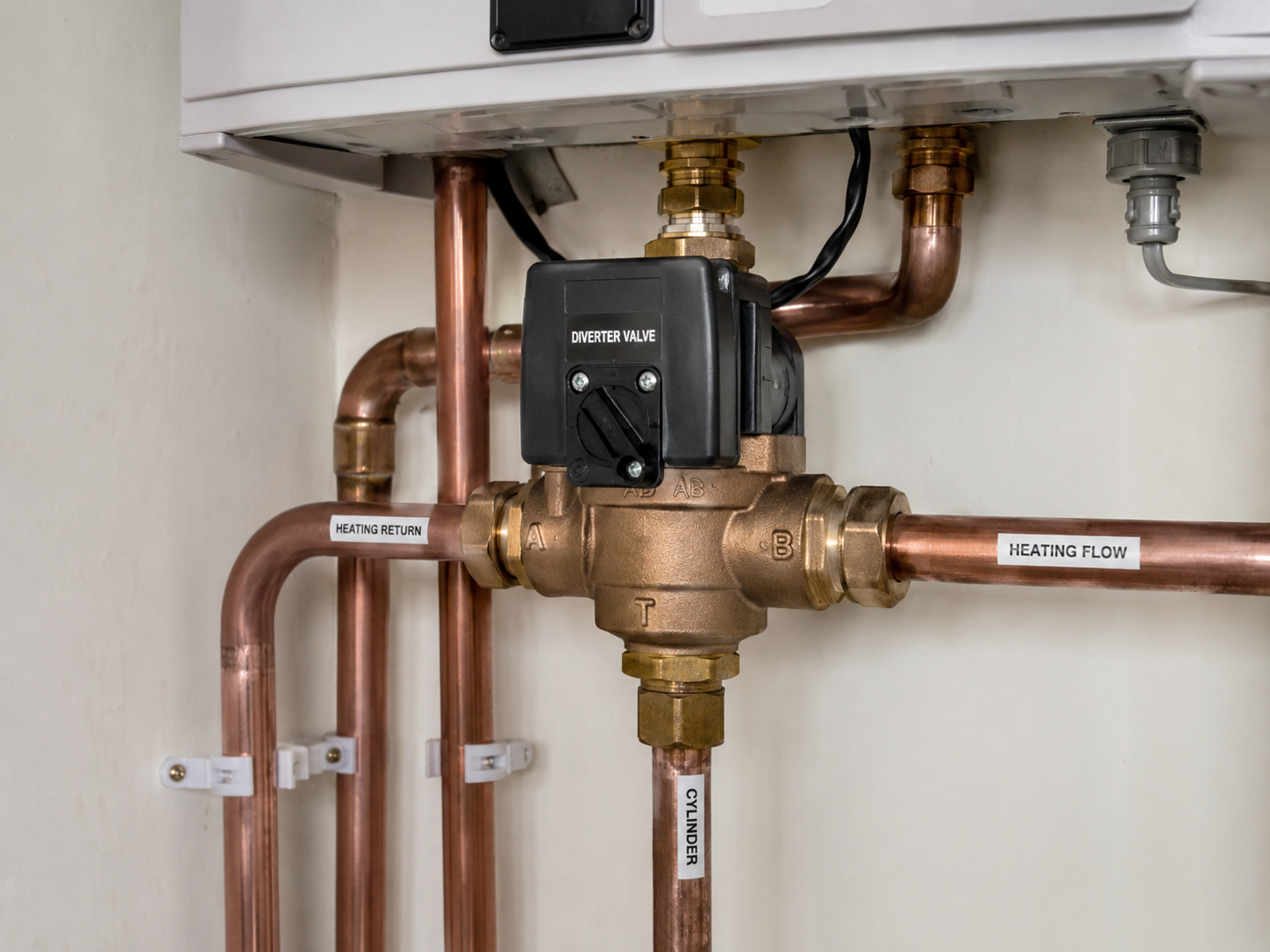
A diverter valve in a combi boiler is a motorised valve that ‘diverts’ hot water to either the central heating circuit or the domestic hot water heat exchanger. Think of it like a set of railway points: it physically moves to send hot water in the right direction depending on what you’ve asked for.
When you turn on the hot tap, the valve switches to hot water mode. When you turn the tap off and the heating comes back on, it moves again. That constant switching is why, in a hard-water area or an unserviced system, it wears out faster than most people expect.
Most modern combi boilers use a three-way diverter valve powered by a small electric motor, sometimes assisted by a wax capsule or diaphragm. Worcester Bosch, Vaillant, Ideal, and Baxi all use broadly similar designs, though the specific part numbers differ.
What Are the Common Symptoms of a Faulty Diverter Valve?
A faulty diverter valve usually announces itself in one or more of the following ways. The annoying part is that some of these symptoms overlap with other boiler faults, which is why a Gas Safe engineer should always confirm the diagnosis before you order parts. No hot water from a boiler that won’t fire at all, for example, is more likely to point to a faulty gas valve in the boiler than to the diverter valve.
- Hot water works but central heating does not come on (or is very slow to warm up)
- Central heating works but there is no hot water at the taps
- Radiators get hot when you only run hot water, or vice versa
- Lukewarm water at the taps even when the boiler flow temperature is set high
- The boiler locks out and displays a fault code
- Unusual banging or humming from inside the boiler when switching between modes
Common Fault Codes Linked to a Diverter Valve Problem
- Vaillant: F28, F75 (sometimes)
- Worcester Bosch: EA 227, D1 286
- Ideal: F1, L2, L6
- Baxi / Potterton: E133, E160, E168
- Glow-worm: F22, F75
Not all of these fault codes point exclusively to the diverter valve, so treat them as a starting point rather than a final verdict. A good engineer will test the valve with a multimeter before replacing anything.
Watch Our Video on Faulty Diverter Valves
What Causes a Faulty Diverter Valve on a Boiler?
Cause 1: The Diverter Valve Motor Has Failed
The motor is the most common part to fail, typically after 8 to 15 years of use. The small electric actuator burns out or the gears inside strip, and the valve stops moving between positions altogether.
How to Fix a Failed Diverter Valve Motor
On most boilers (Worcester Bosch, Vaillant, Baxi, Ideal, Glow-worm), you can replace just the motor head without draining the system. Here is what the process looks like:
- Turn off the power to the boiler.
- Remove the front cover and locate the diverter valve, usually on the right-hand side of the boiler.
- Unplug the electrical connector and undo the two or three fixing screws.
- Lift off the old motor and fit the new one; they typically clip straight on.
- Reconnect and test.
Motor replacement parts typically cost between £45 and £90, and many Gas Safe engineers carry common motors in their van. With labour included, expect to pay £150 to £250 total for a motor-only job.
Cause 2: Stuck or Seized Diverter Valve Spindle
Limescale, magnetite sludge, and general debris can jam the valve spindle so it cannot move fully between positions. This is particularly common in hard-water areas and on systems that have never had a filter fitted.
How to Fix a Stuck or Seized Diverter Valve Spindle
There are two options depending on how seized it is:
- Temporary fix: Gently tap the valve body with a soft mallet or the handle of a screwdriver while switching between heating and hot water. This sometimes frees a lightly stuck spindle, but it is a short-term measure at best.
- Proper fix: Replace the full diverter valve cartridge or complete valve assembly. On Worcester Bosch and Vaillant boilers, the cartridge simply pulls out once two clips are released, making it a 10 to 15 minute job for a qualified engineer.
A full valve replacement, including parts and labour, typically falls in the £250 to £375 range at current prices. Costs can be higher in London and the South East, where engineer rates are generally steeper.
Cause 3: Torn or Perished Diaphragm or Wax Capsule
Older diverter valve designs, common on Potterton, Baxi, and some Ideal Logic boilers, use a rubber diaphragm or wax capsule to help move the valve. These perish over time, especially in systems where the water chemistry has never been treated.
How to Fix a Torn Diaphragm or Failed Wax Capsule
The diaphragm is not sold separately on most modern boilers, so the only reliable fix is a complete diverter valve assembly replacement. It is worth asking your engineer to check the heat exchanger and pump at the same time, since these components age at a similar rate.
Cause 4: Faulty Microswitch or PCB Communication Issue
The microswitch tells the printed circuit board (PCB) that the valve has reached the correct position. If the switch fails, the boiler thinks the valve is stuck and locks out, even if the valve itself is physically fine.
How to Fix a Faulty Microswitch
A Gas Safe engineer will test the switch with a multimeter. If the switch has failed, it can often be replaced on its own for £15 to £30. If it is built into the valve head, the whole head will need replacing instead.
Cause 5: Low System Pressure or an Airlock Mimicking a Valve Fault
Very low boiler pressure or an airlock can stop the valve moving properly and produce symptoms that look identical to a failing diverter valve. It is always worth ruling this out first, because it is free to fix yourself. Both appear in our guide to common boiler problems, along with simple checks you can carry out yourself.
How to Fix Low Pressure or an Airlock
- Check the pressure gauge. It should read between 1.0 and 1.5 bar when cold.
- Top up via the filling loop if the pressure has dropped below 1.0 bar.
- Bleed all radiators and the pump to remove trapped air.
If the pressure keeps dropping after topping up, there may be a slow leak elsewhere in the system. That is a separate fault worth investigating before spending money on a diverter valve.
How to Prevent Diverter Valve Problems
Most diverter valve failures are not random. They are the result of years of limescale build-up, dirty system water, or neglected servicing. The good news is that a few simple habits cut the risk significantly.
- Book an annual boiler service with a Gas Safe engineer. A diverter valve check is part of any thorough service, and catching a stiff valve early avoids a full replacement later.
- Fit a magnetic system filter such as a Magnaclean or Fernox TF1 to catch sludge before it reaches the valve. Clean the filter annually at service time.
- Use a quality inhibitor such as Fernox F1 or Sentinel X100 and top it up every year. This protects the entire heating circuit, not just the valve.
- Keep system pressure between 1.0 and 1.5 bar. Low pressure puts extra strain on the motor each time it tries to switch positions.
- In hard-water areas (most of the East and South East of England), fit a scale reducer or inline water softener to slow limescale build-up inside the valve.
For further reading on protecting your heating system, the Energy Saving Trust has useful guidance on boiler efficiency and maintenance, and Gas Safe Register lets you verify any engineer’s credentials before they enter your home.
When to Call a Gas Safe Engineer About a Diverter Valve
Some diverter valve symptoms can be ruled out with a quick pressure check, but certain situations require a qualified engineer straight away. Do not attempt any work yourself if any of the following apply:
- You can smell gas at any point. Leave the house, do not use any switches, and call the National Gas Emergency Service on 0800 111 999.
- The boiler is leaking water.
- You have a fault code and no heating or hot water during cold weather.
- The boiler is still within the manufacturer warranty period. DIY repairs void cover.
- You are unsure about any step of the diagnosis. The gas-carrying side of a diverter valve is not something a non-qualified person should touch.
Never attempt to dismantle sealed gas-carrying parts yourself. It is illegal without a Gas Safe qualification and genuinely dangerous.
Should You Repair the Diverter Valve or Replace the Boiler?
It depends on the age and overall condition of the boiler, and it is one of the questions engineers hear most.
If the boiler is under 12 years old and otherwise in good shape, a diverter valve repair at £250 to £375 is almost always the better option compared to a new boiler installation, which typically costs £2,250 to £3,000 for a standard combi swap.
On a boiler that is 15 years old or older with a history of breakdowns, the maths shifts. You may be better off putting that £300 towards a replacement. Our guide on whether to repair or replace your boiler walks through the decision, and our best boiler brands guide compares long-term reliability.
Faulty Diverter Valve: FAQs
How Long Should a Diverter Valve Last on a UK Combi Boiler?
Most quality diverter valves last 10 to 15 years with annual servicing. In hard-water areas or systems without a filter, failure can come much earlier, sometimes between 6 and 8 years. Regular servicing is the single biggest factor in extending the valve’s life.
Can a Faulty Diverter Valve Cause High Gas Bills?
Yes. If the valve is stuck in a mid-position, the boiler keeps firing to try and satisfy both heating and hot water demand simultaneously. That wastes gas continuously, and the effect on your bills can be noticeable within a single month.
How Much Does It Cost to Replace a Diverter Valve in the UK?
At current prices, a full diverter valve replacement in the UK typically costs between £250 and £375, covering both the part and labour. Costs in London and the South East tend to be higher. If only the motor needs replacing, the job can come in closer to £150 to £250 all-in.
Will a Powerflush Fix a Stuck Diverter Valve?
A powerflush can free a lightly seized valve by flushing out sludge and debris. However, if the valve spindle is heavily scaled or the motor has burned out, a powerflush alone will not be enough and the valve will still need replacing.
Are Some Boiler Brands More Prone to Diverter Valve Problems?
Worcester Bosch and Vaillant have strong reputations for reliable diverter valves when serviced regularly. Some older Baxi, Potterton, and Glow-worm models from the 2000s and early 2010s showed higher failure rates, partly because of the diaphragm-style valves used at the time.
Can I Check the Diverter Valve Myself Before Calling an Engineer?
You can check the pressure gauge and bleed the radiators yourself, which rules out low pressure and airlocks. Beyond that, any work on the internal components of the boiler should be carried out by a Gas Safe registered engineer. Attempting to remove or replace the valve yourself is not only risky but could also invalidate your home insurance.
How Do I Find a Reliable Gas Safe Engineer Near Me?
The official Gas Safe Register engineer finder lets you search by postcode and verify credentials. Always ask to see an engineer’s Gas Safe ID card before they start work on your boiler.

I’m Penny North, a home energy heating expert. My mission is to demystify new boilers and complex heating systems to help you achieve a warm, cosy home with lower energy bills and a smaller environmental footprint.