

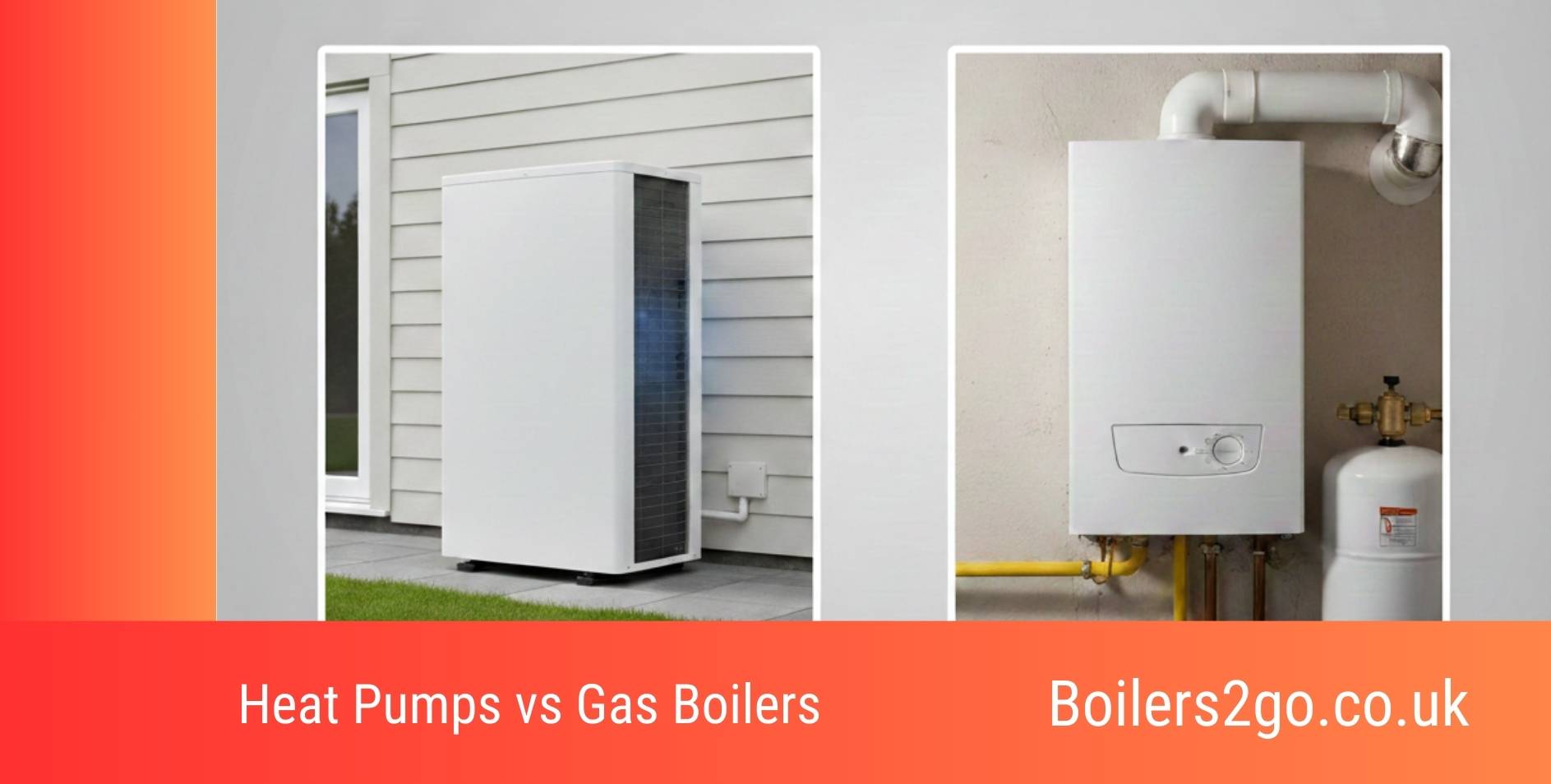
Heat pumps and gas boilers both keep UK homes warm and deliver hot water, but they operate on very different principles. That difference affects efficiency, running costs, carbon emissions, and how your heating feels day to day.
Where a gas boiler burns fuel to make heat, a heat pump moves heat from outside air into your home. In 2026, with energy prices shifting and the Boiler Upgrade Scheme still open, understanding how these two technologies compare has never mattered more for homeowners making long-term decisions.
How Do Heat Pumps and Gas Boilers Work?
A gas boiler takes natural gas or LPG and combusts it to heat water that then feeds radiators or underfloor circuits. Modern condensing boilers are typically 90 to 94% efficient, meaning you lose a small amount of energy in the combustion process. A heat pump works differently, moving heat from the outside air or ground rather than burning fuel, and our guide to how heat pumps work explains the process step by step.
An air-source heat pump (ASHP) uses electricity not to generate heat directly, but to transfer it from outside air into your home. Even on cold days it can deliver more heat than the electricity it uses. The efficiency is measured as a Seasonal Coefficient of Performance (SCOP) rather than a percentage.
The key distinction in plain terms: gas boilers convert fuel to heat. Heat pumps move heat from the air. That is why heat pumps can appear far more efficient in theory, though the real-world economics depend heavily on energy prices and installation quality.
Watch Our Video Comparison on Boilers vs Heat Pumps
Heat Pump vs Gas Boiler Efficiency: The Numbers in 2026
This is where the original heat pump marketing often oversimplifies things. A heat pump’s running cost advantage depends on two factors working together: how efficiently the specific installation performs (SCOP), and how much your electricity tariff costs versus gas.
Under the Ofgem price cap, electricity typically costs around four times as much per unit as gas (check the current Ofgem price cap for today’s rates). For a heat pump to match a gas boiler’s running cost, it therefore needs to deliver roughly four units of heat per unit of electricity, which requires a SCOP of around 4.0.
The honest reality: well-installed UK heat pumps typically achieve SCOPs of 2.8 to 3.5 in real-world conditions, based on monitored data from the Energy Saving Trust and the Heat Pump Monitor programme. At those SCOP levels, a heat pump on the standard Ofgem tariff runs at broadly similar cost to gas, with a gap of roughly £30 to £80 per year in favour of gas on most standard homes. The gap can swing significantly with the right electricity tariff, as described below.
Real Hourly Running Costs: Heat Pumps vs Gas Boilers
The figures below are illustrative, based on recent price cap rates for gas and standard electricity, and a typical specialist heat-pump off-peak tariff. Check the current Ofgem price cap for today’s rates. Real-world costs vary with insulation, outdoor temperature, and thermostat settings.
Small Home (70 to 90 m²)
A smaller property typically needs around 8 to 12 kW of heat on a cold day.
- Gas boiler: approximately £0.90 to £1.30 per hour
- Air-source heat pump (standard tariff): approximately £1.00 to £1.50 per hour
- Air-source heat pump (off-peak tariff): approximately £0.60 to £0.90 per hour
Medium Home (90 to 120 m²)
A 3-bedroom semi-detached typically needs 12 to 18 kW of heat at peak.
- Gas boiler: approximately £1.30 to £2.00 per hour
- Air-source heat pump (standard tariff): approximately £1.50 to £2.30 per hour
- Air-source heat pump (off-peak tariff): approximately £0.90 to £1.40 per hour
Large Home (120 to 160 m²)
A bigger property at peak demand might need 20 to 30 kW. The heat pump’s efficiency advantage plays a bigger role here, but the electricity price ratio still determines whether standard tariff running costs are competitive.
- Gas boiler: approximately £2.00 to £3.00 per hour
- Air-source heat pump (standard tariff): approximately £2.30 to £3.50 per hour
- Air-source heat pump (off-peak tariff): approximately £1.40 to £2.10 per hour
Ultra-Efficient Scenario: High Insulation and Off-Peak Tariff
For a well-insulated home on a specialist heat pump electricity tariff (such as Octopus Cosy or Economy 7, with cheaper off-peak rates), the economics shift clearly in the heat pump’s favour:
- Heat pump: approximately £0.60 to £1.20 per hour
- Gas boiler: approximately £1.30 to £2.00 per hour
In this scenario, the heat pump beats gas on running cost and on carbon. This is where the technology is genuinely at its best.
Heat Pump vs Gas Boiler Annual Bills in 2026
For a typical 3-bedroom home requiring approximately 12,000 kWh of heat per year, based on recent price cap rates (check the current Ofgem price cap):
- Gas boiler (90% efficient): approximately £760 to £900 per year
- Air-source heat pump (standard tariff, SCOP 3.0): approximately £800 to £960 per year
- Air-source heat pump (off-peak tariff, SCOP 3.0): approximately £400 to £600 per year
- LPG boiler: approximately £1,800 to £2,200 per year
- Oil boiler: approximately £1,400 to £1,800 per year
The key takeaway: on a standard electricity tariff, gas and a well-installed heat pump run at broadly comparable annual cost. On a specialist off-peak tariff, the heat pump wins clearly. For off-grid homes currently on LPG or oil, a heat pump already makes strong financial sense even at standard electricity rates.
Heat Pump vs Gas Boiler Upfront Costs
Running costs only tell half the story. The upfront difference between the two technologies remains significant.
A typical gas combi boiler installation in a UK home costs between £2,500 and £4,500 fully installed. Output rating, warranty length and brand support matter alongside price, and our guide to the best combi boilers compares the leading models.
An air-source heat pump installation typically costs £8,000 to £14,000 before any grants. The Boiler Upgrade Scheme (BUS) provides £7,500 directly off the installed cost when using an MCS-certified installer, bringing the effective net cost to £500 to £6,500. The BUS is confirmed open until at least March 2028 and is available for properties in England and Wales.
If you are weighing up all-electric heating, our electric boiler vs gas boiler comparison adds a useful third option alongside heat pumps.
Heat Pump vs Gas Boiler: Comfort and Home Suitability
A heat pump delivers steady, lower-temperature heat that works best matched with low-temperature emitters: underfloor heating circuits or oversized radiators designed for flow temperatures of 35 to 45 degrees rather than the 60 to 70 degrees a gas boiler typically produces. Well-insulated homes with good airtightness get the most from heat pump technology.
Gas boilers deliver hotter flow temperatures and warm rooms quickly, which tends to feel more intuitive in older, draughtier homes or where insulation is difficult to upgrade.
A heat pump also requires a suitable outdoor location for the external unit. This is straightforward for a detached home with a garden; more challenging in terraced houses with shared walls or flats where space is tightly constrained.
Should You Choose a Heat Pump or a Gas Boiler?
It depends on your home, fuel supply and budget. Most UK households fall into one of three situations.
Still on Mains Gas with Budget or Insulation Constraints
A modern high-efficiency gas boiler still makes excellent sense. Our guide to green boilers covers lower-emission options that avoid the full cost of a heat pump installation.
Well Insulated with Outdoor Space and Tariff Flexibility
An air-source heat pump can compete on running cost and clearly outperform on carbon emissions. Getting your electricity tariff right is not optional here; it is the single biggest variable in whether the heat pump saves money or costs more than gas. Specialist tariffs from Octopus, OVO, and EDF are designed specifically for heat pump households.
Rural or Off-Grid Properties
LPG and oil boilers have filled important roles in rural UK, but heat pumps are increasingly compelling for these properties because the comparison is against expensive off-grid fuels rather than mains gas. Our natural gas vs LPG boilers guide compares the two fuels in more detail.
A Pragmatic Path for Most UK Households
For many homeowners the answer in 2026 is not “either gas or heat pump today.” A staged approach often makes more financial sense:
- Improve insulation and controls now. This reduces bills regardless of which heating system you have.
- Upgrade controls. Smart thermostats with scheduling and modulation can cut gas usage by 10 to 20% on their own, regardless of whether you switch to a heat pump later.
- Replace an ageing boiler if needed. A new A-rated gas boiler is the right call for immediate reliability and comfort, particularly if the heat pump transition is 3 to 5 years away.
- Plan the heat pump transition. When the home is ready, financially and physically, the combination of a well-insulated building, an off-peak electricity tariff, and the BUS grant makes the economics considerably more attractive than in 2023 or 2024.
This staged approach avoids rushed decisions and spreads investment while still cutting costs and emissions over time.
Heat Pump or Gas Boiler: Final Thoughts
Heating choice in the UK is not just about technology. It is about the home you live in, the fuel available, the insulation you can realistically achieve, and how you use heat every day. Our guide to central heating running costs can help you set realistic long-term budgets.
Whether you stay with gas and plan for a heat pump transition later, or move to electric heat now, the decisions that tend to pay off best are those that match your house’s actual condition and your household’s real lifestyle, not the most optimistic scenario from a marketing brochure.
Heat Pumps vs Gas Boilers: FAQs
Is a Heat Pump Cheaper to Run Than a Gas Boiler in 2026?
On a standard price-capped tariff, running costs are broadly comparable for a well-installed heat pump achieving SCOP 3.0 to 3.5. The difference is typically £30 to £80 per year in favour of gas at standard rates. On a specialist off-peak heat pump tariff, a heat pump can be £300 to £600 cheaper per year than gas, depending on insulation level and SCOP.
What Is SCOP and Why Does It Matter?
SCOP stands for Seasonal Coefficient of Performance. It measures how many units of heat a heat pump produces for every unit of electricity it consumes, averaged across a full UK heating season. A SCOP of 3.0 means 3 kWh of heat for every 1 kWh of electricity. Real-world UK air source heat pumps typically achieve SCOPs of 2.8 to 3.5. Installation quality, insulation level, flow temperature, and outdoor conditions all affect SCOP significantly.
How Much Does the Boiler Upgrade Scheme Grant Cover?
The Boiler Upgrade Scheme (BUS) provides £7,500 directly to your MCS-certified installer, which is deducted from your final invoice. You never handle the grant money yourself. It is available for air source and ground source heat pump installations in England and Wales. The property must have a valid EPC with no outstanding recommendation to insulate loft or cavity walls. The BUS is confirmed open until at least March 2028.
Can a Heat Pump Work in an Older or Poorly Insulated UK Home?
Heat pumps can work in older homes, but efficiency drops significantly with poor insulation or inadequate radiators. A heat pump in a draughty property with single glazing and undersized radiators will achieve a lower SCOP, potentially making it more expensive to run than gas on a standard tariff. Addressing insulation and upgrading radiators before installation is strongly recommended, and is in many cases a condition of BUS grant eligibility.
Do I Need Planning Permission for a Heat Pump?
Most air source heat pump installations in England fall under permitted development rights and do not require planning permission, provided the unit is not installed on a wall or roof facing a highway, is not in a Conservation Area or listed building, and meets certain size and noise limits. Scottish and Welsh rules differ slightly. Always confirm with your MCS-certified installer before proceeding.
What Happens to Gas Boilers After 2035?
The UK Government’s Future Homes Standard (published in 2026) will end new gas boiler installations in most new-build homes in England once it takes effect, and the Heat and Buildings Strategy outlines a longer-term transition away from fossil fuel heating across the existing housing stock. The 2035 date for ending new gas boiler sales in existing homes has faced political uncertainty and should not be treated as confirmed at the time of writing. The BUS grant mechanism suggests the government expects heat pump adoption to grow progressively rather than through an abrupt ban.

I’m Penny North, a home energy heating expert. My mission is to demystify new boilers and complex heating systems to help you achieve a warm, cosy home with lower energy bills and a smaller environmental footprint.