

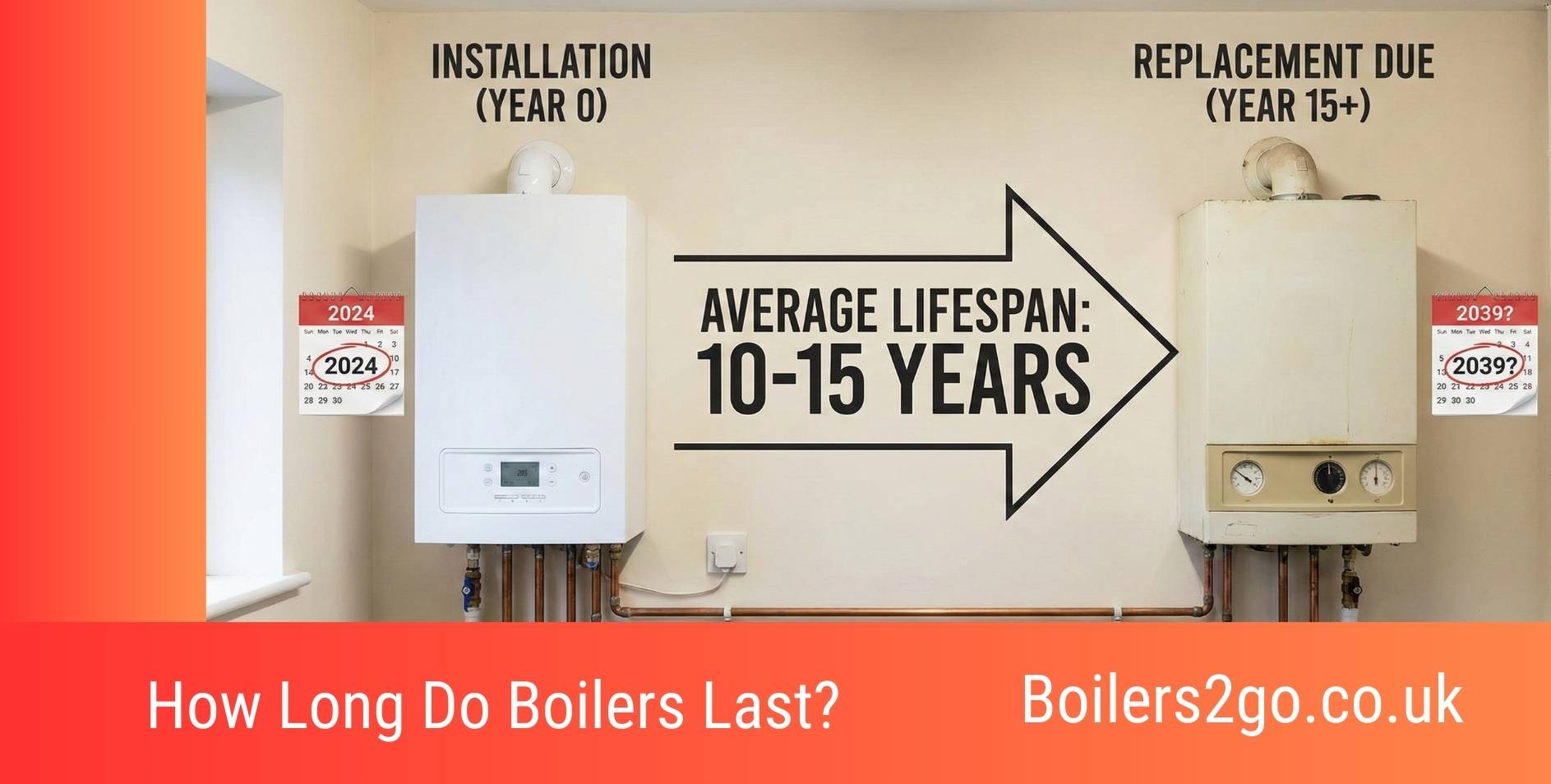
The average UK gas boiler lasts between 10 and 15 years. That is the figure quoted by all five major UK manufacturers (Worcester Bosch, Vaillant, Ideal, Baxi, and Viessmann), and it is broadly consistent with what Gas Safe engineers see in practice.
That said, a neglected boiler can fail in as little as 6 to 8 years, while a well-maintained one from a quality brand can run reliably for 20 years. The gap between those two outcomes comes down almost entirely to installation quality, servicing, and water treatment.
Watch Our Video on How Long Boilers Last
What Is the Average Lifespan of a Boiler in the UK?
The 10 to 15-year benchmark is the consistent figure across the industry. However, there is interesting context worth understanding: in Germany, where the same boilers are sold under the same brand names, manufacturers quote 15 to 20 years and homeowners routinely keep boilers for 20 years or more. The difference is largely attributed to installation standards and system maintenance practices.
UK boilers do tend to cycle more frequently due to less prevalent use of weather compensation controls, and system water quality is often lower due to higher rates of hard water and less consistent inhibitor use. These factors compress the practical lifespan even when the mechanical quality of the boiler itself would support longer service.
The practical implication: the 10 to 15-year figure is realistic for the average UK home, but homeowners who invest in proper installation, annual servicing, and system filtration consistently get more years from their boilers than those who do not. If you are not sure when your current boiler was fitted, our guide to working out how old your boiler is shows how to date it from the serial number.
How Long Do Different Boiler Types Last?
- Combi boilers: 10 to 15 years on average. They have more components under regular pressure (diverter valve, plate heat exchanger, expansion vessel) than other types, which gives more points of potential failure over time.
- System boilers: 12 to 17 years typically. Slightly longer than combis because some of the work (hot water storage) is offloaded to a separate cylinder, reducing thermal cycling on the boiler itself.
- Regular (heat-only) boilers: 15 to 20 years. The simplest internal arrangement, fewer moving parts under pressure, and typically more durable over the long term when properly maintained.
- Electric boilers: 15 to 25 years. No combustion process means no heat exchanger degradation from acidic condensate, and fewer moving parts overall.
- Oil boilers: 15 to 25 years in many cases. Built more sturdily with lower operating pressures than gas equivalents. Rural properties often keep oil boilers for significantly longer than the industry norm.
How Long Do Different Boiler Brands Last?
Brand choice can affect lifespan. The following figures are typical estimates based on manufacturer information and installer feedback:
| Brand | Typical Lifespan | Max Warranty |
|---|---|---|
| Viessmann | 15 to 20 years | Up to 12 years |
| Vaillant | 15 to 18 years | Up to 10 years |
| Worcester Bosch | 12 to 15 years | Up to 12 years |
| Ideal | 10 to 12 years | Up to 12 years (Vogue Max) |
| Baxi | 10 to 15 years | Up to 10 years |
Viessmann’s stainless steel Inox-Radial heat exchanger is the primary reason for its longer lifespan: it is more resistant to the mildly acidic condensate that all condensing boilers produce, which is the leading cause of heat exchanger deterioration over time. Worcester Bosch and Vaillant use aluminium heat exchangers on most models, which are effective but require consistent servicing and inhibitor treatment to achieve their maximum lifespan.
What Factors Influence How Long a Boiler Lasts?
Installation Quality
Installation is the single most important factor, yet it is often the most overlooked. A boiler installed by a non-Gas Safe engineer, sized incorrectly for the property, or connected to an unflused system carrying years of sludge will underperform from day one. An oversized boiler short-cycles; an undersized one overworks. Both outcomes accelerate component wear.
Professional installation by a Gas Safe engineer who carries out a heat-loss calculation, flushes the system, and sets correct pump speed and flow temperature gives a boiler the best possible start and is the only way to activate extended manufacturer warranties.
Annual Servicing
Annual servicing by a Gas Safe engineer is the single biggest maintenance factor. A consistently serviced boiler is likely to last longer than an unserviced equivalent. A thorough service checks pressure, combustion quality, heat exchanger condition, flue integrity, and all safety controls, addressing minor issues before they become expensive faults.
Servicing also keeps manufacturer warranties valid. Most brands require documented annual service records to honour extended warranty claims.
Water Quality and System Treatment
Approximately 70% of the UK’s population lives in hard water areas, according to the Water Research Centre. In the South East, Midlands, and parts of Yorkshire, limescale builds up inside the heat exchanger and pipework, acting as insulation and forcing the boiler to work harder and hotter to deliver the same output. This directly shortens lifespan.
An inhibitor (Fernox F1 or Sentinel X100) added to the system and topped up annually reduces internal corrosion across all components. A magnetic system filter (MagnaClean, Fernox TF1) captures magnetite sludge before it reaches the heat exchanger. In hard-water areas, a scale reducer or water softener on the cold mains inlet also makes a meaningful difference.
Usage Patterns
High-demand households running the boiler continuously put more thermal cycles through the heat exchanger, pump, and fan than a single-person flat using the boiler for a few hours a day. More cycles mean more wear. This is why correctly sizing the boiler matters: a modulating boiler matched to the property’s heat demand runs fewer, steadier cycles than an oversized unit switching on and off at full power.
Environmental Conditions
Coastal properties experience higher levels of salt air corrosion on external components (flue, casing, condensate pipework). Homes in northern UK with colder average temperatures put more demand on the boiler during winter months. Both factors can bring lifespans toward the lower end of the expected range without affecting the fundamental reliability of the unit.
Signs Your Boiler Is Approaching the End of Its Life
Most boilers do not fail suddenly. They give clear signals over months or years that the end of economic service life is approaching. Watch for:
- Breakdowns becoming more frequent, particularly repeat faults on the same component
- Repair costs that are climbing year on year rather than stabilising
- Kettling: a rumbling or boiling sound from the heat exchanger caused by limescale or sludge restricting water flow
- Inconsistent hot water temperature or slow heating-up times
- Pressure dropping regularly despite no visible leaks
- A yellow or orange pilot flame rather than a crisp blue flame (this requires immediate engineer attention)
- Gas bills rising without any change in usage, indicating declining efficiency
A useful rule of thumb: if repair costs in any 12-month period exceed 30 to 40% of what a replacement would cost, the financial case for replacement is strong. A boiler that is 12 years or older and has required two or more significant repairs in recent years has usually reached this threshold.
How Regular Maintenance Extends Boiler Life
The relationship between servicing and lifespan is well established. Here is what a thorough annual service covers and why each element matters:
- Cleaning the heat exchanger: removes combustion deposits that reduce heat transfer efficiency and can cause localised overheating
- Checking flue and combustion integrity: ensures the boiler is burning gas safely and efficiently rather than wasting fuel
- Testing the safety controls: overheat stat, pressure relief valve, and gas valve are all verified to operate within safe parameters
- Checking and adjusting system pressure: correct pressure prevents pump cavitation and heat exchanger stress
- Inspecting the condensate trap: a blocked condensate trap is one of the most common causes of winter lockouts
Landlords have an additional legal obligation: an annual gas safety check (CP12) is required by law under the Gas Safety (Installation and Use) Regulations 1998. This is separate from a service but often carried out at the same time by the same engineer.
What Does Replacing a Boiler Cost in 2026?
A like-for-like combi boiler replacement in 2026 typically costs between £2,250 and £3,500 fully installed for a standard gas combi swap in a typical UK property. More complex installations (system changes, new flue routes, altered pipework) sit at the higher end or above.
If you are considering relocating the boiler as part of a replacement, our guide to moving boiler costs explains how the distance and complexity involved add to the base installation cost.
Upgrading to an A-rated condensing boiler from a G-rated model (one manufactured before 2004) can reduce annual heating bills by up to £580 per year, according to the Energy Saving Trust. For landlords, compliance with the current and anticipated regulatory landscape around heating efficiency should also factor into the replacement decision.
Grants and Funding to Reduce Replacement Costs
Two government schemes are worth investigating before committing to a replacement:
- ECO4 scheme: runs until 31 December 2026 and can fund a boiler repair or replacement for some low-income households on qualifying benefits, mainly where the existing heating is broken or inefficient. Eligibility depends on benefit status and EPC rating.
- Boiler Upgrade Scheme (BUS): provides £7,500 off the cost of an air source heat pump if replacing a fossil fuel heating system. Available until at least March 2028 for properties in England and Wales.
How Long Do Boilers Last: FAQs
How Does Water Quality Affect Boiler Lifespan in Different UK Regions?
Hard water in the South East, Midlands, and parts of Yorkshire causes faster limescale build-up inside the heat exchanger, potentially shortening lifespan by 3 to 5 years compared to soft-water regions such as Scotland and much of Wales. A scale reducer on the cold mains inlet, combined with annual inhibitor top-ups, significantly reduces this risk.
What Role Do Warranties Play in Boiler Lifespan?
A warranty up to 10 or 12 years reduces the financial risk of owning the boiler during the period when components are most likely to fail. However, warranties require annual Gas Safe servicing and registration within 30 days of installation to remain valid. They also encourage regular maintenance, which itself extends lifespan. Our guide to the best boiler warranties compares the leading manufacturers.
Are There Environmental Factors That Shorten Boiler Life?
Yes. Coastal salt air accelerates corrosion on external components. Properties in colder northern regions put more seasonal demand on the boiler, increasing the number of thermal cycles the heat exchanger undergoes per year. Both factors tend to bring lifespans toward the lower end of the expected range rather than causing premature failure, particularly when annual servicing is in place.
How Do Smart Controls Affect Boiler Lifespan?
Smart thermostats with weather compensation or load compensation features reduce the number of unnecessary on-off cycles by allowing the boiler to modulate its output in response to actual demand rather than switching at full power. Fewer high-intensity cycles mean less thermal stress on the heat exchanger over time. Load-compensating controls are estimated to extend boiler service life by 2 to 4 years in well-insulated properties.
What Innovations Are Extending Modern Boiler Lifespans?
Stainless steel heat exchangers (Viessmann, Vaillant ecoTEC), advanced corrosion-resistant alloys, modulating burners that reduce thermal cycling, and integrated smart diagnostics that flag faults before they become failures are all pushing premium boiler lifespans toward 15 to 20 years. Hydrogen-blend-ready models (up to 20%) are also available, although the UK has not yet confirmed a role for hydrogen in home heating.
Is It Worth Repairing a Boiler Over 10 Years Old?
It depends on the repair cost, the brand, and the boiler’s overall condition. For a well-maintained Worcester Bosch or Viessmann under 13 years old, a single repair costing £150 to £350 is almost always worth doing. For a budget brand approaching 12 years with a history of recurring faults, the same repair cost may be better redirected toward a replacement budget. The 30 to 40% rule (if annual repairs approach that share of replacement cost, replace) is a useful practical guide.

I’m Penny North, a home energy heating expert. My mission is to demystify new boilers and complex heating systems to help you achieve a warm, cosy home with lower energy bills and a smaller environmental footprint.