

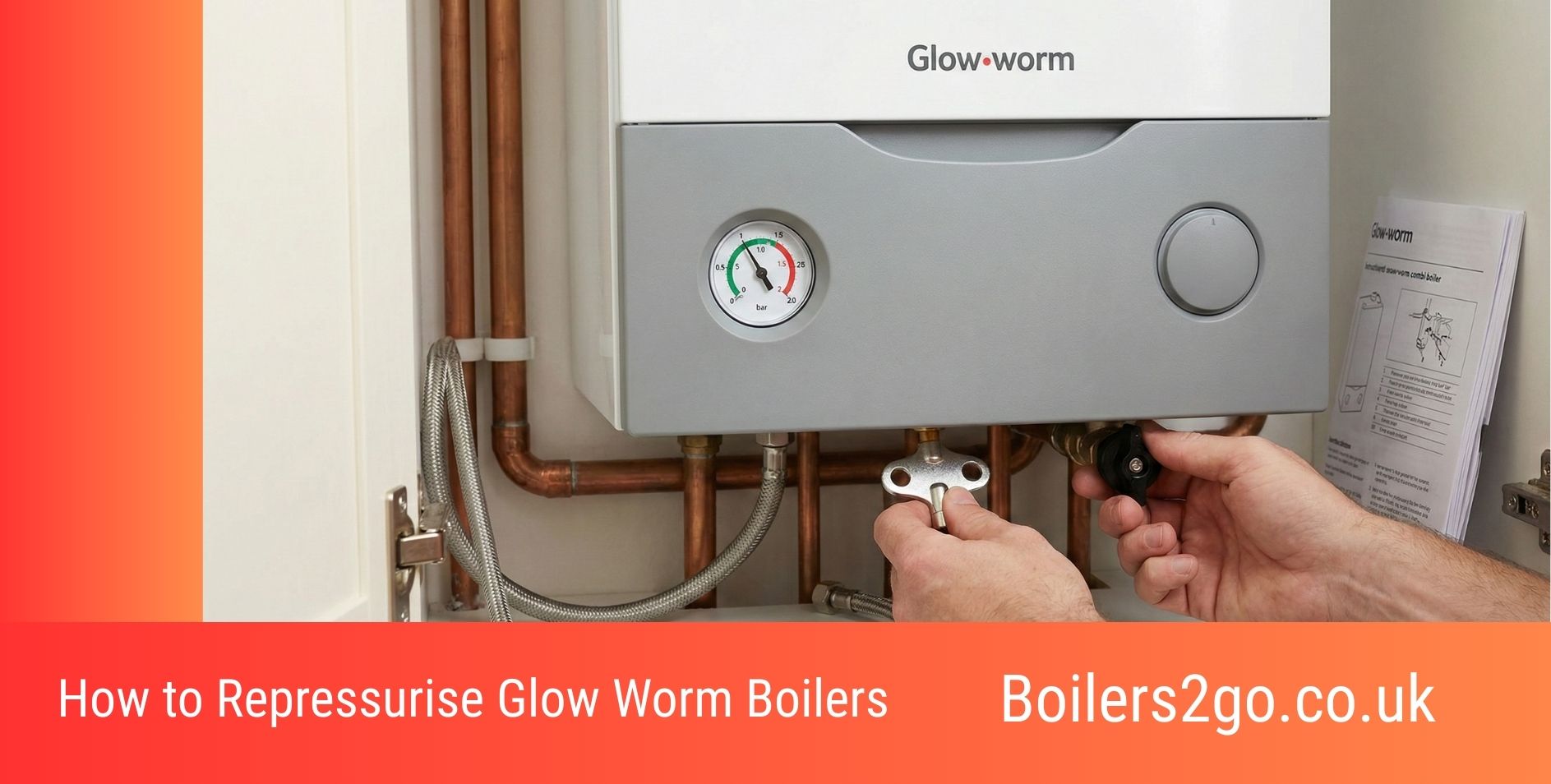
If your Glow-worm combi boiler is showing a low-pressure fault code, including F22, F1, L1, or a flashing red light, the system pressure has dropped below the safe operating level. This is one of the most common Glow-worm boiler issues and in the vast majority of cases it is something you can fix yourself in under ten minutes.
This guide covers the repressurise process for every current Glow-worm model (Energy, Betacom, Flexicom, Ultracom, Easicom, and Procombi), what causes pressure to drop in the first place, and how to stop it happening again. If your boiler is showing a different code, our Glow Worm boiler error codes guide covers the full list.
Get a boiler cover, repair and annual service plan online here >
How to Repressurise a Glow-Worm Boiler: Video Guide
How to Repressurise a Glow-Worm Boiler: Step-by-Step
Every current Glow-worm combi has one of three filling mechanisms: a built-in keyless pull lever (Easicom 3 and Energy 3 models), an external flexible silver filling loop, or an internal rigid loop with a lever and tap. Identify your type from the descriptions below, then follow the matching method.
Method 1: Built-in Keyless Filling Lever (Easicom 3, Energy 3, Ultimate 3)
This is the simplest method and requires no tools at all.
- Locate the white plastic pull-down knob underneath the boiler, usually on the right-hand side or hidden behind the bottom drop-down flap.
- Pull the knob firmly downwards until it clicks and you hear water flowing into the system.
- Watch the pressure gauge rise. Stop when it reaches 1.3 to 1.5 bar.
- Push the knob firmly back up until it clicks into the off position.
- Reset the boiler by pressing the reset button. The F22 or low-pressure code should clear within 10 to 20 seconds.
Method 2: External Flexible Silver Filling Loop
This is the most common setup on older Glow-worm models. The loop is either kept loose under the boiler or fixed in place.
- Find the braided silver hose with two grey or black valves. Connect it between the cold mains tap (left) and the heating flow valve (right) if it is not already attached.
- Slowly open both grey valves a quarter turn at the same time.
- Listen for water entering the system and watch the pressure gauge rise slowly to 1.3 to 1.5 bar.
- Close both valves tightly and remove the loop if it is not permanently fitted. Wipe any drips.
- Reset the boiler.
Method 3: Internal Rigid Filling Loop with Black or Blue Lever (Flexicom, Ultracom, Betacom)
- Look for a black or blue lever underneath the boiler, running parallel to the pipework.
- Turn the lever 90 degrees so it runs in line with the pipe, opening the filling valve.
- Open the small blue cold-water tap next to it. This usually requires a flat-blade screwdriver in the slotted head.
- Fill to 1.3 to 1.5 bar, then close the tap first and then return the lever to its original position.
- Reset the boiler.
Important: never exceed 2 bar when the system is cold. If the gauge climbs past 3 bar or water starts discharging from the orange PRV pipe outside, close everything immediately and call a Gas Safe engineer. The pressure relief valve has opened and the system is overfilled.
What Causes Low System Pressure on Glow-Worm Boilers?
Pressure does not drop without a reason. Identifying the cause prevents the problem from recurring every few weeks. Our general guide to low boiler pressure covers causes that apply to all brands.
1. A Small Leak on the Heating System
The most common cause by far. Even a drip the size of a pinhead on a radiator valve, pipework joint, or the boiler itself can drop pressure by 0.1 to 0.2 bar per week. Inspect visible pipework, radiators, and the underside of the boiler for any damp patches or dried mineral deposits where water has previously dripped and evaporated.
2. Recently Bled Radiators
Bleeding lets air out of the radiators, but a small amount of water escapes each time. If you have bled several radiators, a quick top-up via the filling loop is all that is needed. This is normal and not a sign of any underlying problem.
3. Faulty or Weeping Pressure Relief Valve
The orange or yellow PRV outside the boiler is designed to release water if system pressure climbs too high. If it is old or partially blocked with limescale (common in hard-water areas), it can start weeping water continuously at normal operating pressure, slowly draining the system. Check the discharge pipe outside for dripping when the boiler is running. If the PRV is leaking, a Gas Safe engineer will need to replace it. Our boiler pressure release valve guide explains how the valve works.
4. Leaking Automatic Air Vent
Many Glow-worm boilers have an automatic air vent on top of the pump. The float inside can stick in the open position, causing a slow drip into the boiler casing. This often goes unnoticed for months before the pressure drop becomes obvious. A Gas Safe engineer can replace the AAV during a service visit.
5. Recent Boiler Service or Repair
If an engineer has recently drained the system or replaced a component such as an expansion vessel or diverter valve, the pressure will have been reduced during the work. A simple top-up via the filling loop is all that is needed in this case, and the engineer should normally do this before leaving.
6. Faulty Expansion Vessel
The expansion vessel is a sealed red or silver tank inside the boiler that absorbs the increase in water volume as the system heats up. If the rubber diaphragm inside has perished or the Schrader valve has lost its air charge, pressure can rise rapidly during heating then fall sharply when the system cools. This pattern (pressure correct when cold, high when hot, then low again after cooling) is the classic symptom of a failed expansion vessel.
A Gas Safe engineer can recharge the vessel or replace it. Our guide to the boiler expansion vessel explains how it works.
How to Check Glow-Worm Boiler Efficiency After Repressurising
Once the pressure is back in range and the boiler is firing normally, it is worth noting how the system performs over the following week. A well-maintained Glow-worm running at correct pressure should hold steady between 1.0 and 1.5 bar without requiring a top-up more than once every few months.
For more on how Glow-worm models compare for running costs and efficiency, see our Glow-worm boiler reviews.
How to Prevent Low Pressure on a Glow-Worm Boiler
- Check the pressure gauge once a month. It only takes a few seconds and catches slow leaks before they become a fault code.
- Fit a magnetic system filter (MagnaClean or Fernox TF1) to catch sludge that can damage seals and fittings over time.
- Book an annual Gas Safe service. The engineer will recharge the expansion vessel, test the PRV, check the AAV, and inspect for slow leaks that are not yet visible.
- Fix even minor radiator valve leaks as soon as you notice them. A dripping lockshield or thermostatic head can cause a weekly pressure drop that never quite clears the fault code for good.
- In hard-water areas such as London and the South East, consider a scale reducer or water softener on the cold mains inlet to slow limescale build-up in the PRV and AAV.
When to Call a Gas Safe Engineer About Glow-Worm Boiler Pressure
Repressurising the boiler yourself is safe and straightforward. Call a Gas Safe registered engineer if any of the following apply:
- Pressure drops again within a few days of topping up, indicating an active leak that needs tracing.
- You can see water dripping from the boiler itself or from the orange PRV discharge pipe outside.
- The pressure gauge goes above 3 bar and will not come down by bleeding a radiator.
- You hear banging, kettling, or unusual noises from the boiler or pipework.
- A fault code other than F22, F1, or L1 appears on the display.
- Your Glow-worm boiler is still within its warranty period. DIY work beyond repressurising can invalidate cover.
Use the Gas Safe Register engineer finder to verify credentials before anyone works on your boiler.
Repressurising a Glow-Worm Boiler: FAQs
Why Does My Glow-Worm Show 0 Bar Even After Filling?
If the gauge does not move at all when you open the filling loop, either the pressure gauge itself has failed, or there is a significant leak that is immediately releasing the water you are adding. A Gas Safe engineer will fit a new gauge or pressure-test the system to identify which it is.
Is It Normal for Glow-Worm Boiler Pressure to Rise When the Heating Is On?
Yes. Pressure normally rises by 0.3 to 0.8 bar when the water heats up and expands. Starting from 1.2 bar cold and reaching 2.0 to 2.2 bar hot is completely normal. If it climbs above 2.8 to 3 bar when hot, the expansion vessel has likely failed and needs recharging or replacing by an engineer.
Can I Use an External Filling Loop on My Glow-Worm Boiler?
Yes. Any standard braided filling loop with 15mm connectors and double check valves is compatible, provided it meets Water Regulations. The check valves prevent backflow of heated system water into the cold mains, which is a legal requirement. Any loop sold by a plumber’s merchant or major DIY retailer for boiler use will meet this standard.
Where Is the Filling Lever on a Glow-Worm Easicom?
On 2023 to 2025 Easicom 3 models, the white pull-down lever is behind the drop-down flap at the bottom right of the boiler face. Press the flap down or in, depending on the year, to access it. If you have an Easicom 2 rather than an Easicom 3, it uses an external flexible loop rather than the built-in keyless mechanism.
Will Repressurising Clear the Glow-Worm F22 Fault Code?
Yes, on most Glow-worm models. Once pressure climbs above roughly 0.8 bar, the fault code clears itself within 10 to 20 seconds and the boiler will attempt to fire again without you needing to press the reset button. If the fault code does not clear after the pressure is restored, press the reset button once and allow the boiler to complete its ignition sequence.
Stay warm, The Boilers2Go Team

I’m Penny North, a home energy heating expert. My mission is to demystify new boilers and complex heating systems to help you achieve a warm, cosy home with lower energy bills and a smaller environmental footprint.