

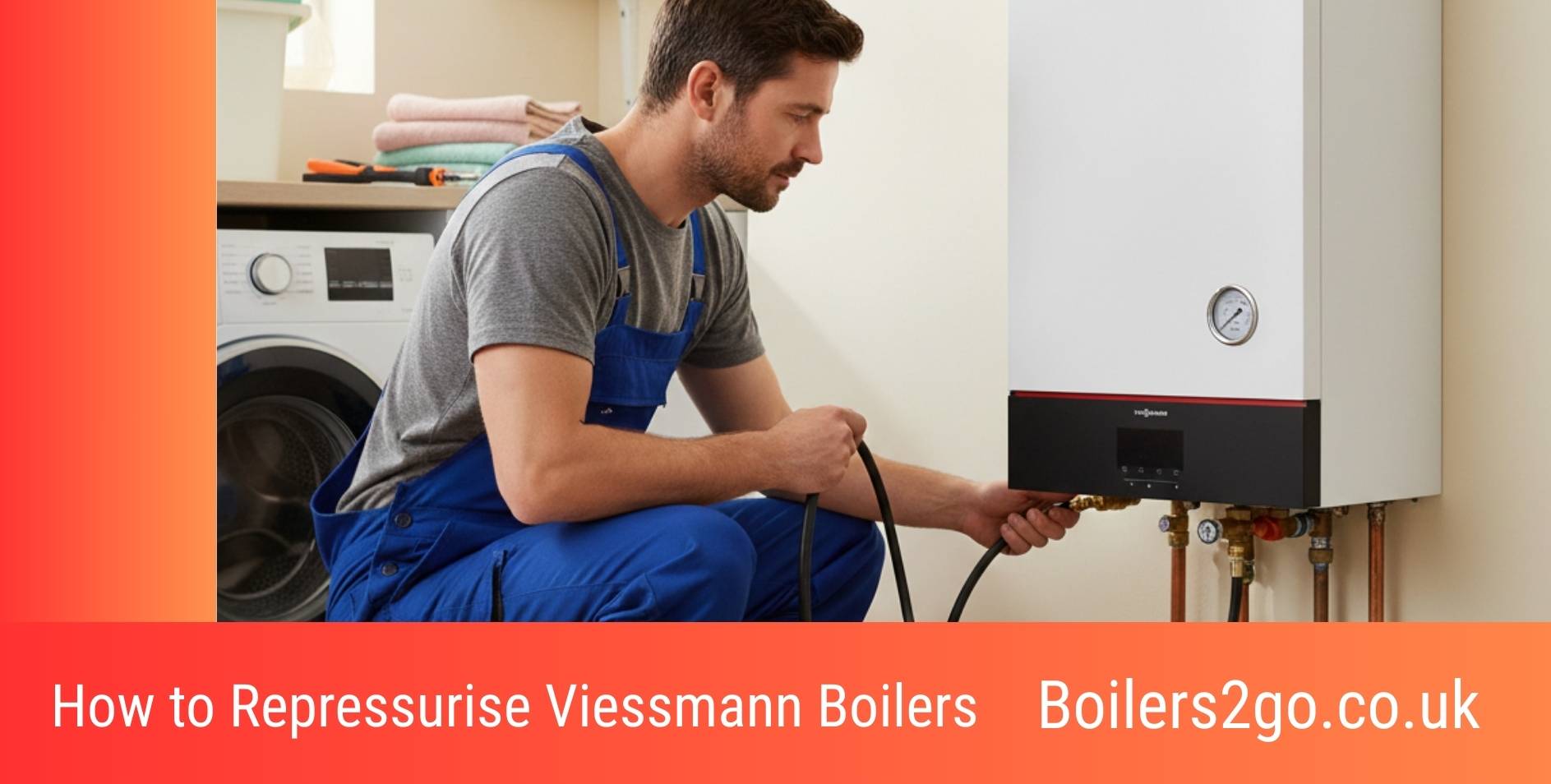
Low boiler pressure is one of the most common issues experienced by UK homeowners and landlords, particularly during the colder months when heating systems work harder.
This guide covers why Viessmann boilers lose pressure, how to correctly and safely increase it, and which specific causes are worth investigating first.
Get a boiler cover, repair and annual service plan online here >
How to Repressurise Viessmann Boilers Using the Built-In Filling Loop (Standard Method)
This is the most straightforward process for most boilers in the Vitodens range, especially the Vitodens 050-W, 100-W, and 111-W.
Ideal pressure sits at 1.0 to 1.5 bar when cold, according to Viessmann’s own UK guidance, though it’s always worth checking the manual for the exact figure for a specific model.
Step-by-Step Guide to Repressurising a Viessmann Boiler
- Turn off the boiler. Switch it off and allow it to cool slightly.
- Locate the pressure gauge. On most Viessmann boilers, this sits on the display panel.
- Find the filling loop. Viessmann boilers may use an internal filling loop lever system, or an external braided hose beneath the boiler.
- Open the taps or levers. Slowly turn or lift them so mains water begins flowing into the heating circuit.
- Watch the pressure gauge rise. Stop when the gauge reaches 1.4 bar, and never exceed 2 bar.
- Close both levers or taps fully. This step is vital, since failing to do so is a common cause of overpressurisation.
- Turn the boiler back on. Check for normal operation and reset any low-pressure fault code if one is displayed.
Why Does My Viessmann Boiler Lose Pressure?
Pressure loss is usually linked to water leaving the central heating loop. This happens when water is either released intentionally, such as when bleeding radiators, escaping unintentionally through leaks, or being handled incorrectly through filling loop faults.
Regular maintenance and prompt troubleshooting help prevent these pressure drops. If problems persist, our guide to common Viessmann boiler problems covers other faults worth ruling out before you call a Gas Safe engineer.
If a fault code appears alongside the pressure drop, our Viessmann boiler F1 fault code guide covers one of the most common, with causes and fixes.
Get a quote today and take the stress out of replacing your boiler. At Boilers2Go, we offer fast, reliable installation across the UK - often as soon as the next day. 
Need a new boiler?
Causes of Low Pressure in Viessmann Boilers (With Fixes)
Below are the most common causes of pressure loss, along with a dedicated fix for each to keep the guide practical.
Radiator Bleeding
Bleeding a radiator releases trapped air, which allows water to escape the system. Every time a radiator is bled, a small amount of water is lost, reducing overall system pressure.
How to Fix Pressure Loss After Bleeding Radiators
- Confirm pressure is below 1 bar
- Follow the standard repressurising method above
- Recheck radiators for cold spots to ensure no more air remains
- Perform a final pressure top-up if needed
Leaks in the Central Heating System
Water can escape through pipework joints, radiator valves, towel rails, or even the boiler’s internal components such as the pump, heat exchanger, or pressure relief valve.
Common signs include:
- Visible drips under radiators
- Green or white crust on copper joints, a sign of slow weeping
- Pressure dropping daily or hourly
- Damp patches on walls or ceilings
- PRV discharge pipe dripping outside
How to Fix Leaks Causing Pressure Loss
For visible leaks:
- Tighten loose radiator valve nuts using an adjustable spanner
- Use PTFE tape on minor weeping compression joints
- Replace worn TRV valve heads or lockshields
For hidden leaks:
- Isolate sections using radiator valves to narrow down the leak location
- Add a leak detection dye to the system, which is safe for most Viessmann models
- Call a heating engineer for inaccessible leaks behind floors, walls, or boilers
Important: never repeatedly repressurise a leaking system, since this can damage the heat exchanger.
Faulty Expansion Vessel
The expansion vessel is a diaphragm tank that holds air on one side and system water on the other. When the diaphragm fails or loses its charge, pressure swings become extreme.
How to Fix Expansion Vessel Issues
Check the pressure behaviour: if it rises rapidly when the heating is on, the expansion vessel is likely flat. A Gas Safe engineer should then measure the vessel charge with a Schrader valve tool, recharge it to around 0.75 to 1.0 bar, or replace the vessel entirely if the diaphragm has ruptured.
This is not a DIY fix.
Stuck or Faulty Pressure Relief Valve (PRV)
A stuck or faulty PRV opens incorrectly and releases water through the discharge pipe. Once a PRV has lifted once due to overpressure, it often fails to reseal perfectly.
How to Fix PRV Faults
- Check if the copper discharge pipe outside is dripping
- The only remedy is PRV replacement by a Gas Safe engineer
- PRV faults often occur because someone previously overfilled the boiler
Incorrect Filling Loop Installation
This is caused by the loop being left slightly open, leaking from the loop itself, or hoses that have been wrongly connected.
How to Fix Filling Loop Faults
- Ensure both levers or taps are firmly closed
- Check washers in external hoses and replace if worn
- Fit a new filling loop entirely if corrosion is visible
How to Prevent Low Pressure in Viessmann Boilers
- Bleed radiators only when necessary, and repressurise immediately afterwards
- Check system pressure monthly, especially in winter
- Inspect radiator valves and connections annually for early signs of weeping
- Get an annual service, which includes expansion vessel checks
- Avoid overfilling the boiler, as this stresses the PRV
- Use inhibitor to protect against internal corrosion and pinhole leaks
When Should You Call a Gas Safe Engineer About Your Viessmann Boiler?
Call a Gas Safe engineer immediately if:
- Pressure drops daily even after repressurising
- Water is escaping from inside the boiler casing
- The PRV discharge pipe is constantly dripping
- The boiler shows repeated F9, F22, or other pressure-related codes
- A faulty expansion vessel is suspected
- The filling loop cannot be safely located
Working on internal boiler components without certification is unsafe and illegal in the UK. Only a Gas Safe registered engineer is legally permitted to carry out this kind of work.
Repressurising Viessmann Boilers: FAQs
Can I Repressurise My Viessmann Boiler While It Is Running?
No. Always turn the boiler off before repressurising, since doing it while the system is hot can give inaccurate gauge readings. Once the boiler has cooled, it’s safe to proceed. If a fault remains afterwards, our guide on how to reset a Viessmann boiler explains how to clear minor lockouts.
What Pressure Should My Viessmann Boiler Be When the Heating Is On?
Typically between 1.5 and 2.0 bar, depending on the size of the system. It will naturally rise a little while the heating is active.
Why Does My Viessmann Boiler Pressure Keep Rising After I Repressurise?
This usually points to an overfilled system or a flat expansion vessel, both of which need proper diagnosis by an engineer.
Can Cold Weather Cause Viessmann Boiler Pressure Loss?
Yes. Pipe contraction, minor leaks widening, and frozen condensate runs can all contribute to a drop in pressure during colder months.
Is It Normal to Repressurise a Viessmann Boiler Once or Twice a Year?
Yes, occasional top-ups are completely normal. Frequent top-ups, on the other hand, point to a deeper issue that’s worth investigating.
Does Viessmann Pressure Guidance Differ Between Combi and System Boilers?
The basic cold-fill range of 1.0 to 1.5 bar applies across most Viessmann residential models, but system boilers paired with unvented cylinders can have slightly different requirements, so it’s worth checking the specific manual.
What Should I Do If My Viessmann Boiler Has No Visible Pressure Gauge?
Some Viessmann models, including certain Vitodens 100-W units, show pressure through the digital display rather than a traditional dial. Checking the control panel menu or the manual will confirm where this reading appears before attempting to repressurise.
How Much Does It Cost to Have a Viessmann Boiler Repressurised or Fixed?
A straightforward repressurising call-out typically costs between £60 and £120. If the underlying cause turns out to be a faulty expansion vessel or PRV, repair costs usually rise to somewhere between £150 and £350, depending on parts and labour.
Get a quote today and take the stress out of replacing your boiler. At Boilers2Go, we offer fast, reliable installation across the UK - often as soon as the next day.
Need a new boiler?

I’m Penny North, a home energy heating expert. My mission is to demystify new boilers and complex heating systems to help you achieve a warm, cosy home with lower energy bills and a smaller environmental footprint.