

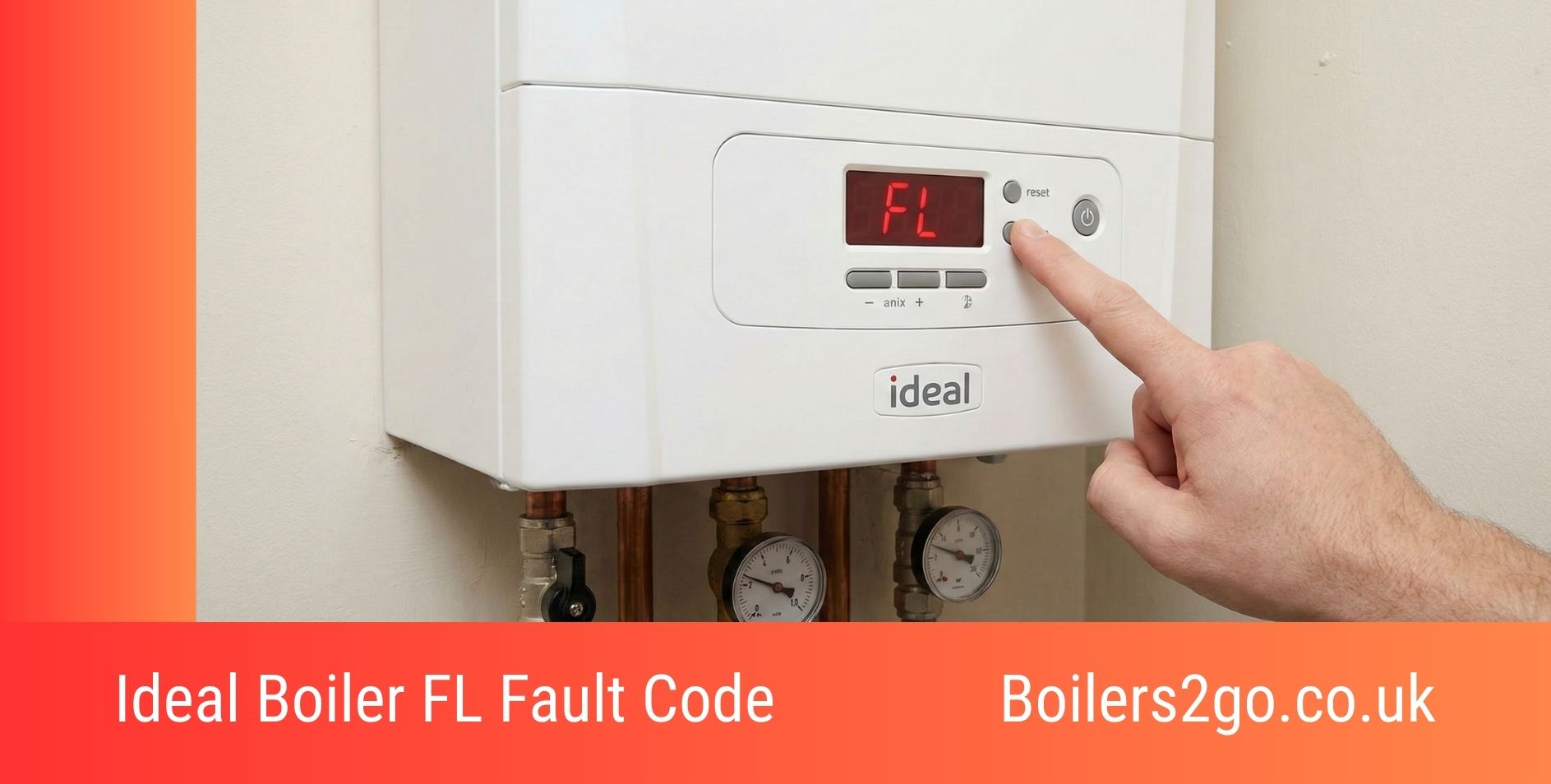
The Ideal boiler FL fault code means the boiler has detected flame loss: the burner either failed to ignite at all, or lit briefly and then went out. As a safety measure, the boiler shuts itself down to prevent unburnt gas from accumulating, leaving you without heating or hot water until the underlying cause is resolved.
FL (sometimes displayed as LF or F/L depending on the model generation) is one of the most common lockout codes on Ideal Logic, Isar, and Icos boilers. The good news is that a few of the causes are straightforward to check yourself before calling anyone out. Most of the rest need a Gas Safe engineer.
For a broader overview, our Ideal boiler error codes guide covers the full range. If you have an F1 code instead of FL, see the separate Ideal boiler F1 fault code guide, as that points to a different underlying fault.
Get a boiler cover, repair and annual service plan online here >
Watch Our Ideal Boiler FL Fault Code Video
What Does the Ideal Boiler FL Fault Code Mean?
The FL code signals that the boiler went through its ignition sequence but the PCB (printed circuit board) could not confirm a stable flame was established. This triggers an automatic safety lockout.
On modern Ideal Logic and Vogue models, the display shows FL or LF as alternating letters. On older Isar and Icos models, you may see F and L flashing alternately. All of these indicate the same core fault: the ionisation probe (flame sensor) has not detected the flame it expected after the gas valve opened and the spark electrode fired.
One important thing to understand: the FL code can appear either because the flame never lit, or because it lit and then went out during operation. The first is an ignition failure; the second is a flame loss fault. Both produce the same display code, which is why there are several different possible root causes.
Get a quote today and take the stress out of replacing your boiler. At Boilers2Go, we offer fast, reliable installation across the UK - often as soon as the next day. 
Need a new boiler?
What Causes the Ideal Boiler FL Fault Code?
Interrupted Gas Supply
An interrupted gas supply is one of the first things to check because it is free to rule out. A tripped gas meter, empty prepayment credit, or an accidentally closed isolation valve will all starve the burner of gas and produce the FL code.
How to Fix an Interrupted Gas Supply
- Test another gas appliance in the property such as a hob or gas fire. If it does not light or the flame is very weak, the problem is with the supply rather than the boiler.
- Locate the yellow-handled gas isolation valve close to the boiler. When open, the handle runs in line with the pipe. If it has been turned, open it fully.
- If on a prepayment meter, top up the credit and check the meter has not tripped.
- Switch the boiler off at the fused spur for 30 seconds, then back on, and press the reset button. Allow it to complete a full ignition cycle.
- If the gas pressure is suspected to be low (below the required 20 millibar at the boiler), a Gas Safe engineer can measure and adjust this. It is not a homeowner task.
Faulty Gas Valve
The gas valve controls the flow of gas to the burner. If it is stuck, worn, or not receiving the correct signal from the PCB, it will not open properly during the ignition sequence. The result is either no ignition at all or a weak flame that the ionisation probe cannot detect reliably.
How to Fix a Faulty Gas Valve
- Do not attempt to touch or adjust the gas valve yourself. It is a sealed gas-carrying component.
- Switch the boiler off at the mains and call a Gas Safe engineer.
- The engineer will test the solenoid operation with a multimeter and check for correct voltage signal from the PCB before concluding the valve has failed.
- A replacement gas valve on an Ideal boiler typically costs around £320 for the part, plus labour. If the boiler is under 7 years old and serviced annually, check whether this falls within your warranty coverage before commissioning a repair.
Blocked Flue or Exhaust System
The fan must create sufficient draught to evacuate combustion gases through the flue before the gas valve opens. If the flue terminal is blocked by a bird nest, compacted leaves, ice in winter, or soot from incomplete combustion, the boiler cannot confirm correct airflow and the ignition sequence is aborted.
How to Fix a Blocked Flue
- Safely inspect the external flue terminal. Look for obvious blockages: nesting material, leaves, snow or ice on the guard, or nearby plant growth that has grown over the terminal.
- Clear any external debris carefully without dislodging the flue seals.
- Check the boiler’s air intake grille at the front or bottom for dust accumulation.
- Reset the boiler and test once the terminal is clear.
- If FL returns immediately or you hear unusual fan noises (grinding, rattling), the fan itself may be failing. That requires a Gas Safe engineer to diagnose and replace.
Blocked or Frozen Condensate Trap
Condensing boilers produce acidic wastewater as a byproduct of their high efficiency. This drains through a plastic condensate trap and pipe. If the trap becomes blocked with limescale sludge, or the external pipe freezes in cold weather, the system backs up and triggers the FL code as a safety interlock.
How to Fix a Blocked or Frozen Condensate Trap
- In cold weather, check the external condensate pipe (the white plastic pipe exiting the boiler to an outside drain). Pour warm water along frozen sections or apply a hot water bottle. Never use boiling water, which can crack the pipe.
- Locate the white plastic condensate trap at the boiler base (check your model’s user manual for the exact position). Empty any accumulated water into a bucket, wearing gloves as the condensate is mildly acidic.
- Flush the trap with warm water to clear any sludge, reassemble securely, and reset the boiler.
- If blockages are recurring, an engineer can descale the full drain line at a service visit. Fitting a condensate siphon is a long-term solution for traps that block frequently.
Dirty or Faulty Ignition Electrode and Ionisation Probe
The ignition electrode creates the spark that lights the gas. The ionisation probe (sometimes the same component, sometimes separate depending on the Ideal model) detects the flame by measuring the small electrical current the flame produces. Carbon deposits on either component, or erosion from constant sparking, reduce their effectiveness and cause false flame-loss readings.
How to Fix Electrode and Ionisation Probe Faults
- Do not attempt to clean or adjust these components yourself. The electrode sits adjacent to the gas burner and is accessed through the sealed combustion chamber. This is a gas appliance component that must only be handled by a Gas Safe engineer.
- A Gas Safe engineer will test flame signal strength with a multimeter, inspect for physical erosion or carbon fouling, and clean or replace the electrode and probe as needed.
- The correct electrode gap on most Ideal Isar, Icos, and Logic models is 3 to 4 mm. Misalignment or erosion beyond this causes intermittent or absent spark.
- Genuine Ideal parts should be used for replacement to ensure correct fit and avoid recalibration issues.
How Many Times Can You Reset an Ideal Boiler Showing FL?
You can safely attempt one reset after checking for obvious causes (gas supply, frozen condensate, external flue blockage). If the FL code returns after a single reset, stop there. If the code changes to L1 after a reset, the boiler has detected a flow temperature problem rather than a flame fault, which our guide to the Ideal boiler L1 fault code explains.
Resetting more than two or three times in quick succession without fixing the root cause can cause excess gas to accumulate briefly during failed ignition attempts and puts unnecessary stress on the spark electrode and PCB. If the fault is persistent, a Gas Safe engineer is the correct next step.
When to Call a Gas Safe Engineer for an Ideal FL Fault
Call a Gas Safe registered engineer straight away if:
- The FL code returns after one reset and the gas supply is confirmed as working.
- You can smell gas at any point. Leave the property, do not operate any switches, and call the National Gas Emergency Service on 0800 111 999.
- The boiler makes a loud bang on attempted ignition (this is explosive ignition and suggests gas has accumulated before lighting).
- The FL code is accompanied by an unusual noise from the fan or flue system.
- The boiler is still within warranty. DIY interference beyond resetting can invalidate cover.
Verify any engineer’s credentials using the Gas Safe Register before they work on your boiler.
Get a quote today and take the stress out of replacing your boiler. At Boilers2Go, we offer fast, reliable installation across the UK - often as soon as the next day.
Need a new boiler?
Ideal Boiler FL Fault Code: FAQs
How Often Should You Service an Ideal Boiler to Avoid FL Faults?
An annual service by a Gas Safe engineer is the most effective prevention for FL faults. The engineer cleans the ignition electrode and ionisation probe, checks gas pressure and combustion quality, inspects the flue, and clears the condensate trap. These are the exact components most commonly responsible for the FL code. Keeping service records also maintains your Ideal warranty.
Does the Ideal FL Code Affect Hot Water as Well as Heating?
On combi boilers, yes. The burner serves both central heating and domestic hot water, so an FL lockout stops both simultaneously. On system boilers connected to a separate hot water cylinder, the cylinder may retain some stored hot water for a period after lockout, but no further hot water will be produced until the fault is cleared.
Can Cold Weather Cause the Ideal Boiler FL Fault Code?
Yes, and this is one of the most common winter causes. A frozen condensate pipe backs up into the boiler and triggers the lockout. Strong winds blowing back down a horizontal flue can also momentarily extinguish the flame, particularly on exposed properties. In both cases the fix is usually straightforward: thaw the condensate pipe or wait for wind conditions to improve before resetting.
Is the Ideal Boiler FL Code Covered by Boiler Cover?
Usually. Most UK boiler cover policies include ignition faults provided the boiler has been serviced within the past 12 months. Faults caused by neglected maintenance or a frozen condensate pipe that could have been lagged are sometimes excluded. Check your policy wording carefully, particularly around “sudden and unforeseen” versus “wear and tear” exclusion clauses.
Does an Ideal FL Fault Mean the Boiler Needs Replacing?
A single FL event, even on an older boiler, does not necessarily mean replacement is imminent. If an Ideal Logic or Vogue is under 12 years old and the fault is resolved cleanly with a single repair, it is almost always worth fixing. A pattern of recurring FL codes over two or three heating seasons, alongside other faults, on a boiler approaching 12 to 15 years is a stronger indicator that the boiler is approaching the end of its economical service life.
Get a quote today and take the stress out of replacing your boiler. At Boilers2Go, we offer fast, reliable installation across the UK - often as soon as the next day.
Need a new boiler?

I’m Penny North, a home energy heating expert. My mission is to demystify new boilers and complex heating systems to help you achieve a warm, cosy home with lower energy bills and a smaller environmental footprint.