

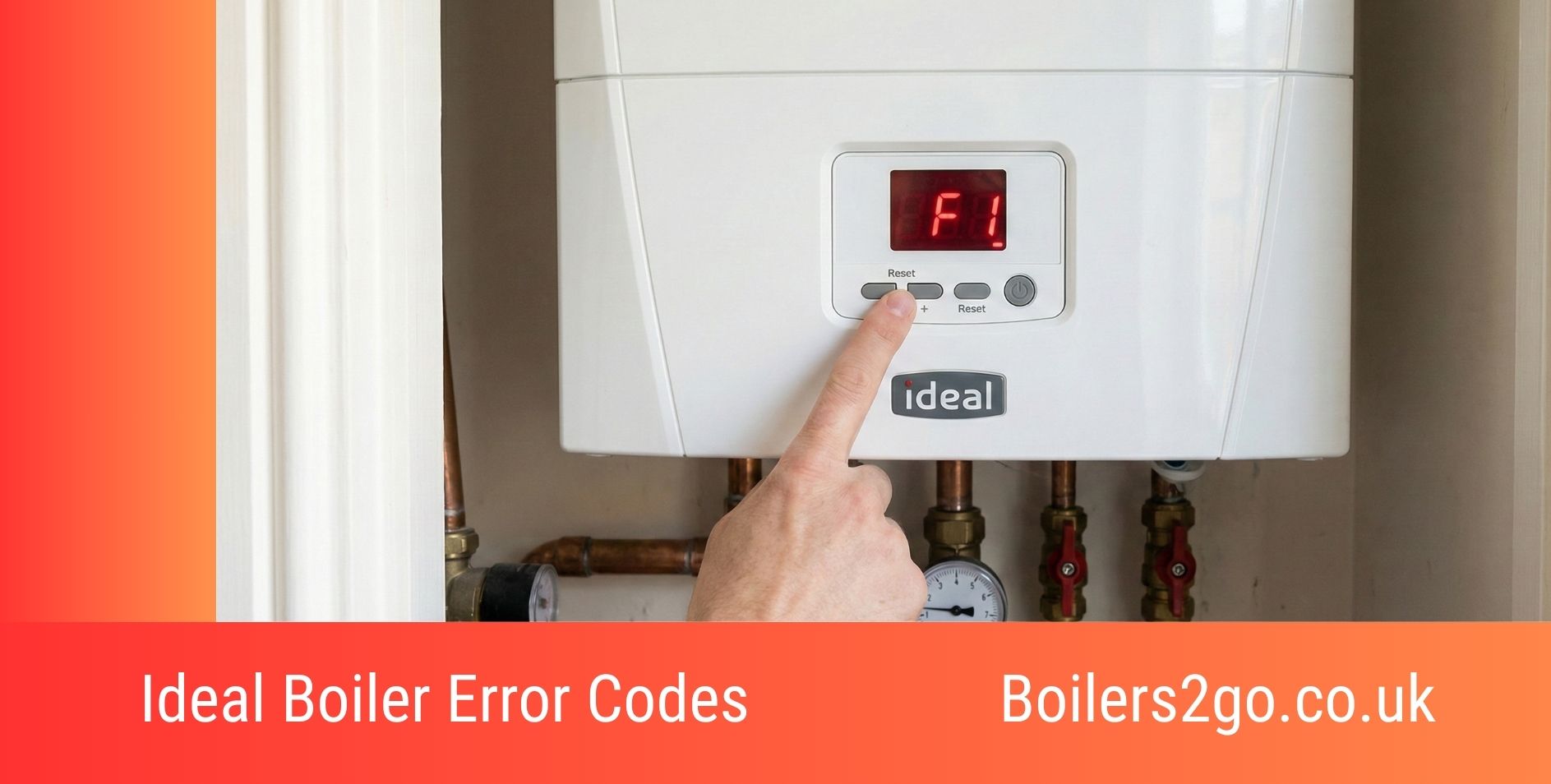
Common Ideal boiler error codes, such as F1, F2, F3, L1 and L2, are predefined alerts from the boiler’s printed circuit board (PCB) that indicate a specific fault in the appliance.
These codes help diagnose problems in the gas valve, thermistor, fan or water circulation, preventing further damage to the boiler. For UK households relying on a gas boiler for hot water and radiators, recognising these signals is key to minimising downtime.
This guide breaks down the most common Ideal boiler fault codes, their meanings, root causes, and step-by-step fixes.
While some issues, such as low water pressure, are DIY-friendly, gas appliances always demand caution. If a gas leak is ever suspected, the boiler should not be touched; leave the property, keep the door open, and call the National Gas Emergency line on 0800 111 999.
What Does the Ideal F1 Error Code Mean?
The F1 error code on an Ideal boiler signals low water pressure in the central heating system, a frequent issue on combi boilers like the Ideal Logic Max where pressure drops below around 1 bar. Our Ideal F1 fault code guide covers it in more detail.
This fault locks the boiler out to avoid overheating or pump strain, leaving radiators cold and hot water disrupted.
What Causes the F1 Error Code?
- Leaks in the system: small drips from radiator valves, pipe joints, or the boiler itself can gradually deplete pressure, especially in older properties.
- Recently bled radiators: releasing trapped air improves heating efficiency, but forgetting to repressurise afterwards causes a pressure drop.
- A faulty pressure relief valve: this safety component can stick due to limescale build-up in hard water areas.
How to Fix a Leak Causing the F1 Error Code
- Inspect visible pipes and radiators for damp spots or puddles. Wipe areas dry and monitor for 24 hours; if wetness reappears, trace the source.
- Tighten loose connections gently, avoiding over-tightening, which can crack fittings.
- If a leak persists after repressurising, a Gas Safe registered engineer will need to replace seals or sections, typically costing £150 to £300.
How to Fix Pressure Drop After Bleeding Radiators
Locate the filling loop, a flexible hose near the boiler base. Connect it to the mains cold water supply and slowly open the valve until the pressure gauge reads 1 to 1.5 bar with the system cold. Close the valve, disconnect the loop, and bleed radiators again if needed. This simple repressurisation often resolves F1 in under 10 minutes.
How to Fix a Faulty Pressure Relief Valve
- Visually check the valve, a small lever on the boiler exterior, for corrosion.
- Gently lift the lever to test discharge; water should briefly flow then stop.
- For a stuck or faulty valve, professional replacement is needed, typically £100 to £200 for parts and labour.
What Does the Ideal F2 Error Code Mean?
An F2 error code indicates flame loss on an Ideal boiler, where the main burner ignites but extinguishes prematurely, halting combustion and central heating operation. This lockout protects against carbon monoxide risk. See our Ideal F2 fault code guide for the full set of fixes.
The Ideal FL fault code can share causes such as flame sensor issues, an insufficient gas supply or a blocked flue, so it is worth checking both codes if the display is unclear.
What Causes the F2 Error Code?
- Incorrect gas pressure: fluctuations from a partially closed meter valve or supply issue reduce fuel delivery to the heat exchanger.
- Blocked or faulty flue: soot or debris in the exhaust pipe restricts airflow, causing incomplete combustion.
- Defective gas valve: the solenoid controlling gas flow can fail electrically over time, particularly on a heavily used system.
How to Fix Incorrect Gas Pressure
Check other gas appliances, such as a cooker, to confirm the wider gas supply is working. If it is, a single reset can be attempted. Gas valve pressure adjustment at the boiler’s test point should only be carried out by a Gas Safe registered engineer using a manometer.
How to Fix a Blocked or Faulty Flue
Externally, check the flue terminal for nests, leaves or frost and clear any obvious obstruction. Persistent blockages, or damage inside the flue itself, need inspection and possible relining by a specialist, which can cost £400 to £800.
How to Fix a Defective Gas Valve
A missing click during ignition attempts can suggest a burnt-out valve coil. Replacement requires isolating the gas and electrical supply and swapping the valve assembly, typically £150 to £250, and must be carried out and re-certified by a Gas Safe registered engineer.
What Does the Ideal F3 Error Code Mean?
The F3 error code points to a fan fault on an Ideal boiler, where the combustion fan fails to reach the correct speed, preventing safe ignition and triggering a safety lockout. This is common on system boilers like the Ideal Logic+ System. Our Ideal F3 fault code guide covers it in more detail.
What Causes the F3 Error Code?
- Wiring or connection problems: loose harnesses from vibration can disrupt power to the fan motor.
- Blocked air intake: dust or debris in the air intake or flue can restrict airflow, so the fan cannot reach its target speed.
- Failed fan motor: bearings can seize after years of use, especially without regular servicing.
How to Fix Wiring, Blocked Intake or a Failed Fan Motor
A Gas Safe registered engineer can test fan wiring for continuity, clean or clear a blocked air intake, and replace a failed fan motor with the correct part, recalibrating fan speed via the control board afterwards. Combustion ratios must be verified after any fan work to confirm safe operation.
What Does the Ideal L1 Error Code Mean?
The L1 error code denotes an overheat lockout, where the boiler has detected low water flow or a flow temperature reading outside the normal safe range. This safety feature protects against scalding and component damage. See our Ideal L1 fault code guide for the full set of fixes.
What Causes the L1 Error Code?
- Airlocks in the circuit: trapped air slows water flow, mimicking low circulation.
- Pump failure: a weakening circulator pump reduces flow through the radiators.
- Sludge build-up: corrosion debris in an older system can restrict flow around the diverter valve.
How to Fix Airlocks, Pump Failure or Sludge Build-Up
- Bleed all radiators, starting with the highest in the property, until water flows steadily, then bleed the boiler’s own air vent screw.
- Top up pressure to around 1.2 bar afterwards to restore circulation.
- A weak or noisy pump may need replacing, typically £200 to £400 including labour, and persistent sludge issues usually call for a professional power flush, around £300 to £500, followed by fresh inhibitor.
What Does the Ideal L2 Error Code Mean?
The L2 error code signifies an ignition lockout, where repeated failed attempts to light the flame trigger a safety shutdown. This protects against a build-up of unburnt gas in models such as the Ideal Isar. Our Ideal L2 fault code guide covers it in more detail.
What Causes the L2 Error Code?
- No gas supply: a closed valve or an empty prepayment meter.
- Electrode fault: the ionisation probe misreads the flame.
- Gurgling noises indicating a blockage: air or sludge in the burner or condensate route.
How to Fix the Ideal L2 Error Code
Confirm the gas meter is on and valves are open, checking a hob or cooker if unsure. If supply is confirmed and a single reset does not clear the fault, an electrode fault or blockage needs diagnosis by a Gas Safe registered engineer, since cleaning or repositioning the ignition probe and clearing a blocked burner both require the case to be opened safely.
How to Prevent Ideal Boiler Error Codes in the Future
Preventing Ideal boiler fault codes starts with proactive maintenance, saving time and money on emergency repairs. An annual Gas Safe service, typically £80 to £120, inspects the PCB, thermistors and flue, catching issues such as limescale in the heat exchanger early.
Maintaining system pressure at 1 to 1.5 bar and using an inhibitor to combat sludge in radiators both help avoid repeat faults.
For combi boilers, insulating exposed pipework helps prevent condensate freezing in winter, and landlords should keep service records for compliance. These steps support reliable, efficient operation and a longer boiler lifespan.
When Should You Call a Gas Safe Engineer About an Ideal Error Code?
Basic troubleshooting such as repressurising suits a confident homeowner, but certain faults demand a Gas Safe registered engineer immediately to avoid risks such as carbon monoxide exposure or a voided warranty.
Call one if error codes persist after a single reset, involve gas components such as an F2 valve fault, or are accompanied by smells, leaks or unusual noises. Always confirm an engineer’s ID on the Gas Safe Register before they start work.
Ideal Boiler Error Codes: FAQs
How Often Should I Check My Ideal Boiler’s Pressure Gauge?
Checking the pressure gauge monthly, and especially before winter, helps catch a drop early and avoid an F1 lockout. Aim for 1 to 1.5 bar when cold; slight variation with temperature is normal, but a consistently low reading signals an underlying issue.
What Role Does the PCB Play in Ideal Boiler Fault Codes?
The printed circuit board coordinates sensors such as the flow and return thermistors and fan speed feedback. A faulty PCB can mimic multiple error codes by misreading these signals, sometimes following a power surge, and diagnosing this accurately needs specialist tools.
Can Hard Water Cause More Frequent Ideal Boiler Errors?
Yes. Hard water regions accelerate limescale build-up on components such as the heat exchanger, which can worsen fan strain or overheat faults over time. A water softener or magnetic descaler can help reduce this.
How Do Seasonal Changes Affect Ideal Boiler Error Codes?
Colder winters increase demand on the pump and system generally, while summer disuse can allow sludge to settle. Running the boiler briefly on a low setting every few weeks during quieter months helps keep seals and circulation in good condition.
Do Ideal Combi and System Boilers Use Different Error Codes?
Core codes such as F1 and F2 are shared across the range, though system boilers like the Logic+ System can show additional variants relating to an external pump. Always check the specific model’s manual for exact code meanings.
Can I Keep Resetting My Ideal Boiler If the Same Code Returns?
No. A single reset after checking the obvious causes, such as gas supply or pressure, is reasonable. If the same code returns, repeated resetting can mask a genuine fault and should be avoided in favour of a proper diagnosis. If you are not sure how to carry out that reset safely, our guide on how to reset an Ideal Logic combi boiler walks through the steps.

I’m Penny North, a home energy heating expert. My mission is to demystify new boilers and complex heating systems to help you achieve a warm, cosy home with lower energy bills and a smaller environmental footprint.