

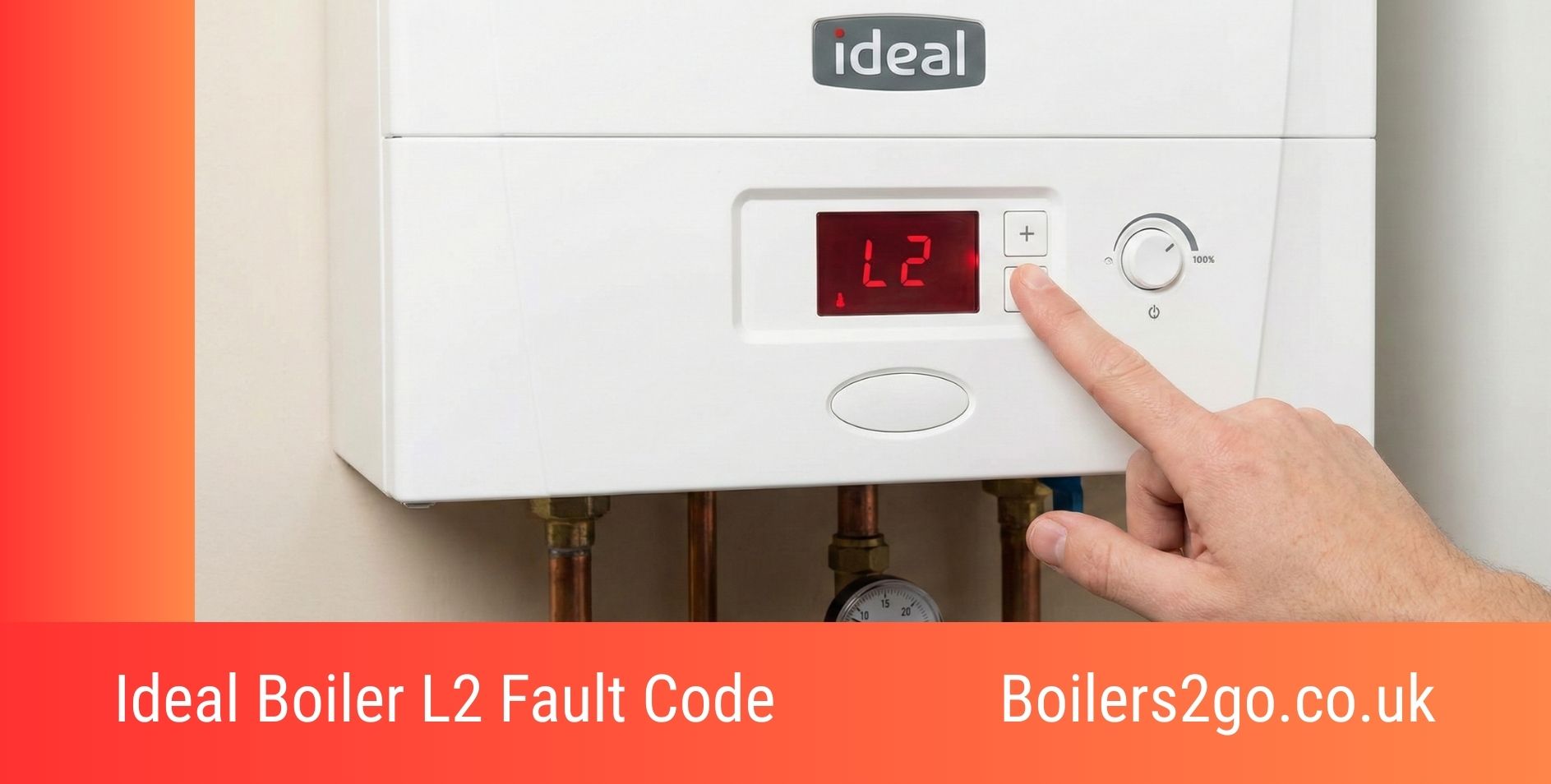
If your heating has suddenly stopped and the display is showing the L2 fault code on an Ideal boiler, it’s a common issue reported by UK homeowners and landlords, and it usually points to an ignition or flame detection problem.
This guide covers what the L2 fault code means, the most common causes, and how to fix them safely.
Need a new boiler?
Get a quote today and take the stress out of replacing your boiler, with fast, reliable installation across the UK, often as soon as the next day.
What Is the Ideal Boiler L2 Fault Code?
The L2 fault code on Ideal boilers indicates a lockout due to flame loss or failed ignition. In simple terms, the boiler tries to ignite but cannot establish or maintain a flame, so it shuts itself down as a safety precaution. This is different from a status display such as 0, which simply means the boiler is on standby with no demand for heat, and our guide to Ideal boiler status 0 explains when that is worth checking.
This fault is common on models such as Ideal Logic, Ideal Logic+ and Ideal Independent.
What Causes the Ideal Boiler L2 Fault Code?
Frozen Condensate Pipe
When an Ideal boiler runs it produces condensate, a mildly acidic waste water, that drains away through a small plastic pipe to the outside. In cold UK weather that thin external pipe can ice up or partially block, so the condensate can’t escape.
The boiler senses the blockage and shuts down with an L2 lockout to protect itself.
How to Fix
- Check the outdoor pipe. Look at the slim white or grey pipe running from the boiler to outside. If it’s covered in ice or frost, it’s likely frozen.
- Thaw it safely. Pour warm tap water over the frozen length, not boiling water. Work along the frozen section with a jug until flow resumes, since hot water on very cold plastic can crack the pipe.
- Protect and insulate. Once thawed, wrap the exposed section with lagging or a condensate sleeve from a DIY store. If the pipe runs along an exposed wall, consider re-routing it, which is an engineer job.
- Reset the boiler. After thawing, perform a single reset and let the boiler try to restart.
- Monitor. If the L2 returns after a few hours of cold weather, note the dates and times and contact an engineer, since repeat freezing can point to poor installation or inadequate insulation.
Safety note: if the pipe is inside a cavity or below ground, don’t dig or force it. Call an engineer.
When to call an engineer:
- The pipe keeps freezing despite insulation
- You can’t locate the external pipe, or it’s buried under paving
- Condensate is leaking inside the house, or you see damp damage
Low Gas Supply or Gas Pressure
Boilers need a steady gas flow to light the burner. If pressure is too low, ignition fails or the flame can’t stay lit, and the boiler locks out with L2. Common causes are an unexpected supply interruption, an empty prepayment meter, a partly closed isolation valve, or an issue at the gas supplier.
How to Fix
- Check other gas appliances. Try a hob ring or gas fire. If they’re weak or not working, that points to a supply problem.
- Locate the gas isolation valve. Usually by the meter or just outside the property. Make sure it’s fully open, running parallel with the pipe. Don’t tamper with meter valves or regulators.
Look and sniff. If you smell gas strongly, evacuate the property and call the National Gas Emergency Service on 0800 111 999, and don’t operate electrical switches or light flames.
- Record info. Note when the fault began, whether other appliances are affected, and any supply notices from your gas company. This helps both the engineer and the supplier.
When to call a Gas Safe engineer or supplier:
- Other appliances are affected or low pressure persists
- You suspect a leak or smell gas, in which case call the emergency number immediately
- The isolation valve or meter looks tampered with or damaged
Important: don’t attempt to adjust gas pressure yourself or interfere with the meter or regulator. That’s a job for licensed professionals.
Faulty Flame Sensor (Ionisation Probe)
The flame sensor is the boiler’s proof that gas has ignited. If it’s dirty, corroded or worn, the control system may not detect the flame even though the burner is lit, causing the boiler to shut down for safety.
What you might notice:
- The boiler attempts to light but shuts down quickly
- Repeated L2 lockouts after short ignition attempts
- Recent servicing or condensation issues, since moisture can corrode the probe
First checks, without touching electrical parts:
- Turn off and isolate. Switch the boiler off at the programmer and isolator before touching anything close to components.
- Look for visible soot or damage. With the casing off, only if you’re confident and the boiler is isolated, check the probe for cracks or heavy soot. If in doubt, stop and call an engineer.
- Attempt a single reset. A transient fault sometimes clears once, but don’t keep resetting.
- Book a service. Cleaning or replacing the ionisation probe needs a Gas Safe engineer with the right tools and parts.
An engineer is usually needed because the probe sits close to live electrical and gas components, and cleaning or replacing it correctly requires the boiler to be bench tested and calibrated.
Ignition Leads or Electrodes Damaged
The ignition system creates the spark that lights the gas. If the electrodes are cracked or worn, or the leads are brittle, the spark can be weak or misdirected, so ignition fails.
Signs you could see:
- No audible clicking or spark when the boiler tries to ignite
- Visible cracks in ceramic electrode tips, if exposed
- Repeated L2 faults after a period of normal operation
What you can safely check:
- Listen for the ignition click. When you initiate heating, you should hear a click or spark. No sound suggests an ignition fault.
- Visual check, only when isolated. With the boiler powered down and isolated, you can look for obvious physical damage to electrodes or leads, but avoid touching them.
- Don’t replace it yourself. Replacing ignition leads or electrodes isn’t DIY unless you’re qualified, since these parts must be installed and set up correctly for safe combustion.
When to call the engineer:
- There’s no spark noise, or you see damage
- Resetting doesn’t clear the lockout
PCB (Printed Circuit Board) Failure
The PCB is the boiler’s brain. If it fails intermittently or completely, the ignition sequence or flame detection logic can misbehave and produce L2 lockouts among other errors.
When these issues occur, it helps to diagnose the underlying cause quickly. If your display shows FD rather than L2, see our Ideal Logic boiler FD fault code guide.
PCB issues include:
- Random, unexplained errors or different fault codes alongside L2
- The boiler lighting sometimes but not other times
- Faults persisting after checking the obvious causes
What you can do:
- Record patterns. Note when errors happen, such as after power cuts, during high demand, or after servicing. This helps the engineer diagnose intermittent PCB faults.
- Check external power. Make sure the boiler has a stable mains supply, since brownouts or spikes can damage electronics, and nearby plugged-in timers or motorised switches can cause interference.
- Call an engineer. PCB replacement requires parts coding and testing, and an engineer will advise whether a repair or replacement makes more sense given the boiler’s age.
Air in the Gas Supply Line
If air is present in the gas line, common after the gas has been turned off for work or after a new meter fitting, the boiler’s ignition can’t establish a steady flame and it will lock out.
When this can happen:
- After maintenance work on the gas supply
- After a long period of disuse, such as a holiday home or empty rental
- Following a meter replacement or emergency supply shut-off
What you should do, without trying to purge it yourself:
- Try a reset once. Sometimes a single reset after supply is restored lets the boiler purge small amounts of air and ignite.
- Call a Gas Safe engineer if ignition still fails. Purging a supply line needs the correct tools and safety checks.
- Tell the engineer what happened. Mention recent gas work, a meter replacement, or long inactivity, since this speeds up diagnosis.
Safety reminder: purging gas lines is a licensed task and should never be attempted yourself.
How Much Does It Cost to Fix an Ideal Boiler L2 Fault?
Costs vary widely depending on the cause, and a Gas Safe registered engineer should always confirm a price before starting any work. The table below gives a rough guide to 2026 UK repair costs by cause.
| Likely Cause | Typical UK Repair Cost (2026) |
| Frozen condensate pipe | Free to thaw yourself, or a standard callout fee if you need an engineer |
| Ignition leads or electrodes | Around £150–£250, including diagnostics |
| Faulty flame sensor | Around £150–£250 |
| Stuck or faulty gas valve | Around £300–£360 |
| PCB replacement | Around £400–£600 |
An L2 fault doesn’t automatically mean the boiler needs replacing. It’s worth weighing up replacement if the boiler is over 15 years old, breakdowns are becoming frequent, or repair costs are creeping close to the price of a new installation.
How to Reset an Ideal Boiler After an L2 Fault Code: Step-by-Step
Resetting an Ideal boiler is simple but should be done carefully and only once you’ve checked the obvious safe items, such as thawing the condensate or checking the meter. Repeated resets mask the real problem and can stress components. If the fault returns after a single reset, call a Gas Safe engineer. Other codes on the display are explained in our Ideal boiler error codes guide.
Regular maintenance and check-ups prevent many common issues from arising in the first place, and it’s worth keeping a record of any error codes and symptoms for whoever you call out.
- Locate the reset button. Check the front panel or casing and consult your manual if you’re unsure. The reset is usually a small labelled button or dial.
- Note the boiler pressure. Look at the pressure gauge. A healthy cold system is typically around 1 to 1.5 bar. If pressure is very low, below 0.7 bar, topping up may be required using the filling loop, or wait for an engineer if unsure.
- Ensure safety checks are done. If you smell gas, don’t reset. Get everyone out and call the gas emergency number. Check the condensate is thawed and the isolation valve is open first.
- Press reset once. Press and hold for the manufacturer recommended time, usually a single press or 3 to 5 seconds. Release and watch the panel.
- Watch and listen. The boiler should run through an ignition sequence: fan running, gas valve clicking, ignition spark, then the burner lighting. If it returns to L2 quickly, don’t keep trying.
- Record what happened. Note the time of the reset, any noises, and whether hot water or heating returned. This helps a visiting engineer diagnose intermittent faults.
- Monitor for 24 to 48 hours. Look for recurring lockouts, strange noises, or loss of pressure. If the fault returns, call a Gas Safe engineer.
What to tell the engineer when you call:
- The exact error code (L2), how many times it’s shown, and when it started
- What you did, such as thawing the pipe, a single reset, or checking pressure
- Any recent work on the gas or boiler, and whether other appliances are affected
Ideal L2 Fault Code Tips for Landlords
Log all tenant reports and repairs in a simple spreadsheet, recording the date and time, fault, action taken, and engineer name. This helps with landlord responsibilities and warranty claims.
If the property is empty for a while, a winterisation check helps prevent condensate freezing and avoids air building up in the lines.
Ideal Boiler L2 Fault Code: FAQs
Does the Ideal L2 Fault Code Affect Both Heating and Hot Water?
Yes. When the boiler locks out with an L2 fault, both heating and hot water stop working until the issue is resolved.
Does Cold Weather Make the Ideal L2 Fault More Likely?
Yes. Cold temperatures increase the likelihood due to frozen condensate and pressure fluctuations.
Will an Ideal Boiler Warranty Cover L2 Fault Repairs?
It depends. Warranty cover depends on service history and whether the issue is due to component failure rather than installation or user neglect.
Can a Dirty Boiler Cause the Ideal L2 Fault Code?
Yes. A poorly serviced boiler can lead to soot deposits, poor ignition performance, and flame sensing errors linked to the L2 fault.
Is the Ideal L2 Fault Code Dangerous?
Not in itself. The code is a protective safety lockout, meaning the boiler shuts down to prevent risk, but gas-related causes should always be checked professionally.
What Is the Typical Cost to Fix an Ideal L2 Fault?
It depends entirely on the cause. A frozen pipe can be free to thaw yourself, while a PCB replacement can run to £400 to £600. An engineer should always confirm the price before carrying out any work.
Does an Ideal Boiler Need Replacing If L2 Keeps Recurring?
Not necessarily, but a recurring L2 fault on an older boiler is worth discussing with your engineer, since repeated repairs can add up to more than the cost of a new, more efficient installation.
How Can You Stop the Ideal L2 Fault Recurring in Winter?
Insulating the condensate pipe, keeping the boiler serviced annually, and re-routing an exposed pipe run are the most effective ways to reduce the chance of a repeat lockout during cold weather.

I’m Penny North, a home energy heating expert. My mission is to demystify new boilers and complex heating systems to help you achieve a warm, cosy home with lower energy bills and a smaller environmental footprint.